


Zurich Airport is one of Europe’s most efficient hubs, but its rail connections, multiple gate areas and expanding security and passport procedures can still feel confusing if you do not use it often. This guide walks you through a typical departure from Zurich, from arriving at the airport and checking in to finding your gate, choosing a lounge and boarding with confidence.
Get the latest updates straight to your inbox!
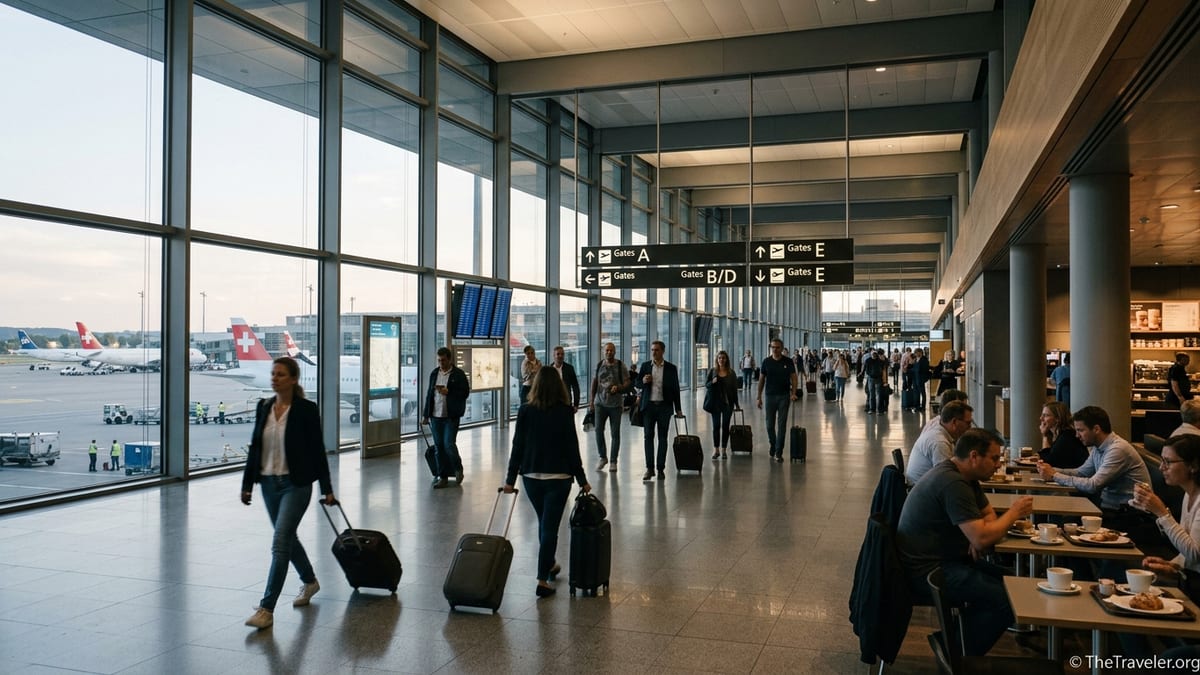
Understanding Zurich Airport’s Layout Before You Arrive
Zurich Airport has a single main terminal complex with three airside gate piers: Gates A, Gates B/D and Gates E. Gates A are used for Schengen flights, while B and D share one pier that can be switched between Schengen and non Schengen operations. Gates E form a separate midfield terminal reached by an underground Skymetro train and are dedicated mainly to long haul and non Schengen flights. This means two people on the same airline can still depart from very different parts of the airport depending on destination.
Check in areas are numbered Check in 1, 2 and 3 in the Airport Centre above the railway station. Many Star Alliance carriers, including Swiss and Lufthansa, use Check in 1 and 3, while oneworld and SkyTeam airlines are often concentrated around Check in 2. For example, a mid morning Swiss flight to London may check in at counters in Check in 3 and depart from a D gate, whereas an early afternoon Swiss flight to Rome could check in next door but leave from an A gate.
From the check in halls you pass through centralized security, then into the Airside Center. From here it is a short walk to Gates A and B/D, typically 5 to 10 minutes for most travelers. If your flight goes from Gates E you will follow signs to the Skymetro shuttle. The train ride itself takes only around 3 minutes, but you should still allow roughly 10 to 15 minutes from security to reach an E gate at a relaxed pace.
Because distances are modest compared with many other hubs, Zurich publishes a general minimum connection time of about 40 minutes and seasoned travelers often manage domestic or Schengen connections in less than an hour. As a departing passenger, this compact layout is an advantage, but it is still wise to build in enough buffer for security and passport control, especially in busy ski and summer holiday seasons.
When to Arrive and How Check-in Works
For most European flights from Zurich, airlines recommend arriving around 2 hours before scheduled departure; for long haul flights, 3 hours is a common guideline. During peak winter weekends when ski charter traffic is heavy, or on summer Friday evenings, security and check in can become noticeably busier, and some carriers advise arriving a little earlier than usual. A typical family of four flying economy to Spain during school holidays might want to be at the terminal 2.5 hours before departure to allow extra time for bag drop and security.
Online check in for major airlines such as Swiss, Lufthansa, British Airways and Emirates usually opens 24 hours before departure. If you have checked in online and travel with hand luggage only, you can proceed straight to security, although some non Schengen destinations like the United States may still require a quick passport and document check at a desk or automated kiosk before security. For example, travelers flying Zurich to New York on Swiss who have checked in digitally usually still stop at a separate document check counter near the security entrance.
Traditional counter check in is available in all three check in halls and is clearly marked by airline name and flight number on overhead screens. Larger carriers operate a mix of dedicated staffed counters and self service bag drop machines. It is common to find self service bag drops for Swiss and Edelweiss flights near the main check in areas, where you print a bag tag and place luggage on a belt yourself after scanning your boarding pass. Smaller airlines and some holiday charters often rely on standard counters only, which can result in queues forming earlier before departure.
If you arrive very early in the day, some airlines at Zurich offer early bag drop the evening before travel for selected flights, particularly during busy seasons. For example, passengers on certain morning Lufthansa departures may be able to check their luggage the previous night during defined hours, then arrive at the airport the next day with only hand luggage, moving quickly through security.
Security, Passport Control and Getting to Your Gate
After check in you follow signs for security control. Zurich operates centralized security checkpoints where passengers from all check in halls converge. In quieter midweek periods, typical waiting times can be under 10 minutes, while early morning waves between 06:30 and 08:30 or Sunday evenings can sometimes see queues of 20 to 30 minutes. Many European airlines offer a fast track lane for business class and elite status customers, which can reduce the wait considerably at these peak times.
Immediately after security you enter the Airside Center, a large atrium level with shops and restaurants. If you are flying to a Schengen destination such as Paris, Vienna or Lisbon, you will normally go directly from here to Gates A or B without further checks. The walks are short: expect roughly 5 minutes from the center to the far end of Gates A, and around 7 to 10 minutes to the gates at the end of the B pier, depending on walking speed and crowd levels.
For non Schengen flights, including the United Kingdom, North America, much of Asia and the Middle East, you must clear passport control after security. For flights leaving from D gates, this usually happens in the transition area within the B/D pier, where border police booths and automated eGates are installed. Flights departing from E gates require you to pass through passport control and then take the Skymetro down one level below the Airside Center. The short automated shuttle brings you beneath the airfield to the midfield terminal, where you ascend again to the E gate departure level, which is entirely non Schengen.
Passengers subject to the newer Entry/Exit System for third country nationals may be asked to record fingerprints and a facial image at dedicated kiosks during passport control, which can add a few extra minutes per traveler. On a busy afternoon bank of long haul departures, a queue for these checks might add 10 to 15 minutes, so families connecting to flights from Gates E often report feeling more comfortable with at least one hour between security and boarding time.
Navigating Gates A, B/D and E: What to Expect
Gates A serve primarily European Schengen flights, including many Swiss domestic and nearby routes such as Zurich to Geneva, Milan or Munich. These gates have a straightforward layout with glass fronted waiting areas and a mix of seats, charging points and nearby grab and go food counters. Because of the high frequency of short haul flights, gate changes within the A pier are relatively common, so it is wise to recheck monitors when you settle down with a coffee.
The B/D pier is a double use concourse, with each physical gate assigned two designations, one starting with B and one with D. When used as B gates, they handle Schengen departures; when used as D gates, they serve non Schengen flights such as services to the United Kingdom, Morocco or certain Balkan destinations. Practical examples include a morning flight to London Gatwick boarding from D33 and an early afternoon flight to Barcelona later using the same physical jet bridge listed as B33. Signage and floor markings separate Schengen and non Schengen passenger flows, so follow the B or D indications shown on your boarding pass.
Gates E form Zurich’s midfield terminal across the runway. Most long haul Swiss and partner flights to North America and Asia depart from here, along with some flights by other international carriers such as Emirates and Singapore Airlines. Once you arrive at the E concourse via Skymetro, you find a bright terminal space with large windows and extensive views of the airfield and surrounding hills. Walking times within E are modest, usually 2 to 6 minutes between the central plaza and even the farthest gates like E62 or E67.
Because the E concourse is dedicated to non Schengen traffic, facilities are geared to passengers on longer journeys. You will find multiple duty free shops, a range of sit down restaurants and several lounges grouped on upper levels. If you are connecting from a Schengen arrival in A or B to a long haul departure at E, you will repeat the pattern of walking back through the Airside Center, clearing passport control and taking the Skymetro. With normal queues, travelers commonly report making this Schengen to non Schengen transfer in 30 to 45 minutes at a comfortable pace.
Lounges at Zurich Airport: Where to Relax
Zurich Airport offers a notable range of lounges, from airline operated facilities to independent spaces accessible via day passes or membership programs. Swiss alone runs several branded lounges in different gate areas, including Swiss Business and Swiss Senator lounges in the Airside Center and at Gates A and E. For example, a business class passenger flying Swiss to New York from Gate E may spend time in the Swiss Business Lounge E, which provides hot meals, showers and quiet work zones with apron views before heading to the gate just a few minutes away.
Independent lounges complement these airline spaces. Aspire operates lounges in the main Airside Center for Schengen departures and in the E concourse for non Schengen flights. These lounges typically offer buffet snacks, simple hot dishes, a full bar with local wines and beers and views over the taxiways. Many travelers access them using membership cards such as Priority Pass or through walk up paid entry when capacity allows. Prices for a three hour stay are often in the range of what you might spend on a full meal and drinks in the public terminal, making them appealing for longer waits.
In addition, Zurich features the marhaba Lounge in the Airside Center, oriented toward international travelers, and the Primeclass Lounge in the E concourse, which is part of a global network managed by a large independent lounge operator. These lounges are especially useful for passengers flying on airlines without their own Zurich facilities, such as some Gulf carriers or leisure airlines. For instance, an economy passenger departing on a late night Dubai flight from E gates might choose to purchase access to Primeclass for a quiet meal, a shower and a comfortable seat instead of waiting at a crowded gate.
Admission rules vary, so always check your airline and ticket class. First and business class passengers on full service airlines usually have complimentary access to their own or partner lounges. Passengers in premium economy or economy cabins may be able to enter by paying at the door, using a credit card benefit or pre booking a spot online. During peak evening waves of long haul departures, notably between 19:00 and 22:00, lounges at Zurich can become busy and may temporarily restrict walk in guests if capacity is reached.
Food, Shopping and Services Before Your Flight
Zurich Airport is known among frequent flyers for its high quality food options compared with many hubs of similar size. In the public Airport Centre before security you will find Swiss brands such as Confiserie Sprüngli offering pastries and its well known Luxemburgerli macarons, plus international chains for coffee and quick snacks. This area is convenient if friends or family are seeing you off, as they can access cafés and bakeries without a boarding pass while you check in nearby.
Beyond security, the Airside Center and gate piers offer a mix of sit down restaurants, bars and grab and go counters. Travelers in a hurry might pick up a freshly made sandwich, salad and drink from a market style kiosk in the Airside Center and then walk to their gate, while those with more time can settle into a brasserie or wine bar overlooking the apron. Prices are broadly in line with Swiss city standards, so a simple meal with a drink often costs roughly what it would in central Zurich, which is higher than in many other European airports but tends to reflect good quality ingredients and service.
Shopping includes duty free stores stocking Swiss chocolate, watches and cosmetics, fashion boutiques, electronics outlets and newsstands. At Gates E in particular, the range of boutiques caters to long haul travelers, with several Swiss watch and jewelry shops, premium fashion brands and larger duty free outlets. Many passengers take advantage of duty free prices on Swiss chocolate boxes or local spirits such as Kirsch to bring as gifts when visiting friends and family abroad.
Zurich also offers practical services that can make departures smoother. Lockers and baggage wrapping services are available landside, and there is a well equipped supermarket in the Airport Centre, useful for picking up last minute travel items or affordable snacks for the flight. Medical services, pharmacies and currency exchange counters are present both landside and airside. The integrated railway station below the Airport Centre provides frequent trains to Zurich main station in about 10 to 12 minutes, meaning that even city centre hotel guests can comfortably plan to leave for the airport only a couple of hours before a short haul European departure.
Boarding at Zurich: Timing and Practical Tips
Boarding procedures at Zurich follow familiar European patterns, but small details can make the process smoother. Gate displays show boarding groups or zones depending on airline policy. For example, Swiss and Lufthansa often board by groups related to seat row and frequent flyer status, while some low cost carriers using the B/D pier may organize boarding by rear and front rows or by priority and standard tickets. Boarding usually begins around 30 to 40 minutes before departure for European flights and up to 45 to 60 minutes before for long haul flights to North America or Asia.
Staff commonly conduct an additional passport or visa check at the gate for flights to destinations such as the United States, Canada or the United Kingdom, even if you have already passed through passport control. Travelers referred to a small desk near the boarding podium may have their passport scanned again or their ESTA, eTA or visa visually verified. It is helpful to arrive at the gate at least 10 to 15 minutes before the printed boarding time for these destinations, especially during busy travel periods.
Many Schengen flights at Zurich use contact gates with jet bridges, but some regional or holiday flights may board by bus from remote stands, particularly from parts of the B/D pier or occasionally from the A area. In those cases, boarding typically starts earlier to allow multiple bus transfers. Passengers with reduced mobility or young children are usually offered pre boarding and can take elevators directly to the bus boarding level. If you know you are on a bus boarding flight, it is wise to stay near the gate when your boarding group is called, as the bus doors can close quickly once full.
Announcements at Zurich are made in German and English, with additional languages sometimes used for specific routes. Information screens are clear and widely distributed, both in the gate areas and in the Airside Center, so you can easily monitor your flight’s status while enjoying a coffee in another part of the terminal. Because Zurich is compact, it can be tempting to linger in a lounge or café until the last moment, but giving yourself a 10 to 15 minute margin to walk to the gate and handle any last minute checks is usually a safer strategy.
The Takeaway
Zurich Airport combines a relatively small physical footprint with a wide global network, which makes it an efficient and often pleasant place to begin a journey. Understanding the separation between Schengen and non Schengen areas, the role of Gates A, B/D and E, and the extra steps involved in passport and entry exit checks can remove much of the stress from departure day. For many travelers this means building a little more time into the schedule for security and passport control while taking advantage of the airport’s lounges, food outlets and services.
If you are flying short haul within Europe, arriving about 2 hours before departure, checking in online and heading directly through security is usually sufficient, with only a short walk to Gates A or B. For long haul or non Schengen flights, planning 3 hours, allowing extra minutes for passport and biometric checks and making use of the well regarded lounges at Gates E can turn the wait into something close to enjoyable. With clear signage, frequent rail links to the city and a calm, orderly atmosphere, Zurich Airport rewards a bit of preparation with a smooth, almost seamless departure experience.
FAQ
Q1. How early should I arrive at Zurich Airport before my flight?
For most European flights, arriving about 2 hours before departure is typically enough. For long haul and non Schengen flights, aim for around 3 hours, and consider adding extra time during peak holiday seasons or busy early morning and evening periods.
Q2. How long does it take to get from security to Gates E at Zurich?
From the main security area to a typical gate in the E concourse, plan on roughly 10 to 15 minutes. This includes walking through the Airside Center, taking the Skymetro train and walking to your specific gate.
Q3. Which gates at Zurich are for Schengen and which are for non Schengen flights?
Gates A are used for Schengen flights. The B/D pier can be configured for both, with B gates used for Schengen and D gates for non Schengen. Gates E are dedicated mainly to non Schengen and long haul departures.
Q4. Are there good lounge options at Zurich Airport if I fly economy?
Yes. Independent lounges such as Aspire, marhaba and Primeclass offer paid entry or access via membership programs like Priority Pass. Depending on time of day and capacity, you can usually buy a three hour stay that includes food, drinks and a quiet place to sit.
Q5. What are typical security waiting times at Zurich Airport?
Outside peak hours, security waits are often under 10 minutes. During busy morning and evening waves, especially in ski season and summer holidays, queues of 20 to 30 minutes can appear, so arriving a bit earlier is sensible.
Q6. Do I need to go through passport control for flights to the UK or the US from Zurich?
Yes. Flights to the United Kingdom, United States and other non Schengen countries require you to pass passport control after security. For many of these destinations you will also undergo an additional document check at the gate before boarding.
Q7. Is Zurich Airport easy to reach by public transport from the city?
Yes. Frequent trains connect Zurich main station with the airport railway station beneath the terminal in about 10 to 12 minutes. This makes it practical to leave a central city hotel roughly 2 to 2.5 hours before a typical European departure.
Q8. Can I find affordable food options inside Zurich Airport?
Prices reflect Swiss standards, but there are ways to keep costs down. The Airport Centre has a supermarket and bakery style outlets, while airside you can choose grab and go counters for sandwiches and salads instead of full service restaurants.
Q9. How much time do I need for a connection from a Schengen flight to a non Schengen flight at Zurich?
Minimum connection times are around 40 minutes, but practically most travelers feel more comfortable with at least 60 to 75 minutes for a Schengen to non Schengen connection, especially when passport control and biometric checks are involved.
Q10. Are there facilities to shower or rest before a long haul flight from Zurich?
Yes. Several lounges at Zurich, including Swiss lounges and independent options like Aspire and Primeclass, offer showers. For longer layovers, there is also a transit hotel in the gate areas where you can book a room for a few hours to rest.