


Choosing a wildlife cruise from Seward in 2027 is not as simple as picking any tour labeled “Kenai Fjords.” The real differences lie in how far each boat travels beyond protected Resurrection Bay, how much time you actually spend in exposed Gulf of Alaska waters, and whether you reach tidewater glaciers and seabird colonies. This guide breaks down verified 2027 schedules and prices from Major Marine Tours, Kenai Fjords Tours and other Seward operators, then matches them to the wildlife, comfort level and budget that are right for you.
Get the latest updates straight to your inbox!
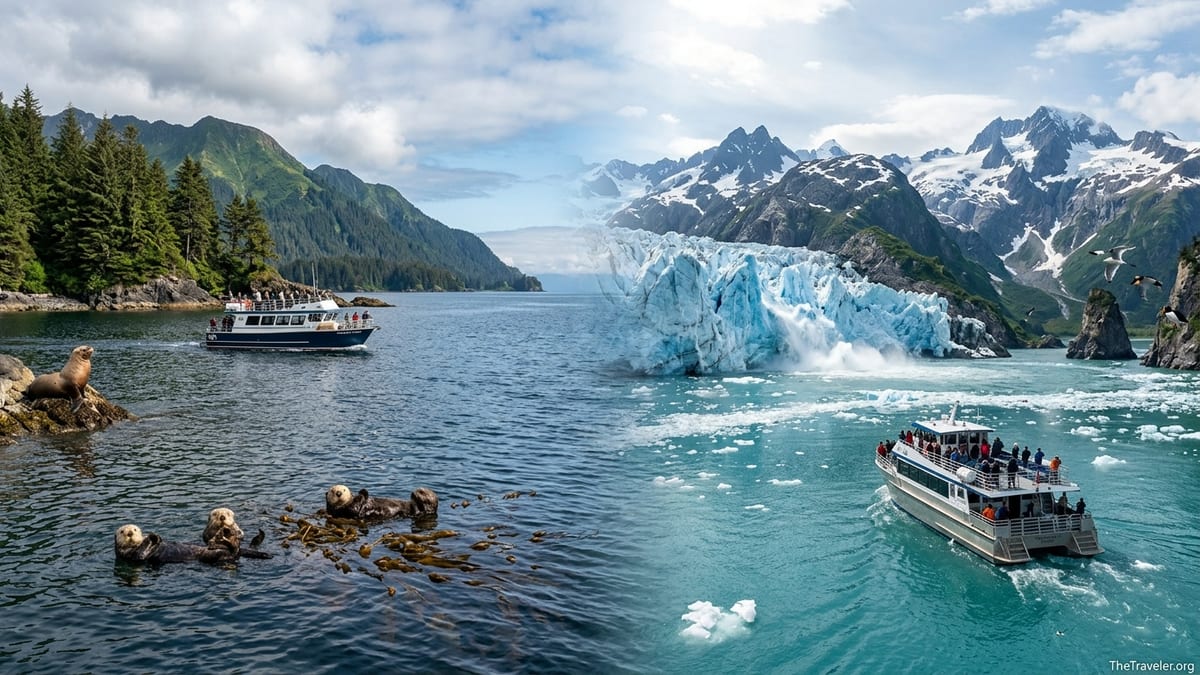
Half-day Resurrection Bay vs full-day Kenai Fjords: the core difference
For 2027, Seward’s big-boat operators continue to split their offerings into two fundamentally different products. Shorter wildlife cruises, usually four hours or less, stay inside or close to Resurrection Bay. The bay is relatively protected by the surrounding Kenai Peninsula so seas are typically calmer and routes hug the coastline while captains look for sea otters, Steller sea lions, bald eagles and, when conditions permit, whales near the bay entrance. These trips are often branded as “wildlife cruises” or “spring gray whale cruises,” but they are not designed to reach tidewater glaciers.
By contrast, six to eight-and-a-half-hour national park excursions travel far beyond the mouth of Resurrection Bay into Kenai Fjords National Park and the more exposed Gulf of Alaska. Standard-day cruises of about six hours turn west toward Aialik Bay to view a tidewater glacier such as Aialik or Holgate, while extended trips of seven-and-a-half to eight-and-a-half hours may continue past the Chiswell Islands seabird colonies toward Holgate, Aialik and sometimes Northwestern Fjord. These longer runs spend significant time in open swells where the Kenai Peninsula no longer shelters the water.
The practical consequence is that a four-hour wildlife cruise is mainly about protected-water scenery and nearshore marine mammals, whereas a six-to-eight-and-a-half-hour trip adds glacier viewing, offshore seabird colonies and better access to open-water whale habitat. That extra reach does not guarantee more wildlife, but it creates more varied opportunities and a more “expedition-style” feel that many travelers expect from a national park cruise.
Because operators advertise different tours as “Kenai Fjords” experiences, it is critical to read each route description. Some gray whale or wildlife departures remain within Resurrection Bay even if they mention the national park in their marketing. Others, particularly the six-hour and longer itineraries, explicitly state that they enter Kenai Fjords National Park and visit Aialik Bay, Holgate Glacier or Northwestern Fjord.
Verified 2027 routes and prices from Major Marine Tours
Major Marine Tours is one of the two large Seward operators with detailed 2027 schedules already published. According to its current pricing, adult fares in 2027 start around 109 dollars for the earliest-season Resurrection Bay wildlife cruise and reach 329 dollars for the longest Northwestern Fjord trip, with dock fees and local sales tax added at checkout. Children’s tickets are priced lower on most departures, and promotional family packages are sometimes offered in shoulder seasons, though exact discounts vary by date.
At the short end, Major Marine’s four-hour Resurrection Bay cruise is listed at about 159 dollars for adults in 2027. This route remains in or near the bay and does not advertise tidewater glacier viewing. It focuses on sea otters near the harbor, Steller sea lions on haul-outs closer to the bay entrance, bald eagles along the shoreline and early-season gray whales when they pass the outer bay in spring. The company’s dedicated spring gray whale cruise, priced from roughly 109 dollars in 2027, also stays in Resurrection Bay and operates on a limited schedule from March into May, before the main summer glacier-cruise season starts.
Major Marine’s six-hour Kenai Fjords National Park cruise is priced at about 259 dollars for adults in 2027. This itinerary typically runs in the afternoon from early May through September and is advertised to visit a tidewater glacier in Aialik Bay or Holgate Bay whenever sea and ice conditions allow. The widely marketed seven-and-a-half-hour “Extended Glacier Cruise” is currently listed around 289 dollars and adds more time along the rugged coast and at the glacier face. The flagship eight-and-a-half-hour Northwestern Fjord cruise, at about 329 dollars, pushes even farther into Kenai Fjords National Park to the remote Northwestern Fjord, usually viewing multiple glaciers along the way. Taxes and port fees, often around 7 percent sales tax plus a per-person dock fee, are added to all base fares.
Across these cruises, Major Marine typically includes naturalist commentary, heated indoor seating, outdoor viewing decks, restrooms and basic beverage service. Some departures include lunch or offer it as an optional add-on, particularly on six-hour and longer itineraries. Most Resurrection Bay and six-hour cruises welcome children of all ages, while the Northwestern Fjord trip is strongly recommended only for older children and adults because of its length and higher likelihood of rougher seas in the outer Gulf of Alaska.
Kenai Fjords Tours and other operators: 2027 offerings compared
Kenai Fjords Tours, operated by Pursuit, offers a parallel lineup from the same Seward small boat harbor. Its classic six-hour Kenai Fjords National Park cruise is broadly comparable to Major Marine’s six-hour trip, traveling out of Resurrection Bay and into Aialik Bay for glacier viewing when conditions permit. The company’s eight-hour Northwestern Fjord tour runs on selected dates, usually from late May into late August, and is priced in a similar range, with recent indications that 2027 adult fares for this route start from the high 200s per person before tax and fees.
Kenai Fjords Tours also sells shorter Resurrection Bay sightseeing cruises of roughly three-and-a-half to four hours, generally at prices similar to Major Marine’s four-hour wildlife cruise. These bay-focused trips emphasize sea otters, sea lions and coastal scenery and do not usually promise tidewater glacier visits. Where the two big operators most clearly diverge is in small differences in boat size, food service and departure times rather than in the basic route concepts: both companies send their full-day trips to Aialik Bay and their longest ones to the Northwestern Fjord region.
Beyond the two mainlines, several smaller operators based in Seward offer wildlife and glacier cruises in Kenai Fjords National Park on vessels carrying far fewer passengers. Companies such as Seward Ocean Excursions, Northern Latitude Adventures and Alaska Coastal Explorer typically operate boats with a few dozen guests or fewer. Their 2027 per-person prices are often higher than the big catamarans on comparable durations, reflecting the small group size and flexible routing. For example, a small-boat full-day glacier and wildlife charter in 2027 may run well above 300 dollars per adult, with base prices commonly 20 to 40 percent higher than the large-vessel six-hour and eight-hour departures.
Specialty birding operators also schedule 7-to-8-hour day trips from Seward to the Chiswell Islands and Aialik Bay, targeting rare seabirds and spending prolonged time near colonies. These charters are typically priced for dedicated birders and photographers, with limited space and strict age minimums. They function more like custom expeditions than general sightseeing cruises, so families with young children and motion-sensitive travelers usually find better value on the mainstream national park itineraries.
Wildlife habitats, seasons and realistic expectations
The waters around Seward are rich in marine life, but each species tends to concentrate in different areas and seasons. Humpback whales usually arrive in growing numbers from late May through September, feeding in both Resurrection Bay and offshore around the Kenai Fjords. Orcas, including both resident and transient pods, can be seen in these waters at almost any time of the cruise season, though sightings peak irregularly and are never guaranteed. Gray whales are mostly a spring phenomenon, with northbound migrants moving through the Gulf of Alaska in March, April and early May; that is why dedicated gray whale cruises run only in early season and remain closer to the bay entrance.
Sea otters, harbor seals and Steller sea lions are present throughout the cruise season. Sea otters are especially common within Resurrection Bay, where they often float on their backs near the harbor and in kelp beds along the shoreline. Harbor seals prefer quieter waters close to glacier faces and in sheltered coves, so longer national park cruises that reach Aialik, Holgate or Northwestern glaciers create better chances to see them hauled out on ice floes. Steller sea lion rookeries and haul-outs dot rocky islands and headlands near the mouth of Resurrection Bay and farther out toward the Chiswell Islands.
Birdlife is one of the strongest arguments for venturing beyond the bay. The Chiswell Islands, around 35 miles south of Seward and part of the Alaska Maritime National Wildlife Refuge, host major seabird colonies in summer. Here, cliff faces and offshore stacks support nesting tufted and horned puffins, murres, kittiwakes and cormorants, among others. Full-day national park cruises commonly circle these islands when sea conditions allow, giving birdwatchers and photographers extended views of puffins flying, rafting on the water or perched on grassy ledges. Shorter Resurrection Bay trips rarely reach this far, meaning puffin encounters are possible but less reliable.
No reputable Seward operator guarantees sightings of specific whales or birds, although many advertise historical sighting rates for certain months. When a tour promotes a “whale watching” or “puffin viewing” focus, it usually means that the captain and naturalist will prioritize known feeding grounds or colonies within the day’s safe operating area. Weather, sea state and the current location of wildlife still dictate what you will actually see, whether you choose a half day in Resurrection Bay or a full day into the fjords.
Routes, glacier access and why distance matters
Geography explains why most shorter wildlife cruises do not reach tidewater glaciers. Aialik Bay, one of the primary glacier destinations, lies roughly 30 to 35 miles from Seward by water. Reaching the head of Aialik Bay, where Aialik Glacier calves into the sea, requires passing the mouth of Resurrection Bay, transiting a portion of the Gulf of Alaska coastline, and then turning into the fjord. Similarly, Holgate Glacier lies in Holgate Arm off Aialik Bay, while Northwestern Fjord extends even farther west beyond the Harris Peninsula. Covering this distance by boat and still allowing meaningful time at the glacier face demands at least six hours dock to dock.
As a result, four-hour cruises typically confine themselves to Resurrection Bay and nearby headlands. They may cruise as far as Cape Resurrection at the bay entrance when seas are calm, but there is not enough time to continue to tidewater glaciers and return on schedule. The real “Kenai Fjords National Park” experience, in the sense of seeing calving glaciers at the heads of fjords like Aialik and Northwestern, belongs to the six-hour, seven-and-a-half-hour and eight-and-a-half-hour itineraries.
Standard six-hour national park cruises generally aim for at least one tidewater glacier in Aialik Bay or Holgate Bay, spending 20 to 45 minutes near the ice depending on traffic, sea state and calving activity. Extended seven-and-a-half-hour trips add more time along the outer coast, often visiting both Aialik and Holgate or lingering longer among icebergs to search for harbor seals and bears foraging along the shoreline. The Northwestern Fjord itineraries, at eight to eight-and-a-half hours, push beyond Aialik Bay into a more remote complex of fjords where multiple glaciers descend from the Harding Icefield and the setting feels more isolated.
Different operators may alter these general patterns on any given day. If strong swell or wind develops along the outer coast, captains may choose a more protected route, shorten the time at a particular glacier or substitute an alternative fjord that offers safer conditions. This flexibility is built into their operating plans and is one reason that even long national park cruises never promise a specific glacier by name, although Aialik Glacier is the most frequently visited for large-vessel day tours.
Comfort, seasickness and the Resurrection Bay “gateway”
Passenger comfort on Seward wildlife cruises hinges on two main variables: vessel design and sea conditions. The large catamarans used by Major Marine Tours and Kenai Fjords Tours offer indoor heated seating on multiple decks, large viewing windows, outdoor rail space, restrooms and snack counters. Their twin-hull designs are more stable than small monohulls in choppy seas, but they still move significantly when crossing the swell line at the mouth of Resurrection Bay. Smaller vessels used by boutique operators can feel more lively in waves but provide a more intimate viewing experience and greater flexibility in responding to wildlife reports.
The transition from protected Resurrection Bay to exposed Gulf of Alaska waters is usually the point at which seasickness becomes an issue. Inside the bay, waves are often modest and the ride feels similar to a large lake crossing. As the boat rounds the headlands into open water, swell from the Gulf can create larger, more regular heaving and occasional side-to-side motion. Travelers who felt fine on a short bay cruise may find the next hour uncomfortable on a longer national park trip, especially if wind or swell is running across the vessel’s path.
Most operators recommend that motion-sensitive passengers take preventive steps before boarding. That may include over-the-counter seasickness medication, acupressure bands or simply choosing a seat near the center of the boat on a lower deck, where movement is minimized. Captains will adjust speed and headings when possible to reduce discomfort, but they cannot eliminate swell entirely without abandoning the outer-coast portion of the route.
From a comfort perspective, four-hour bay cruises are a safer choice for travelers with serious motion concerns, young children prone to nausea or seniors worried about balance on stairs and outdoor decks. Those who want glacier viewing but are unsure about their sea legs might consider the six-hour national park cruise as a compromise: it offers tidewater glaciers and Chiswell Islands wildlife in many conditions yet returns to town earlier and usually spends slightly less time in the roughest open water than the Northwestern Fjord marathon.
Practicalities: timing, accessibility, policies and family costs
In 2027, Major Marine indicates a cruise season from March 20 to October 10, with different tour types operating within that window. Spring wildlife and gray whale cruises typically run from late March to mid May. Six-hour national park cruises operate from roughly early May through mid September, while seven-and-a-half-hour and Northwestern Fjord departures concentrate between late May and early September. Kenai Fjords Tours follows a similar seasonal arc, with its classic park tour and Northwestern Fjord trip concentrated in high summer when daylight is longest and sea ice retreats.
Departure times are structured to fit around same-day Alaska Railroad schedules as much as possible. The morning train from Anchorage usually arrives in Seward near midmorning, in time for many six-hour and some four-hour cruises departing late morning or early afternoon. Travelers hoping to connect a full-day Northwestern Fjord tour with same-day rail travel need to check 2027 timetables closely, because the earliest Northwestern departures often leave around 8:30 a.m., before the train arrives. In that case, an overnight stay in Seward before the cruise is generally required.
Accessibility varies by vessel and operator. The largest catamarans typically offer level boarding ramps, wide interior aisles and accessible restrooms on at least one deck, making them suitable for many travelers with mobility limitations. Outdoor upper decks, however, may only be reachable via stairs. Northwestern Fjord trips on smaller or older vessels may be less accessible, and some specialty or birding charters specifically exclude wheelchairs or set a minimum age of 12. Luggage storage on day cruises is usually limited to small bags and daypacks; larger suitcases are commonly left at hotels, the train station or baggage-storage services in town.
Cancellation policies for 2027 bookings are operator specific but tend to allow changes or cancellations up to a few days before departure, with stricter terms for groups or discounted promotional fares. Weather and sea conditions give captains authority to alter routes, substitute destinations or, in rare cases, cancel departures entirely. In the event of cancellation for safety or mechanical reasons, operators normally provide a full refund or offer to rebook guests on a different day. Travelers should confirm the exact cut-off times for penalty-free cancellation when booking, especially in July and early August when demand and waitlists are high.
To estimate family costs, consider a typical mid-season day in 2027. A family of four with two adults and two school-age children might pay roughly 259 dollars per adult and a reduced per-child rate for a six-hour national park cruise, plus tax and dock fees. The same family on an eight-and-a-half-hour Northwestern Fjord trip at 329 dollars per adult would see the base fare jump by around 70 dollars per adult, with similar increases for children. When multiplied across four tickets and adjusted for fees and optional lunches, the difference between a six-hour and Northwestern itinerary can easily exceed several hundred dollars for one day on the water.
Comparing 2027 tours side by side: value and best uses
When comparing specific 2027 offerings, it helps to think in terms of route, wildlife potential, glacier access, exposed-water risk and included services rather than just headline duration. A four-hour Resurrection Bay cruise from Major Marine, priced around 159 dollars for adults, offers mostly protected waters, good chances for sea otters, sea lions and coastal birds, and modest possibilities for whales near the bay entrance in summer. It generally does not include glacier viewing, meals or extended time in the Gulf of Alaska, which keeps both costs and seasickness risks lower.
Stepping up to the six-hour Kenai Fjords National Park cruise at about 259 dollars adds a tidewater glacier stop, routine visits to seabird-rich islands near the Chiswell group when seas allow, and more time scanning for humpbacks, orcas, Dall’s porpoises and harbor seals. The exposed-water segment between Resurrection Bay and Aialik Bay raises the motion factor but also opens access to richer feeding grounds and dramatic coastal scenery. For many first-time visitors, this six-hour tier represents the best balance of price, wildlife variety and comfort.
The seven-and-a-half-hour extended glacier cruise at roughly 289 dollars and the eight-and-a-half-hour Northwestern Fjord excursion at about 329 dollars further increase the distance traveled and time spent in the park. Photographers and dedicated wildlife enthusiasts often consider these longer trips good value because they allow the captain to linger when whales are actively feeding or glaciers are calving dramatically. However, the extra one-and-a-half to two-and-a-half hours can feel long for young children, motion-sensitive adults or anyone trying to fit multiple activities into a short Seward stay.
If you compare cost per hour, the price difference between tiers narrows somewhat, but additional hours are not spent uniformly on wildlife viewing. Part of the extra time funds the longer transit to Northwestern Fjord and return. For some travelers, that extended coastal run is a highlight, with sweeping views of the Harding Icefield spilling down to the sea. For others, especially on a bumpy day, those same miles can feel repetitive and tiring. Evaluating whether the longest cruises justify their price hinges on your personal interest in glaciers and remote landscapes versus your tolerance for a potentially rougher, more exposed ride.
Who should choose which cruise?
For whale enthusiasts, the six-hour and seven-and-a-half-hour national park cruises are strong all-around choices. They combine enough time in both Resurrection Bay and offshore fjords to search for humpbacks and orcas, yet they do not require the full-day commitment and higher motion exposure of Northwestern Fjord. Travelers visiting between late June and early August, when humpbacks are most consistently present in the area, will likely find these durations give captains the flexibility to follow feeding reports and adjust the route in real time.
Dedicated birdwatchers and photographers may lean toward the longest available options. Northwestern Fjord and specialized Chiswell Islands birding trips devote more time near seabird colonies, glacier faces and rugged sea stacks where light, weather and wildlife behavior can change hour by hour. On these itineraries, the chance to circle the same colony multiple times or wait for a cloud break over a glacier often justifies the extra cost and motion exposure. For serious photographers, small-boat charters, although pricier per person, offer unobstructed rail space and the ability to adjust positioning precisely for light and background.
Families with young children, seniors and travelers highly sensitive to motion usually fare better on shorter cruises. A three-and-a-half to four-hour Resurrection Bay trip delivers wildlife, scenery and a taste of Kenai Fjords without committing everyone to a full day at sea. If glacier viewing is a must, families might consider the six-hour national park cruise as a middle ground, especially on days with favorable marine forecasts. In contrast, Northwestern Fjord and some small-boat expeditions often recommend a minimum age of 12 and caution that conditions can be too demanding for very young kids or anyone with significant mobility or balance challenges.
Budget-conscious travelers should weigh not only the base fare but also taxes, dock fees, optional meals and the opportunity cost of a full day on the water. A carefully chosen four-hour or six-hour cruise can free up time and money for hiking the Exit Glacier area, visiting the Alaska SeaLife Center or simply enjoying Seward’s waterfront. Since July and early August departures frequently sell out, booking in advance is advisable for all but the earliest-season wildlife cruises, particularly if you need specific dates to match flights, rail tickets or cruise ship schedules.
Conclusion: choosing the right Seward wildlife cruise in 2027
In 2027, travelers choosing a wildlife cruise from Seward have a clear fork in the road. Half-day Resurrection Bay trips keep to relatively protected waters, prioritize comfort and affordability, and deliver reliable encounters with sea otters, sea lions, eagles and coastal scenery, with a modest chance of whales near the bay entrance. Full-day Kenai Fjords National Park cruises push beyond that sheltered environment to tidewater glaciers, seabird colonies around the Chiswell Islands and more open-water whale habitat, at the cost of higher fares, longer days and increased exposure to swell.
For many visitors, the six-hour national park cruise remains the best overall value. It reaches at least one tidewater glacier in Aialik or Holgate Bay, spends meaningful time scanning for whales and puffins, and still fits reasonably alongside same-day rail travel or a packed road-trip itinerary. Travelers keen to explore the park’s more remote corners, capture dramatic glacier scenes or devote a full day to wildlife may find the seven-and-a-half-hour and eight-and-a-half-hour options worth their premium, provided they are comfortable with a more energetic ride offshore.
Whatever itinerary you choose, verify 2027 prices, departure times, age restrictions and cancellation policies at the time of booking, since details can change from season to season. Book early for mid-summer weekends, especially if you are coordinating with Alaska Railroad schedules or large-cruise-ship departures. With realistic expectations about wildlife, weather and sea conditions, a carefully chosen Seward wildlife cruise is one of the most rewarding single days you can spend in Alaska.
FAQs: whales, puffins, rough seas, rain, refunds and reservations
Whale sightings are never guaranteed, but humpbacks are most consistently seen from roughly late May through early September, and orcas are possible in any month of the cruise season. Spring gray whale cruises, operating primarily in March, April and early May, focus on migrating gray whales closer to the mouth of Resurrection Bay. Puffins nest around the Chiswell Islands and other offshore rocks in summer, with the best viewing typically from June through early August on full-day national park cruises that reach these colonies.
Rough seas are most likely when your route leaves Resurrection Bay and enters exposed Gulf of Alaska waters. Even on calm days, a moderate ocean swell is normal near the bay mouth and along the coast toward Aialik Bay and Northwestern Fjord. Operators run in rain and low cloud as long as visibility and wind remain within safe limits. Waterproof outer layers, warm hats and gloves make a significant difference to comfort on deck in any conditions, and staying flexible about where you sit or stand on the boat can help minimize motion and spray.
Refund and rebooking policies vary by operator, but most allow guests to cancel or change reservations without penalty up to a set number of days before departure, then apply partial or full charges closer to the sail date. If a cruise is canceled by the company due to weather, mechanical issues or operational constraints, a full refund or alternative date is normally offered. Travelers should confirm specifics for 2027 at the time of purchase, especially for promotional fares and packages bundled with rail or hotel stays.
Booking in advance is strongly recommended for June, July and early August sailings, as well as for any Northwestern Fjord, small-boat or specialty birding cruise. Shoulder-season Resurrection Bay wildlife tours in May and September may have more day-of-availability, but even then, coordinating with Alaska Railroad arrivals or large cruise ship schedules makes pre-booking wise. With realistic expectations and careful selection between half-day bay trips and longer national park excursions, Seward’s wildlife cruises remain one of Alaska’s most worthwhile advance reservations.