


The Caryatids of the Acropolis are among the most recognisable figures in ancient Greek art, yet many visitors only know them from photos of the Erechtheion’s “Porch of the Maidens” on the Acropolis hill. Today, the original statues are protected inside the Acropolis Museum, while exact replicas stand in their historic outdoor setting. This guide explains how the Caryatids got there, where to find them in the museum, what still stands on the Acropolis, and how to navigate modern photography rules so you can enjoy and document the experience respectfully.
Get the latest updates straight to your inbox!
Who Are the Caryatids and Why Do They Matter?
The term “Caryatid” describes an architectural support carved in the form of a standing woman. The best known examples in the world are the six marble maidens that once supported the roof of the south porch of the Erechtheion, a temple on the Acropolis built in the late 5th century BC. Instead of using conventional columns, the Athenians placed these draped female figures on a raised podium, their braided hair and flowing garments ingeniously designed to bear the weight of the structure above.
In antiquity, the Erechtheion stood on the most sacred part of the Acropolis, associated with the cults of Athena and Poseidon. The Caryatids formed a ceremonial balcony overlooking the route of the Panathenaic procession, the great citywide festival in honour of Athena. Their position meant they were not just structural elements but also part of the religious theatre of the Acropolis, silently “participating” as the procession passed below.
Scholars still debate exactly whom the Caryatids represent. Some link them to women from the village of Karyes in the Peloponnese, known for ritual dances to Artemis. Others interpret them as priestesses or noble maidens of Athens. Whatever their precise identity, the figures project a blend of grace and quiet strength that has made them enduring symbols of classical Athens. Modern visitors often describe their first encounter with the originals in the museum as surprisingly emotional, precisely because they have seen the figures so often in books and films.
Copies of these Caryatids can now be found around the world, from architectural facades in London and Paris to plaster casts in university collections. Yet the originals in the Acropolis Museum are unique: they preserve ancient tool marks, traces of original paint, and even damage from centuries of weathering and historical events, including the removal of one figure in the early 19th century to what is now the British Museum.
From Sacred Porch to Museum Masterpieces: A Short History
The Erechtheion was constructed between about 421 and 406 BC on the northern side of the Acropolis. Unlike the symmetrical Parthenon, it is an irregular, multi-level building designed to accommodate multiple cults and earlier sacred spots. On its south side, the so-called Porch of the Maidens features six Caryatids in a row, facing towards the Parthenon and the route of religious processions. For more than two thousand years, these figures stood in the open air, exposed to sun, wind, and pollution.
In the early 1800s, one of the six statues was removed from the porch by agents of Lord Elgin and shipped to London. That Caryatid is now displayed in the British Museum, while the remaining five stayed on the Acropolis until the late 20th century. By the 1970s, Athens’ air pollution was severely damaging the marble. To protect them, conservation authorities decided to move the statues indoors and replace them with high-quality copies on the Erechtheion itself.
Between the late 1970s and 1980s the five original Caryatids were carefully removed from the porch, one by one, using crane systems that avoided further stress to the already fragile figures. They were stored and conserved, then finally given a permanent home in the new Acropolis Museum, which opened in 2009 at the foot of the Acropolis hill. Their relocation was part of a wider restoration of the Erechtheion, which also included reinforcing its foundations and cleaning its delicate reliefs.
Inside the museum the Caryatids have undergone state-of-the-art laser cleaning to remove soot and crusts from their surfaces while leaving original tool marks and pigment residues intact. Visitors can see before-and-after images in some museum publications and in older video material, which show how the statues’ details, such as the intricate braids and folds of the peplos garments, emerged more clearly after conservation. This history explains why the museum insists on certain photo restrictions: new damage from light and flash is taken seriously after so much effort to repair centuries of wear.
Finding the Caryatids Inside the Acropolis Museum
The Acropolis Museum stands on Dionysiou Areopagitou Street, just southeast of the Acropolis rock. Once you pass security and the ticket desk, you move up through the museum’s levels, following a chronological route from the slopes of the Acropolis to the height of the classical period. The Caryatids are one of the key highlights of the first floor, in the section devoted to the Archaic and early Classical Acropolis.
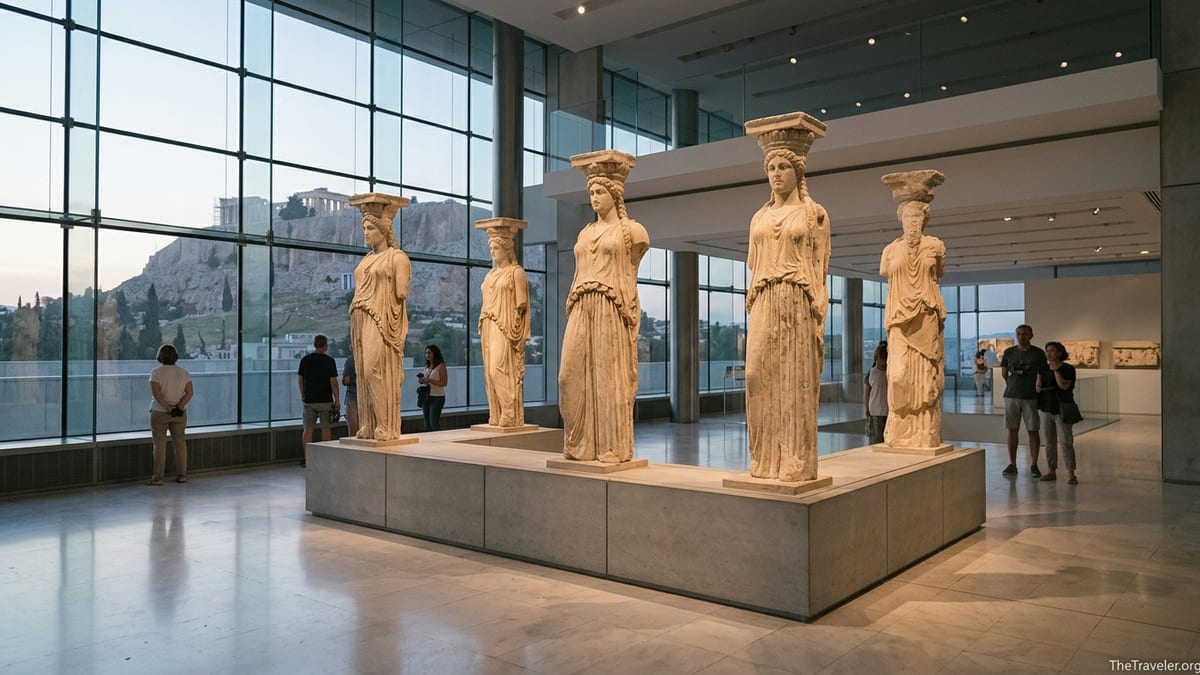
Practically, most visitors reach them after ascending the escalator or main staircase from the ground floor. The Caryatids stand together on a special raised platform in a high-ceilinged hall, arranged so you can walk around them on all sides. Large windows and the museum’s glass floors create a sense of continuity with the Acropolis outside; from some angles, you can see the Erechtheion itself in the distance while standing face-to-face with its original maidens inside.
The display leaves a deliberate empty space where the sixth Caryatid, now in London, would stand. This absence is immediately visible: five statues are present, while a distinct gap marks the missing figure. Interpretive panels explain that this position has been left vacant to symbolise the missing statue and to underline the original configuration of the porch. Guides often pause here to discuss the wider debate around the return of Acropolis sculptures, but even without a guide the narrative is clear to most visitors.
Time of day can influence your experience. In the late morning, when many group tours arrive, the area around the Caryatids can be busy, with guides speaking in multiple languages and visitors queueing politely for photos. In the late afternoon outside peak season, you may find the hall much quieter, which allows for longer, more contemplative viewing and easier photography without people in the frame. The museum’s air conditioning and lighting are subtle, so you can closely observe the statues’ surfaces without glare or heat.
What Remains on the Acropolis: Seeing the Porch of the Maidens Today
On the Acropolis itself, the Erechtheion remains one of the most distinctive buildings visitors encounter after passing through the Propylaia gate. The temple sits slightly north of the Parthenon, and the Porch of the Maidens is clearly visible on its south side. From the main visitor path, you can look across to the porch and see six figures supporting the entablature, but these are modern replicas rather than the ancient originals now in the museum.
The replicas are made in artificial stone closely matched to the original Pentelic marble and are based on detailed measurements of the ancient statues. They allow visitors to appreciate how the porch looked in situ, in open daylight, without exposing the fragile originals to further deterioration. On a bright summer day you will often see visitors pausing along the railing to zoom in with their phone cameras on the porch, capturing the overall composition with the Parthenon rising behind and, further beyond, the sprawl of modern Athens.
Although you cannot walk into the porch itself, you can observe important details with the naked eye or a simple 2x–3x zoom on a smartphone, such as the variations in each figure’s pose and hairstyle. Behind the temple, the terrain drops away and views open toward Mount Lycabettus and the city. Good guiding companies in Athens commonly pair a morning Acropolis visit with an afternoon slot at the Acropolis Museum, so travellers can first see the Caryatids in their original architectural context outdoors and then meet the originals face-to-face indoors a few hours later.
If you are planning your own route, it usually works best to visit the Acropolis site early in the morning to avoid heat and crowds, then walk downhill via the pedestrianised Dionysiou Areopagitou to the museum. From the Acropolis exit, it is roughly a 10-minute walk to the museum entrance. Along the way, you will pass street musicians and small kiosks selling bottled water and sun hats, a reminder that the Caryatids you are about to see in climate-controlled conditions once endured the full force of this Mediterranean environment.
Understanding the Stories and Symbolism of the Caryatids
For many visitors, knowing a bit of the Caryatids’ symbolism deepens the experience of seeing them up close. The figures are not identical: each has a slightly different stance and drapery, and subtle variations in hairstyle and facial expression. Their heavy, thick braids are not just decorative; they help strengthen the neck area, which must bear the weight of the structure above. This functional design choice is also a reminder that ancient Greek architects blended aesthetics with engineering in sophisticated ways.
Traditional explanations, following the Roman architect Vitruvius, say the Caryatids represent women from Karyes in Laconia who were punished and made to carry heavy loads after their city allegedly sided with the Persians. More recent research, however, suggests they may instead represent sacred dancers or priestesses associated with Artemis at Karyes, or simply idealised maidens in service of the Acropolis’ cults. Today, museums and guidebooks tend to present both interpretations, while emphasising that our evidence remains incomplete and open to debate.
When you stand in front of the originals in the Acropolis Museum, you may notice faint patches and lines that look like ghostly stains on the marble. These can be remnants of ancient pigments or the scars of past damage. In some areas, such as the folds of the garments or the decorative bands along the shoulders, experts have detected traces of colour, reminding us that the Caryatids and the Erechtheion were once brightly painted, not the plain white we usually imagine.
Watching other visitors interact with the statues can also be revealing. Many people instinctively lower their voices, step back to take in the whole group, then move closer again to focus on details such as the fingers resting gently on their garments. Others compare the statues with photos of the porch they have just taken on the Acropolis, using their phones almost like visual bridge tools between the site and the museum. This back-and-forth viewing mirrors what the Acropolis Museum itself encourages: an understanding of the Caryatids not just as isolated artworks but as living parts of a wider sacred landscape.
Photography Rules for the Caryatids and the Acropolis Museum
The Acropolis Museum generally allows visitors to take photos for personal use, but there are clear limitations designed to protect sensitive objects and ensure a respectful atmosphere. According to the museum’s own guidance, amateur photography and filming are permitted in most areas, but flash and extra equipment such as tripods, monopods, portable lights, and selfie sticks are not allowed inside. Professional photo shoots, commercial use, and media filming require advance permission and the payment of specific fees to the museum.
Where travellers often get confused is the first-floor Archaic Gallery, the long space that includes the Caryatids and many early statues and reliefs. Parts of this level are subject to stricter rules, and signs at certain entrances indicate that photography is either restricted or must exclude visitors’ faces. Guards may ask you not to pose or stage photos directly in front of sensitive works, or to refrain from taking close-ups that involve bright phone screens very near delicate surfaces.
Recent visitors sometimes report that guards stopped them from photographing some of the korai statues near the Caryatids, even when no flash was used. The museum’s reasoning is usually to minimise light exposure to sculptures that still preserve traces of original colour. As a visitor, the most practical approach is to look carefully for signage at each gallery entrance and follow instructions from staff. If in doubt, a polite question such as “Is photography OK here without flash?” is typically answered clearly and courteously.
On the Acropolis hill itself, photography of the Erechtheion and the porch is allowed and extremely common. However, professional-looking set-ups or drone use will attract the attention of site staff and can be prohibited without advance permits from the Greek authorities. For most travellers with smartphones or a simple mirrorless camera, common sense rules apply: no climbing barriers for a “better” angle, no leaning over protective railings, and no blocking narrow paths to take extended selfie sessions in front of the porch.
Practical Tips for Visiting the Caryatids
To make the most of your Caryatid experience, consider timing and logistics. In peak season, many organised tours combine the Acropolis and the museum in a four-to-six-hour itinerary. If you prefer a quieter visit, you might book a morning entry slot for the Acropolis and a late-afternoon visit to the museum, purchasing separate tickets. Check current opening hours before you go, as the museum occasionally extends evening hours in summer, which can give you more space and softer lighting around the Caryatids.
Inside the museum, temperatures are cool and bags are subject to security screening. Larger backpacks may need to be deposited in the cloakroom. This can actually make your visit more comfortable: without a heavy bag, you can spend more time moving around the Caryatids, viewing them from different angles without worrying about bumping into others. Comfortable shoes are essential for both the museum’s glass floors and the uneven, sometimes slippery stones of the Acropolis hill.
If you want a guided explanation focused on the Caryatids, you can look for small-group tours that specifically mention the Acropolis Museum’s sculpture collection, or hire an accredited licensed guide at the museum entrance. Many guides carry laminated images of the Erechtheion porch, showing reconstruction drawings or old photographs, so they can illustrate how the statues looked before removal and restoration. This can be especially helpful for families: children often respond well to the narrative of the “outdoor sisters” on the hill and the “indoor sisters” in the museum.
Finally, allow time to step back and simply observe. It is tempting to rush from one famous highlight to another, but the Caryatids reward slow looking. Standing at a medium distance, you can see how their bodies subtly shift to balance the architectural load; stepping closer, you can trace the fine carving of their braids and the patterning on their belts. Even if you already know that only replicas stand on the Acropolis, the moment when you realise that these five figures in front of you once held up a temple porch in the open Athenian air is often the most powerful memory travellers take home.
The Takeaway
The Caryatids of the Acropolis are far more than decorative supports on a famous porch. They embody the artistic, religious, and engineering sophistication of classical Athens, and their journey from the windswept Erechtheion to the controlled light of the Acropolis Museum tells a story of loss, protection, and conservation. Today, travellers can experience both versions: the reconstructed porch in its dramatic hilltop setting and the original statues preserved just a short walk away.
By understanding where the Caryatids came from, what remains on the Acropolis, and how modern photo rules work inside the museum, you can plan a visit that is both respectful and rewarding. Take the time to see the figures in context on the hill, then meet the originals face-to-face in the museum, and you will leave with a richer sense of how ancient Athens still shapes the city that surrounds it.
FAQ
Q1. Where exactly are the original Caryatids displayed in the Acropolis Museum?
The originals are on the first floor of the Acropolis Museum, in the gallery dedicated to the Archaic and early Classical Acropolis. They stand together on a raised platform in a large hall where visitors can walk around them on all sides.
Q2. Are the Caryatids on the Erechtheion real or replicas?
The six figures you see on the Porch of the Maidens on the Acropolis are replicas made to match the originals. Five original Caryatids are in the Acropolis Museum, and the sixth is in the British Museum in London.
Q3. Why were the Caryatids moved from the Acropolis into the museum?
They were moved to protect them from air pollution, weathering, and further damage. Indoors, they can be conserved in a stable environment and studied using modern techniques, while replicas on the Erechtheion preserve the outdoor appearance of the porch.
Q4. Can I take photos of the Caryatids inside the Acropolis Museum?
Personal photography without flash is generally allowed in most museum areas, but parts of the Archaic Gallery, including some statues near the Caryatids, can have stricter rules. Always follow posted signs and instructions from staff before taking photos.
Q5. Do I need a special ticket to see the Caryatids in the museum?
No separate ticket is required. The Caryatids are included in the standard admission to the Acropolis Museum, which covers all permanent displays, including the Archaic Gallery and the Parthenon Gallery.
Q6. How long should I plan for a visit focused on the Caryatids?
If you are mainly interested in the Caryatids and nearby sculptures, allow at least one to one and a half hours in the museum. Most travellers combine this with broader exploration of the museum and easily spend two to three hours in total.
Q7. Is there a best time of day to see the Caryatids with fewer crowds?
Late afternoon outside peak season is often quieter, with fewer tour groups around the Caryatids. In high summer, visiting the museum during extended evening hours, when available, can provide a calmer experience and softer lighting.
Q8. Can children appreciate the Caryatids, or is the display mainly for adults?
Children often enjoy spotting differences between the six figures and hearing simple stories about their journey from the Acropolis to the museum. Many guides and family-oriented audio tours include the Caryatids as a highlight suitable for all ages.
Q9. Are there information panels explaining the Caryatids’ history in English?
Yes. The Acropolis Museum provides clear bilingual labels and panels, typically in Greek and English, near the Caryatids. These explain their history, removal from the Erechtheion, and conservation inside the museum.
Q10. Do I need a guide to understand the Caryatids, or is self-guided visiting enough?
A guide can add depth by connecting the Caryatids to wider Acropolis history, but self-guided visiting is perfectly feasible. Museum panels, audio guides, and your own comparison between the porch on the hill and the statues in the museum already offer a rich experience.