


More news on this day
Published accounts of a traveler’s “11-hour” journey to Europe ballooning into a roughly 40-hour grind, capped by a reported 15-euro food voucher, are amplifying a familiar frustration: when delays cascade, the assistance offered at the airport can feel wildly out of step with the time lost.
Get the latest news straight to your inbox!
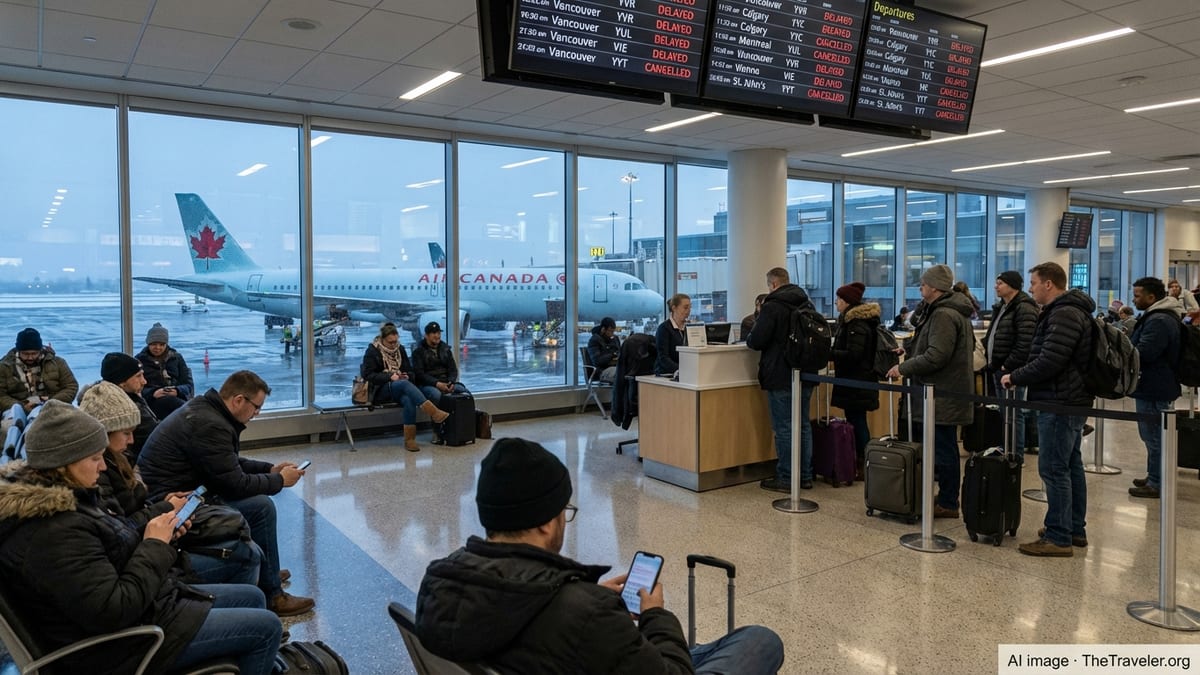
How a routine itinerary can unravel into a multi-stop delay marathon
Coverage describing an intended 11-hour transatlantic trip that stretched to about 40 hours points to a common pattern in modern air travel: a single delay that triggers a missed connection, followed by rebooking onto later flights that may themselves be constrained by aircraft availability, crew scheduling limits, and airport congestion.
In these scenarios, the most visible “help” passengers receive is often a small airport meal voucher, sometimes denominated in local currency when the delay occurs in Europe. A 15-euro voucher, while not unusual in practice, can feel inadequate at large hub airports where food and beverages can be costly, especially during long waits that span multiple meal periods.
Even when the original disruption starts in North America, knock-on effects can strand travelers mid-itinerary in European airports, where the passenger may be navigating not only a new terminal but also unfamiliar rules for where vouchers can be redeemed and how quickly rebooking options disappear.
What airlines are expected to provide during long delays
Air Canada’s published conditions and disruption notices describe “food and drink in reasonable quantities” as part of assistance during certain long delays and cancellations, along with hotel accommodation for overnight disruptions in some circumstances, subject to availability. The carrier’s materials also note that responsibilities can depend on the operating airline, particularly for codeshare itineraries.
In Canada, the Air Passenger Protection Regulations framework centers on whether a disruption is within the airline’s control, within its control but required for safety, or outside its control. Guidance from Canada’s air passenger protection site describes an airline obligation to provide assistance such as food and drink in qualifying cases, with details tied to timing and the nature of the disruption.
In Europe, passenger-rights guidance similarly emphasizes the concept of “assistance” during long delays, including meals and refreshments, and in many cases accommodation and communication, depending on the length of delay and flight distance. European Commission materials also caution that reimbursement for self-purchased meals is generally expected to be reasonable and proportionate to the delay.
Why a 15-euro meal voucher has become a flashpoint
A modest voucher can become a symbol of a bigger disconnect between passenger expectations and what is actually delivered during disruptions. In a multi-hour or multi-day delay chain, travelers typically face repeated out-of-pocket costs: multiple meals, drinks, airport essentials, and sometimes ground transportation or lodging if rebooking pushes departure to the next day.
Regulators have previously scrutinized airline handling of meal assistance. A publicly posted enforcement action from the Canadian Transportation Agency describes a past case in which the agency found Air Canada failed to provide a meal voucher during an extended delay, reflecting how basic “assistance” can become contentious when disruptions drag on.
Meanwhile, accounts across consumer forums and complaint sites frequently describe small, fixed-value vouchers offered during long waits. Those anecdotes are not the same as adjudicated cases, but they illustrate why a 15-euro voucher can ignite discussion: many travelers perceive it as insufficient relative to airport prices and the real duration of the disruption, especially when the delay stretches well beyond a single meal period.
Which passenger-rights rules may apply on Canada-to-Europe trips
For Canada-originating flights, Canadian rules often govern core obligations related to assistance and compensation, though the details can hinge on the cause of the disruption and whether the airline classifies it as within its control, safety-related, or outside its control. Canada’s passenger protection guidance also outlines rebooking expectations, including when a carrier must look to place a passenger on another airline if it cannot rebook within certain time windows.
For trips departing the European Union on the way home, EU passenger-rights protections are more likely to apply, including well-known compensation structures that can reach hundreds of euros in eligible situations, plus assistance such as meals and accommodation. European Union guidance makes clear that compensation and assistance are separate concepts: a passenger may be owed assistance during the wait regardless of whether compensation is ultimately due.
Air Canada’s own passenger-rights notices for certain European markets reference EU-style compensation levels in euros in specific contexts, while also noting that passengers cannot collect duplicative compensation under multiple regimes for the same disruption. For travelers trying to sort out what they are owed, the practical challenge is identifying which rules attach to each disrupted segment and which carrier was operating it.
What travelers can do after an extreme delay chain
When a trip planned at around 11 hours turns into a 40-hour ordeal, documentation becomes essential for any follow-up claim. Passengers typically benefit from saving boarding passes, rebooking receipts, delay notifications, and itemized receipts for meals or essentials purchased while stranded, especially if the airline’s assistance was limited or unclear at the airport.
Travelers may also want to confirm whether their disruption involved a segment departing the EU or the UK, where assistance expectations and compensation pathways can differ from Canada’s, and whether the flight was operated by Air Canada, Air Canada Rouge, Air Canada Express, or a partner carrier. Air Canada’s published materials note that in codeshare situations, the operating carrier generally holds the compensation and assistance obligations.
Finally, if the only immediate support offered during a prolonged delay was a small meal voucher, passengers can still review whether they were entitled to additional assistance such as hotel accommodation for overnight delays, or whether they may be eligible to seek compensation under the applicable regime. Publicly available regulator guidance in both Canada and the EU provides step-by-step descriptions of assistance and compensation concepts, but outcomes ultimately depend on the specific facts of the disruption and the itinerary.