


More news on this day
A routine telecom upgrade at a remote Federal Aviation Administration facility on November 13 triggered a cascading router failure that forced a rare nationwide ground stop, disrupting tens of thousands of flights and exposing how a single point of failure can still paralyze aviation across the United States.
Get the latest news straight to your inbox!
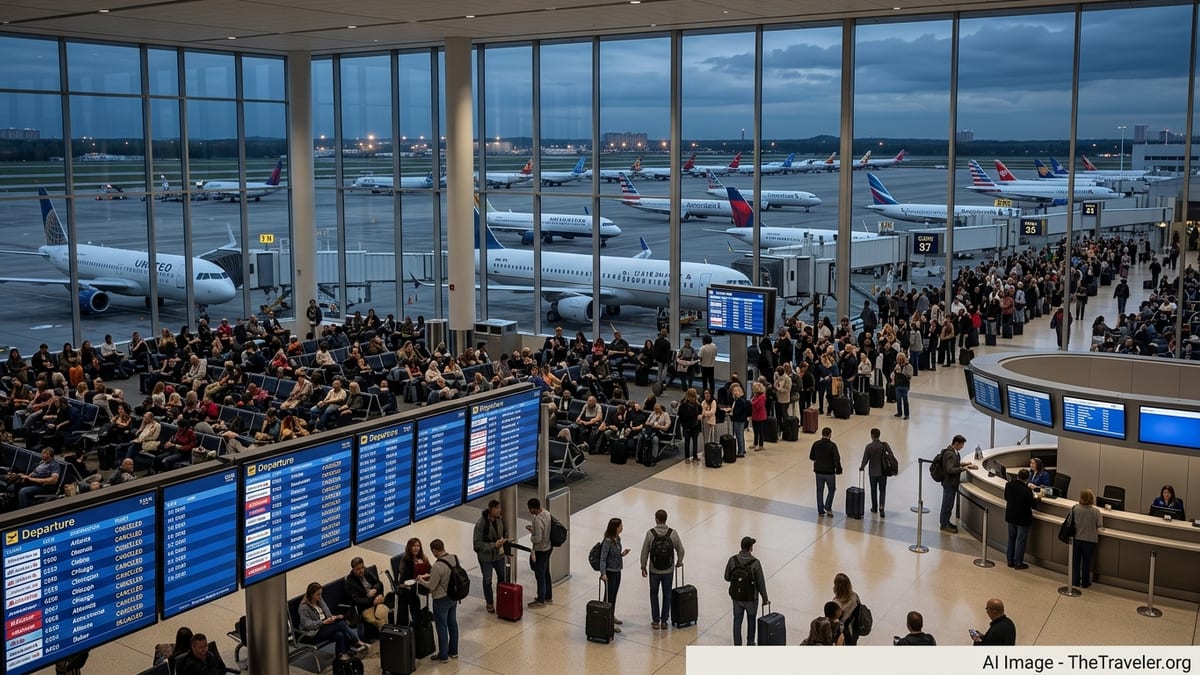
From Routine Maintenance to Nationwide Ground Stop
Publicly available information shows that the crisis began during scheduled work to replace aging copper telephone lines with fiber at an FAA telecommunications site that links regional air route traffic control centers. During that upgrade, a newly installed router began behaving abnormally, flooding other devices in the network with traffic and triggering instability across the system.
According to published coverage drawing on federal briefings, the router generated more than 1,000 connection attempts every four to five seconds, overwhelming interconnected equipment and disrupting the digital backbone controllers use to communicate with aircraft and share radar data. What began as a localized maintenance task quickly rippled across the specialized network that connects 22 en route centers managing high‑altitude traffic over the continental United States.
As communication links and radar feeds became unreliable in multiple regions, the FAA issued a nationwide ground stop at 3:54 p.m. Eastern time, halting most departures from US airports. Arrivals already in the air were managed carefully into available airports, but new takeoffs largely ceased until technicians could stabilize the system and confirm that controllers had dependable communications with pilots.
Reports indicate that the ground stop lasted around 90 minutes before being lifted, but the operational fallout extended well into the weekend, as aircraft and crew schedules were thrown off balance and airports struggled to clear backlogs of stranded passengers.
One Router, Thousands of Cancellations
By the time operations began to normalize, the numbers underscored the scale of disruption that one malfunctioning device could cause. International news outlets, citing aviation data services, reported that over two days more than 15,000 flights were canceled and another 14,000 to 15,000 were delayed across US carriers. Some estimates focused specifically on cancellations attributed directly to the day of the outage, placing that figure between 9,000 and 11,000 flights.
The discrepancy reflects different ways of counting knock‑on effects, but the outline is clear: a single router failure at one telecom site cascaded into one of the most severe systemwide disruptions since the immediate aftermath of the September 11, 2001 attacks. Aviation trackers showed choke points at major hubs such as Atlanta, Chicago, Denver, Dallas, and New York, where ground operations struggled to park aircraft, rebook travelers, and reposition crews.
In many airports, passengers were left facing long lines at customer‑service counters and hours‑long waits as airlines worked through cancellations and rolling delays. With aircraft and staff stranded out of position, published accounts described operations that remained fragile well into Sunday, even after the FAA declared its systems to be fully functional again.
The incident highlighted how even a relatively short nationwide halt can unravel a tightly choreographed domestic network. Once flights resume, aircraft may be in the wrong cities, pilots and cabin crews may be out of hours, and maintenance checks can fall out of their planned rotations, compounding delays long after the original technical issue is resolved.
Inside the Technical Failure
Technical explainers released in the aftermath point to a confluence of legacy infrastructure and modern networking features that combined to magnify what might otherwise have been a routine equipment fault. The problematic device was part of a router pair installed during the copper‑to‑fiber switchover. When it came online, a configuration or hardware problem appears to have caused it to broadcast an excessive volume of connection requests to other routers in the FAA’s private communications network.
Analyses in technology publications describe the effect as similar to a localized denial‑of‑service event, but originating from inside the network itself rather than from an external attacker. Some reports note that a feature on the new router functioned “as designed,” but interacted badly with decades‑old systems and topology, effectively flooding circuits and exhausting the capacity of older equipment to process and route traffic.
Industry reporting indicates that the fault affected communications at 17 of the 22 en route centers, which handle aircraft in the cruise phase between takeoff and landing. Controllers at those centers rely on constant data feeds for surveillance information and voice or data links to pilots. When those feeds become intermittent, standard safety protocols require that traffic be reduced or halted until reliable contact can be restored.
Once engineers identified the pattern of abnormal traffic, they disabled the offending feature across similar routers in the FAA network and isolated the problematic device. Investigations now focus on whether the root cause was an installation error by contractors, a configuration oversight, or a latent defect in the hardware or software of the router itself.
Aging Infrastructure Under Scrutiny
The incident has intensified scrutiny of the condition of US air traffic infrastructure. Publicly available information from government audits and aviation analysts has long flagged the FAA’s dependence on equipment that dates back decades, including copper lines, aging routers, floppy‑disk‑based systems at some facilities, and paper flight progress strips still in use at busy airports.
Congress previously approved multi‑billion‑dollar funding to modernize air traffic systems, but progress has been uneven. Some facilities have migrated to newer digital tools and fiber networks, while others still rely on legacy components that are costly to maintain and difficult to integrate with modern technology. The November 13 outage, which unfolded during an upgrade intended to reduce such vulnerabilities, has renewed debate over the pace and sequencing of these modernization efforts.
Coverage from policy and technology outlets notes that the router failure occurred in a network designed for resiliency and redundancy, yet still harbored a hidden single point of failure. The idea that two updated routers at one site could trigger restrictions across the entire national airspace system has prompted calls for deeper architectural reviews, including stress‑testing for failure modes that may not have been fully anticipated.
At the same time, comparisons are being drawn to earlier aviation technology breakdowns, such as the 2023 failure of the NOTAM pilot advisory system and major airline IT outages tied to third‑party software. Together, these events suggest that both government and industry systems are operating near the edge of their resilience, where small faults in a complex web of legacy and modern components can escalate rapidly.
What Comes Next for Travelers and the FAA
For travelers, the immediate concern has been whether another such outage could recur in the short term. Aviation experts cited in news coverage stress that the November 13 incident, while dramatic, demonstrated that safety mechanisms functioned as intended by halting departures when communications became unreliable. Still, they argue that the scope of the disruption shows the need to design networks that degrade more gracefully, allowing partial operations rather than forcing nationwide stoppages.
Industry observers expect the FAA and its contractors to carry out a detailed forensic analysis of the failed router and its configuration, followed by network‑wide checks to ensure similar devices are patched, reconfigured, or replaced. Labor groups representing technical staff have also drawn attention to staffing levels and training, contending that complex cutovers on aging infrastructure demand more conservative planning and additional safeguards.
On the policy front, the crisis is likely to fuel discussions in Washington about accelerating modernization funds and tightening oversight of large‑scale IT and telecom projects within the national airspace system. Lawmakers are already signaling interest in hearings that would examine not only the specific contractor involved in the failed upgrade, but also the broader procurement, testing, and change‑management practices that allowed one device to wield such influence.
For the traveling public, the episode serves as a stark reminder that the invisible networks underpinning modern aviation remain vulnerable to both human error and technical fragility. As airlines and regulators work through the aftermath, passengers may see more communication about infrastructure upgrades, contingency planning, and what is being done to ensure that the next faulty router does not again bring air travel across America to a standstill.