


More news on this day
Airlines across the United States are racing to stabilize schedules and rebook hundreds of thousands of passengers after a nationwide air traffic control systems failure triggered the most disruptive flight shutdown in a quarter century.
Get the latest news straight to your inbox!
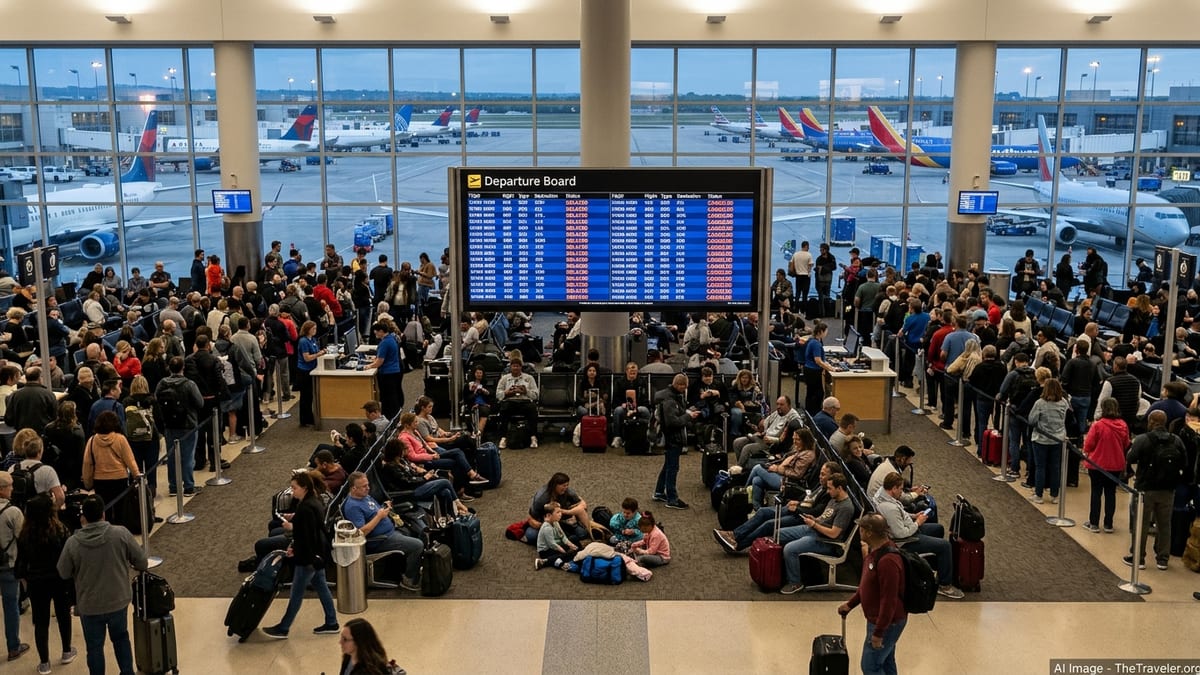
Ground Stop Freezes a Nation on the Move
The Federal Aviation Administration ordered a rare nationwide halt to departures on Friday evening after what officials described in public briefings as a major telecommunications and radar communications outage within key air traffic control systems. The move effectively froze takeoffs at airports across the country for more than an hour, with lingering restrictions in some regions as controllers worked to restore service.
Published coverage from major U.S. outlets indicates that this was only the third time in roughly 25 years that all U.S. departures were stopped simultaneously, placing the event in the same category of severity as the January 2023 Notice to Air Missions system failure and the shutdown that followed the September 11, 2001 attacks. Early tracker data compiled by aviation analytics firms showed thousands of flights either canceled outright or significantly delayed as the outage rippled through the network.
The ground stop came at the height of a busy travel period, with domestic demand running near or above pre pandemic levels. While the outage itself was relatively brief, the abrupt halt to departures created an immediate queue of aircraft waiting for clearance, clogging departure banks at major hubs and leaving arriving flights circling or idling on taxiways as gates filled.
As systems were brought back online, the FAA announced that air traffic control operations had returned to what it described as full capability. However, airline schedule data and airport boards on Saturday morning still showed widespread disruption, underscoring how even a short national pause can take days to unwind.
Airlines Add Crews and Extra Sections to Dig Out
Major U.S. carriers including American, Delta, United, Southwest, Alaska and JetBlue shifted quickly into irregular-operations mode, activating recovery playbooks honed during previous weather and systems crises. According to airline statements and operations updates, carriers added extra late night and early morning “section” flights on key routes, pulled spare aircraft into service and rerouted planes and crews to the most heavily affected hubs.
Industry trackers reported that more than three thousand flights were canceled and several thousand more delayed on Friday alone, with additional cancellations on Saturday as aircraft and crew rotations fell out of sync. The big four network airlines appeared to concentrate on restoring long haul and transcontinental services first, while trimming some off peak regional frequencies to free up aircraft.
Low cost and leisure focused carriers faced their own challenges, with point to point networks offering fewer options to substitute equipment or swap crews mid route. In some cases, aircraft and pilots ended up out of position for the next day’s schedule, forcing rolling cancellations even after the FAA lifted all airspace restrictions.
Publicly available operations dashboards suggested that airlines were gradually closing the gap by Saturday afternoon, though recovery remained uneven. Some coastal hubs reported improving on time performance, while large Midwest and Sun Belt airports continued to show elevated delays as storms, crew duty limits and the lingering effects of the outage combined.
Passengers Endure Long Lines, Lost Connections and Frayed Plans
For travelers, the sudden shutdown translated into hours long waits in terminals, stretched customer service lines and a scramble for scarce hotel rooms and rental cars. Social media posts and local broadcast coverage showed passengers sleeping on terminal floors, families improvising overnight stays in concourses and business travelers rerouting through multiple cities to reach their destinations.
Consumer advocates pointed to existing U.S. Department of Transportation rules, which entitle passengers to refunds if an airline cancels a flight and the traveler chooses not to fly, regardless of the reason for the cancellation. However, many passengers instead opted to be rebooked, often accepting next day or multi stop itineraries, given the difficulty of finding alternative options during a nationwide disruption.
Several large carriers expanded their “travel waiver” policies, allowing customers booked over the affected period to change flights without penalty and, in some cases, without fare differences within specified date ranges and city pairs. Airline websites and apps directed travelers to digital self service tools in an effort to relieve pressure on airport agents and call centers.
Airport operators warned that baggage backlogs could take additional time to resolve. At some hubs, arriving bags from canceled flights were reportedly stacked in cordoned off areas while airlines worked through claims and rerouting, raising the likelihood that some passengers would reach their final destinations days before their luggage.
Spotlight on Aging Infrastructure and Modernization Push
The outage has renewed scrutiny of the technology underpinning U.S. air traffic control. Recent government watchdog reports and industry analyses have highlighted the age of core systems that manage communications and flight data, some of which date back decades. A series of earlier, more localized disruptions had already prompted calls for accelerated modernization.
Preliminary explanations offered in official briefings linked the latest ground stop to a failure in telecommunications infrastructure that carries critical data between air traffic facilities, possibly exacerbated by ongoing upgrade work. Aviation technology specialists quoted in national coverage noted that the system is designed with redundancy, but that complex integration of old and new components can create unexpected vulnerabilities when a single node or router fails.
Congress has previously approved billions of dollars for modernization under multi year programs intended to replace legacy hardware, migrate software off obsolete platforms and phase out antiquated tools such as paper flight strips. Yet implementation has stretched over many years, and budget documents show that several key projects remain only partially complete, leaving the network in a hybrid state that can be more fragile than either fully old or fully new systems.
Policy analysts say the scale of the latest shutdown, combined with its timing at a peak travel period, is likely to fuel new debate on Capitol Hill over funding levels, deadlines and oversight for the next phase of upgrades. Aviation unions and airport groups have long argued that sustained investment, rather than stop start appropriations, is critical to avoiding repeat crises.
What Travelers Can Expect in the Days Ahead
With the FAA declaring its systems back at full strength, the focus has shifted to how quickly airlines can absorb the backlog. Operations planners typically liken the process to untangling a knot: each canceled flight leaves an aircraft and crew out of position, and it can take several rotations for those assets to return to their intended pattern.
Industry forecasts suggest that, if weather remains relatively stable, the bulk of disruptions for mainline domestic routes could ease within forty eight to seventy two hours. Regional flights serving smaller communities may take longer to normalize as airlines prioritize core trunk routes and international services where demand and revenue are highest.
Travel advisors recommend that passengers with near term departures monitor their flight status frequently, use airline apps where possible and consider arriving at the airport earlier than usual while queues remain unpredictable. For those whose trips are flexible, some experts suggest shifting travel by a day or two or opting for midweek departures, when schedules are less tightly packed.
Regulators and lawmakers have already signaled that formal reviews of the outage and response are forthcoming, with particular attention likely to fall on contingency planning and communication with the traveling public. Regardless of the eventual findings, the episode has underscored how dependent modern mobility has become on a complex, aging digital infrastructure, and how quickly that system’s failure can ripple through the lives and plans of millions of travelers.