


More news on this day
Amman is using the jolt from this year’s regional air traffic disruption affecting Queen Alia International Airport to accelerate a broader shift toward resilient heritage preservation and eco-tourism across Jordan’s capital and its surrounding landscapes.
Get the latest news straight to your inbox!
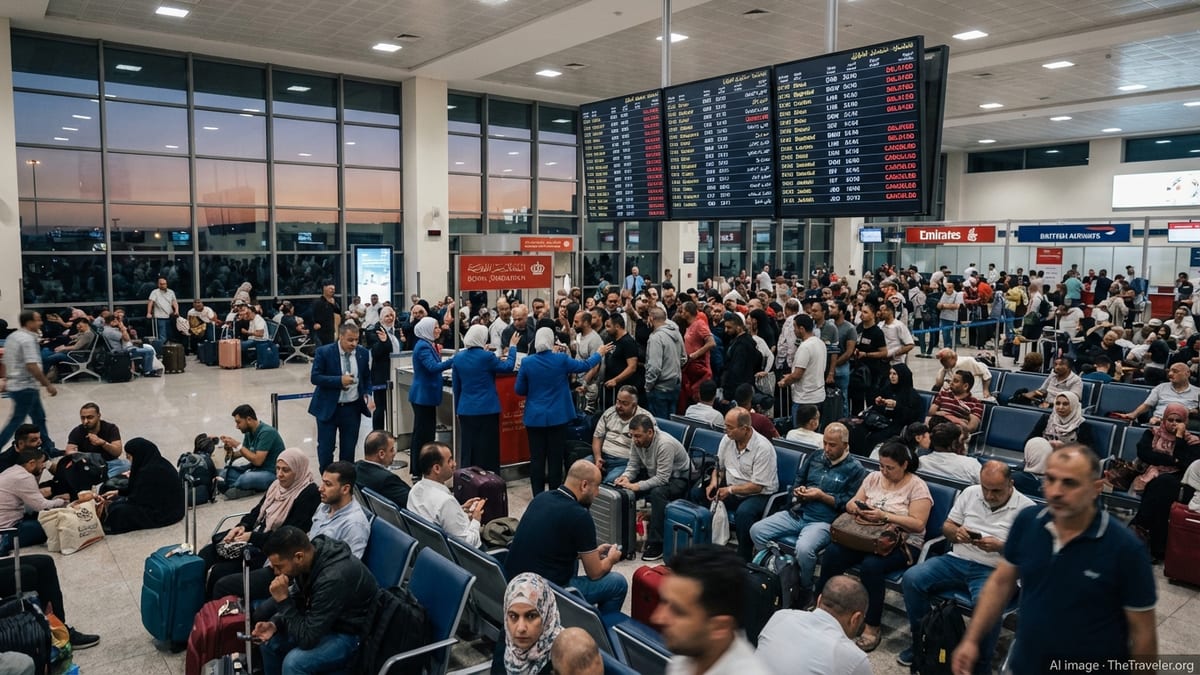
Flight Disruption Exposes Tourism Vulnerabilities
Early 2026 brought renewed uncertainty to air travel across parts of the Middle East, with regional tensions and temporary airspace closures prompting foreign carriers to adjust or suspend routes. Publicly available aviation and regulatory updates indicated that while Jordan’s airspace and Queen Alia International Airport remained technically open, traffic levels fell to well below normal as airlines reviewed risk and capacity on routes into Amman. Industry summaries for late June continued to describe longer routings and limited capacity across Levant corridors, underscoring how quickly connectivity to Jordan’s main gateway can be affected by developments beyond the country’s control.
Data released by Jordan’s Civil Aviation Regulatory Commission during the first quarter of 2026 showed that the airport was handling only a portion of its usual flights on some days after several international airlines scaled back regional operations. Passenger advisories emphasized rebooking rights and alternative flight options, reflecting concern that even short-lived disruptions could undermine confidence during a period when tourism receipts are increasingly important to Jordan’s economy.
The episode has sharpened focus in Amman on the need to diversify the tourism offer and build resilience beyond air traffic volumes. Government strategies already highlighted tourism as a key pillar of national growth, but the early 2026 experience has given added urgency to programs that spread visitors more evenly across the country and deepen the value of each stay through heritage, cultural and nature-based experiences.
Sector analysts note that the disruption has also reinforced arguments for sustainable transport within Jordan’s tourism system. A roadmap for greener tourism transport for 2026 to 2030, prepared with international partners, points to the role of lower-emission buses and integrated routes that can keep heritage sites and ecological reserves accessible even when international flight schedules are volatile.
Ancient Amman Sites Move From Monuments To Living Spaces
Within the capital, recent project announcements show how heritage policy is being translated into visible interventions at some of Amman’s most prominent ancient sites. Greater Amman Municipality reports indicate that work is advancing at Jabal Al Qalaa, the Citadel that dominates the city skyline, where new visitor facilities, panoramic plazas and a dedicated bus terminal have been completed. Municipal information describes the initiative as part of a broader effort to link the city’s historic core with modern services, positioning the hilltop complex as both an archaeological landmark and a usable public space.
Just downhill, the Nymphaeum, a Roman-era monumental fountain near downtown, has entered a new restoration phase. According to project details released by the municipality and academic partners, this stage will not only stabilize and conserve the structure but also transform the surrounding area into an archaeological park. Plans call for the site to function as an open-air museum and small performance venue that complements nearby monuments such as the Odeon and the Roman Theatre, effectively creating an expanded heritage district in central Amman.
These initiatives align with Jordan’s national strategy for the management of archaeological heritage, which emphasizes integration of conservation with community use and tourism. Policy documents from the Department of Antiquities and the Ministry of Tourism and Antiquities prioritize adaptive reuse, improved site interpretation and better visitor circulation rather than isolated restoration campaigns. In practice, the work at the Citadel and Nymphaeum is turning policy into a network of accessible, well-signed sites that can be connected to walking routes and cultural events.
International cultural cooperation is reinforcing this trend. Development agencies with offices in Amman continue to support technical training, risk management and conservation at major sites, building on earlier work in Petra and museum collections. Recent funding announcements, including grants for specific restoration efforts, highlight a focus on long-term capacity within Jordan’s own institutions so that urban heritage in Amman can be maintained even if external conditions limit tourism revenues in a given season.
Eco-Tourism Routes Offer Alternatives Beyond the Capital
The push for resilience is not confined to the city center. Jordan’s network of nature reserves and biosphere areas, managed with the support of national and international conservation organizations, is being positioned as a cornerstone of eco-tourism that can offset fluctuations in mass travel. Official investment promotion material frames these reserves, such as Dana and Mujib, as strategic assets where small-scale lodges, guided hiking and community-based tourism can generate income while protecting biodiversity.
Domestic travel programs are being scaled up to feed this network. The expanded “Urdunna Jannah” initiative, described in national news coverage as a major domestic tourism drive, aims to reach hundreds of thousands of residents in 2026 through subsidized trips. Program literature indicates that more than 60 tourism routes have been created, many connecting historic towns, nature reserves and lesser-known archaeological sites, with a focus on areas that saw a decline in foreign visitors in recent years.
Alongside the established reserves, new archaeological and natural destinations are being prepared for visitors. A recently announced multi-year project at Ain az Zara, also known as Kallirhoe on the eastern shore of the Dead Sea, combines excavation and conservation with the goal of eventually opening the Hellenistic and Roman-era settlement to the public. Project descriptions emphasize both scientific research and the potential to create a new heritage node along a corridor already popular for wellness and religious tourism.
Environmental and social assessments tied to Jordan’s tourism strategy underline the need to manage these sites within clear carrying-capacity limits. Proposed measures include better waste management, zoning for eco-lodges, and monitoring of trail use to prevent erosion and habitat disturbance. The approach indicates that authorities and partners see eco-tourism not only as an economic hedge against aviation shocks, but also as a way to showcase Jordan’s landscapes without repeating past patterns of overconcentration at a handful of iconic locations.
National Strategies Tie Heritage To Climate And Transport
Jordan’s heritage and tourism planning frameworks are increasingly explicit in linking cultural preservation with environmental sustainability and climate resilience. The national strategy for archaeological heritage management running through 2026 calls for protection of both built heritage and its surrounding landscapes, warning that urban expansion, infrastructure projects and climate-related hazards can erode the integrity of ancient sites if not carefully managed.
In parallel, the Jordan National Tourism Strategy for 2021 to 2025, supported by economic modernization plans, sets objectives for higher-value tourism with lower environmental impact. Publicly available summaries of these policies refer to the development of differentiated tourism products that include faith-based itineraries, desert and nature tourism, and cultural circuits anchored around cities such as Amman, Madaba and Jerash. A supporting roadmap for sustainable transport in the tourism sector, produced in 2025, proposes shifting more visitor movements onto efficient bus fleets and integrated routes, a change that could ease dependence on transfer-heavy air schedules.
International agencies working with Jordan highlight heritage and tourism as central to broader sustainable development goals. Recent UNESCO reviews of activities in the country identify cultural heritage safeguarding, sustainable tourism and community resilience as intertwined priorities, reflecting the view that well-managed sites can provide both identity and livelihoods. The Economic Modernization Vision adopted at the national level positions tourism, including eco and cultural segments, as a growth engine that must nonetheless operate within environmental limits.
For Amman, these frameworks provide a policy backdrop for the specific projects underway at the Citadel, the Nymphaeum and other historic quarters. They also justify investment in interpretation centers, signage, public transport links and digital tools that can distribute visitor flows more evenly across districts, reducing pressure on any single monument and creating opportunities for local businesses.
From Disruption To Opportunity In Jordan’s Capital
By mid 2026, aviation updates suggested that Queen Alia International Airport had largely adapted to the regional situation, with airlines recalibrating capacity and routing as conditions evolved. Yet the earlier period of reduced traffic left a clear imprint on tourism planning discussions in Amman. The experience has strengthened arguments for a model in which the capital is more than a transit point, instead functioning as a gateway to a diversified network of heritage and eco-tourism experiences that can attract visitors even when flight schedules are less than ideal.
In practical terms, this means continuing to invest in downtown Amman’s ancient landmarks and public spaces, ensuring that the city center tells a coherent story from Roman and Byzantine layers through to modern urban life. It also means more efforts to connect urban heritage with the nature reserves, religious sites and new archaeological parks that lie within a few hours’ drive of the capital, building itineraries that encourage longer stays and repeat visits.
Observers of Jordan’s tourism sector note that the combination of upgraded sites, domestic route programs and sustainability-focused planning could leave the country better positioned for future shocks. If flight disruptions recur, a tourism portfolio centered on authentic, locally grounded experiences and a strong domestic market may help stabilize revenues while international demand recovers. For Amman, the test will be whether today’s restoration works and eco-tourism initiatives can be maintained and expanded once immediate memories of the 2026 aviation turbulence begin to fade.