


Cruise drink packages in 2027 can be fantastic value or a very expensive habit. They are not automatically a good deal. The correct comparison is not the headline package price but what you would realistically spend buying drinks a la carte, including automatic gratuities and the drinks already included in your cruise fare such as tap water, buffet coffee and basic juices.
Get the latest updates straight to your inbox!
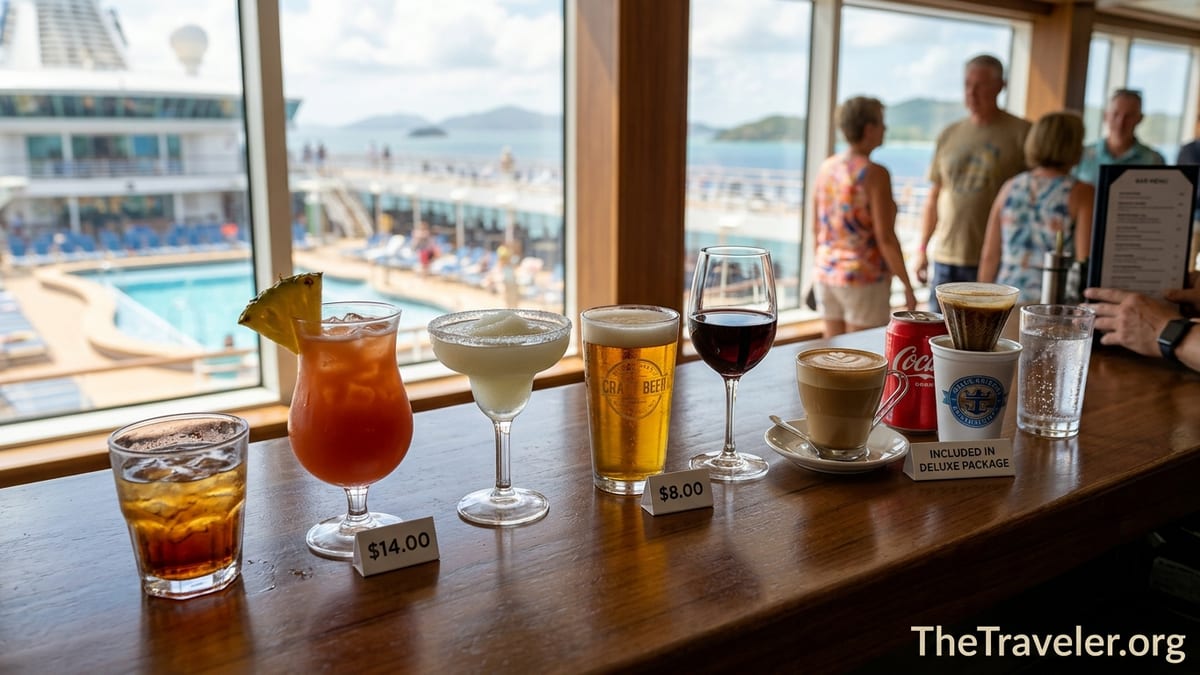
How Cruise Drink Packages Really Work in 2027
Every major cruise line sells some version of an unlimited or fixed price beverage package, but the structures differ. Royal Caribbean, Celebrity, Norwegian Cruise Line, MSC Cruises and Carnival all add a mandatory service charge on top of drink prices, whether you buy individual drinks or a package. On most current sailings that charge is around 18 to 20 percent. That means a menu cocktail listed at 14 dollars on Royal Caribbean actually costs about 16.50 dollars once gratuity is added if you pay by the drink.
Most alcoholic packages cover drinks up to a certain per glass price and then either exclude more expensive options or charge the difference. For example, Royal Caribbean’s 2026 beverage brochure states that its Deluxe Beverage Package includes any single beverage item with a menu value up to 14 dollars on many U.S. sailings. Drinks above that ceiling are permitted but the guest pays the difference plus gratuity. Celebrity, Norwegian, MSC and Carnival use similar thresholds, although their exact dollar caps and rules vary by brand and ship.
Another key feature is that packages rarely cover everything you can drink on board. Port taxes on alcohol served while docked can be added to your bill. Minibar items in your stateroom, bottled liquor, souvenir glasses, most room service beverages and some specialty café drinks are typically excluded. Private island rules also differ. For instance, Royal Caribbean extends its packages to Perfect Day at CocoCay bars, while some competitors only honor packages at certain venues or not at all on their private destinations.
Because of these complexities, a package is only worthwhile if the total value of what you would genuinely order at real menu prices, plus service charges, meets or exceeds the full cost of the package for your entire cruise. That calculation has to be made per line, per sailing and often per person in the cabin.
Royal Caribbean in 2027: 18 Percent Gratuity, 14 Dollar Cap and Freestyle Changes
Royal Caribbean’s Deluxe Beverage Package remains one of the most discussed at sea. Official materials show an 18 percent gratuity automatically applied to the package price when you purchase it. If your sailing advertises the package at, for example, 85 dollars per person per day in the Cruise Planner, your actual cost is roughly 100.30 dollars per day once that service charge is included. The package usually covers cocktails, beer, wine by the glass, soda, specialty coffees, bottled water and fresh juices up to the 14 dollar per serving cap.
A crucial policy difference on Royal Caribbean is that, on most itineraries, any guest of legal drinking age in a stateroom must purchase the Deluxe Beverage Package if one adult in that cabin buys it. Royal Caribbean will occasionally allow exceptions, typically for medical or religious reasons, but the default rule is that all adults in the room take the same alcoholic package or none. This is not an industry wide rule and should not be assumed on other brands.
There have also been specific changes to how soda is handled. Royal Caribbean’s beverage package page notes that beginning 15 March 2026 the Coca Cola souvenir cup and automatic access to Coca Cola Freestyle machines are no longer included with the Deluxe and Refreshment Packages. Guests now need to pay a small separate charge if they want the souvenir cup. Frequent cruisers have confirmed that the 14 dollar drink ceiling still applies on many U.S. sailings for cocktails and wine by the glass, as referenced in the 2026 Royal Caribbean beverage brochure and recent itineraries, though individual ships may vary slightly.
Concrete bar menu examples help frame the math. Recent Royal Caribbean menus show common beers at roughly 7 to 8 dollars before gratuity, standard cocktails and frozen drinks around 13 to 14 dollars, specialty coffee between 4 and 6 dollars and bottled water in the 3 to 4 dollar range. At these prices, a sea day with three 14 dollar cocktails, a specialty coffee and two bottled waters could easily reach 65 to 70 dollars plus gratuity if bought individually, or roughly 77 to 82 dollars all in. Comparing that to a Deluxe Beverage Package at around 100 dollars per day including tip gives you a concrete bar for what “break even” consumption looks like.
How Celebrity, Norwegian, MSC and Carnival Differ
Celebrity Cruises structures its offerings into Classic, Premium and Non Alcoholic drinks packages. Recent tracking by cruise pricing sites in late 2026 shows the Classic package typically starting around 89 dollars per person per day and Premium around 109 dollars, with a 20 percent service charge added at checkout. That brings effective daily prices to roughly 107 and 131 dollars respectively. The published rules state that each package includes drinks up to a set menu value, historically around 10 dollars for Classic and 15 dollars for Premium, with an upcharge on the difference if you order something more expensive. Celebrity’s policy allows adults in the same cabin to hold different package types or for one to have no package provided minimum purchase requirements are met when booking bundled fares.
Norwegian Cruise Line ties most of its beverage access to its Free at Sea promotions. The standard Unlimited Open Bar perk covers most beer, wine by the glass and spirits up to a certain price point and carries its own 20 percent gratuity on the package value. Public guidance and recent explanations from travel agencies in 2026 indicate the effective cost for the drinks portion of Free at Sea on cruises of six nights or longer is around 28.50 dollars per person per day in service charges, with the base perk itself rolled into the fare. Upgrading to Free at Sea Plus, which adds higher priced drinks, Starbucks coffee and bottled water, costs extra per day and also attracts a 20 percent gratuity calculated on the discounted amount.
MSC Cruises has simplified its drinks packages in the North American and Caribbean markets, with recent guidance in 2025 and 2026 noting the retirement of the older Easy and Easy Plus tiers and a move toward a set of broader alcoholic and nonalcoholic packages. Reports from recent U.S. sailings describe cocktails priced around 14 to 16 dollars and beers roughly 9 dollars, with an 18 percent gratuity in the MSC for Me app. MSC also caps alcoholic drinks on its packages at around 15 per day, similar to several competitors, and often sells its packages at substantial pre cruise discounts when bundled with fare promotions.
Carnival’s CHEERS program is one of the more straightforward. Carnival’s official help pages show CHEERS costing 83.94 dollars per person per day including a 20 percent service charge when purchased before sailing and 89.94 dollars per day including service charge when bought on board. The package allows up to 15 alcoholic drinks per 24 hour period from 6 a.m. to 6 a.m., though sodas and covered nonalcoholic beverages are unlimited and do not count toward the 15 drink cap. Carnival also requires that if one adult in a stateroom buys CHEERS, every adult aged 21 or older in that cabin must purchase it as well, echoing Royal Caribbean’s cabin wide rule but applying only to its own product.
What Is Actually Included: Menus, Limits and Exclusions
Across these lines, inclusions and exclusions follow a pattern but diverge in the details. Beer is almost always included in alcoholic packages up to the menu price cap. On Royal Caribbean, a 7.50 dollar lager is covered by the Deluxe Beverage Package with no extra cost, while a rare craft beer priced at 15 dollars would typically incur a roughly 1 dollar plus gratuity surcharge. Celebrity’s Classic package focuses on house and standard beers, while Premium opens up more craft and imported labels at higher price caps.
Cocktails are where many travelers hope to find value. On Royal Caribbean and Carnival, common frozen cocktails and mixed drinks are usually priced at 11 to 14 dollars before gratuity. Under a qualifying package, anything within the cap is fully covered. If a martini bar on Celebrity lists signature creations at 17 dollars and your package cap is 15 dollars, you would see an additional 2 dollars plus 20 percent service added to your folio. Wine by the glass runs from roughly 9 to 13 dollars for basic pours up to 16 dollars or more for premium selections on contemporary lines, again with caps determining whether an upcharge is due.
Nonalcoholic drinks are treated differently but still impact value calculations. Soda packages on Royal Caribbean and Carnival are much cheaper, often in the low teens per day plus gratuity, and cover fountain soft drinks and sometimes Freestyle machines with the purchase of a souvenir cup. Bottled water, specialty coffee drinks from cafés like Royal Caribbean’s Café Promenade or Norwegian’s onboard Starbucks outlets, energy drinks and fresh squeezed juices may or may not be included depending on the package tier. For instance, many of Norwegian’s standard Unlimited Open Bar perks do not include Starbucks branded beverages, which are reserved for higher tier packages such as Free at Sea Plus.
Several consistent exclusions are important for your budget. Most minibar items in your cabin, full bottles of liquor or wine, souvenir mugs and elaborate coffee creations are not covered by the base packages. Room service beverages can be included or excluded depending on the line; Carnival’s documentation notes that room service and minibar are outside the scope of CHEERS, while Royal Caribbean excludes minibar and some in room services but allows package use on drinks delivered from regular bars. Taxes may be applied on alcoholic purchases made while the ship is in certain U.S. ports, and although your package covers the drink itself, the tax may appear as a small line item on your onboard account.
Three Seven Night Break Even Case Studies
To see how these numbers work out in practice, consider three sample seven night itineraries using representative 2026 and 2027 prices. First, a light drinking couple on Royal Caribbean who each enjoy two cocktails per day and otherwise drink the included buffet coffee, tea and tap water. If cocktails average 14 dollars before gratuity, each person’s daily bar bill for two drinks is 28 dollars. Adding the 18 percent service charge brings it to about 33 dollars per day, or 231 dollars per person over seven nights. By comparison, if the Deluxe Beverage Package on their sailing is 90 dollars per person per day before gratuity, the all in daily cost is about 106 dollars and the seven night total roughly 742 dollars per person. For this couple, buying the package would cost more than three times what they would otherwise spend.
Now take a moderate traveler on Celebrity with the Premium Drinks Package. Assume a realistic pattern of three alcoholic drinks, one specialty coffee and two bottled waters per day. Using sample shipboard prices from recent bar menus, we can approximate three 15 dollar cocktails or glasses of wine, one 5 dollar specialty coffee and two 3.50 dollar waters, totaling 47 dollars before gratuity. With a 20 percent service charge on individual purchases, the daily cost is about 56.40 dollars. Over seven nights, this comes to roughly 395 dollars. Against that, the Premium package might cost about 131 dollars per day including service, or roughly 917 dollars for the week. Unless this traveler significantly increases daily consumption, the package does not represent value.
For a heavy spending couple on Carnival who use CHEERS to its limit, the equation looks different. Suppose each adult routinely enjoys five cocktails or glasses of wine at around 11 dollars, two beers at 7 dollars, one specialty coffee at 4.50 dollars and two energy drinks at 5 dollars, for a pre gratuity total around 77.50 dollars. Adding 18 to 20 percent service per drink brings the effective daily spend without a package to roughly 91 to 93 dollars. CHEERS, purchased in advance at 83.94 dollars per day including service, now saves perhaps 7 to 9 dollars per person per day, or roughly 50 to 65 dollars per person over a seven night cruise, assuming they consistently drink at that pace.
These examples highlight why a realistic self assessment of your drinking habits matters more than the marketing language. Light to moderate drinkers on mainstream lines often do not reach the thresholds needed to justify high tier alcoholic packages unless they also place high value on specialty coffee, soft drinks and bottled water and price those items carefully.
Port Intensive Itineraries and Days Ashore
Another key variable is how many hours you will actually spend on the ship. On Caribbean or Mediterranean itineraries with long port days, you may leave after breakfast and not return until late afternoon. During those hours ashore, your cruise line beverage package provides no value. Many passengers instead buy a local beer for a few euros at a seaside café or a coffee in town and effectively substitute cheaper onshore drinks for onboard spending.
Imagine a seven night Mediterranean cruise on MSC with five full port days. A guest who might order five or six drinks on a lazy sea day may find they only have time or appetite for two or three once you subtract the hours spent touring, swimming and dining ashore. If that traveler bought a 70 dollar per day alcoholic package including gratuities and only managed two 14 dollar cocktails and a 4 dollar espresso most days, their effective daily value would be about 32 dollars in drinks for a 70 dollar spend. In contrast, paying per drink with 18 percent gratuity would cost perhaps 38 dollars on that lighter day.
When you factor in port taxes, this gap can widen. In certain U.S. ports and European jurisdictions, a small local tax can be levied on alcoholic beverages poured on board while the ship is docked. Some lines pass that tax through even on package drinks, leading to minor but noticeable extra charges on days when you have just stepped back onto the ship and order a drink before sail away. If the bulk of your itinerary consists of such port calls, the relative value of a package falls compared to more sea day heavy routes like transatlantic crossings.
Because of this, port intensive trips favor either per drink spending or lower cost nonalcoholic packages. For example, opting for a soda or refreshment package at roughly 20 to 30 dollars per day including gratuity on Royal Caribbean or Celebrity might make sense if you are in port most days but still enjoy mocktails, specialty coffees and sparkling water in the evenings.
Promotions, Pre Cruise Discounts and Refund Rules
All five lines use dynamic pricing and frequent promotions to sell beverage packages. Royal Caribbean in particular is known for listing a “full” price and then advertising periodic percentage off sales in its Cruise Planner. Travel price trackers that monitor Royal Caribbean and Celebrity have documented midweek price swings of several dollars per day, with some Celebrity drink packages dropping notably on certain Wednesdays and rising again on Thursdays. For a seven night sailing, a five dollar per day difference translates into 70 dollars per person.
Celebrity often ties its drinks packages to bundled fares such as “All Included” or premium bundles that also incorporate Wi Fi. The underlying package prices shown in the pre cruise planner can still fluctuate, and status with Celebrity’s loyalty program may unlock modest additional discounts on pre purchased packages. Norwegian’s Free at Sea and Free at Sea Plus work differently, with the drink component essentially baked into the fare but service charges and any upgrade fees itemized so you can see the beverage cost element.
Carnival and MSC routinely run pre cruise promotions where buying CHEERS or a comparable package before sailing is several dollars per day cheaper than waiting until you are on board. Carnival’s official materials clearly show a lower price including service charge when CHEERS is pre purchased. Royal Caribbean and Celebrity typically allow cancellation and repurchase of packages in the Cruise Planner up to a cut off date, so many experienced cruisers watch prices and rebook if they see a lower rate. However, final payment deadlines and regional consumer laws can affect how easy it is to cancel, so always read the conditions displayed before confirming.
Refund policies during the cruise are stricter. It is common across these brands for beverage packages to be sold on an all or nothing basis for the full length of the voyage, with no partial refunds if you change your mind midweek. That makes it especially important to run your own break even numbers ahead of time rather than assuming you can test the package for a day and then drop it if you are not using it fully.
Nonalcoholic Packages, Loyalty Perks and Health Caveats
Nonalcoholic packages can be an overlooked middle ground. Royal Caribbean’s Refreshment Package, Celebrity’s Zero Proof or Non Alcoholic package, Norwegian’s soda and specialty coffee options and MSC’s nonalcoholic tiers are all priced well below the full alcoholic packages. For travelers who do not drink alcohol or only have a glass of wine a couple of nights, combining a nonalcoholic package with the occasional a la carte alcoholic drink often produces a far lower weekly bar bill than an unlimited alcohol package.
Loyalty benefits further complicate the value math. Royal Caribbean’s Crown and Anchor, Celebrity’s Captain’s Club and Norwegian’s Latitudes, among others, provide free daily drink vouchers or periodic evening happy hours at higher tiers. A guest receiving four complimentary drinks each day as a loyalty perk on Royal Caribbean will find it much harder to justify paying over 100 dollars per day for a Deluxe Beverage Package. On the other hand, new cruisers without status and with high onboard consumption patterns might see net value.
There are also health and safety caveats. Unlimited or very high capped alcohol packages can create subtle pressure to drink more than you otherwise would “to get your money’s worth.” Cruise lines unofficially emphasize responsible drinking and can refuse service if a guest appears intoxicated even if they have not hit a numerical package limit. Travelers should be wary of planning their vacation around hitting a certain number of cocktails each day; no spreadsheet saving is worth a hangover on every port call.
For families and multigenerational groups, remember that several lines extend the adult package obligation to all legal drinkers in the cabin. If one person is a very light drinker and another much heavier, the combined cabin cost can exceed what the heavier drinker alone would spend without any package. In such cases, checking whether the lighter drinker can opt for a nonalcoholic package or no package at all, as Celebrity often permits, becomes critical.
A Simple Daily Drink Count Calculator and Final Recommendations
To build your own daily calculator, start with current menu prices from your line or recent bar photos from your specific ship. List what you realistically drink on a sea day and on a port day across beer, cocktails, wine, specialty coffee, soda, bottled water and mocktails. Multiply by the menu price and then add the line’s service charge, which is 18 percent on Royal Caribbean, around 20 percent on Celebrity and Norwegian drink packages and similar levels on Carnival and MSC. Average those numbers across your itinerary’s mix of sea and port days.
Next, compare that figure to the real per day package cost including gratuities. For instance, if Royal Caribbean’s Deluxe Beverage Package is offered at 78 dollars per person per day before gratuity, your effective cost is about 92 dollars per day once the 18 percent charge is added. If your calculator shows that your genuine consumption is likely to be 60 dollars per day in drinks plus gratuity, you would effectively be donating about 32 dollars per day to the cruise line for the convenience and psychological comfort of not seeing individual drink charges.
Packages tend to offer real value in a few situations. First, when you are a genuinely heavy consumer of alcoholic and premium nonalcoholic drinks and know from past cruises that you will sustain that level every day, including port days. Second, when a line offers a particularly strong promotion or bundles a package into a fare at a marginal upcharge that is clearly lower than your projected a la carte spending. Third, when nonalcoholic coverage for specialty coffees, mocktails and bottled water is almost as important to you as alcohol itself.
On the other hand, if you are a light or moderate drinker, have many long port days, benefit from loyalty drink vouchers or prefer the occasional fine wine or top shelf spirit that exceeds package caps, buying drinks individually usually saves money. In 2027, the smartest move is to treat a beverage package not as an automatic add on but as a calculated choice, anchored in the actual bar menus and rules of your particular sailing rather than in broad assumptions about cruising or alcohol consumption.