


More news on this day
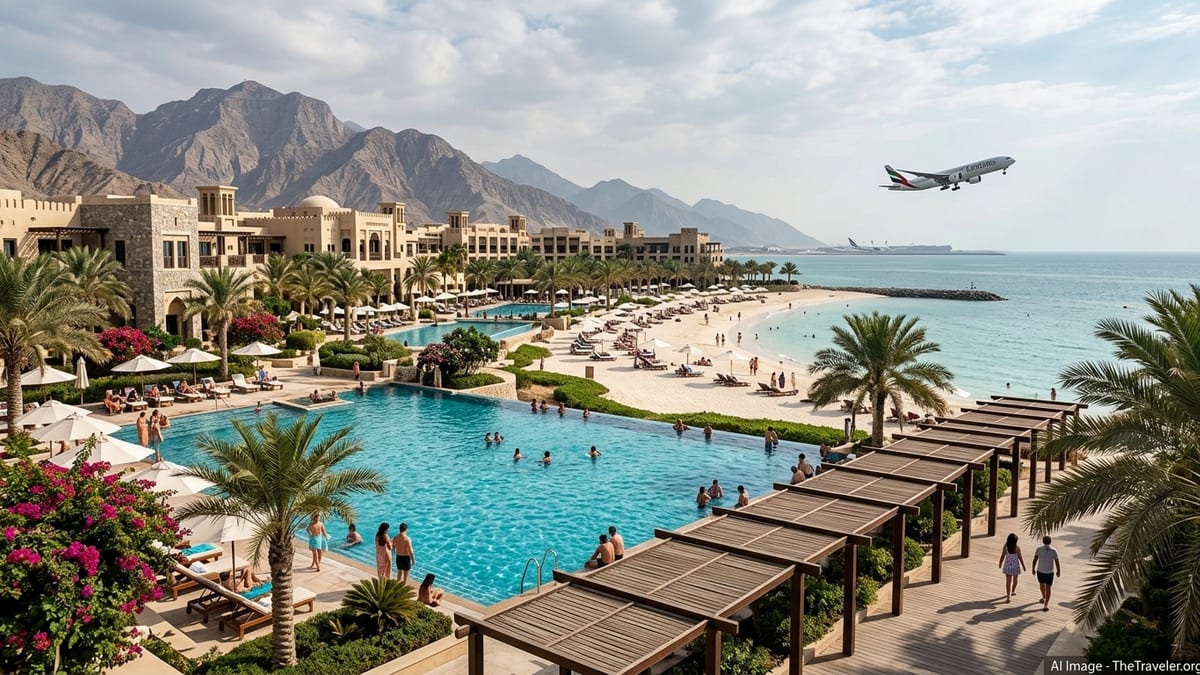
A leading beachfront resort in Ras Al Khaimah, in the United Arab Emirates, reports holding about 80 per cent occupancy through October and early November 2026, even as a patchwork of airline suspensions, reroutings and conflict-related advisories has disrupted flight schedules across the wider Middle East and dampened demand on key regional routes.
Get the latest news straight to your inbox!
The core development: strong resort bookings despite regional air turmoil
The most concrete new development is the resort’s claim that its rooms have remained roughly 80 per cent full during a period when international and regional air traffic to the Gulf has been hit by successive shocks. While the resort has not released its own detailed figures publicly, that occupancy level is broadly consistent with Ras Al Khaimah’s recent performance, where official statistics from the emirate’s tourism authority show hotel occupancy averaging in the high 70s in late 2025 and early 2026.
The resort’s experience contrasts with the broader picture for Middle East aviation in the second half of 2026. Conflict-related incidents, including attacks that forced temporary closure of Riyadh’s main airport and triggered extended flight suspensions by several foreign airlines to Gulf hubs, have cut seat capacity and led to cancellations on routes linking the region to Europe and parts of Asia. Industry data for the third quarter of 2026 show demand between Saudi Arabia and the UAE contracting sharply year on year, and European carriers postponing the restoration of some Middle East services.
Yet Ras Al Khaimah appears to have retained a relatively stable flow of guests, helped by its position within the UAE, which remains accessible via Dubai and other airports that continue to handle large volumes of traffic despite schedule changes. The emirate’s own tourism authorities have not reported a collapse in visitor numbers, and the 80 per cent figure indicates that, at least for this particular beachfront property, room demand has so far proved resilient even as many travellers face more complex journeys into the region.
How flight disruptions are affecting access to the UAE
Flight disruption in late 2026 has not taken the form of a blanket closure of Gulf airspace, but rather a rolling series of route suspensions, diversions and timetable changes. Advisory notices from aviation regulators in North America and Europe have urged airlines to avoid certain conflict zones, while individual carriers, such as KLM and Air France, have extended suspensions of services to Dubai and other Gulf airports for weeks or months at a time. Some Asian airlines have also cancelled or delayed the return of Dubai and Riyadh flights, and cargo operators have flagged ad hoc cancellations to and from multiple Gulf destinations.
For travellers, these decisions translate into fewer nonstop options and a heightened risk of last minute changes on itineraries involving the Middle East. Travel media and regional newspapers have documented days when departures from Dubai, Abu Dhabi and Sharjah saw clusters of cancellations and long delays, particularly on services involving Saudi Arabia, Iran and Israel. At the same time, the UAE’s own restrictions on flights operated by Iranian carriers remain in place, further narrowing options on some regional links.
Despite this, the UAE’s main gateways continue to function, and Ras Al Khaimah remains reachable via a combination of international flights into Dubai or Abu Dhabi and surface transfers of around one to two hours. The emirate’s official visitor advisory acknowledges that operations at Ras Al Khaimah International Airport can be interrupted or rescheduled as the regional situation evolves, and explicitly encourages anyone facing travel disruption to contact their airline or hotel directly. This means that while the route map has become more complicated, travellers who are prepared to connect or adjust times can still reach Ras Al Khaimah without transiting airports most directly affected by security incidents.
Why Ras Al Khaimah’s resort bookings are holding up
Several factors help explain why a resort in Ras Al Khaimah can report occupancy around 80 per cent at a time when Middle East tourism as a whole is under pressure. First, the UAE has a large domestic and resident travel base, and Ras Al Khaimah’s beach resorts have historically attracted weekend and short-stay visitors from Dubai and other emirates who arrive by car rather than by air. This local market is largely insulated from international airline schedule cuts.
Second, the emirate has been positioning itself as a quieter alternative within the UAE, with a focus on family resorts and outdoor activities along the coast and in the Hajar Mountains. Even as some international visitors defer trips to the wider region because of conflict headlines, others may actively choose a smaller Gulf destination over busier hubs. Consulting and hotel-industry analyses of the current disruption describe it as an aviation and confidence shock rather than a collapse in underlying travel interest, with some travellers simply switching destinations within or beyond the region.
Third, Ras Al Khaimah entered this period from a position of relative strength. Data from its tourism development authority and statistics center show that hotel occupancy across the emirate was already climbing into the mid to high 70 per cent range by late 2025, supported by new room supply and targeted promotion in source markets such as Europe, India and the wider Gulf. Against that backdrop, a resort maintaining about 80 per cent occupancy in October and early November 2026 looks more like continuity than a sudden spike, suggesting that existing channels such as tour operators, charter flights and repeat guests are still functioning, even if some source markets have softened.
Practical impact on travellers heading to Ras Al Khaimah
For travellers, the combination of high resort occupancy and uneven airline schedules has two main consequences. Availability at popular beachfront properties may be tighter than the broader headlines about regional tourism weakness would suggest, particularly for peak winter dates in December and January when Ras Al Khaimah traditionally sees strong demand. Prospective guests looking at school holidays or long weekends may find that preferred room categories are already heavily booked or priced higher than expected, even as some airfares into the UAE soften on routes where demand has dropped.
At the same time, getting to the resort can require more planning than in previous seasons. Because direct services to Dubai and other Gulf hubs have been temporarily suspended or reduced by several foreign airlines, travellers from affected cities often need to route via alternative hubs or switch carriers entirely. Those travelling for short breaks need to balance potential schedule changes against limited hotel flexibility, particularly on advance-purchase or non-refundable rates. Regional reports repeatedly stress the importance of checking both the flight status and any special ticketing policies on the operating airline before committing to non-flexible accommodation.
The resort’s ability to maintain about 80 per cent occupancy also means that it has not so far been forced into last minute mass cancellations or closures, issues that have affected some properties elsewhere during previous aviation disruptions. Guests with existing bookings should still monitor their flights closely, but the main risk is disruption en route rather than the hotel itself ceasing operations. For travellers who are willing to accept the possibility of changes and build in some buffer time on arrival and departure days, Ras Al Khaimah remains a viable beach destination, supported by the broader UAE infrastructure even as regional air connectivity adjusts.
What to check before booking and what could change next
The key step for anyone considering a stay at a Ras Al Khaimah resort in the coming months is to verify current air-service options from their departure city. Travellers should confirm which airlines are operating into Dubai, Abu Dhabi or Ras Al Khaimah on their preferred dates, and whether any published suspensions or reroutings affect their journey. They should then check how easy it is to reach Ras Al Khaimah from their chosen airport, including transfer times and any late-night arrival issues that could complicate ground transport.
Given the fluid nature of the security environment and airline responses, conditions may change again in the weeks ahead. Carriers that have currently suspended Dubai or Riyadh flights could extend or shorten those suspensions, regulators could revise conflict-zone advisories, and insurers could adjust coverage for trips involving particular airports. None of these shifts automatically make travel unsafe or impossible, but they can affect schedules, connection times and ticket flexibility. As a result, booking options that allow for date changes or refunds may be prudent for trips into the wider Gulf for the rest of the 2026 winter season.
On the ground in Ras Al Khaimah, the tourism authority advises visitors experiencing disruptions to stay in close contact with both their airline and accommodation provider, and that remains sound guidance. If flight reliability improves and more carriers restore Gulf services in early 2027, resorts that have already sustained occupancy around 80 per cent through the current turbulence could benefit from a stronger high-season finish. For now, would-be guests should approach the destination with realistic expectations: hotel operations are broadly normal, rooms at some properties are in demand, and the main variable is still the route their aircraft takes to get them to the UAE.