


More news on this day
After days of disruption triggered by a telecommunications failure at a regional air traffic facility, flight operations at Philadelphia International Airport have largely resumed, but travelers are still facing scattered delays as airlines clear a backlog of trips.
Get the latest news straight to your inbox!
Ground Stops Lifted After Major Equipment Outage
Philadelphia International Airport was one of several major Northeast hubs hit by a ground stop on Monday, September 21, after an equipment failure at an air traffic control facility handling traffic for the region. Publicly available information from the Federal Aviation Administration shows that arrivals and departures into PHL were restricted for hours while technicians worked to resolve the outage.
Local and national outlets report that the issue began with a failed circuit at the air traffic facility serving both Philadelphia and Newark, compounded by a cut backup fiber line at a construction site in New Jersey. This combination disrupted communications and radar feeds for multiple airports, including Philadelphia, Newark, LaGuardia, John F. Kennedy and Teterboro, forcing a pause in flights across a large swath of the Northeast.
Coverage from Philadelphia news organizations indicates that the ground stop at PHL was lifted late Monday afternoon. By early Monday evening, the FAA’s airspace status pages showed that the formal restrictions on flights into and out of Philadelphia had been removed, allowing airlines to gradually restart operations.
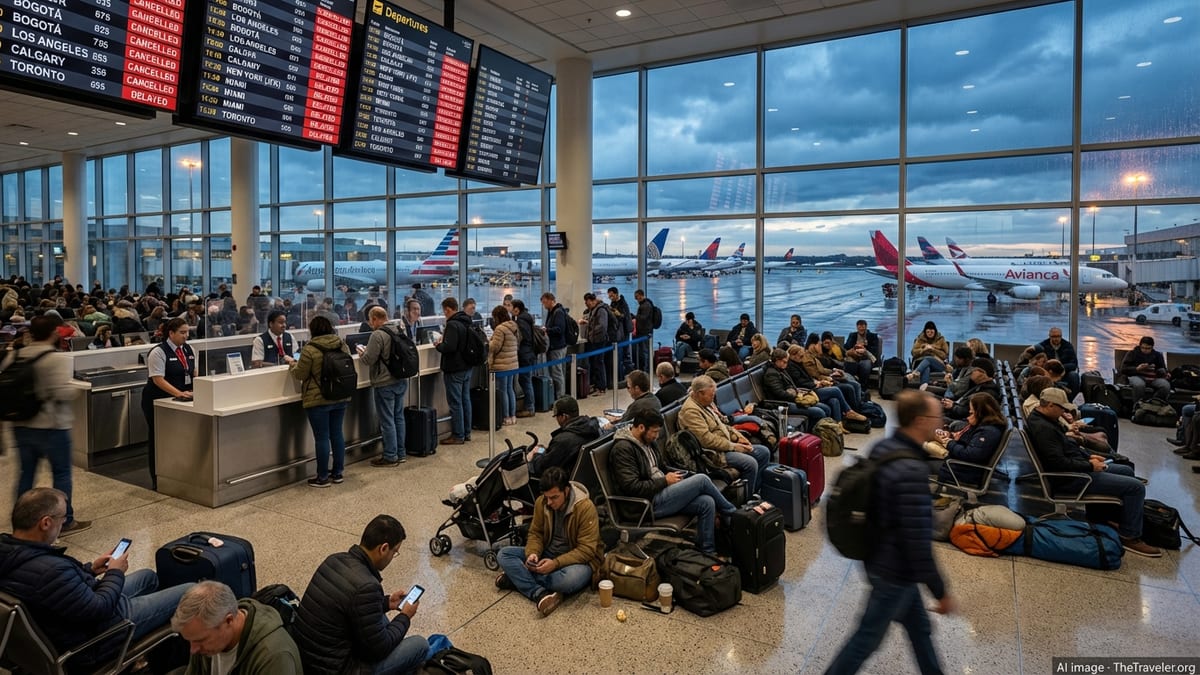
Broadcast reports from CBS Philadelphia and other local stations on Monday night described flights once again departing and arriving, but with many passengers still stuck due to earlier cancellations and missed connections. Those accounts characterize the scene as a transition from full-scale disruption to a slow restart, with long lines at rebooking desks and crowded gate areas.
Ongoing Delays as Airlines Work Through Backlog
While the technical problem behind the ground stop has been addressed, flight-tracking data and regional coverage from Tuesday, September 22, show that delays have continued at Philadelphia International Airport, although at reduced levels compared with Monday’s peak disruption. Reports describe lingering knock-on effects as aircraft and crews cycle back into place.
Television coverage from 6abc in Philadelphia on Tuesday night highlighted a rise in delayed flights across major airports, including PHL, as the schedule absorbed both the previous day’s outages and ongoing weather challenges. Travelers interviewed in those reports mentioned holding patterns, late departures and missed connections as airlines adjusted their networks.
Philadelphia-based newspaper reports on Tuesday noted that PHL was still recording a significant number of delayed and canceled flights relative to a typical weekday, but that operations were no longer at a standstill. The characterization shifted from widespread gridlock to what was described as a difficult but improving travel day, with some terminals running closer to normal while others remained congested.
Regional and national coverage of the outage indicates that the ripple effects have extended beyond Philadelphia, with Newark in particular experiencing severe cancellations. Because PHL functions as a connecting hub, especially for transatlantic and domestic routes, schedule disruptions elsewhere in the Northeast have continued to translate into delays on some arrivals and departures in Philadelphia.
What Travelers Can Expect at PHL Today
On Wednesday, September 23, publicly accessible flight-status boards and airline updates show that Philadelphia International Airport is operating, with most airlines running their schedules, but with isolated delays and a smaller number of cancellations compared with the previous two days. The situation is described in news coverage as fluid, varying by carrier, destination and time of day.
Travelers checking departures from PHL today will find that many flights are listed as on time, particularly during off-peak periods. However, early morning and late afternoon banks still show clusters of delays, often tied to aircraft arriving late from other Northeast or Midwest airports that also experienced the earlier outage or later weather-related slowdowns.
Arrivals into PHL reflect a similar pattern. Routes from airports that were heavily affected by Monday’s ground stops have seen more persistent disruption, while flights from unaffected regions are closer to schedule. According to published coverage and flight data, some delays today are measured in tens of minutes rather than multiple hours, although a few longer holds remain where aircraft rotations are still recovering.
Travel information services and airline advisories available as of Wednesday morning encourage passengers flying through Philadelphia to monitor their flight status frequently and allow extra time at the airport. Some major carriers serving PHL have kept flexible travel waivers in place for affected dates, allowing customers to adjust plans without standard change fees when their itineraries involve the hardest-hit airports.
Why Philadelphia Was So Heavily Affected
The outage that led to ground stops at Philadelphia International Airport underscores how dependent modern air travel is on regional traffic control infrastructure. The affected facility near Philadelphia manages traffic not only in and out of PHL but also for other major airports, including Newark. When the primary circuit failed and the backup fiber line was damaged, routing and surveillance data across this sector were disrupted.
National and regional reporting notes that this is not the first time the same facility has been linked with widespread delays. Coverage recalls a separate incident in 2025 that also caused major problems at Newark. The recent disruption has renewed attention on the resilience of critical communications lines and the need for multiple independent backups in high-density airspace.
Philadelphia International Airport’s role as a large hub further amplified the impact. As a primary base for a major airline and a key gateway for both domestic and international routes, PHL handles hundreds of daily flights that connect travelers between regions. When arrivals and departures are halted, aircraft quickly accumulate at gates and on taxiways, and schedules in cities far beyond the Northeast can be thrown off.
Local business and travel coverage in Philadelphia has also pointed out that the disruption arrived in what has already been a busy travel season for the airport. Earlier this month, airport publications highlighted that PHL expected more than half a million passengers over the Labor Day holiday period, reflecting sustained high demand following a summer of major events and tourism in the city.
Practical Advice for Upcoming Flights Through PHL
For travelers with flights in the next few days, publicly available advisories from airlines and travel services suggest treating Philadelphia International Airport as operational but still in a recovery phase. That means planning for largely normal operations, with the understanding that some residual delays are possible, particularly on routes connected to other Northeast hubs.
Passengers are being encouraged by carriers to use mobile apps or airline websites to check in early and track gate and departure time changes in real time. Where flexible travel waivers remain in effect, customers with nonessential trips in the affected window may be able to move to alternate times or days without additional fees, which can reduce crowding on the most impacted flights.
Given the recent disruptions, travel experts cited in media coverage recommend allowing extra buffer time for connections through PHL, especially for international itineraries or last flights of the day. Building in additional time can reduce the risk of missed onward flights if a departure from another city is delayed reaching Philadelphia.
For now, the answer to whether flights are still delayed at Philadelphia International Airport is nuanced. The most severe disruptions tied directly to the equipment outage and ground stop have eased, and the airport is no longer under broad FAA restrictions. However, a mix of residual scheduling challenges and ongoing weather-related issues means that while many flights are operating on time, passengers can still expect some level of delay risk at PHL in the short term.