


More news on this day
Air travelers in and out of Argentina this week are being warned to expect disruption, as a 48-hour airport labor action scheduled for Thursday, September 3, and Friday, September 4, threatens delays and possible cancellations at dozens of airports nationwide.
Get the latest news straight to your inbox!
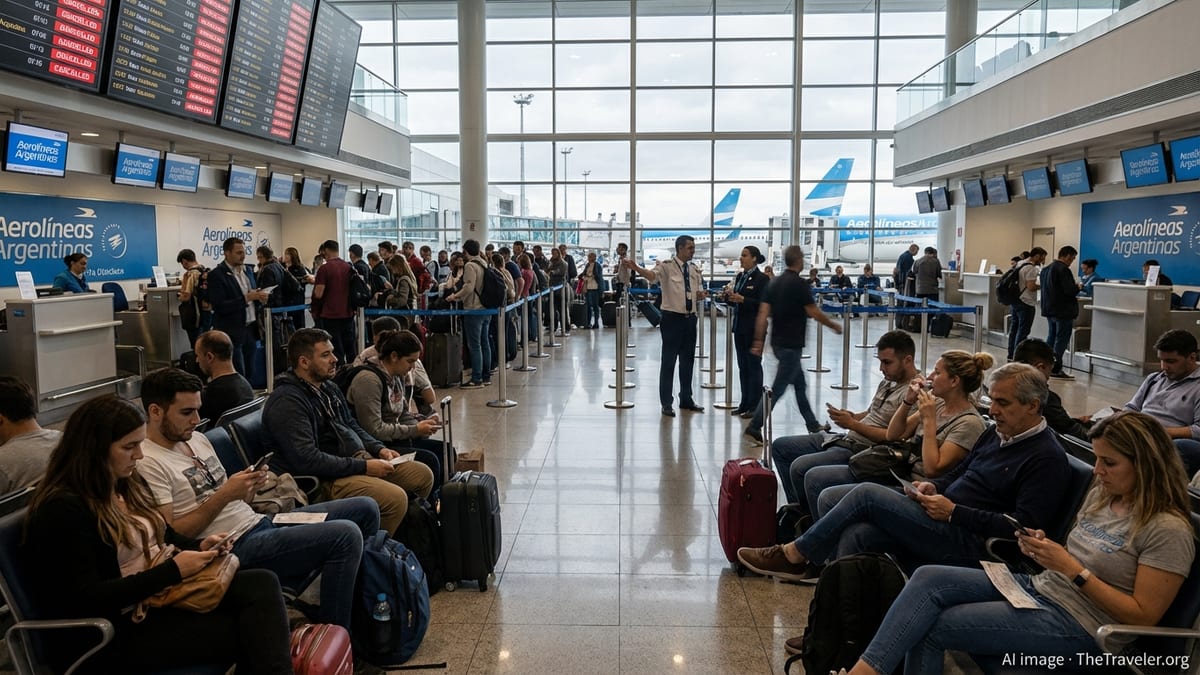
Nationwide walkout to hit key travel hubs
Published coverage in Argentina indicates that workers at the National Civil Aviation Administration (ANAC) represented by the State Workers Association plan a coordinated work stoppage affecting airport operations across the country. The industrial action is planned as part of a 48-hour campaign over pay and conditions and is expected to impact around 27 to nearly 30 commercial airports, depending on the outlet consulted.
The walkout is set to touch Argentina’s busiest gateways, including Buenos Aires’ Ministro Pistarini International Airport in Ezeiza and Aeroparque Jorge Newbery, as well as several regional terminals. Reports describe the measure as national in scope, covering a majority of ANAC-managed airports rather than a single region or operator.
While airlines themselves are not at the center of the dispute, the involvement of ANAC staff means that critical support services on the ground could be reduced or temporarily halted during specific periods of the day. That in turn raises the risk of schedule disruption, particularly around peak travel times coinciding with the strike windows.
Targeted time windows for work stoppages
According to multiple local news reports, the strike is not a continuous 48-hour shutdown but will instead be concentrated in two three-hour blocks on each of the two days. On both Thursday and Friday, operations linked to the protest are due to be interrupted from 9:00 to 12:00 and again from 18:00 to 21:00 local time.
Within those windows, affected ANAC personnel are expected to scale back or pause normal duties, with workers participating in assemblies, marches, and other protest activities at various airports. Outside the designated periods, commercial operations are generally expected to resume, although delays may cascade into later time slots.
Publicly available information suggests that essential services will continue despite the protest. Flights already in the air, along with medical, humanitarian, organ transport, and official state flights, are expected to receive attention from on-duty staff. However, passengers booked on regular domestic and international services during the strike windows may face schedule changes at short notice.
Which services and airports are most at risk
Reports indicate that the labor action involves ANAC staff in areas such as airfield rescue and firefighting units, airport health services, inspection teams, and administrative roles. Because these functions underpin safe and legally compliant airport operations, even a partial withdrawal of labor can constrain the number of flights that can be handled during the affected hours.
Local media highlight that the protest will reach major hubs such as Ezeiza and Aeroparque, in addition to regional airports including several in the interior provinces. Coverage from regional outlets notes that airports like Sauce Viejo and others operated under the ANAC umbrella are preparing for potential schedule modifications, with mentions of possible delays, rescheduling, and in some cases cancellations during the protest periods.
Analysts following the sector stress that impacts are likely to vary by airport and airline, depending on the share of operations within the strike windows and the flexibility to retime flights. Some carriers may be able to adjust departure and arrival times to operate outside the protest blocks, while others with tight turnarounds or slot constraints could face more pronounced disruption.
Advice for travelers with upcoming flights
For passengers scheduled to travel on September 3 or 4, industry coverage strongly recommends monitoring flight status closely in the 24 hours before departure and on the day of travel. Airlines serving Argentina typically publish real-time updates on their websites and mobile apps, and many also notify passengers directly by email or text message in the event of schedule changes.
Travelers are also encouraged to allow extra time at the airport, particularly if their flight falls near or within the 9:00 to 12:00 or 18:00 to 21:00 windows when services are expected to be partially interrupted. Longer check-in queues, slower security procedures, and extended turnaround times on the ground are all possible during a labor action of this nature.
Argentine media note that official airport information portals can be useful for cross-checking the status of arrivals and departures across the national network. For those with tight connections, same-day business meetings, or onward international travel, considering backup plans or more flexible arrangements may reduce the risk of missed commitments if disruptions materialize.
Labor dispute adds to regional travel uncertainty
The planned action at ANAC is the latest in a series of labor disputes affecting transport and public services in Argentina in recent months, reflecting broader tensions over inflation, wage levels, and public spending. Aviation unions and airport-related workers in the region have periodically resorted to strikes to press demands, often creating short-term uncertainty for both domestic and international travelers.
While the current measure is time-limited and structured around defined windows, the scale of participation across almost 30 airports means its effects could ripple through airline networks beyond Argentina’s borders. Delays or aircraft and crew displacements at Buenos Aires hubs, for example, can have knock-on consequences for routes across South America and on long haul services linking the country with North America and Europe.
Travelers and industry watchers will be closely following how the situation evolves during the week. If negotiations between the parties lead to modifications, suspension, or escalation of the announced measures, schedules and operational plans could change again at short notice, underlining the importance of checking for updates directly with carriers and airport information services.
Buenos Aires Herald coverage of the planned airport strike