


More news on this day
Australian air travelers are enduring a fresh wave of disruption as more than four hundred flights are reported delayed across the nation’s major airports, straining airline schedules at the height of the southern winter travel period.
Get the latest news straight to your inbox!
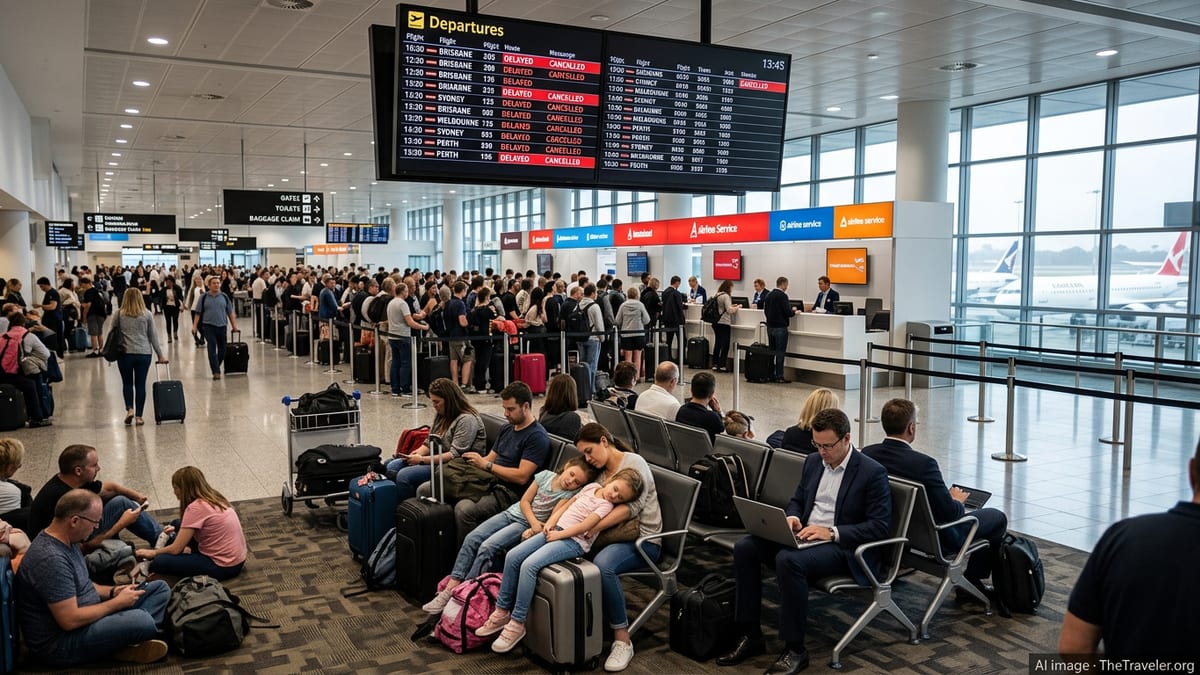
Heavy Delays Across Major Hubs
Flight-tracking data and airport operation summaries indicate that Australian flight networks are experiencing a concentrated surge in delays, with more than 400 services affected in a single day across key hubs including Sydney, Melbourne and Brisbane. The disruption is being felt on both domestic and international routes, with knock-on effects for connecting passengers and regional communities.
Publicly available information points to extended queues at check-in and security, congestion on taxiways and holding patterns in the air as traffic banks up around peak morning and evening periods. Travelers are reporting departure pushes ranging from 30 minutes to several hours, compressing already packed winter schedules and increasing the likelihood of missed connections.
Operational data from aviation network overviews shows that Australian airports have been running close to capacity on busy days, leaving little margin when delays accumulate. Once a threshold is crossed, subsequent flights are forced into revised departure slots, compounding the disruption and driving the total number of delayed services into the hundreds.
While many services are still operating, the reduced reliability is prompting airlines to issue broad advisories asking passengers to arrive earlier than usual and to monitor flight status closely on official channels throughout their travel day.
Technology Outages and Network Vulnerabilities
The current wave of delays follows a period in which Australian transport and communications systems have highlighted their sensitivity to technical failures. Recent mobile network outages have affected digital communications across the country, underlining how dependent aviation operations are on stable connectivity and precise timing systems for everything from crew scheduling to passenger notifications.
Industry analyses describe how modern airline and airport systems rely on tightly synchronised timekeeping and resilient data links between aircraft, ground services and control systems. Any disruption in those networks, even outside the airport perimeter, can slow the flow of information, complicate resource allocation and delay decision-making, contributing to extended turnaround times at the gate.
Reports on Australian aviation network performance show that, alongside weather and air traffic constraints, technology-related issues are an increasingly prominent factor in delay statistics. When timetable buffers are already thin, relatively small outages or system slowdowns can quickly ripple into widespread schedule disruption, as aircraft and crews fall out of position.
Recent international cases, where software defects or IT outages have cascaded into mass cancellations and rolling delays, are being cited by analysts as cautionary examples for Australian operators seeking to strengthen the resilience of their own systems and avoid similar large-scale breakdowns.
Weather, Winter Peaks and Airspace Congestion
Seasonal conditions are adding further pressure to Australia’s flight networks. Aviation performance reports for 2026 attribute a significant share of delay minutes to low cloud, strong winds and storm systems over the east coast, particularly around Sydney and Melbourne. These conditions can reduce runway capacity, increase separation between aircraft and force diversions or holding patterns that extend flight times.
Air traffic management summaries indicate that ground delay programs are being applied more frequently during adverse weather, intentionally spacing departures to prevent airborne congestion. While these measures are designed to maintain safety and reduce en‑route holding, they also mean that flights may depart well behind schedule, driving up the total number of recorded delays.
The timing of the disruption coincides with a busy domestic travel period, as leisure travelers, business passengers and fly‑in, fly‑out workers all compete for limited seat capacity. Network planners note that when load factors are high and aircraft utilisation is intense, there is limited flexibility to swap equipment or retime services without causing further knock-on effects.
As a result, even localized weather systems over one or two major hubs can reverberate through the national network, delaying flights on otherwise clear routes and pushing the nationwide tally of affected services well beyond the 400 mark.
Impact on Passengers and Airlines
The immediate impact of the latest disruption is being felt by passengers facing missed appointments, disrupted holidays and unexpected overnight stays. Consumer advice from travel operators urges travelers to build in longer connection times, carry essential items in hand luggage, and consider flexible tickets where possible to account for the increased risk of delay.
For airlines, the surge in delays translates into higher operating costs, including additional fuel for holding patterns, overtime for crew and extended use of airport infrastructure. Industry observers also highlight the reputational risk associated with persistent punctuality problems, particularly in a competitive domestic market where on-time performance is a key marketing claim.
Regulatory and competition reports show that Australian carriers have been working to improve reliability after earlier periods of elevated cancellations and delays. However, analysts note that progress remains vulnerable to external shocks such as network outages and severe weather, as well as internal factors like crew availability and aircraft maintenance scheduling.
Passengers affected by long delays are being reminded by consumer advocates to review their airline’s conditions of carriage and, where applicable, seek refunds or alternative transport options. Travel insurers are also reporting higher inquiry volumes related to delay and missed-connection coverage, reflecting broader concern about schedule reliability.
Calls for Greater Resilience and Transparency
The clustering of more than 400 delays across Australia’s flight networks is intensifying debate about how much resilience is built into the system and how disruption is communicated to the public. Aviation performance reports and consumer watchdog publications have been urging clearer, more timely information for passengers when schedules unravel.
Policy discussions around domestic aviation have increasingly focused on contingency planning, with proposals ranging from mandated minimum communication standards during disruptions to more detailed public reporting on the causes of delays and cancellations. Advocates argue that granular data helps travelers make informed choices and can encourage airlines and airports to address recurring problem areas.
Technical experts are also pointing to the importance of diversified and tested backup systems for critical IT and communications infrastructure. Recent outages in other sectors have been cited as evidence that even brief technical failures can have outsized effects when systems are tightly integrated and highly automated.
As airlines, airports, regulators and technology providers review the latest wave of disruption, observers suggest that improving transparency, investing in resilient systems and preserving operational buffers will be central to reducing the risk that hundreds of Australian flights grind to a halt when the next shock hits the network.