


More news on this day
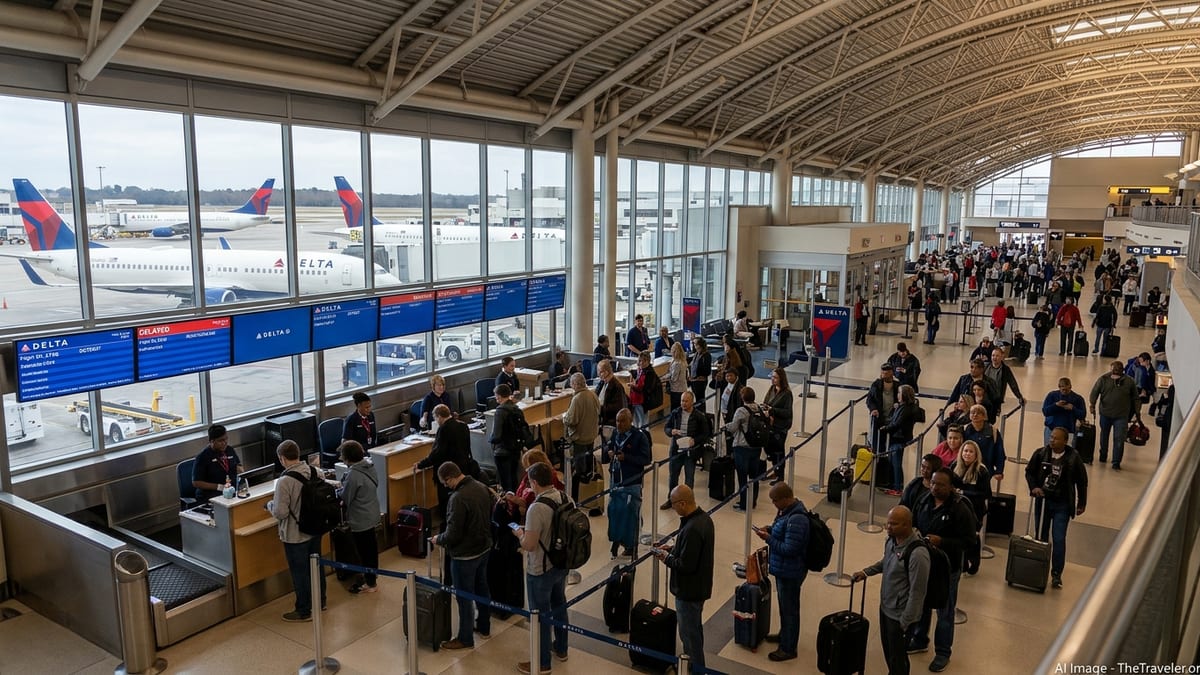
Delta Air Lines suffered a widespread technical failure of its automated weight-and-balance system on Sunday, November 22, 2026, delaying well over 1,000 flights across its network, briefly halting departures bound for its Atlanta hub and complicating travel plans in the final days before the busy U.S. Thanksgiving period.
Get the latest news straight to your inbox!
What went wrong with Delta’s weight-and-balance system
According to Delta and multiple aviation and news outlets, the disruption stemmed from an outage affecting one of the airline’s automated systems used to calculate each aircraft’s weight and balance before departure. The system accounts for passengers, baggage, cargo and fuel and is used to ensure aircraft remain within strict structural and performance limits. Complying with these limits is a core safety requirement: if an aircraft exceeds weight limits or the load is not properly distributed, its performance on takeoff and landing can be compromised.
The malfunction began early on Sunday, November 22, and quickly affected operations at Hartsfield-Jackson Atlanta International Airport, Delta’s primary hub, and then across the carrier’s domestic network. The airline said pilots and operations teams were temporarily unable to rely on the automated tools that normally generate the final weight-and-balance figures needed before an aircraft can push back from the gate and taxi for departure.
Flight-tracking data compiled throughout Sunday indicated that more than 1,500 and possibly over 1,600 Delta flights arrived at least 15 minutes late, representing close to half of the airline’s schedule that day. Some delays were also tied to weather and knock-on congestion, but airlines and regulators identified the system outage as the principal trigger. Airports that see heavy Delta traffic, including Atlanta, Detroit, Minneapolis–St. Paul, Salt Lake City, New York–LaGuardia and Los Angeles, all reported clusters of delayed departures linked to the incident.
Ground stop in Atlanta and manual workarounds
As the scope of the outage became clear, Delta requested that the Federal Aviation Administration issue a ground stop on Sunday morning for Delta flights destined for Atlanta. That instruction required affected flights that had not yet departed to remain at their origin airports while the airline assessed the technical problem and began implementing contingency measures. The FAA confirmed that the disruption involved Delta’s systems rather than any degradation of federal air traffic control infrastructure.
The ground stop remained in place for roughly an hour before being converted to a ground delay program, which allowed flights to depart their origin airports but required them to comply with assigned departure times and arrival slots into Atlanta. Both the formal ground stop and the follow-on ground delay measures were lifted before midday local time, but their effects rippled through Delta’s schedule into the afternoon and evening as aircraft and crews ended up out of position.
Throughout the disruption, Delta said its operations staff and flight crews shifted to manual procedures to keep aircraft moving. Instead of relying on the automated system, teams used alternative tools and additional checks to calculate and verify loads for each flight. Passengers on affected flights reported announcements from pilots and cabin crews explaining that weight-and-balance calculations were being conducted manually and that staff were waiting for final numbers from Delta’s operations center before they could depart. While such measures are more time-consuming and can reduce departure rates, they are standard contingency steps designed to preserve safety when primary automation is unavailable.
Scale of delays, restoration of systems and passenger support
By Sunday afternoon Delta reported that the automated weight-and-balance system had been restored to service. The airline stated that the incident was the result of a technical failure and said there was no indication that it was caused by a cyberattack. Operations metrics and accounts from key hubs showed a gradual reduction in new delays later in the day, although many aircraft were operating out of their planned sequence and some crews had reached duty-time limits, prolonging recovery on certain routes.
Estimates from flight-tracking services indicated that between roughly 49% and 58% of Delta flights on November 22 were delayed by at least 15 minutes, depending on the time window used and whether regional partners were included. In raw numbers, that translates to more than 1,500 and possibly over 2,000 delayed flights on Sunday alone. A smaller number of flights were ultimately canceled when extended holds, crew timeouts or aircraft rotation issues made it impractical to operate them later in the day. Disruptions were most acute at Atlanta, but knock-on delays were reported across much of the domestic network.
Delta said it was rebooking customers whose flights were canceled or who misconnected because of the outage and was providing meal vouchers, hotel accommodations and refunds where applicable under its customer service commitments. The carrier emphasized that safety procedures were followed and that flights did not depart without the necessary performance data, even when this meant lengthy waits on the ground. By Monday, November 23, Delta and several outlets reported that operations were broadly stable again, though some residual delays and equipment swaps were still occurring as the airline worked through the backlog of displaced passengers and aircraft.
How this fits into a week of aviation technology disruptions
The incident at Delta followed a separate United Airlines technology outage on Monday, November 16, 2026, that also centered on access to vital aircraft weight data. In that case, United pilots reported losing access to final aircraft weights used to calculate takeoff performance, and the airline temporarily paused departures while technicians restored the affected systems. Public statements from United and air traffic control recordings indicated that, as with the Delta event, flights could not depart until accurate, verified weight figures were available.
Both airline-specific problems unfolded in the days after a major, unrelated failure in Federal Aviation Administration telecommunications infrastructure on Friday, November 13. That earlier problem disrupted communications between air traffic controllers and aircraft and prompted the FAA to order a rare nationwide ground stop affecting all U.S. departures. The agency later attributed the ground stop to network issues involving high traffic loads on parts of its telecommunications system and said it was working to harden and modernize the affected components.
Authorities and the airlines involved have not presented evidence that the FAA ground stop, United’s system issues and Delta’s weight-and-balance outage shared a common technical cause. At this stage they are treated as separate failures that happened to occur within a short period. Regulators and aviation safety specialists have nonetheless highlighted the cluster of incidents as an illustration of how dependent modern airline and air traffic operations have become on a range of complex digital systems, many of which have limited manual backups and require careful contingency planning when they fail.
Implications for Thanksgiving travelers and what to check next
The outage struck at a sensitive moment for U.S. travelers, falling just ahead of the extended Thanksgiving holiday period. Federal agencies and major airlines expect passenger volumes over the holiday week to be among the highest in more than a decade, and heavy traffic typically leaves networks less resilient when unexpected problems occur. While Delta’s weight-and-balance automation is now back online and both the airline and the FAA report normal operations, residual issues such as displaced aircraft, rerouted crews and rebooked customers can take time to unwind fully.
Passengers with upcoming travel on Delta around Thanksgiving are being advised by airlines, airports and travel agents to monitor their flight status frequently through official channels and to allow additional time at the airport, particularly at large hubs like Atlanta, Detroit and Minneapolis–St. Paul. Same-day schedule changes, equipment swaps or gate changes remain possible as the carrier continues to fine-tune its operations following the disruption. Travelers who were already affected on November 22 should review any emails or app notifications from Delta outlining rebooking options, vouchers or refunds, and should keep boarding passes and receipts in case they need to follow up with customer service.
Looking ahead, both airlines and regulators have indicated that they are reviewing the recent spate of technology failures, including the Delta outage, to determine whether additional safeguards, redundancy or procedural changes are needed. For travelers, the most practical steps over the near term remain straightforward: confirm reservations before heading to the airport, stay alert for schedule changes on the day of travel, and, where possible, build extra time into connections, particularly through Atlanta and other busy hubs during the Thanksgiving rush.