


Exploring the Canary Islands without a rental car is perfectly possible, but how easy it feels depends a lot on which island you choose and where you stay. The main islands all have bus networks, taxis, ferries and organised excursions, yet some are far more public-transport friendly than others. This guide focuses on real journeys and concrete examples so you can decide whether to rely on buses, mix in a few taxis, or book a hire car for part of your stay.
Get the latest updates straight to your inbox!
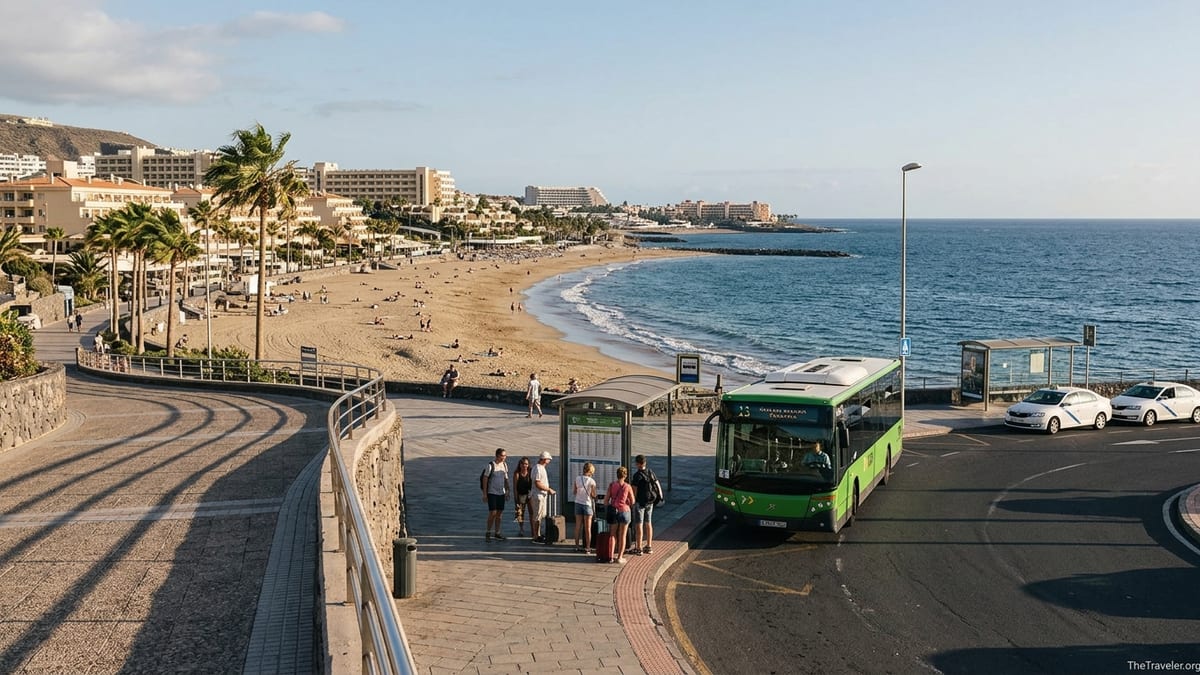
Choosing the Right Island if You Do Not Want to Drive
If you plan to rely mainly on buses, Tenerife and Gran Canaria are the most forgiving islands. Both have dense networks, frequent services between their capital cities and resort areas, and direct airport connections. In Tenerife, the green TITSA buses link Tenerife South Airport with Costa Adeje, Los Cristianos and Santa Cruz, and an express route connects the south with Puerto de la Cruz in the north. In Gran Canaria, turquoise Guaguas Global coaches run up and down the east coast, including links from the airport to Las Palmas and the main southern resorts.
Lanzarote is manageable without a car if you stay in one of the three main resort areas: Puerto del Carmen, Costa Teguise or Playa Blanca. Intercity buses operated under the Arrecife Bus brand link these resorts with Arrecife and the airport, and there are additional local blue buses in the capital. Buses are less frequent than in Tenerife or Gran Canaria, but for a relaxed week focused on beaches and a few excursions, they are usually enough.
Fuerteventura is the first island where many visitors start to feel the limits of public transport. There are reasonable connections between Corralejo, the capital Puerto del Rosario and the airport, and south to Caleta de Fuste. Beyond that, however, long north–south journeys, for example from Corralejo to Costa Calma or Morro Jable, can easily take three to four hours with changes, which is why a lot of repeat visitors either rent a car for a few days or base themselves in one area.
On the smaller western islands such as La Gomera, La Palma and El Hierro, there are public buses, but they are geared more to residents than tourists, with limited evening services and long gaps in rural areas. These islands are still doable without a car if you are happy to work around timetables or use taxis selectively, but first-time visitors often find Tenerife, Gran Canaria or Lanzarote more straightforward when travelling car free.
How the Bus Networks Actually Work
Each island has its own bus company and colour scheme, which helps you recognise vehicles quickly. In Tenerife, TITSA runs green buses that cover both long-distance and city routes. A typical real-world example is line 111, which shuttles between Santa Cruz and Costa Adeje via Tenerife South Airport. Another is the overnight 711 service linking Santa Cruz and Costa Adeje in the small hours, useful if you land on a late flight and want to avoid a taxi.
Gran Canaria’s interurban buses are run by Guaguas Global and are normally turquoise. Line 66 connects Gran Canaria Airport with Faro de Maspalomas, serving resort stops in Playa del Inglés on the way. For Las Palmas, you will usually take line 60 or 91 from the airport, which run to the main city bus stations at San Telmo or Santa Catalina. Within Las Palmas itself, the bright yellow city buses are a separate company, Guaguas Municipales, and you tap a different ticket or pay separately when you transfer between them.
On Lanzarote, intercity services marketed as Intercity Bus Lanzarote link the airport with Arrecife and on to Puerto del Carmen (for example line 3) or Costa Teguise (line 3 or 25 depending on time of day). To reach Playa Blanca, you take line 60 or a similar long-distance route from Arrecife. Timetables often show hourly or every-30-minute frequencies in daytime, dropping to one bus every 60 to 90 minutes in the evening, which is manageable if you plan around them but can be frustrating if you are used to big-city transit.
Fuerteventura’s green buses are run by the island’s public operator with numbered routes radiating from Puerto del Rosario. A fencible example itinerary is travelling from Caleta de Fuste to Corralejo: you first take a local bus such as line 3 or 10 into Puerto del Rosario, then change to line 6 for Corralejo. Each leg may cost only a few euros, but with waiting time you should expect the whole trip to take around two hours one way. For this kind of journey, some travellers decide a one-day car rental at the resort is worth it.
Airport Transfers and Resort Bases Without a Car
All four main tourist islands offer straightforward bus transfers from the airports to at least one or two major resort areas. At Tenerife South Airport, you can catch a TITSA bus right outside arrivals. Lines 40 and 111 serve Los Cristianos and Costa Adeje, and line 343 runs all the way between the south and north airports via Puerto de la Cruz. Many visitors do not realise this and book a private transfer instead, but in practice you can step out of baggage claim and be on a public bus to Costa Adeje within 20 to 30 minutes most days.
In Gran Canaria, Guaguas Global buses pick up just outside the terminal. Line 66 goes south to Faro de Maspalomas and stops at key areas of Playa del Inglés, while line 60 heads north to Las Palmas. A typical fare from the airport to Maspalomas is around 4 to 5 euros, compared with 35 to 45 euros in a taxi. The buses have luggage racks and are used daily by both tourists and workers commuting to the resorts.
Lanzarote’s airport is close to the capital, so airport buses are quick. The common pattern is to take a short local bus from the terminal to Arrecife, then change to an intercity route for Puerto del Carmen, Costa Teguise or Playa Blanca. Puerto del Carmen is so close that many taxi rides take less than 15 minutes, so if you arrive late at night when the last bus has gone, a cab is a realistic fallback that will not break the bank.
On Fuerteventura, the airport sits between Puerto del Rosario and Caleta de Fuste. Public buses run this short corridor frequently during the day. If you are staying in Corralejo at the far north, you usually change in Puerto del Rosario. In practice, that means rolling your suitcase a short way between stands, waiting 20 to 30 minutes and then riding north along the coastal road. For south-coast resorts such as Costa Calma or Jandía, there are through buses from Puerto del Rosario, but schedules are not always aligned with flight times, which is why many package holidays still include coach transfers or encourage private shuttles for that part of the island.
Where a Car Makes Sense and Where Buses Are Enough
The strongest public transport corridors are between airports, capital cities and the big resort zones. If your trip is essentially one resort plus a handful of day trips, you can often avoid driving altogether. For example, a week in Costa Adeje in Tenerife can easily combine beach days with bus excursions to Santa Cruz, Puerto de la Cruz and even Teide National Park using TITSA routes. Similarly, staying in Playa del Inglés in Gran Canaria gives you direct buses to Las Palmas, Puerto de Mogán and several inland towns.
Once you move away from those main spines, the picture changes. Reaching Tenerife’s Teide National Park by bus is possible using dedicated lines from Costa Adeje and Puerto de la Cruz, but services are limited to a couple of departures per day and sell out in peak seasons. If you want the freedom to arrive early for sunrise, hike one-way trails or continue to remote viewpoints, a hire car or organised tour becomes much more practical than trying to join up infrequent buses.
On Lanzarote, public buses serve popular spots like the César Manrique Foundation, Jameos del Agua and Cueva de los Verdes, but flagship sights inside Timanfaya National Park and the remote wine villages of La Geria are not well covered. Many visitors staying in Puerto del Carmen or Costa Teguise book a one-day coach excursion that loops through Timanfaya, La Geria wineries and viewpoints such as El Golfo. This lets you see the highlights without driving, while still using regular buses the rest of the week for shorter hops.
Fuerteventura’s best beaches often lie far from the main highway. Getting to places like Cofete beach on the Jandía peninsula requires a long, rough track that most rental companies cover only under specific conditions, and there is no conventional bus. From resorts such as Morro Jable, local tour operators run 4x4 excursions there, which function like an informal public transport option for non-drivers. The northern surfing villages around El Cotillo are technically reachable by bus from Corralejo, but evening returns are sparse, so a taxi back after a late dinner is often worth budgeting for.
Ferries, Island Hopping and Combining Transport Modes
Even without a car, island hopping is straightforward along the main ferry corridors. Fast catamarans run frequently between Lanzarote and Fuerteventura, especially on the short route from Playa Blanca to Corralejo. In practice, many travellers walk to the port in Playa Blanca, ride the 25-minute ferry, then continue by bus or taxi from Corralejo to their final accommodation. The ferry terminals are compact, and port staff are used to foot passengers with luggage.
Tenerife and Gran Canaria are also linked by multiple daily ferries departing from Santa Cruz de Tenerife or Agaete in Gran Canaria to Las Palmas. If you are travelling without a vehicle, you simply buy a foot-passenger ticket, board with your bag and use the city or intercity buses on either end. A practical example would be combining a few nights in Las Palmas with a week in northern Tenerife: you can ride Guaguas Municipales to the Las Palmas ferry terminal, cross to Santa Cruz, then continue by TITSA bus to Puerto de la Cruz.
To reach La Gomera, La Palma or El Hierro without driving, you generally pass through Tenerife first. Ferries to La Gomera leave from Los Cristianos, which is well served by buses from Tenerife South Airport and Costa Adeje. On arrival in San Sebastián de La Gomera, local buses meet some of the ferries and fan out to Valle Gran Rey, Vallehermoso and Playa Santiago. However, frequencies are often limited to a handful of daily departures, so it helps to choose accommodation that lines up with those routes.
Taxis can plug the gaps in these multimodal journeys. For instance, if your flight into Gran Canaria lands after the last direct bus to Puerto de Mogán, you might take the bus as far as Playa del Inglés and then a taxi for the final section. Splitting the journey this way often cuts the taxi fare in half while still keeping travel times reasonable. The same logic applies in Lanzarote, where a short taxi hop from the end of a bus route can get you to a rural villa or a smaller village hotel.
Understanding Limits: Timetables, Strikes and Realistic Expectations
Travelling the Canary Islands without a car works best when you accept that island buses are not metropolitan metros. Timetables can be sparse outside peak hours, and rural routes may run only a few times a day. On Tenerife and Gran Canaria you will notice commuter-style bursts of frequency around school and work times, with quieter mid-day or Sunday patterns. Planning your excursions around morning outbound buses and late afternoon returns is still the safest strategy.
Occasional disruptions also happen. In recent years, Lanzarote’s bus network has seen industrial action and driver shortages that led to last-minute cancellations on certain lines, including routes to northern villages and the airport. In those situations, visitors waiting at Arrecife bus station have sometimes discovered that a planned bus simply is not operating that day, forcing them to share taxis or rearrange excursions. While these events are not daily occurrences, they highlight why a flexible mindset and a backup plan are useful if you are set on travelling car free.
Another common limit is evening and late-night travel. Last departures from inland villages or quiet coastal towns can be early, around 8 or 9 pm, which effectively means you either dine near your base or budget for a taxi back after a late meal elsewhere. This is particularly true on Fuerteventura and the smaller islands, where nightlife is concentrated in a few resort hubs, and long stretches of coast have no buses after dark.
Information quality can be patchy as well. Official bus websites are the most accurate reference, but apps and third-party maps sometimes lag behind schedule changes. On Tenerife, for instance, travellers often report that the TITSA app feels clunky, and they have better luck scanning QR codes at the stop or asking drivers directly. In Gran Canaria, many regular visitors rely on the official Guaguas Global app to check live times and platform numbers, especially at busy interchanges like San Telmo station in Las Palmas.
The Takeaway
The Canary Islands can absolutely be explored without a rental car, but not all islands are equal when it comes to buses and public transport. Tenerife and Gran Canaria offer the most comprehensive networks, with airport buses to the main resorts, reliable links between capitals and beaches, and enough coverage for several independent day trips. Lanzarote works smoothly if you focus on the main resort triangle and supplement buses with the occasional organised tour or taxi. Fuerteventura and the smaller western islands demand more compromise, with long cross-island journeys and limited evening services.
If you are comfortable checking timetables, building in slack for connections and occasionally changing your plans to match the buses, travelling car free can be economical and low stress. Choose resort bases that sit directly on major bus lines, such as Costa Adeje in Tenerife, Playa del Inglés or Las Palmas in Gran Canaria, Puerto del Carmen in Lanzarote or Corralejo in Fuerteventura, and you will spend more time on beaches and promenades than at remote bus stops. For those willing to mix buses, ferries, taxis and a day tour or two, the islands open up surprisingly well without ever picking up a set of car keys.
FAQ
Q1. Which Canary Island is easiest to visit without a car?
Tenerife and Gran Canaria are generally the easiest if you want to rely on buses. Both have extensive island-wide networks, frequent airport buses to major resorts, and good connections between the capital cities and tourist zones, so you can comfortably spend a week or more using only public transport, taxis and occasional day tours.
Q2. Can I get from Tenerife South Airport to my resort by bus?
Yes. TITSA buses stop directly outside Tenerife South Airport. Regular routes serve Los Cristianos and Costa Adeje, and there is also an express service linking the south to Santa Cruz and Puerto de la Cruz. As long as your flight arrives before the last evening departures, most visitors find it straightforward to roll their luggage to the stop and board a bus to their resort.
Q3. Is Gran Canaria’s south coast well served by public transport?
Yes, the south coast corridor from the airport to Playa del Inglés, Maspalomas and Puerto de Mogán is one of the best served in the archipelago. Guaguas Global operates frequent buses along this strip, and you can often travel between resorts every 20 to 30 minutes in daytime. This makes it easy to stay in one resort and still explore neighbouring beaches and towns without hiring a car.
Q4. How reliable are buses in Lanzarote for tourists?
Lanzarote’s buses work well for the main triangle of Arrecife, Puerto del Carmen and Costa Teguise, and for reaching Playa Blanca. Services are less frequent than on Tenerife or Gran Canaria, especially in the evenings and to rural areas, and occasional disruptions have occurred in recent years. For most resort-based holidays they are adequate, but if you want to tour the island intensively, you may prefer a mix of buses, taxis and organised excursions.
Q5. Is Fuerteventura a good choice if I do not want to drive?
Fuerteventura can be enjoyed without a car if you base yourself in a well-connected resort like Corralejo, Caleta de Fuste or Puerto del Rosario and mainly explore nearby areas. Long cross-island journeys, such as travelling from Corralejo to Costa Calma or Morro Jable, are time consuming and involve changes, so many visitors either accept a few long bus days or rent a car for one or two days to reach more distant beaches.
Q6. Are taxis easy to find and affordable in the Canary Islands?
Licensed taxis are easy to find in resort areas, at airports and in town centres on all the main islands. Short trips within resorts or from bus stations to nearby hotels are usually reasonably priced, while long cross-island journeys can be expensive. Many travellers use taxis strategically to bridge the last few kilometres from a bus stop to a rural accommodation or to return late at night when the final buses have already departed.
Q7. Can I visit Teide or Timanfaya National Park without a car?
Yes, but it takes more planning. Teide National Park in Tenerife has limited daily bus services from both the south and north, and several companies run guided coach excursions from major resorts. Timanfaya in Lanzarote is best reached on organised tours from Puerto del Carmen, Costa Teguise or Playa Blanca, as regular public buses do not serve the most popular viewpoints inside the park.
Q8. How easy is it to hop between islands by ferry if I do not drive?
Island hopping by ferry is straightforward for foot passengers. High-frequency routes such as Playa Blanca to Corralejo or Santa Cruz de Tenerife to Las Palmas are set up for travellers without vehicles, with buses and taxis available on both sides. You simply buy a ticket as a foot passenger, board with your luggage and then continue your journey using local transport at the destination port.
Q9. Are there any special tickets or passes for buses?
Each island has its own fare system, and residents benefit from generous discounts and rechargeable cards. Visitors typically pay single fares in cash or by bank card, or in some cases can buy contactless passes or pre-paid cards at major stations. It is worth checking the local bus company’s website for current ticket types before you travel, but for occasional use, buying individual tickets on board is still the norm.
Q10. What is the best strategy if I want to minimise driving but still see a lot?
A practical strategy is to choose an island with a strong bus network, base yourself in a transport hub such as Costa Adeje, Las Palmas, Puerto del Carmen or Corralejo, and plan most outings around public buses. Then add one or two organised excursions for hard-to-reach highlights, and consider renting a car for just a single day if there is a specific remote area you do not want to miss. This approach keeps costs and stress low while still letting you experience a wide range of landscapes and towns.