


More news on this day
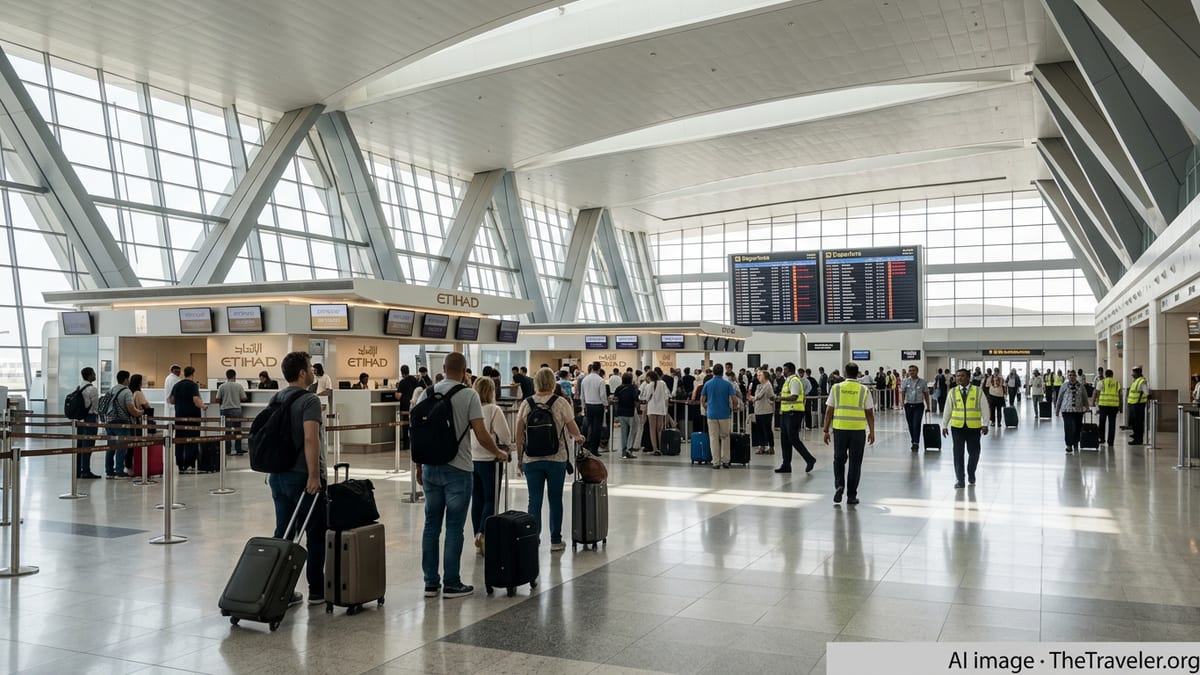
Most flights to and from the United Arab Emirates are operating on schedule this week, even as Etihad Airways, Air Arabia and other regional carriers temporarily suspend or trim select Gulf routes in response to renewed disruptions around Kuwait and Bahrain.
Get the latest news straight to your inbox!
Targeted cancellations on Kuwait and Bahrain routes
Recent updates from airline schedules and travel advisories show that the latest disruption remains concentrated on services linking the UAE with Kuwait and, to a lesser extent, Bahrain. Etihad Airways has removed certain Abu Dhabi to Kuwait rotations from its timetable, including flights EY653 and EY654 on multiple days in July 2026, while maintaining its wider Gulf and long haul network.
Low cost carrier Air Arabia has also suspended some of its Kuwait operations from Sharjah, with flight status pages indicating cancellations on selected dates rather than a full withdrawal. Other UAE based airlines, including Emirates and flydubai, have issued similar route specific changes focused on Kuwait City and nearby Gulf points, but their overall networks continue to operate.
Industry trackers and aviation focused news outlets describe these adjustments as phased and selective, intended to avoid bottlenecks at Kuwait International Airport while preserving as much regional connectivity as possible. The pattern stands in contrast to the blanket airspace closures seen earlier in the year, when a wider Iran related security crisis triggered large scale suspensions across multiple Middle Eastern hubs.
Passenger feedback shared on travel forums and flight tracking platforms suggests that, although some itineraries involving Kuwait have been cancelled or rerouted at short notice, travelers flying point to point into major UAE gateways such as Abu Dhabi, Dubai and Sharjah continue to see largely normal operations.
Underlying disruption in Kuwait and regional airspace
The current wave of adjustments follows repeated disruptions at Kuwait International Airport after missile and drone incidents and temporary airspace restrictions earlier in the summer. Travel blogs and regional media chronologies point to periods of partial reopening, followed by renewed interruptions, as authorities and airport operators work to restore capacity while managing security considerations.
Reports also highlight a broader pattern of volatility in Gulf airspace since the escalation of tensions involving Iran in early 2026. While the UAE has moved to stabilize its own airports and restore long haul connectivity, short haul routes that cross sensitive corridors, including those into Kuwait and occasionally Bahrain, have remained more exposed to schedule changes.
Scheduled data compiled by aviation analytics services shows that airlines have generally opted for a conservative approach on these shorter sectors, cancelling flights when operational predictability is uncertain and consolidating demand onto remaining services or alternative routings. This approach reduces last minute diversions and ground delays at airports that are still working through infrastructure or security related constraints.
At the same time, long haul flights to and from the UAE that overfly alternative corridors continue to operate, with some routings adjusted to avoid affected airspace. For most international visitors whose itineraries begin or end in the UAE, the impact is limited compared with passengers whose journeys rely on direct links to Kuwait or other nearby points.
How UAE bound travelers are being affected
For travelers heading to or transiting through the UAE, the immediate impact depends largely on whether Kuwait or Bahrain are part of their plans. Published coverage and booking engine data indicate that passengers on non stop flights between the UAE and Europe, Asia, North America and Africa are mostly seeing normal schedules, aside from the usual operational delays that can occur during the busy summer period.
Those traveling between the UAE and Kuwait are facing more uncertainty. Some have reported receiving email notifications of cancellations within days of departure, particularly on Etihad and Air Arabia flights serving Kuwait City. Others have been rebooked onto later dates, alternative routings via third country airports, or in some cases onto other carriers still operating limited Kuwait services.
Travel rights platforms note that standard airline policies remain in place, with options typically including complimentary rebooking for affected flights, travel vouchers or refunds, depending on fare conditions and the level of disruption. However, processing times can vary, and passengers may need to monitor booking portals closely to keep track of schedule changes.
In Bahrain, the impact appears more contained, with some UAE carriers temporarily adjusting frequencies but continuing to operate a core schedule. Travelers with near term flights on this city pair are still advised in public advisories to confirm status before departure, yet broad based cancellations similar to the Kuwait situation have not been widely reported in recent days.
Advice for passengers planning trips via the UAE
Travel advisers and consumer groups are emphasizing preparation and flexibility for anyone planning to fly into or through the UAE while the situation around Kuwait and parts of the Gulf remains fluid. The primary recommendation is to monitor flight status directly with airlines and airport departure boards in the days leading up to travel, particularly for itineraries touching Kuwait, Bahrain or other nearby points that have seen intermittent disruption.
Booking guidance published by online travel agencies suggests that travelers who have yet to purchase tickets might consider longer connection times if their journey involves a Gulf transfer, or opt for routings that avoid Kuwait as a transit point. Where possible, choosing fully refundable or changeable fares can provide additional flexibility if schedules shift again.
Passengers already holding tickets are being encouraged by public information sources to ensure their contact details are up to date in airline booking systems so that any schedule changes can be communicated quickly by email or text message. Keeping digital copies of booking confirmations and tracking updates through airline mobile apps can also help if rebooking is needed at short notice.
For visitors whose plans involve both Kuwait and the UAE, travel experts advise confirming hotel reservations and ground transport arrangements only after flight operations for specific dates are clearer, to avoid unnecessary cancellation costs. Those with time sensitive trips, such as students or business travelers, may wish to build in additional buffer days in case of last minute route changes.
What this means for the UAE summer travel season
Despite the localized cancellations, publicly available statistics and on the ground reports from major UAE airports indicate that the broader summer travel season remains strong. Passenger volumes through Abu Dhabi and Dubai are described as high, with airlines operating dense schedules across Europe, Asia and the Americas, and only a narrow slice of routes affected by the latest Gulf disruptions.
The selective nature of the cancellations suggests that airlines are seeking to preserve confidence in the UAE as a stable hub while still responding to operational and security considerations in neighboring airspace. By limiting suspensions mainly to Kuwait and a handful of other Gulf services, carriers are aiming to contain knock on effects for travelers whose destinations lie further afield.
For now, the situation underscores how quickly regional dynamics can reshape travel patterns in the Gulf. While travelers bound exclusively for the UAE can, in most cases, proceed with their plans, those connecting to Kuwait may continue to face rolling schedule changes. Industry observers expect airlines to keep adjusting their timetables in line with airport capacity and regional security assessments in the weeks ahead.
Prospective visitors are therefore likely to see a dual picture in the near term: busy, largely uninterrupted operations at the UAE’s main gateways, alongside a more fragile network on select short haul Gulf routes that remain sensitive to events beyond the control of carriers or passengers.