


Like many visitors to Helsinki, I first went to Temppeliaukio Church expecting to tick off an architectural icon: the famous “Rock Church” with its copper dome and raw granite walls. I had seen the photographs, read the superlatives, and knew the basic story of this Lutheran church carved straight into two-billion-year-old bedrock. Yet what surprised me most about Temppeliaukio Church was not the architecture itself, but everything that happens inside it: the sound, the silence, the steady stream of ordinary life that has quietly transformed this bold design into one of the city’s most human spaces.
Get the latest updates straight to your inbox!
First Impressions: From Tourist Attraction to Living Room
Standing outside Temppeliaukio Church in the Töölö district, you could easily miss it. From street level on Lutherinkatu, the building is mostly a low, grassy rock outcrop ringed by a simple stone wall, with only the greenish copper dome hinting that something special lies below. Guidebooks love to call it a UFO that landed in central Helsinki, and on a grey winter afternoon it does resemble a patinated spaceship sunk into the hill. Yet the moment you step through the glass entrance doors and down the short ramp, the atmosphere changes from curiosity to something closer to entering a communal living room.
On my latest visit, I arrived just after opening time on a weekday morning. A small cluster of visitors queued quietly to buy the 8 euro day ticket for adults, while children and teenagers walked past for free, as they do under the church’s policy of free entrance for under-18s during regular visiting hours. At the ticket desk, a staff member greeted each person individually, switching smoothly between English, German, and Finnish. It felt more like arriving at a neighborhood cultural center than at one of Helsinki’s busiest attractions, which reportedly welcomes hundreds of thousands of visitors a year.
The first thing that struck me was not the architecture but the sound, or rather the soft layering of it: the murmur of multiple languages, the shuffle of winter boots on the slate floor, the faint hum of organ practice drifting from the altar. The huge rock walls and low copper dome create acoustics that make every sound feel close, even in a space that can seat around 750 people. Instead of echoing like a cavern, the church swallows noise into a warm, almost intimate hush. You register the physical drama of the setting, but your senses fix first on how the space feels to inhabit.
Silence You Can Hear
Despite the constant flow of visitors, Temppeliaukio Church is punctuated by regular moments of deliberate silence. Several times a day, staff make a brief announcement in multiple languages asking everyone to sit and observe a few minutes of quiet. When this happens, the rustle of jackets and phone cameras suddenly stops, and the entire hall settles into stillness. It is one of the most unexpected experiences in a place that is often marketed as a photo stop on city tours.
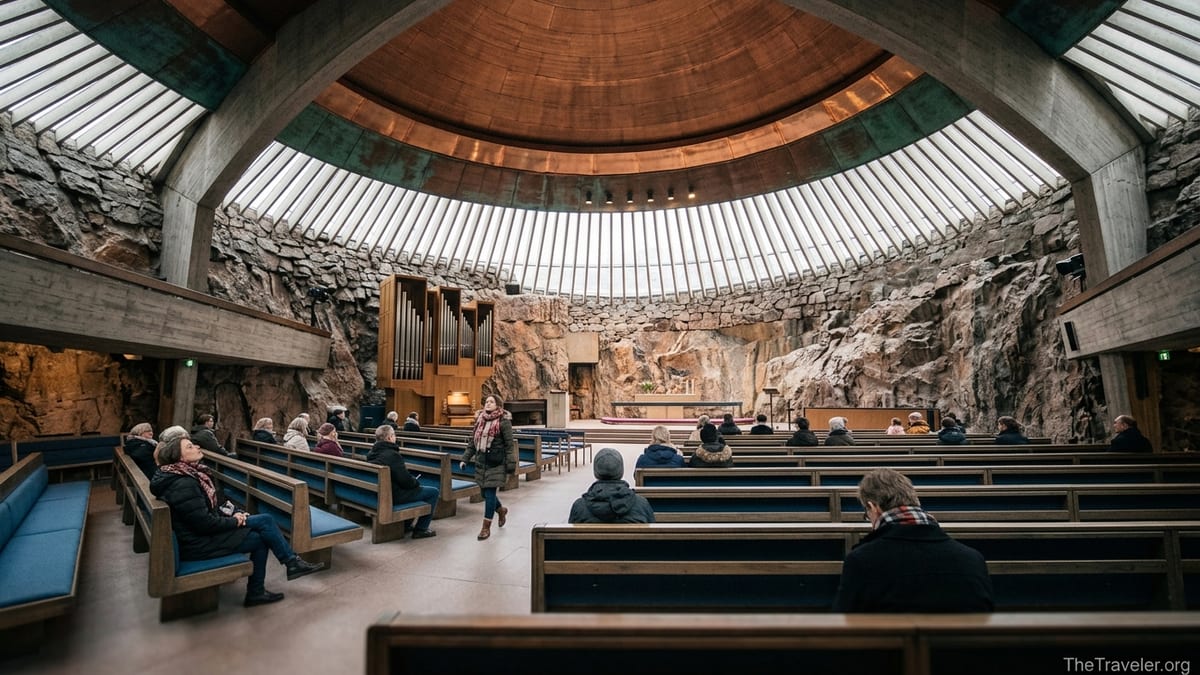
During one such pause, I watched a group of cruise passengers, identifiable by their matching lanyards, fidget with their cameras for a second before eventually lowering them. A teenager who had been filming a slow pan of the copper dome tucked her phone into her pocket, then simply looked up. The usual church furnishings were there, of course: rows of simple wooden pews, the pale stone altar set against a natural ice-age crevice in the rock, a modern organ with over 3,000 pipes. But in the quiet, these elements receded, and what remained was the sensation of sitting inside solid earth, held in place by uncut stone.
It is in these few minutes that many visitors seem to register that Temppeliaukio is not just a design experiment or concert hall; it is an active parish church. Weddings, baptisms, and regular Lutheran services still happen here, which explains why opening hours change daily and why staff often ask visitors to leave the hall briefly for a ceremony. On a Saturday afternoon, I watched guides gently redirect tour groups to the side balcony as a couple posed for wedding photographs near the altar, her white dress stark against the rough granite. No one complained. The space seemed to invite a kind of unspoken respect, even from those who might never step into a church at home.
The Acoustics That Turn a Church into a Concert Hall
Temppeliaukio is famous among musicians for its near-perfect acoustics, something you understand the instant live music begins. The Suomalainen brothers originally planned to cover the rock walls, but acoustic experts persuaded them to leave the stone exposed. Today, the jagged surfaces act almost like a huge natural diffuser, softening and scattering sound so that even a single violin or human voice feels full and enveloping in every corner of the room.
On many days, you can catch a short midday performance or sound check included in the regular visit. During one winter visit, a local organist was rehearsing a fragment of Sibelius. I was sitting halfway up the gently raked seating area, yet the sound reached me with remarkable clarity, without any harshness. There were no obvious “dead spots” that you sometimes find even in purpose-built concert halls. A couple from Italy, seated nearby, exchanged surprised glances and stayed for the entire practice, leaving only when staff began to prepare the hall for a private event.
Concerts are frequent here, particularly classical and choral performances. Helsinki tour operators often sell evening concert tickets that cost significantly more than the daytime 8 euro entrance, but for many visitors the highlight is not a ticketed event at all. It is the unadvertised moment when someone sits at the piano near the altar and plays a simple melody that floats through the copper dome. Once, a visitor quietly began to sing a hymn in a language I did not recognize. Others looked up, listened, and let the final note fade into the stone. If you love music, it is worth checking the church’s weekly schedule, posted at the entrance and on its official channel, to time your visit around an organ recital or choir rehearsal.
Small Human Details in a Monumental Space
The Rock Church appears monumental in photos, but in person it is surprisingly human-scaled, and the details that stand out most are ordinary ones. On one side of the hall, a modest kiosk sells postcards, simple jewelry, and small objects with motifs of the copper dome and skylights. There is a donation box where locals drop coins or tap bank cards in support of the parish’s work. On a weekday afternoon, I saw a retiree from Helsinki quietly lighting a candle at a side table, while just a few meters away a group of students compared photos of the dome’s concentric copper bands.
The seating is another reminder that this is a working community space. The pews are fitted with blue upholstery, more functional than ornate, and the aisles are wide enough to accommodate wheelchairs and strollers. Information panels are printed in several languages, explaining not only the architecture but also basic etiquette: no flash photography during services, respect for ongoing prayers, and why opening hours can close suddenly if there is a funeral. In high summer, when bus tours arrive in quick succession, staff members in simple name tags move quietly through the hall, answering questions and occasionally asking visitors to lower their voices.
Practical touches continue outside. Despite the church’s somewhat hidden appearance, access is straightforward: a short walk from the Kamppi or central railway station areas, with tram and bus stops nearby. Winter can mean snow on the surrounding rock, so the main entrance area is kept carefully cleared and gritted. There is usually a modest queue on peak days, but ticketing is efficient. Payment by card is the norm, and you can also buy tickets in advance to skip the line, which is especially useful when cruise ships are in port and tour buses arrive almost simultaneously.
Architecture That Disappears into Experience
None of this is to say that the architecture is unremarkable. Temppeliaukio Church remains a masterclass in modern Scandinavian design: a circular sanctuary hewn directly into granite, topped by a 24-meter-wide copper dome held up by concrete beams and encircled by 180 narrow skylights that pour natural light into the hall. The raw rock walls still bear drill marks from construction, deliberately left visible. The architects wanted to keep the building honest to its origins in the site’s bedrock, and the result is a rare example of architecture that feels literally rooted in place.
Yet during my visits, the most memorable moments came when I stopped consciously looking at these features. Sitting on the balcony, you see how the design subtly orchestrates movement and stillness. People enter, drift towards the center, then either sit quietly or arc around the perimeter to examine the rock. Children often run their hands over the walls, tracing the grooves where dynamite once cracked the stone. The copper dome, composed of roughly 22 kilometers of copper strip coiled into a spiral, fades from shiny object to something like a giant, warm-toned ceiling. It is there, but it is not the star; the people under it are.
That is perhaps Temppeliaukio’s biggest surprise. Many iconic churches around the world invite you to look at them: Gothic cathedrals with intricate facades, baroque interiors heavy with gold. The Rock Church, in contrast, invites you to notice how you feel inside it. The architecture is both subtle and radical, creating the conditions for contemplation and community without insisting that you admire it. You leave with images of rock and copper, yes, but also with the memory of a place where strangers from many countries sat together in shared silence for a few minutes in the middle of an otherwise busy day.
Planning Your Visit: Realistic Expectations and Useful Details
Because Temppeliaukio Church is both a parish church and a major attraction, practical planning matters more here than at many sights. Admission for adults during standard visiting hours is currently 8 euros, with minors under 18 entering free of charge. Opening hours change daily and are updated about a week in advance, since services, concerts, weddings, and funerals all influence when the hall is open to visitors. It is wise to check the schedule shortly before you go, particularly around major holidays such as Easter and Christmas, when special services may limit tourist access.
Most independent travelers report that a typical visit lasts between 30 and 60 minutes. If you want time to sit, listen, and perhaps stay for a short musical performance, plan on the upper end of that range. Peak times are often late morning to mid-afternoon, especially in summer when cruise ship excursions arrive. Early morning visits on weekdays tend to be quieter. In winter, the play of low Nordic light through the skylights can be especially beautiful, though you will want warm clothing for the walk there, as winds off the Baltic can make Helsinki feel colder than the temperature suggests.
Photography is allowed during normal visiting hours, but flash is discouraged and sometimes explicitly forbidden, particularly during musical performances or any religious service. Tripods are generally not welcome inside, as they can obstruct movement in the pews and aisles. If you are hoping to record audio of an organ recital or concert, it is polite to ask staff or the performer beforehand. Some events, especially ticketed evening concerts, may have stricter rules about filming or sound recording.
For many travelers, combining the Rock Church with nearby sights makes for an efficient half-day in Helsinki. The Sibelius Monument in Sibelius Park, another modern Finnish icon dedicated to the composer Jean Sibelius, lies about a 15 to 20 minute walk away through residential streets and green spaces. From central Helsinki, you can walk to Temppeliaukio in roughly 15 minutes from the main railway station, or take a tram or bus that stops within a few blocks. Public transport tickets in Helsinki are easily purchased via machines, mobile apps, or kiosks at major stops, and the church’s central location means you do not need a rental car to visit.
Why Temppeliaukio Stays With You
Long after you leave Helsinki, what returns most vividly about Temppeliaukio Church is rarely a single photograph. It is more likely the memory of a sound or a feeling. You might recall the way a chord from the organ seemed to hang in the air for several seconds longer than expected, or how the murmur of visitors speaking different languages blurred into something peaceful rather than chaotic. You might remember the moment when staff asked everyone to sit for a brief time of silence, and how unusual it felt in an age when most famous landmarks are experienced through a screen.
The church’s story also lingers. Built in 1969 after years of debate about how a new church should look in modern Helsinki, it once divided public opinion. Some saw it as too radical, too modest on the outside for a sacred building. Today, that same restrained exterior allows the neighborhood to flow around it naturally, while the interior has become a shared reference point for locals and visitors alike. Ask a Helsinki resident for a recommendation beyond the standard market square and waterfront, and many will still mention the Rock Church alongside the Finnish National Museum or the contemporary art museum.
Ultimately, what surprised me most was that Temppeliaukio does not feel like a monument frozen in time. It feels like a living room, a concert hall, and a place of prayer layered together inside a ring of stone. The architecture is extraordinary, but its greatest achievement may be that, within a few minutes of entering, you stop thinking about it as a spectacle and start experiencing it as a space for simply being present.
The Takeaway
If you go to Temppeliaukio Church expecting only a striking piece of modern architecture, you will certainly find it: the drilled granite walls, the copper dome, the ring of skylights that seem to float above you. Yet the real memory most visitors carry away is less about what they saw and more about what they felt. It might be a shared moment of silence with strangers, a brief organ melody that seems to vibrate in the rock, or the quiet realization that this celebrated landmark is still, at its core, a neighborhood church.
Plan your visit with practical details in mind, from variable opening hours and the modest entrance fee to the likelihood of concerts and ceremonies that temporarily close the hall. Arrive with enough time not just to take photographs, but to sit, listen, and let the atmosphere reveal itself. In a city known for cool design and clean lines, Temppeliaukio stands out because its design ultimately disappears into experience. You leave with fewer perfectly composed images than expected, but with a stronger sense that somewhere in Helsinki there is a circular room carved into rock where, for a short while, the world above feels a little farther away.
FAQ
Q1. Where is Temppeliaukio Church located in Helsinki?
Temppeliaukio Church sits in the Töölö district at Lutherinkatu 3, a short walk northwest from Helsinki’s central railway station and the Kamppi area.
Q2. How much does it cost to visit Temppeliaukio Church?
During standard visiting hours, adults pay an entrance fee of around 8 euros, while minors under 18 can usually enter free of charge.
Q3. How much time should I plan for a visit?
Most visitors spend between 30 minutes and 1 hour inside the church, depending on whether they stay for a short musical performance or periods of quiet reflection.
Q4. Are opening hours the same every day?
No, opening hours change daily because the church hosts services, weddings, funerals, and concerts, so it is important to check the schedule close to your visit date.
Q5. Can I take photos inside the Rock Church?
Photography is generally allowed during visiting hours, but flash and tripods are discouraged, and stricter rules may apply during concerts or religious services.
Q6. Is Temppeliaukio Church suitable for people with limited mobility?
Yes, the main entrance and interior have step-free access and wide aisles, and staff are accustomed to assisting visitors using wheelchairs or strollers.
Q7. Do I need to book tickets in advance?
You can usually buy tickets on arrival, but during busy periods, such as summer and cruise ship days, advance tickets help avoid queues and manage visiting times.
Q8. Are there regular concerts at Temppeliaukio Church?
Yes, the church frequently hosts organ recitals, choral performances, and other concerts, many taking advantage of its renowned acoustics and unique rock-hewn interior.
Q9. Is the church still used for regular worship services?
Temppeliaukio Church is an active Lutheran parish church with regular services, baptisms, weddings, and funerals that can temporarily limit tourist access.
Q10. What is the best time of year to visit Temppeliaukio Church?
The church is open year-round; summer offers longer days and higher visitor numbers, while winter brings dramatic low light and often a calmer, more contemplative atmosphere.