


From the outside, Temppeliaukio Church looks almost understated, a low copper dome peeking out of a granite outcrop in a quiet Helsinki neighborhood. The view from the surrounding rock is lovely, taking in the rooftops of Töölö and a slice of Baltic sky. Yet after spending an unhurried hour here, I realized that the church’s most memorable gifts are not visual at all. The Rock Church, as visitors know it, is a place where architecture, acoustics and everyday Finnish life weave together in a way that you do not fully grasp until you sit down, fall silent and simply listen.
Get the latest updates straight to your inbox!
First Impressions Above the Rock
Most visitors arrive at Temppeliaukio Church by tram or on foot from Kamppi, climbing a gentle rise along Lutherinkatu before the city suddenly drops away and bare granite takes over. It is natural to walk straight past the discreet entrance and follow the path up onto the rock itself. Up here, the view is unexpectedly expansive: a ring of apartment blocks, the spire of the National Museum, and on a clear evening the pastel glow that lingers over Helsinki long after the sun has slipped away in summer.
Many travel photos of the church are taken from this vantage point, with the shallow copper dome sitting almost flush with the stone, its weathered surface tinted in shades of green and brown. It is tempting to linger for the panorama, especially if you have just stepped off a crowded cruise ship shuttle and this is your first sense of open space all day. But staying only for the view would be like visiting a concert hall and never going inside for the music.
The path back down leads to a glass-walled foyer where ticket staff greet a constant stream of tour groups and independent travelers. Opening hours change with seasons and church functions, but on a typical weekday you can expect doors to be open most of the day, with some closures around services or private events. Admission for visitors is modest by Northern European standards, especially given that the church receives roughly half a million visitors a year, and the short wait to enter is usually measured in minutes rather than half hours.
It is at this threshold, passing from street daylight into the dim, cool interior carved into bedrock, that Temppeliaukio begins to shift from attraction to experience. The temperature drops subtly, the chatter of groups falls away, and the rough texture of the stone walls draws your attention from the city outside to the space you are about to enter.
Inside the Rock: Architecture That Feels Lived In
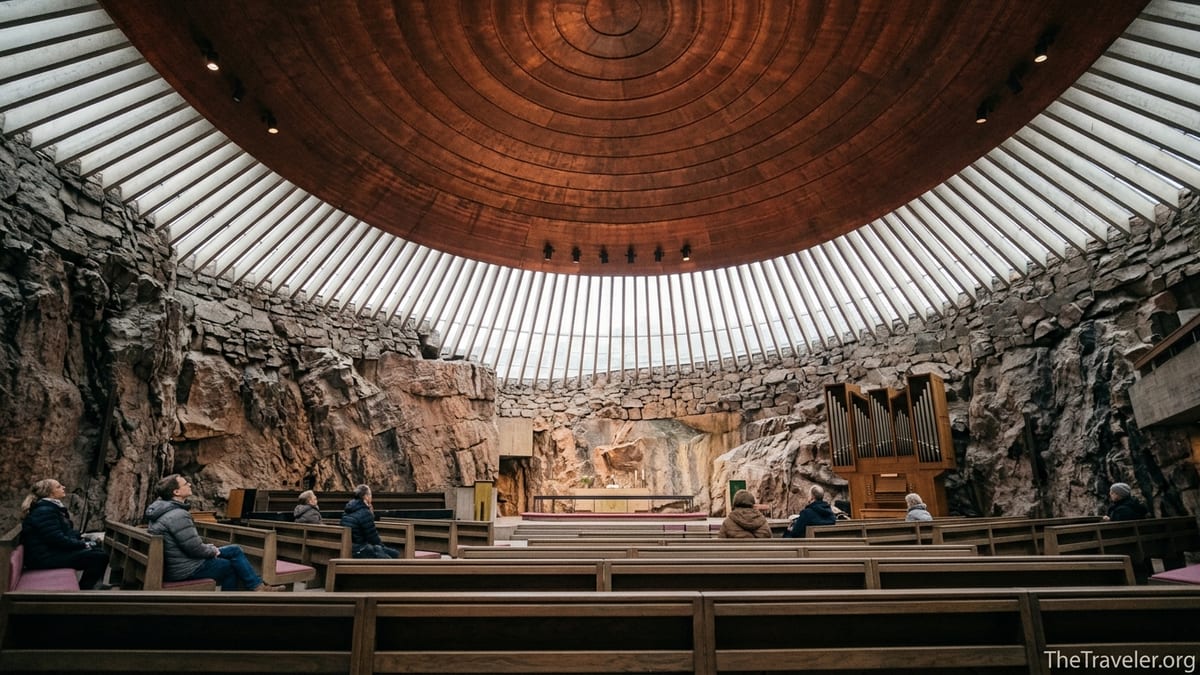
The first full view of the sanctuary is quietly theatrical. You step out from the entrance corridor and the entire circular hall opens around you: raw granite walls rising in gentle tiers, pierced by narrow staircases, and above them the famous copper dome, encircled by a band of skylight windows that let daylight spill over everything. Designed by brothers Timo and Tuomo Suomalainen and completed in 1969, the church was literally excavated from solid rock, so that the original granite forms both foundation and decoration.
On paper, the elements sound severe: concrete beams, thousands of kilograms of copper, bare stone. In reality, the space feels surprisingly warm. The rows of simple wooden pews, the pale floor and the quiet presence of potted green plants soften the geology, while the light filtering through 180 or so narrow glass panels around the dome changes constantly with the weather. On a bright winter morning, the light is cold and crystalline, tracing a sharp halo on the dome. On a rainy autumn afternoon, it turns diffuse and blue-grey, pooling gently onto the altar.
Architectural purists come here to admire the structure, tracing the concrete ribs from the rock up to the dome and noting how the designers avoided adding a tall tower, choosing instead to let the building sit low and almost hidden in the cityscape. Yet the detail that begins to matter after a few minutes is not anything you can capture easily in a photo. It is the way sound behaves in the space, bouncing off rough stone, absorbed by wood, and rising into the copper shell above. Even the shuffle of shoes across the floor and the soft closing of the heavy wooden doors have a particular resonance.
The church is still very much a working Lutheran parish, not just a museum of 1960s design. On weekdays you might notice a pastor in a dark clerical shirt chatting casually with visitors, or a small group of locals lighting candles at the side chapel. Around weddings and baptisms, the front rows of benches may be reserved and a simple white cloth laid over the altar. The everyday life of the congregation sits comfortably beside the tourist fascination with the building itself.
The Sound of Stone: Why the Acoustics Steal the Show
Temppeliaukio is regularly described as one of the best acoustic spaces in Helsinki, and it does not take a professional ear to notice. The combination of irregular granite walls and the shallow copper dome creates a natural reverb that musicians around the world come to test. It is no coincidence that the sanctuary doubles as a concert venue for classical chamber music, organ recitals and choral performances throughout the year.
Even outside concert times, staff occasionally invite visitors to sit quietly while a pianist or organist rehearses. On one recent weekday, a student trio arrived carrying battered instrument cases, set up modest music stands near the altar and began working through a Mozart divertimento. The first notes floated into the hall with a clarity that made individual bow strokes audible at the back row, yet the sound remained warm rather than clinical. A group of cruise passengers who had been busily snapping photos put their phones down almost in unison and simply listened.
The church organ, built by Veikko Virtanen, sits at the front with its pipes fanning out against the rock. You do not need to know that there are more than 40 stops and over 3,000 pipes to feel its impact when someone opens up the lower registers. A slow, sustained chord can fill the entire space without ever feeling painfully loud, the stone walls and dome holding the sound in a kind of embrace. For visitors used to echoey cathedrals where notes blur, the precision here is a pleasant surprise.
Many travelers plan their visit to coincide with a short midday concert, which often lasts about 30 minutes and costs only a little more than the regular admission. It is worth checking the monthly program before you go, as times vary and special evening concerts can sell out in advance, particularly in summer and during December. Audio quality has become part of the Rock Church’s identity, and stepping into a performance feels less like attending a tourist show and more like being allowed into the city’s favorite rehearsal space.
Silence in a Busy City: The Real Heart of the Experience
As impressive as the dome appears in photos and as remarkable as the acoustics are in person, the detail that stays with many visitors is far quieter: the sense of calm that settles once the initial rush of sightseeing passes. On busier days, signs in several languages gently ask groups to maintain silence and refrain from flash photography. Tour leaders often give a brief introduction outside, then invite their groups to spend ten or fifteen minutes inside without commentary.
This simple choice transforms the visit. In the back rows, solo travelers slip off their backpacks and just breathe, shoulders slowly dropping after days of moving between airports and train stations. A pair of students sits side by side, exchanging a quick smile before closing their eyes. Near the side chapel, a woman who seems to be a local office worker, still in her blazer and winter boots, lights a candle, stands for a moment, then takes a seat in the second row and stares into the middle distance as if ordering her thoughts.
For many, this is the favorite part of Temppeliaukio: the rare opportunity to be in silence with other people without it feeling awkward. The architecture helps. Being surrounded by rough stone that has been here for millennia, rather than ornate paintings and gilded decoration, grounds the space. You are literally sitting in the bedrock of Helsinki, shielded from traffic and wind, held in a circle of light. It feels less like a spectacle and more like a pause button.
The effect is especially strong in winter, when outside temperatures slide below freezing and daylight is limited to a few hours. Stepping in from slushy pavements and icy tram stops into a space that is both warm and dimly lit can feel almost medicinal. Some visitors choose to stay longer than planned, simply sitting on a wooden bench until their fingers and thoughts have thawed. In those moments, the view from the rock above becomes a pleasant footnote rather than the main act.
Practical Details That Shape Your Visit
Planning a visit to Temppeliaukio Church is relatively straightforward, but a few real-world details can make the difference between a rushed stop and a rewarding hour. Opening hours are somewhat irregular, changing with seasons and scheduled church functions. As a rule of thumb, the church tends to open mid-morning and close late afternoon on weekdays, with shorter visiting windows on Sundays due to services. It is wise to check the latest daily schedule shortly before you go, especially around Easter, Christmas and Finnish public holidays when hours can shift.
There is an admission fee for sightseeing visitors, while those attending services enter without charge. The fee is modest in comparison with major European cathedrals, but travelers on tight budgets sometimes debate whether the short visit justifies the cost. In practice, most find that between the distinctive architecture, the chance to sit in quiet and the possibility of catching a brief rehearsal, the experience feels fairly priced. Families often appreciate that children are either free or heavily discounted.
Getting there is easy without a car. The church sits in the Töölö district, about a seven-minute walk from Kamppi metro and bus station. Several central tram lines stop within a few blocks, and many visitors simply add the Rock Church to a self-guided walking loop that includes the National Museum, Parliament House and the nearby Sibelius Monument in Töölö Bay Park. For those arriving by cruise ship, shore excursion buses often bundle Temppeliaukio into a city highlights tour, typically allowing 30 to 45 minutes inside, which is just enough if you focus on the interior rather than lingering too long on the rock.
Inside, facilities are basic but sufficient. There are restrooms, a small gift corner selling postcards, simple jewelry and design items inspired by the copper dome, and occasionally an information desk staffed by volunteers who can answer questions about both the building and parish life. Photography is generally permitted outside service times, though visitors are encouraged to avoid loud shutters and to keep their phones on silent. It is a place where a little courtesy goes a long way toward preserving the atmosphere that makes the church special in the first place.
Beyond the Instagram Shot: Connecting With Local Life
One of the easiest ways to shift your experience of Temppeliaukio from quick photo stop to meaningful visit is to pay attention to how locals use the space. While the bulk of daytime visitors are tourists, the church remains part of the everyday fabric of the neighborhood. Bulletins on a simple noticeboard advertise choir rehearsals, diaconal services, language conversation groups and occasional ecumenical events. Seating for weddings is often marked off with modest ribbons rather than elaborate floral arches, a reminder of Finnish preference for understatement even on big days.
If you happen to visit on a weekday afternoon, you might see a school group filing in, their teacher quietly pointing out the dome and the organ while the children crane their necks and whisper to each other about how the rocks look like a cave. On another day, an elderly couple may be sitting close to the aisle, clearly waiting for a small memorial service, their hands folded around a simple bouquet of white flowers. These small human details bring the building’s purpose into focus more than any plaque or guided commentary could.
Travelers interested in music sometimes plan their Helsinki stay around a particular concert at the Rock Church, combining it with performances at the nearby Musiikkitalo concert hall or the Finnish National Opera. Ticket prices for evening events at Temppeliaukio are generally accessible, often comparable to a mid-range restaurant meal in the city, and range from solo organ recitals to visiting choirs and chamber ensembles. Sitting among a largely local audience after dark, with candlelight flickering on the stone, can feel entirely different from a midday sightseeing visit.
Even outside organized events, small conversations help bridge the gap between visitor and local. Staff and volunteers, many of whom speak English and other European languages, are often happy to share how the church is used at Christmas, or what it is like to attend a regular Sunday service here instead of in a traditional steepled church. Asking a simple question, then listening, can turn a beautiful building into a living community in your memory.
The Takeaway
Temppeliaukio Church is one of those rare places where the postcard view only hints at what makes it memorable. Standing on the rock outside, looking across Helsinki’s low skyline to the sea, you understand why so many city tours stop here and why social media fills with images of the copper dome under summer skies. Yet it is only when you step inside, let your eyes adjust to the dim light and your ears tune to the soft resonance of the stone, that the church begins to show its real character.
What lingers after you leave is less the geometry of the dome and more the experience of sharing silence and sound with strangers. The reverberation of a single piano note, the way a whisper carries without echoing harshly, the sight of an everyday Helsinki resident taking ten quiet minutes on a pew between errands: these details are what travelers tend to recall months later. The Rock Church is a reminder that great architecture is not only something to look at. It is something you feel in your body and your breathing, and, if you give it time, it sends you back into the city a little quieter and more attentive than before.
FAQ
Q1. Where is Temppeliaukio Church located in Helsinki?
Temppeliaukio Church, often called the Rock Church, is in the Töölö district of central Helsinki, a short walk northwest from Kamppi metro and bus station.
Q2. Do I need a ticket to visit the Rock Church?
Yes, sightseeing visitors usually pay a small admission fee that helps maintain the building, while entry for regular church services is free.
Q3. What are the typical opening hours?
Opening hours vary by season and church events, but the church is generally open from mid-morning to late afternoon on weekdays, with shorter visiting times on Sundays.
Q4. How long should I plan to spend inside?
Most visitors spend 30 to 45 minutes inside, which is enough to explore the architecture, sit quietly for a while and, if you are lucky, hear a short rehearsal.
Q5. Is photography allowed inside the church?
Photography is usually allowed during visiting hours, but flash and loud camera shutters are discouraged, and visitors are asked to keep silence to preserve the atmosphere.
Q6. Can I attend a concert at Temppeliaukio Church?
Yes, the church regularly hosts concerts and organ recitals; it is best to check the current program and buy tickets in advance for popular evening performances.
Q7. Is the Rock Church accessible for travelers with limited mobility?
The main entrance and interior are relatively accessible, with level floors and gentle ramps, though some higher seating tiers are reached by stairs.
Q8. What is the dress code for visiting?
There is no strict dress code, but visitors are expected to dress respectfully and remove hats, as it is an active place of worship used by the local Lutheran parish.
Q9. Can I visit during a religious service?
You may attend services if you wish to participate, but sightseeing and photography are generally not allowed during worship, so it is better to schedule tourist visits outside service times.
Q10. What makes Temppeliaukio Church different from other Helsinki churches?
Unlike traditional steepled churches, Temppeliaukio is carved directly into solid rock, crowned by a copper dome and renowned for its exceptional acoustics and contemplative atmosphere.