


Chiang Mai International Airport (CNX) is small, busy, and far less intimidating than Bangkok’s mega hubs, but first-time visitors can still be caught off guard by the crowds, the heat, and the tangle of transport options just outside the doors. This guide walks you step by step through arrivals, immigration, money, SIM cards, taxis, Grab, buses, and transfers to the Old City and Nimman so you can get from plane seat to guesthouse with minimal stress.
Get the latest updates straight to your inbox!
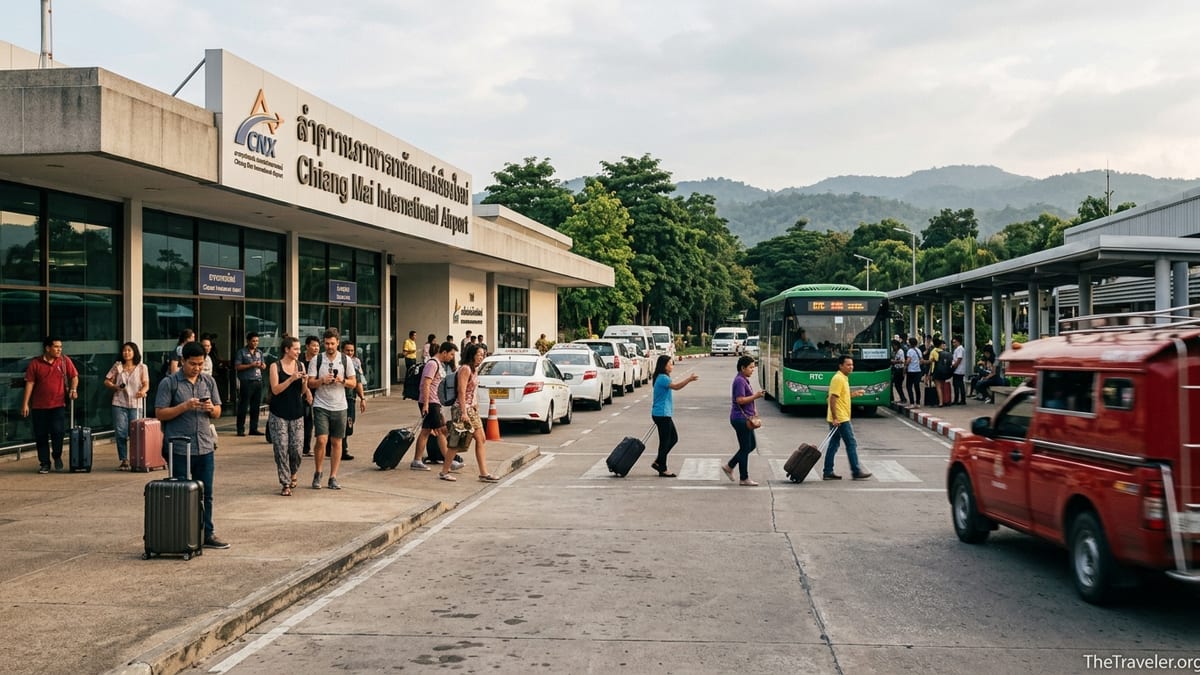
Understanding Chiang Mai International Airport Layout
Chiang Mai International Airport sits only about 4 kilometers southwest of the Old City, which is why airport to hotel transfers are usually quick and inexpensive compared with other Asian cities. The airport is compact, with two connected terminal areas used for both domestic and international flights. In practice, it feels like one elongated building: domestic check in and arrivals at one end, international at the other, linked by a common public hall on the ground floor. You can walk from one side to the other in roughly 5 to 10 minutes.
International arrivals typically emerge on the western side of the building. After passport control and baggage claim, you exit into a hall with money exchange counters, ATMs, SIM card booths, taxi desks, and some coffee and snack outlets. Domestic arrivals come out into a similar hall a short walk away, next to several car rental counters and a small seating area. There are no trains or metro lines connected to the airport, so all onward travel is by road.
Because the airport is relatively small, congestion is a bigger issue than distance. At peak hours in the late morning and early evening, security and immigration queues can spill into the corridors, and arriving passengers can jam the baggage belts. Allow plenty of extra time for departures and be patient when arriving. The upside is that it is difficult to get lost: simply follow the “Exit” signs, and you will quickly reach the public arrivals hall where all ground transport options are based.
If you are connecting between an international and a domestic flight on separate tickets, you will need to collect your bags, pass through customs, and then walk across the main hall to the domestic check in area. This usually takes less than 20 minutes if queues are light, but in high season you should allow at least 2 to 3 hours between flights to be safe.
Arriving at CNX: Immigration, Customs, Money and ATMs
On an international flight into CNX, the first step after disembarking is immigration. Depending on the time of day and how many flights land together, this can take anywhere from 10 minutes to over an hour. Have your passport, completed arrival card if it was provided on board, proof of onward travel, and hotel address ready. Many travelers find that early afternoon flights from regional hubs like Bangkok and Singapore face shorter queues than late evening arrivals when multiple flights land at once.
After immigration you proceed to baggage claim. The area is small and bags are usually on the belt within 15 to 30 minutes of landing, but delays do happen in peak season. There are trolleys available free of charge. Once you have your luggage, you pass through the customs area, which is usually a simple walk past a red or green channel. Customs checks in Chiang Mai are normally light, but you should still be honest about any restricted items such as cigarettes, alcohol, or large amounts of electronics.
Just after customs you will see several currency exchange booths and ATMs operated by major Thai banks. Exchange rates at the airport are typically less favorable than those in town, so many travelers withdraw a modest amount of cash here for immediate expenses and do larger exchanges later at dedicated money changers in the Old City or Nimman. As a concrete example, visitors often withdraw around 2,000 to 3,000 baht to cover a taxi, first meal, and small purchases, then use a better rate changer the next day. ATMs usually accept major international cards, but fees per withdrawal can be substantial, so using a fee free or low-fee card is ideal.
If you prefer to pay for your initial taxi or Grab ride by card, you can often do so directly in the app, but smaller operators such as songthaew shared trucks will be cash only. Having at least a few hundred baht in small notes is very useful when you step outside the terminal and start dealing with drivers or buying snacks and drinking water.
Getting Connected: SIM Cards, eSIMs and Wi Fi
Mobile data is inexpensive in Thailand, and getting a local SIM or eSIM as soon as you land in Chiang Mai makes it far easier to order a Grab, find your hotel, or message your guesthouse. Inside the arrivals halls you will typically find counters for the main Thai operators such as AIS and TrueMove H, selling tourist oriented SIM packages. These packages usually bundle a fixed number of days of high speed data with some local calls and messaging. For instance, it is common to see packages that offer around 30 days of data with a generous allowance for a few hundred baht. Prices at airport counters are slightly higher than in city branches, but the convenience is hard to beat when you are jet lagged and carrying bags.
The process at these counters is straightforward. Staff will take a quick photo of your passport, register the SIM in your name, insert it into your phone, and activate a data plan while you wait. Most travelers walk away with full connectivity in less than 10 minutes. If you are staying more than a month, you can top up later at any convenience store or operator shop in town. For digital nomads or long stays, some prefer to buy a cheap non-tourist plan in a city shop the next day, which can work out cheaper per month than a stack of short tourist packages.
If you prefer not to swap physical SIM cards, several global and Thai providers now offer eSIM data packages for Thailand that you can activate before departure. With these, your phone connects automatically when you land, and you only need Wi Fi briefly to install the profile. Many first-time visitors combine an eSIM for immediate data on arrival with a physical Thai SIM bought later in the city for extended use, so they are not reliant on airport pricing.
Free Wi Fi is available at the airport, although speed and reliability can be inconsistent when many passengers are connected. The network is usually good enough to load a map or request a ride, but it may struggle with video calls or large downloads. If you want to rely on Wi Fi for your entire stay, note that most hotels, cafes, and coworking spaces in Chiang Mai offer solid connections, especially in Nimman and the Old City. Still, a local SIM is often the most practical option for navigation and messaging when you are out exploring temples or night markets.
Transport Options: Taxis, Grab, Buses and Songthaews
Once you step into the public arrivals hall, you will see multiple transport options competing for your attention. The simplest for first-time visitors is the official airport taxi desk. Staff at a counter near the exits ask where you are going, quote a fixed price, and hand you a slip to give the driver waiting outside. Recent reports suggest typical fares of around 150 to 200 baht to most points in the Old City and 180 to 220 baht to Nimman, which are reasonable prices given the short distances. You pay either at the desk or directly to the driver, depending on how the system is operating that day.
Ride hailing apps such as Grab and Bolt also operate at CNX. To use them, you need an active data connection and the app already installed. Fares can be slightly lower than the official taxi desk, for example roughly 100 to 150 baht to the Old City in light traffic, but prices fluctuate with demand, time of day, and promotions. Drivers usually meet you at a designated pick up zone outside departures or arrivals, and the app will show the exact point. This option is especially attractive if you prefer paying by card in the app or if you want to avoid handling cash immediately after landing.
For budget travelers, the RTC Chiang Mai City Bus runs routes looping between the airport and key parts of town. Look for city buses marked with route codes such as R3 and B2, which typically stop at locations like Tha Phae Gate, the Night Bazaar, Nimman area, and Chiang Mai Railway Station. Fares are low, often around 30 baht per trip regardless of distance. The buses are air conditioned and safe, though not as frequent as in major capitals, so you may wait 20 to 30 minutes depending on the time of day. If you arrive late at night, the airport bus may have already finished for the day, in which case taxis and ride hailing apps become your main options.
Songthaews, the ubiquitous red shared trucks that serve as a hybrid between bus and taxi in Chiang Mai, also serve the airport area. Officially there are set fares, but in practice prices are negotiated. A typical fare from the airport to the Old City might be in the range of 70 to 100 baht per person if you join others, but quotes can be higher, especially if drivers spot that you are new to town. Songthaews are fun and authentic, but for your first arrival with luggage they can feel crowded and confusing. Most first-time visitors find that using the airport taxi desk or a Grab car is worth the small extra cost.
Old City Transfers: What to Expect on Arrival
The Old City is the walled, square-shaped heart of Chiang Mai, packed with guesthouses, boutique hotels, temples, and cafes. From the airport, it is a short hop north via the main road, and in light traffic the journey is usually 10 to 20 minutes. If you have booked accommodation near landmarks like Tha Phae Gate, Wat Phra Singh, or Chiang Mai Gate, simply show the name and address on your phone to the driver at the taxi desk. Many drivers recognize the most popular hotels and will nod in recognition as soon as they see it.
When using the official airport taxi, your fare is fixed in advance, so there is no need to negotiate or watch a meter. You hand the slip to your driver, load your luggage into the trunk, and off you go. Some travelers like to tip 20 to 40 baht if the driver helps with heavy bags, but tipping is not compulsory. If you have ordered a Grab, double check that the license plate in the app matches the vehicle that pulls up before loading your bags. A practical approach for a solo traveler or couple with light luggage is to grab a bus or songthaew into the Old City and then walk the last few blocks to the guesthouse.
One real-world example: a couple arriving on a mid-afternoon flight might withdraw 2,000 baht from an ATM, buy an AIS tourist SIM at the arrivals counter, and then head to the airport taxi desk. They are quoted 150 baht to a guesthouse near Wat Chedi Luang. Ten minutes after leaving the airport they are dropped at the south side of the moat, walk two short lanes, and are checked in before their luggage has even cooled from the overhead bin. This combination of quick processing and short driving distances is one of Chiang Mai’s biggest advantages.
Traffic around the Old City can get busy at rush hours and during festivals like Loy Krathong and Songkran, but congestion is still mild compared with Bangkok. If you are arriving during a major festival, build in extra driving time and expect some road closures around the moat and key temple areas. In these periods, taxi drivers may drop you at the nearest accessible gate and let you walk a few minutes rather than navigate blocked streets, so wearing comfortable shoes and using a backpack instead of bulky rolling luggage can make life easier.
Nimman and Beyond: Transfers to Trendy Neighborhoods
Nimmanhaemin Road, often shortened to Nimman, is Chiang Mai’s most popular modern neighborhood, especially for digital nomads and long-stay visitors. It lies northwest of the Old City, not far from the airport, and is packed with cafes, coworking spaces, condos, and boutique hotels. From CNX, an airport taxi or Grab to Nimman typically takes around 15 minutes in normal traffic. Fares from the official taxi desk are usually slightly higher than to the Old City, often falling in the range of 180 to 220 baht depending on the exact location.
The RTC airport bus is a particularly good option for Nimman if you are traveling light. Routes that pass along Nimmanhaemin and Huay Kaew roads stop near popular landmarks such as Maya Lifestyle Shopping Center, which sits at the corner of Nimman and the main highway. From there, many hotels and apartment buildings are only a short walk away. For instance, a traveler staying in a guesthouse a block off Nimman might ride the bus from CNX to Maya for about 30 baht, then walk 5 minutes to check in. This can cut transfer costs significantly for budget conscious visitors or those staying longer term.
Ride hailing apps work very well in Nimman thanks to the neighborhood’s density and constant flow of local users. If you arrive late at night or in heavy rain, many travelers find it easiest to connect to airport Wi Fi, order a Grab or Bolt to their Nimman hotel, and pay within the app. The car then pulls up directly outside the lobby or condo entrance, which can feel safer and more comfortable than negotiating with multiple drivers while tired.
If your final destination is further afield, such as the mountain road to Doi Suthep, the craft villages around San Kamphaeng, or the resort areas towards Mae Rim, plan to book a private transfer or negotiate directly with a taxi company. Fixed price transfers from the airport to these outlying areas are common, and you will often see brochures and counters advertising such services just outside arrivals. These can make sense for families or groups who want to go directly to a resort without detouring through the city.
Car Rental at CNX: When It Makes Sense
Renting a car at Chiang Mai International Airport can be a practical choice if you plan to explore beyond the city, visit national parks, or stay at remote resorts. Several international brands such as Avis, Budget, Hertz, and Enterprise, along with Thai operators like Thai Rent A Car, National, and Chic Car Rent, maintain desks in the arrivals area. Counters are generally concentrated near the domestic arrivals exit, but staff can assist passengers coming from the international side with a short walk across the hall.
Rental rates vary with season and vehicle type, but small hatchbacks are usually the most economical option, well suited to city driving and tight parking around the Old City and Nimman. Larger sedans and SUVs are popular for families or those planning trips into the mountains, where extra power and ground clearance can be helpful. As in many countries, you will generally need a credit card in the main driver’s name for the security deposit, along with your passport and, ideally, an International Driving Permit in addition to your home license.
Driving in Chiang Mai is on the left side of the road, and traffic near the airport and around the city moat can be hectic for newcomers, especially on weekends and holidays. For many first-time visitors who are only staying a few days in town, relying on taxis, Grab, and songthaews is simpler and less stressful than renting a car. On the other hand, if you are planning a multi day loop to Pai, Mae Hong Son, or Chiang Rai, collecting a rental car at the airport and dropping it off on departure can be very efficient, saving the cost and time of separate bus tickets and transfers.
A realistic scenario might be a group of four friends landing in Chiang Mai and planning to head straight to Pai for a week. Instead of taking a minibus from the Arcade bus station, they could rent a compact SUV at the airport on arrival, share the cost, and drive directly to Pai at their own pace. This approach adds flexibility for scenic stops and avoids crowded buses, but it does require that at least one person feels comfortable driving long winding roads in an unfamiliar country.
First Time Chiang Mai Tips from Airport to City
For a smooth experience at CNX and in your first 24 hours in Chiang Mai, a little preparation goes a long way. Having your accommodation address written in both English and Thai, either on paper or as a screenshot on your phone, helps immensely when dealing with drivers who may not be comfortable reading Latin script. Many hotels include a small map and Thai address on their booking confirmation specifically for this reason. Showing this to the taxi desk or Grab driver can prevent confusion and wrong turns.
Another practical tip is to install and log into key apps such as Grab, your banking apps, and messaging services before you fly, and enable offline maps for Chiang Mai in your preferred navigation app. That way, even if the airport Wi Fi is slow or your SIM activation takes a few minutes, you can still show the driver where you are going and double check that the car is headed in the right direction. Travellers sometimes keep a printed copy of their first hotel booking along with their passport in case they run into connectivity issues.
Pacing yourself on arrival is also important. The combination of heat, humidity, and travel fatigue can be draining, especially if you are arriving from a long haul flight via Bangkok or another hub. Plan an easy first evening: check in, take a shower, and perhaps walk to a nearby restaurant or night market rather than rushing straight into full day excursions. The compact nature of Chiang Mai means that you rarely need to hurry; most major sights in the Old City can be reached within a 15 minute drive from central hotels.
Finally, keep your valuables close in the airport and when getting into vehicles, as you would in any busy transport hub. Chiang Mai is generally considered a safe city, but petty theft can happen in crowded places. Use zippers and internal pockets for passports, cash, and phones. Before leaving a taxi or Grab, take a quick look at the seat and floor to make sure you have not left a phone or passport behind. If you do misplace something in an app-based ride, contacting the driver through the app as soon as possible often leads to lost items being returned.
FAQ
Q1. How long does it take to get from Chiang Mai Airport to the Old City?
The drive from Chiang Mai International Airport to most parts of the Old City typically takes around 10 to 20 minutes, depending on traffic and your exact hotel location.
Q2. What is a typical taxi fare from CNX to the Old City or Nimman?
Official airport taxis usually charge fixed fares in the region of 150 to 200 baht for the Old City and around 180 to 220 baht for Nimman, though exact prices can vary slightly over time.
Q3. Is it better to use Grab or the official airport taxi desk?
For first-time visitors, the airport taxi desk is the simplest option with clear fixed prices. Grab can be a little cheaper at quiet times but requires a working data connection and familiarity with the app.
Q4. Can I take a bus from Chiang Mai Airport into town?
Yes. RTC city buses run routes between the airport and popular areas such as the Old City and Nimman, with fares typically around 30 baht per trip. Services run during daytime and early evening.
Q5. Where can I buy a SIM card on arrival at CNX?
You can purchase tourist SIM cards from Thai operators such as AIS and TrueMove H at counters in the arrivals hall. Staff will register and activate the SIM using your passport.
Q6. Is it safe to arrive late at night at Chiang Mai Airport?
Arriving late at night is generally safe. The terminal is well lit and staffed, though some services such as buses may stop running, so you may need to rely on taxis or Grab.
Q7. Should I book an airport transfer in advance or just use local options?
Most visitors simply use the airport taxi desk or Grab on arrival without problems. Prebooked transfers can be worthwhile for large groups, families with young children, or travelers arriving very late.
Q8. Is renting a car at Chiang Mai Airport a good idea for first-time visitors?
Renting a car is useful if you plan road trips to places like Pai or Mae Hong Son, but for short city stays taxis and Grab are usually easier and less stressful for first-timers.
Q9. How much cash should I withdraw or exchange at the airport?
Many travelers withdraw or exchange enough for the first day, often around 2,000 to 3,000 baht, then seek better exchange rates in town for larger amounts later.
Q10. Do I need to tip taxi drivers and other transport staff?
Tipping is not mandatory in Chiang Mai, but rounding up the fare or adding 20 to 40 baht for helpful service is appreciated, especially if the driver assists with heavy luggage.