


Landing in Phuket can be both exciting and overwhelming, especially if you are trying to judge how long it will take to clear immigration, collect your luggage, pass customs, and meet your transfer. Phuket International Airport (HKT) has grown quickly in recent years, and at busy times queues can build up fast. This guide explains what to expect step by step, how long each stage typically takes, and how to plan realistic connections, using recent traveler experiences and the current airport setup in 2025–2026 as a reference.
Get the latest updates straight to your inbox!
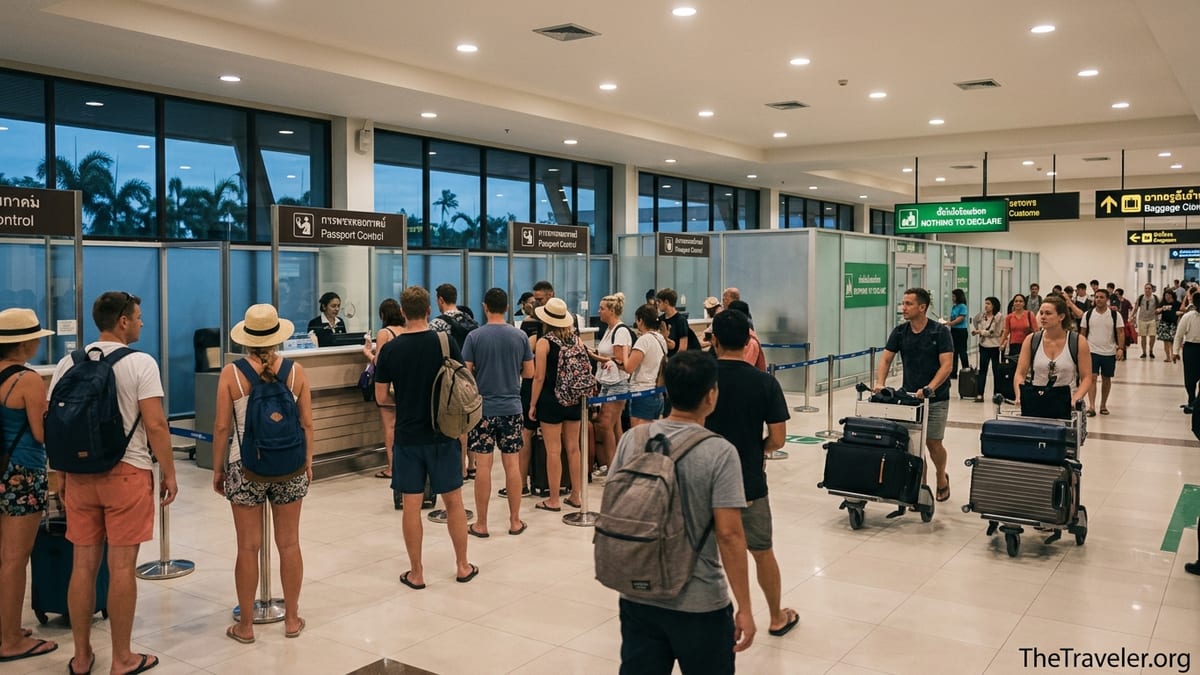
Understanding Phuket International Airport’s Layout
Phuket International Airport sits at the north of the island and is divided into separate international and domestic terminals that sit side by side along the same frontage. International arrivals use the newer multi-level international terminal, while domestic flights operate from the older but updated domestic building next door. The two terminals are connected at ground level, so if you are meeting friends from a domestic flight or connecting between flights, it is a short outdoor walk along the covered sidewalk rather than a shuttle bus ride.
For most international passengers, the arrival path is straightforward. You disembark onto an airbridge or via stairs to a bus, walk through a corridor following signs for “International Arrivals” and “Passport Control,” then descend to the immigration hall. The baggage claim area and customs inspection sit directly after passport control, and on exiting customs you walk into a linear arrivals hall where hotel reps, taxi counters, and car rentals are lined up. Knowing this simple pier-to-immigration-to-baggage-to-customs sequence helps you visualize your progress and makes it easier to estimate timings.
The international terminal’s processing areas are stacked vertically, which can create choke points around escalators and stairways at very busy times. In high season, when several wide-body flights from Europe, the Middle East, and East Asia arrive within a short window, passengers from multiple aircraft feed into the same immigration hall. That is why two people landing on the same day can report very different experiences: one might clear everything in 25 minutes, while another arriving an hour later spends more than an hour in line, purely because of the banked arrivals.
Domestic arrivals are simpler and quicker because there is no immigration check for internal Thai flights. If you are connecting from an international flight into a domestic one, you will still go through immigration, collect and clear your baggage, pass customs, then re-check your bags for the domestic sector in the neighboring terminal. This arrangement matters when you are planning short self-made connections and is one reason why cautious travelers often prefer at least three hours between an international arrival and a separate domestic ticket in Phuket.
Passport Control: How Long Do Immigration Queues Really Take?
Immigration is the step that most often determines whether you are out of the airport in under an hour or still in line two hours after landing. Recent traveler reports from late 2025 and mid 2026 suggest that off-peak queues can be surprisingly short, with some passengers clearing immigration in as little as 10–20 minutes when arriving in the middle of a quiet low-season afternoon. Others landing in the heart of peak season, especially around Christmas, New Year, Chinese New Year, and major events like large music festivals, report waits of 60–90 minutes when multiple flights arrive together.
To handle rising volumes, Thai authorities have introduced the Thailand Digital Arrival Card (TDAC), which replaces the old paper arrival card for foreign visitors and is completed online before travel. On arrival in Phuket, immigration officers scan your TDAC QR code or retrieve your application with your passport details. Travelers who have filled it out correctly report that the actual passport check itself is quick, often under two minutes per person once at the counter, but the overall wait still depends heavily on how many passengers are ahead of you.
Typical wait times at Phuket immigration are often in the 20–45 minute range outside peak holidays, especially for flights landing mid-morning or early afternoon on weekdays. However, you should plan for worse, not best. A realistic planning assumption is that immigration could take up to an hour in high season or at busy evening arrival banks. Several passengers arriving around midday in late May, for example, describe lines that stretched across the hall, with staff opening more counters as queues built up. One traveler reported getting through in about 40 minutes while another on a different day during the same period needed closer to an hour.
Fast-track services are sometimes promoted by airlines, hotels, and third-party agencies for a premium fee, promising an escort through dedicated immigration lanes. Feedback on these services at Phuket is mixed. Some visitors say fast track cut their waiting time from roughly an hour to about 10–15 minutes during Christmas week, while others who paid for it in shoulder season felt it offered little advantage when the regular lines were already short. If you are arriving with young children, tight onward plans, or during a known peak such as late December, a reputable fast-track service booked through your airline or hotel can be worth considering. At quieter times of the year, the extra cost often provides only marginal benefit.
Baggage Claim and Customs: What Happens After Immigration
Once your passport is stamped, you descend or walk directly into the baggage claim hall. For many travelers, baggage handling time is the hidden variable after immigration. Some report that checked bags were already circulating on the belt after a 30–40 minute wait at passport control, so they were able to grab luggage and walk out immediately. Others, especially on wide-body flights from Europe or the Middle East where hundreds of bags must be unloaded, have experienced waits of 20–30 minutes at the belt, even after a short immigration line.
The baggage hall at Phuket serves several flights at once, and the overhead screens indicate which carousel belongs to your flight. Trolleys are readily available and free to use. If you are traveling with only cabin baggage, you can bypass this stage entirely and go straight to customs, which can save considerable time during busy periods. Some experienced visitors now travel hand-luggage-only for week-long stays precisely to avoid baggage delays and to be able to book earlier shuttle buses or ferries with more confidence.
Customs in Phuket generally operates on a green-channel / red-channel system. If you have nothing to declare and are within standard duty-free allowances on items such as alcohol and tobacco, you walk through the green channel, where officers may still conduct random bag scans using X-ray machines. If you are carrying items that might need to be declared, such as expensive electronics for commercial use, large quantities of cigarettes, or high-value luxury goods, you should proceed through the red channel. The customs area is not usually where long delays occur for ordinary tourists, although in very busy waves there can be a short queue for X-ray machines as all bags from several flights are screened.
It is important to understand that customs officers in Thailand have significant discretion. While most visitors pass straight through in a couple of minutes, you should keep receipts handy for high-value items and avoid carrying restricted goods. For example, travelers who attempt to bring in large quantities of vaping devices or certain types of medication may face confiscation or questioning. For the majority of beach holiday visitors with normal personal luggage, however, customs is a brief final formality between baggage claim and the arrivals hall.
Peak Seasons, Busy Hours, and Realistic Wait-Time Scenarios
Phuket’s busiest months run roughly from November to March, with absolute peaks around late December, early January, and Chinese New Year. During these periods, international arrivals include charter flights from northern Europe, scheduled services from hubs such as Dubai, Doha, Hong Kong, Singapore, and Kuala Lumpur, and regional flights from cities like Seoul and Shanghai. When three or four of these flights land within a 45-minute window in the late morning or late evening, the result can be long lines at immigration and noticeable pressure on baggage handling.
One practical way to think about timing is to imagine three scenarios. In a best-case, off-season scenario, a midweek midday arrival in July or September on a narrow-body flight from Bangkok or Singapore with light loads might see you off the plane, through immigration in 15–20 minutes, with a short wait at the carousel or no wait at all if you carry only hand luggage. In this situation, being curbside 25–40 minutes after scheduled landing is entirely possible. Travelers in low season during 2026 have shared experiences of walking straight to virtually empty immigration counters and reaching the taxi stands in under half an hour.
A more typical scenario during the busier months would be a 30–60 minute immigration queue, followed by a 10–25 minute wait for bags and a brief walk through customs. In practice, many visitors in November, January, and February report total times of 60–90 minutes from aircraft door to arrivals hall exit. This is the range you should assume for most practical planning if you are visiting between late autumn and early spring, especially on evening arrivals when many long-haul flights converge.
In a worst-case scenario, such as arriving around Christmas or New Year’s Eve in the late evening when charter flights and regional services are heavily loaded, waits of 90 minutes or slightly more at immigration are possible, particularly if staff numbers are stretched or several flights are delayed into the same time slot. Add potential baggage delays and you could be inside the terminal for up to two hours or more. While this is not the everyday experience, it occurs frequently enough during major peaks that travel planners, tour operators, and seasoned repeat visitors advise building significant buffer time into your onward plans during these dates.
How Much Time to Allow After Landing for Transfers and Connections
The single most practical question for many travelers is how long it will take from landing to reaching a taxi, shuttle, bus, or domestic flight. The answer depends on your season, whether you check bags, and how risk-tolerant you are, but there are patterns you can rely on. In low season, many travelers comfortably book shared minivans or buses scheduled to depart 90 minutes after landing and make them without rushing, provided their flight is on time. In high season, that same 90-minute window can be uncomfortably tight if immigration and baggage both run slow.
If you are booking an intercity bus from the airport, such as to Khao Lak or onward to Krabi via a scheduled coach, a safe planning rule is to allow at least 2 hours between scheduled landing and bus departure, more if you are arriving in December or January. For example, if your flight is due at 14:00, booking a bus at 16:00 should allow for a 45–60 minute immigration and baggage process plus time to purchase a snack and walk to the stand. Attempting to catch a 14:50 or 15:00 departure on a separate ticket leaves you very little margin if your aircraft parks remotely or a second wide-body flight lands just ahead of you.
For international-to-domestic flight connections on separate tickets, experienced travelers often recommend at least 3 hours between scheduled arrival and domestic departure at Phuket. You must clear immigration, collect baggage, pass customs, walk to the domestic terminal, check in again, and go through security. Any one of these steps can eat up more time than expected. Travelers who have tried to connect from a 16:00 international landing to a 17:40 domestic flight on separate bookings routinely describe the experience as stressful and sometimes unsuccessful, especially during the busy season when check-in queues and security lines lengthen.
Pre-booked private transfers to hotels in areas like Patong, Kata, Karon, Bang Tao, or Rawai usually ask for your flight number and monitor arrival times. Drivers are used to waiting inside the arrivals hall with name boards for up to 1–2 hours after landing. When completing the booking form, many operators suggest that guests exiting customs roughly 60–90 minutes after scheduled arrival is normal. If you are hiring a local taxi driver directly or meeting a friend picking you up by car, a practical guideline is to tell them to expect you about 60 minutes after landing in low season and 90 minutes in high season, unless your flight arrives at a very quiet time of day.
Practical Tips to Reduce Waiting and Stress
There are several simple steps you can take before and during your flight to Phuket that can significantly smooth your arrival. Completing the Thailand Digital Arrival Card (TDAC) online in advance is one of the most important. Have a screenshot or printout of the QR code accessible on your phone and be ready to show your hotel address and onward travel details at immigration if asked. Travelers who arrive with missing or incorrect details can be pulled aside to complete or correct their information, which adds extra minutes when queues are already long.
Your seating choice on the plane can also affect how quickly you reach the immigration lines. Passengers seated near the front of the cabin or in rows close to the forward exits tend to disembark sooner and, on full flights, can be 10–15 minutes ahead of those seated at the back, especially when boarding bridges are in use. On busy holiday flights from hubs such as Dubai, Doha, or Istanbul, travelers who selected seats toward the front and walked briskly to immigration often report joining relatively short lines that grew dramatically within minutes as the rest of the plane arrived behind them.
Carrying hand luggage only is one of the most effective ways to cut down your total time in the terminal. Without checked bags, you proceed from immigration straight to customs and exit. Travelers arriving in May and June 2026 with only cabin bags consistently describe being outside in the arrivals hall within 30–45 minutes even when immigration itself was moderately busy. If you must check luggage, pack essentials in your cabin bag in case of delays, including a change of clothes, essential medications, and any paperwork you might need for hotel check-in or onward travel.
Finally, manage your expectations for the first hour or two in Phuket and avoid scheduling anything time-critical immediately after landing. For instance, if you are planning to catch a boat to the Phi Phi Islands or a diving liveaboard that departs from a pier near Phuket Town, choose a departure that leaves you at least two and a half to three hours of buffer after your scheduled arrival time. This not only gives room for airport processing and road traffic but also allows for small delays in your inbound flight, which are common during stormy months or at busy hubs.
The Takeaway
Phuket International Airport has improved facilities and processes in recent years, but its rapid growth means that waiting times at immigration and baggage claim can still fluctuate widely from day to day and hour to hour. Most travelers will find that they are through passport control, baggage, and customs in 45–90 minutes, but at the very busiest times you should be prepared for up to two hours from aircraft door to arrivals hall exit.
By understanding the layout of the airport, completing your digital arrival card in advance, choosing smart seating and luggage strategies, and allowing realistic buffer time before any onward connections, you can turn arrival day from a source of anxiety into the start of a relaxed island holiday. When in doubt, assume that queues will be at the slower end of the spectrum, especially in the November to March high season, and plan your transfers and connections accordingly.
Phuket rewards patience. A little extra time built into your schedule will not feel wasted when you are finally rolling your suitcase past the palm trees outside the terminal, ready to head to your hotel, rather than sprinting between counters or worrying about missed departures. Treat the airport as the first stage of your trip, not a hurdle to be rushed through at all costs, and your arrival experience will almost always feel smoother.
FAQ
Q1. How long does it usually take to clear immigration at Phuket International Airport? In normal conditions you can expect immigration to take around 20–45 minutes, but in high season or during busy arrival waves it can stretch to 60 minutes or slightly longer. It is wise to plan for the slower end of that range when arranging pickups or onward travel.
Q2. How much total time should I allow from landing to exiting customs? Most travelers should plan on 60–90 minutes from scheduled landing to walking out of the customs area, including immigration, baggage, and brief customs checks. In peak periods such as late December and early January, allowing up to two hours provides a comfortable buffer.
Q3. Is 50 minutes after landing enough time to catch a bus from Phuket Airport? Fifty minutes is usually too tight, especially if you have checked luggage or arrive in a busy time slot. Queues at immigration alone can exceed that in high season. A safer plan is to choose a bus that departs at least 90–120 minutes after your scheduled arrival.
Q4. How much time should I allow for an international arrival and separate domestic connection? If your domestic flight is on a separate ticket, aim for at least a 3-hour gap between scheduled landing and domestic departure. This allows for immigration, baggage claim, customs, walking to the domestic terminal, check-in, and security, with some margin for delays.
Q5. Are fast-track immigration services at Phuket worth paying for? Fast-track services can be useful during peak holiday periods or if you are traveling with small children or have tight onward plans. They often cut the queue significantly when the hall is very busy. At quieter times of year, when lines are short, the extra cost may not provide much benefit.
Q6. How long does baggage claim usually take at Phuket Airport? Baggage claim typically takes 10–30 minutes once you reach the carousel, depending on the size of your aircraft and how many flights are being handled at the same time. Sometimes bags are already on the belt when you arrive from immigration, while at very busy times there can be noticeable delays.
Q7. Is customs at Phuket likely to cause long delays? For most tourists, customs is quick. You simply walk through the green channel with your bags, and there may be an X-ray check or a brief question. Unless you are carrying goods that need to be declared or the hall is unusually crowded, customs usually adds only a few minutes to your total time.
Q8. Does arriving with only hand luggage make a big difference? Yes. Travelers with only cabin baggage can go straight from immigration through customs and out to the arrivals hall, skipping any wait at the carousel. During busy periods this can easily save 20–30 minutes and makes it more realistic to catch earlier buses or transfers.
Q9. Are wait times shorter in Phuket’s low season? Generally yes. From roughly May to October there are fewer visitors, and many recent arrivals in these months report shorter or even minimal immigration queues, especially on weekday flights. However, sudden peaks can still occur when several flights land together, so it is still best to allow a sensible buffer.
Q10. What should I tell my hotel or driver about when to expect me after landing? As a guideline, in low season you can suggest that you will exit customs about 60 minutes after landing, while in high season 90 minutes is more realistic. If you are arriving during a major holiday period or late at night when many flights bunch together, letting them know it could be up to two hours will help manage expectations.