


Landing at Chicago O’Hare International Airport can feel intense, especially after a long-haul flight or if you are visiting the city for the first time. With four busy terminals, construction projects and a maze of transport options, it pays to know exactly what to expect once the aircraft doors open. This guide walks you step by step through arrivals at O’Hare in 2026, from baggage claim, immigration and customs to getting a SIM card, withdrawing cash and choosing the best way into downtown Chicago or the suburbs.
Get the latest updates straight to your inbox!
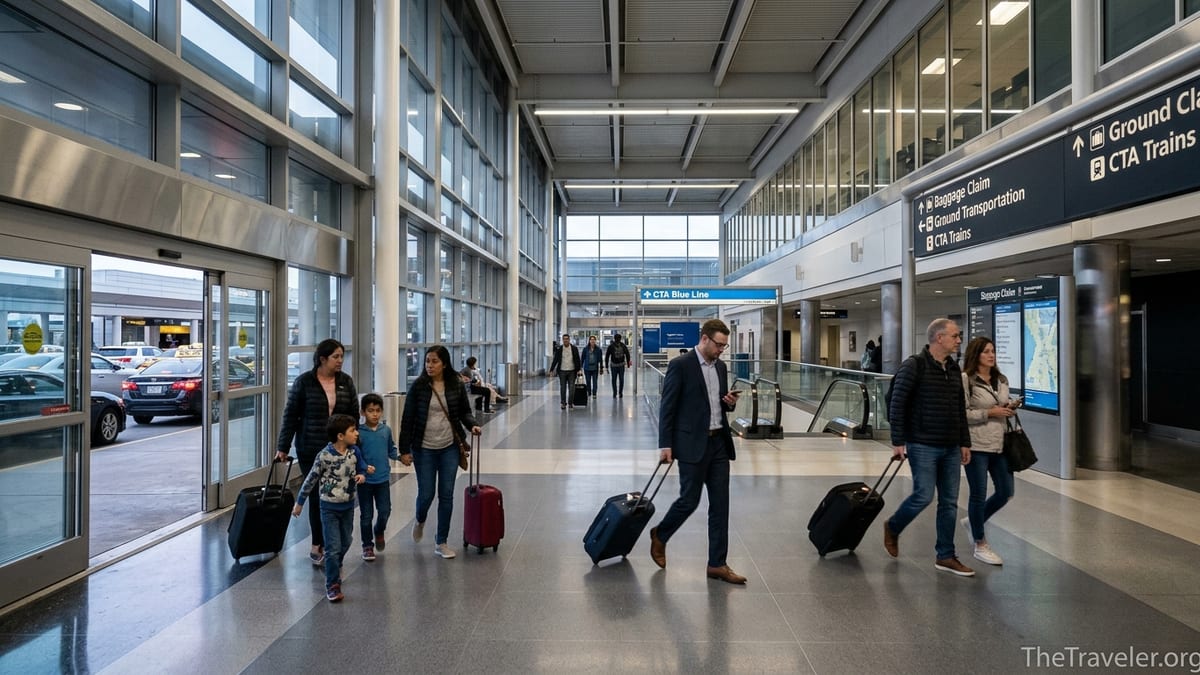
Understanding O’Hare’s Terminals and Arrival Flow
O’Hare International Airport (ORD) has four active passenger terminals: Terminals 1, 2 and 3 primarily serve domestic flights and some short international routes that pre-clear U.S. immigration, while the modernized Terminal 5 handles most international arrivals that require immigration and customs. All terminals are connected by the free Airport Transit System, an automated train running 24 hours a day between Terminals 1, 2, 3, 5, the main parking garage and the Multi-Modal Facility, where most rental car centers are located.
If you arrive from abroad on airlines such as British Airways, Lufthansa, Aer Lingus, Qatar Airways, Turkish Airlines or many major carriers from Europe, Asia and South America, you will almost certainly arrive into Terminal 5. Many United Airlines international flights still arrive into Terminal 1, and some American Airlines international flights arrive into Terminal 3, especially from destinations that already have U.S. preclearance like Dublin or some Canadian airports.
The arrival flow is broadly similar in every terminal. You leave the aircraft, follow the overhead signs for Baggage Claim or Arrivals, and walk through concourses of gates until you reach the main arrivals corridor. Domestic passengers head straight for baggage claim. International passengers needing immigration and customs follow clearly marked signage for U.S. Customs and Border Protection, usually down a separate corridor before reaching the baggage hall.
As you walk, you will see airport information desks near the exits to baggage claim in each terminal. These desks are useful if you are unsure which transport option makes sense for your hotel, or if you need directions to the Airport Transit System or Blue Line station. Staff are used to answering practical questions like “Where is baggage claim for Delta?” or “How do I get to Terminal 5?”
Immigration, Baggage Claim and Customs
International arrivals who have not cleared U.S. formalities before boarding will pass through immigration at O’Hare, usually in Terminal 5. After exiting the aircraft, you simply follow the signs for Passport Control or Immigration. You will queue in lines separated for U.S. citizens, permanent residents and visitors. Automated passport kiosks are used for many travelers, but airport staff and large digital signs will direct you to the right area.
Once you clear immigration, you move directly into the baggage claim hall. Baggage carousels are numbered, and digital screens list flights and corresponding carousel numbers, for example “Flight LH430 Frankfurt – Carousel 7.” If you are on a through ticket to a domestic connection in the United States, check the baggage tag that staff placed on your suitcase at departure. In many cases from Europe or Asia to a smaller U.S. city, you will still need to collect your bag at O’Hare, carry it through customs and then re-drop it at a dedicated transfer belt right after customs for your onward flight.
Customs at O’Hare usually involves handing your customs declaration, which is now often electronic, to an officer and possibly having your luggage scanned or inspected. Many passengers are simply waved through the “Nothing to Declare” channel after a brief confirmation of what they are bringing into the country. If you are carrying food such as meat, fresh fruit or vegetables, be prepared to declare it and potentially surrender prohibited items.
After customs, you enter the public Arrivals Hall. In Terminal 5, this is a busy area with currency exchange counters, a few cafes, ATMs, ride service information desks and access to the Airport Transit System. In Terminals 1, 2 and 3, you exit from baggage claim directly onto the lower level road, where friends, family, taxis and hotel shuttles pick up arriving passengers.
Money, SIM Cards and Essentials in the Arrivals Area
Once you are through customs and into the public area, it is a good moment to sort out basics like local currency, mobile data and a quick snack or drink. ATMs from major U.S. banks are scattered through all terminal baggage claim areas and the main halls. Examples often include machines branded by Chase, Bank of America or regional institutions. Fees vary, but many machines charge a withdrawal fee on top of whatever your home bank charges. If you need only a small amount of dollars for tips and small purchases, many travelers withdraw around 60 to 100 dollars initially.
Currency exchange kiosks are available in Terminal 5 and in some parts of Terminals 1 to 3, but the exchange rates are usually less favorable than withdrawing from an ATM or using a card. If you need to pay for a taxi or train, you can almost always use a credit or debit card, including contactless payments, so you do not need large amounts of cash.
For mobile data, some international visitors rely on eSIMs purchased in advance through travel-focused apps that activate automatically once the phone connects to a U.S. network. If you prefer a physical SIM, look for mobile phone retailers or electronics stores in the terminals. The mix of providers changes from time to time, but you are likely to find prepaid offers from big networks like AT&T or T-Mobile, typically with options for unlimited data for 1 to 4 weeks at a flat price. A simple example would be a 30-day prepaid plan with unlimited data and hotspot for a price in the rough range a budget traveler might expect from a major carrier, suitable for navigation, rideshare apps and streaming.
Before you leave the arrivals area, this is also a good time to refill a water bottle at drinking fountains, grab a coffee or small meal from chains such as Starbucks, Dunkin or local outlets, and use the restrooms. If you are continuing by train or shuttle, it can take 15 to 30 minutes to reach your transport and another 40 to 60 minutes to get into downtown Chicago, so taking a short pause can make the rest of the journey more comfortable.
Using the CTA Blue Line from O’Hare to Downtown
For many visitors, the Chicago Transit Authority (CTA) Blue Line is the most economical and predictable way to reach downtown, known as the Loop. The Blue Line’s northern end is at O’Hare station, which connects via an underground walkway and escalators directly to Terminals 1, 2 and 3. From Terminal 5 you take the free Airport Transit System train to the main terminal station, then follow signs to “CTA Trains” or “Blue Line Trains to City.”
The walk from the terminal to the Blue Line station typically involves following a long corridor, taking an escalator or elevator down and passing through a ticketing hall before reaching the platform. Ticket machines accept cash, credit and debit cards, and also sell reusable transit cards that you can top up. Many riders today simply tap a contactless bank card or mobile wallet directly at the gates, paying the standard airport fare charged for trips originating at O’Hare.
The Blue Line runs 24 hours a day, with trains usually every 5 to 10 minutes during daytime and evening, and less frequently overnight. The ride from O’Hare to the Clark/Lake station in the Loop typically takes around 45 minutes, depending on time of day and any track work. For example, a traveler staying at a hotel near Washington or Monroe stations in the Loop can ride the Blue Line directly from the airport, then walk a few blocks to their accommodation without needing a taxi.
The Blue Line is a practical choice if you are traveling solo or as a couple with reasonably light luggage. During peak commuter hours the trains can be crowded, and at very late night hours some visitors may prefer door-to-door options such as taxis or rideshare for comfort. Always keep your luggage close, avoid blocking doors and be mindful of your belongings, especially if you are jet-lagged.
Taxis, Rideshare Pickup and Shuttles
If you prefer to avoid public transit or are traveling with a group or heavy luggage, taxis and rideshare services are widely used at O’Hare. Official city taxis queue on the lower-level arrivals roadway outside each terminal. After collecting your luggage, follow signs for “Taxis” and step outside to the designated taxi lanes. An airport employee in a reflective vest may direct you to the next available cab. Fares to downtown are metered and vary with traffic, but many travelers find that a typical ride from O’Hare to central Chicago often falls into a commonly reported price band plus tips and tolls, especially during non-peak times.
Rideshare services such as Uber and Lyft operate at O’Hare with specific pickup rules. Domestic arrivals in Terminals 1, 2 and 3 are usually directed to the upper-level Departures curb at designated “Rideshare Pickup” zones. For example, a common arrangement has riders heading to the Terminal 2 upper-level area between doors labeled 2A and 2D, or to a clearly signed pickup zone on the upper level outside parts of Terminal 3. Overhead signs and markings on the sidewalk show color-coded zones corresponding to what you see in the app.
International arrivals into Terminal 5 normally cannot request standard rideshare pickups directly outside the terminal, except for some premium services that may have different rules. Instead, most travelers take the free Airport Transit System to the domestic terminals or Multi-Modal Facility and then order a rideshare from that designated area. For example, you might land in Terminal 5, ride the automated train to Terminal 2, and once on the upper-level curb at the rideshare zone, open your app and request a ride. Many regular users advise not to request your car until you are physically standing in the correct pickup area, because drivers are only allowed to stop briefly at those zones and may cancel if you are not there yet.
Hotel and off-airport parking shuttles use the lower-level roadway and a centralized Bus/Shuttle Center near the main parking garage. After leaving baggage claim, look for signs pointing to “Shuttles” or “Bus/Shuttle Center.” Many airport hotels near O’Hare, including big brands clustered along Mannheim Road and in Rosemont, run free shuttles, often every 20 to 30 minutes. A typical scenario is landing at Terminal 3, walking outside the arrivals level, cross to the center lanes where hotel shuttle signs are posted, and waiting under the sign that lists your hotel’s name.
Rental Cars and the Multi-Modal Facility
Travelers who plan to explore the wider Chicago region, visit clients in the suburbs or continue by road to neighboring states often rent a car at O’Hare. Most major rental car companies, such as Hertz, Avis, Enterprise, National, Alamo, Budget and Dollar, are consolidated at the Multi-Modal Facility on the northeast side of the airport. To get there, follow signs from baggage claim to the Airport Transit System, then ride the automated train to the station called “MMF” or “Multi-Modal Facility.”
Inside the Multi-Modal Facility you will find rental car counters, parking decks full of vehicles, and additional services like some off-airport parking shuttles. Once you complete the paperwork and vehicle inspection, you drive out onto local roads that connect to major expressways like Interstate 190, Interstate 90/94 toward downtown, or Interstate 294 toward the western and southern suburbs. If you are staying in downtown Chicago, remember that hotel parking costs can be significant, and traffic plus one-way streets can be challenging for new visitors.
A realistic example: a family of four arriving from Dallas with two large suitcases and a stroller might decide to rent a midsize SUV from a major agency at O’Hare because they intend to spend a week visiting friends in Schaumburg and Naperville. They ride the Airport Transit System from Terminal 1 to the Multi-Modal Facility, collect their car, and drive directly to the suburbs without entering downtown at all. For them, the added cost of the rental car makes sense compared with multiple taxi or rideshare trips over the week.
If you only need a car for a day or two after spending time downtown, another strategy is to take the Blue Line or a taxi into the city and rent from a neighborhood branch of a rental company later, possibly saving on airport fees and parking costs for the days when you are walking or using transit in Chicago.
Connecting Flights, Accessibility and Practical Tips
Many passengers arriving at O’Hare are connecting to another flight, either within the United States or to another international destination. If your bags are checked through and you have your boarding pass for the next leg, follow the signs after customs (for international arrivals) or after leaving the jet bridge (for domestic arrivals) that indicate “Connecting Flights.” You may be asked to drop any re-checked luggage on a dedicated belt, then proceed back through security before reaching your departure gate.
O’Hare is large, and walking distances between some gates and terminals can be long. The Airport Transit System helps connect Terminal 5 and the Multi-Modal Facility with Terminals 1, 2 and 3, but you may still need to allow 10 to 20 minutes for walking and waiting times when changing terminals. Airlines often recommend at least 90 minutes for domestic-to-domestic connections and longer for international connections, particularly if you need to go through immigration and customs at O’Hare on arrival.
The airport has invested in accessibility features, including elevators at all major junctions, wheelchair-accessible restrooms and designated pick-up zones for people with mobility needs. If you require wheelchair assistance, it is best to request it through your airline at the time of booking or at least 48 hours before departure so that staff are waiting at the aircraft door or gate on arrival. In the baggage claim areas you may also see self-service repair stations for wheelchairs or mobility aids, useful for quick adjustments after a long journey.
Some practical tips can make your arrival smoother. For example, have your hotel address and reservation number written down or saved offline, so that you can show it easily to a taxi driver or copy it into a rideshare app even when your phone signal is weak. If you are using the Blue Line, identify in advance which downtown station is closest to your accommodation. And if you land late at night in winter, be prepared for cold temperatures the moment you step outside the terminal, with coat, hat and gloves accessible in your carry-on rather than buried in checked luggage.
The Takeaway
Arriving at Chicago O’Hare International Airport does not have to be confusing or stressful. Once you understand the basic layout of the terminals, the flow through immigration, baggage claim and customs, and where to find essential services, the airport becomes much more manageable. The key is to decide in advance how you will leave the airport, whether that means riding the CTA Blue Line into the Loop, hopping into an official taxi, arranging a rideshare pickup at the correct zone, boarding a hotel shuttle or picking up a rental car at the Multi-Modal Facility.
For budget-conscious solo travelers or couples with light bags, the Blue Line offers a reliable and affordable route into downtown. Families with children or heavier luggage may lean toward taxis, prebooked car services or rental cars, especially if they are headed directly to the suburbs. International visitors should allow extra time for immigration and customs at Terminal 5 and take advantage of airport ATMs and phone options before heading into the city.
Whatever your final destination, give yourself a few extra minutes after landing to catch your breath, check directions and get oriented. With a little planning and a clear sense of where you are going inside the terminal, your first steps in Chicago can feel efficient and calm, setting the tone for the rest of your stay in this energetic Midwestern city.
FAQ
Q1. How long does it usually take to get from landing at O’Hare to downtown Chicago?
For a typical international arrival at Terminal 5, you might spend 30 to 60 minutes clearing immigration, baggage and customs, then around 45 minutes on the Blue Line train or 35 to 60 minutes by taxi or rideshare depending on traffic. Domestic arrivals without checked bags often reach downtown within about an hour of landing.
Q2. Is it safe and practical to take the Blue Line from O’Hare at night?
The Blue Line runs 24 hours and many travelers use it late at night, particularly to and from the airport. Trains can be quieter in the very early morning hours. Sit in a car with other passengers when possible, keep your belongings close and consider a taxi or rideshare instead if you are carrying a lot of luggage or feel more comfortable with door-to-door transport.
Q3. Can I buy a SIM card easily when I arrive at O’Hare?
Yes, you can usually find mobile phone or electronics retailers offering prepaid SIM or eSIM options from major U.S. carriers like AT&T or T-Mobile in the terminals, especially in the international arrivals area. Choice and pricing can change, so many frequent travelers prefer to purchase an eSIM online before arrival and activate it once they land.
Q4. Where exactly do Uber and Lyft pick up at O’Hare?
Most standard rideshare pickups for domestic arrivals are on the upper-level Departures curb, particularly outside Terminal 2 and sections of Terminal 3, at clearly signed “Rideshare Pickup” zones with color-coded areas that match what you see in the app. International arrivals at Terminal 5 usually take the free Airport Transit System to one of these designated zones before requesting a ride.
Q5. Do I need cash for taxis and trains at O’Hare?
You do not strictly need cash. CTA ticket machines and fare gates accept cards, including many contactless bank cards and mobile wallets, and most official taxis accept credit or debit cards. However, having a small amount of U.S. cash, such as 20 to 60 dollars, can be useful for tipping drivers or porters and for small purchases.
Q6. How far is the rental car center from the terminals?
Most rental car counters and parking decks are consolidated at the Multi-Modal Facility, which you reach by taking the free Airport Transit System train from your arrival terminal. The ride usually takes around 10 minutes from Terminals 1, 2 or 3, slightly longer from Terminal 5 once walking and waiting time are included.
Q7. What is the best option to reach downtown if I have a lot of luggage?
If you are carrying multiple large bags or traveling with children, a taxi or prebooked car service is often the most convenient, as drivers drop you directly at your hotel entrance. Rideshare can also work well if you choose a larger vehicle category. The Blue Line is manageable with one suitcase and a smaller bag per person, but navigating stairs, escalators and busy platforms can be tiring with very heavy loads.
Q8. How early should I schedule a pickup if someone is meeting me by car?
It is best to have your ride wait off-airport, for example at a nearby gas station or parking lot, and only drive to the arrivals curb once you have collected your luggage and stepped outside. Traffic and construction can cause delays, and security officers do not allow private cars to wait at the curb for long. Messaging your driver after you exit baggage claim usually works better than fixing a precise time in advance.
Q9. Is there luggage storage or lockers at O’Hare?
O’Hare does not have traditional self-service luggage lockers in the secure areas or main terminal halls. Some third-party services in Chicago offer luggage storage in the city, often near major train stations or tourist areas. If you have a long layover, it may be easiest to keep your bags with you or check with your airline about short-term checked baggage options if you remain airside between flights.
Q10. What should I do if I miss the last train or feel uncomfortable using public transit?
If you arrive very late and prefer not to use the Blue Line, taxis and rideshare services operate around the clock at O’Hare, though wait times and prices can increase late at night or during bad weather. You can also ask at the airport information desk about authorized shared shuttles or hotel shuttles running at that hour. It is better to wait in a well-lit terminal area until your car or shuttle is confirmed and you know exactly where to meet it.