


Chicago O’Hare International Airport is one of the busiest hubs in the United States, and its four passenger terminals can feel overwhelming if you are connecting on a tight schedule. Understanding how Terminals 1, 2, 3 and 5 work, which airlines use them, and how to move between them can turn a stressful connection into a straightforward walk or quick train ride. This guide focuses on real‑world details so you know exactly what to expect at each terminal, from check‑in and security to baggage claim and international arrivals.
Get the latest updates straight to your inbox!
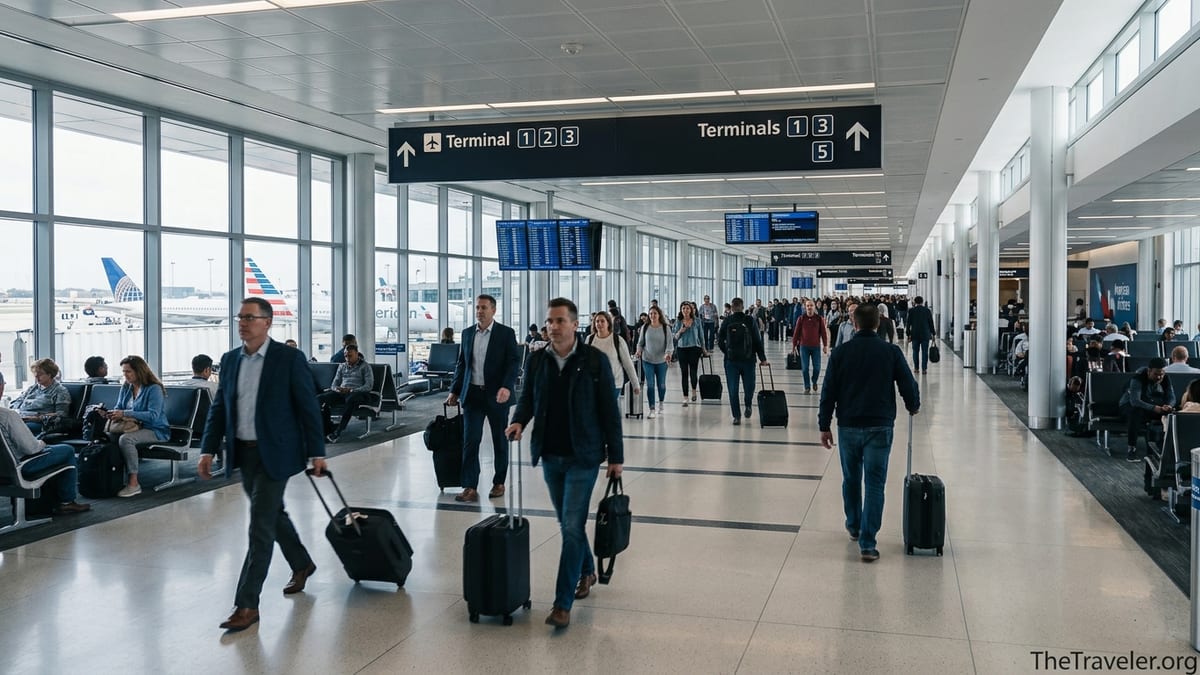
O’Hare at a Glance: How the Terminals Are Organized
Chicago O’Hare has four active passenger terminals: Terminal 1, Terminal 2, Terminal 3 and Terminal 5. Terminals 1, 2 and 3 are in one large horseshoe‑shaped building mainly handling domestic flights plus some international departures. Terminal 5 sits separately across the airfield and is the airport’s primary international terminal as well as the home for several domestic carriers.
If you are flying United, you will almost always use Terminal 1, occasionally Terminal 2. American Airlines primarily uses Terminal 3. Most other full‑service and low‑cost airlines, including Delta, Frontier and Southwest, operate out of Terminal 5 alongside many foreign carriers such as British Airways, Lufthansa and Qatar Airways. Exact assignments can vary slightly by route and season, so boarding passes and airport screens are always the final word.
For connections, the most important distinction is that Terminals 1, 2 and 3 are connected behind security, while Terminal 5 is not. You can walk between Terminals 1, 2 and 3 airside without needing to clear security again. To reach Terminal 5 from any of the others, you normally ride the Airport Transit System train and then pass through security in Terminal 5, or in some cases use an airside shuttle bus.
Because O’Hare is large, walking times can be significant. A typical walk from the far end of United’s Concourse C in Terminal 1 to American’s Concourse L in Terminal 3 can easily take 25 minutes at a normal pace, not including any time spent taxiing on arrival. When booking connections, try to allow at least 60 to 90 minutes if you are changing terminals, and longer if you need to clear immigration in Terminal 5.
Terminal 1: United’s Main Hub and Some International Flights
Terminal 1 is essentially United Airlines territory. United and United Express operate the vast majority of flights here, including many connections to smaller Midwestern cities such as Madison, Green Bay and Des Moines, as well as long‑haul services to destinations like Frankfurt, Tokyo and London. Lufthansa also uses Terminal 1 for many of its flights thanks to its close partnership with United.
Terminal 1 is split into two concourses, B and C. Concourse B runs along the main terminal building with large glass windows overlooking the roadway. Concourse C is a parallel pier accessed via an underground tunnel famous for its neon light installation and moving walkways. If you arrive on a regional jet in Concourse B and depart on a wide‑body to Europe in Concourse C, budget 10 to 15 minutes to walk between your gates, especially during peak times when the walkways are crowded.
Check‑in for United is on the upper level of Terminal 1. There are plenty of self‑service kiosks and bag‑drop counters, but morning bank departures to the East Coast and mid‑afternoon departures to the West Coast can produce long lines. Standard security here usually splits into several lanes, including TSA PreCheck and a dedicated lane for premium cabins and elite members. It is common for regular security wait times to reach 20 to 30 minutes during weekday peaks, while PreCheck often moves faster but can still back up.
Baggage claim for Terminal 1 is on the lower level. Domestic United flights coming from cities such as Denver or Houston will deliver luggage here. However, many United international arrivals, particularly those from non‑preclearance countries in Europe or Asia, are processed through Terminal 5 for immigration and customs before passengers rejoin the domestic terminal system. Some arrivals from Canadian and select Irish airports that have U.S. preclearance may arrive directly into Terminal 1, where you walk off the aircraft like a domestic passenger and go straight to baggage claim.
Terminal 2: A Transitional Space for United Partners and Regional Flights
Terminal 2 is smaller and somewhat older than Terminals 1 and 3, but it still plays an important role in O’Hare’s network. It mainly handles regional operations and partner airlines for United and other carriers. You will often find Air Canada flights to Toronto and Vancouver here, as well as some United Express and other regional services. Depending on the season and airline scheduling, certain Delta or Alaska flights may also be assigned to or from nearby gates, but many of those services have migrated to Terminal 5.
Inside Terminal 2, the primary concourses are E and F. These piers host a mix of narrow‑body jets and regional aircraft. Because gates are close together, Terminal 2 can feel congested during busy banks of departures, especially early in the morning. On the plus side, walking distances are modest compared with much of Terminal 3. Travelers connecting from a United flight in Terminal 1 to a regional Air Canada or United Express flight in Terminal 2 can typically make the walk airside in 10 to 15 minutes via clearly signed corridors.
Check‑in counters for airlines using Terminal 2 are on the upper level, with security screening nearby. Wait times here are often a bit shorter than in Terminals 1 and 3, simply because passenger volumes are lower, but this can vary depending on the time of day. If you arrive at O’Hare mid‑afternoon on a weekday and need to catch a regional connection out of Terminal 2, you will likely appreciate the smaller crowds and slightly calmer feel compared with the mainline hubs.
Baggage claim for Terminal 2 sits on the lower level beneath the ticketing hall. Domestic arrivals such as a United Express flight from Grand Rapids or an Air Canada flight from Montreal will typically send bags here. International arrivals without preclearance, however, still go through Terminal 5’s federal inspection area. If you connect from an international flight that ends in Terminal 5 to a regional departure from Terminal 2 on a separate ticket, plan to retrieve your luggage in Terminal 5, clear customs, then ride the Airport Transit System back to Terminal 2 and check in again.
Terminal 3: American Airlines Stronghold and Mixed Domestic & International
Terminal 3 is O’Hare’s largest terminal by number of gates and is dominated by American Airlines and American Eagle. It has four concourses: G, H, K and L. Gates in the G concourse often handle regional American Eagle flights to smaller markets such as Peoria or Sioux Falls, while H and K serve a mix of mainline domestic routes, including heavy traffic to hubs like Dallas Fort Worth, Miami and Phoenix. Concourse L handles both domestic and international departures, including American’s nonstop flights to cities such as London, Tokyo and various destinations in Mexico and the Caribbean.
Because American runs a dense schedule from O’Hare, Terminal 3 can be extremely busy throughout the day. The central rotunda area, where H, K and L diverge, is a focal point filled with restaurants and shops. If you are connecting from, say, a morning arrival from New York LaGuardia in Concourse H to a midday departure to Los Angeles from Concourse K, expect crowds at coffee lines and seating areas but relatively manageable walking distances of about 5 to 10 minutes between most gates in the same terminal.
American’s check‑in operation occupies much of the upper level roadway frontage at Terminal 3. There are dedicated zones for full‑service check‑in, self‑service kiosks, priority lanes for premium customers and oversized baggage. Security screening feeds multiple concourses, and during holiday periods standard lines here can rival those at Terminal 1, with waits sometimes approaching 30 minutes or more. TSA PreCheck and CLEAR are both available, which can cut that down substantially if you are enrolled.
Baggage claim for Terminal 3 handles a huge volume of domestic arrivals every day, from short hops within the Midwest to transcontinental services from Seattle or San Diego. Many of American’s international arrivals, however, now use Terminal 5 so that passengers can clear immigration there. After completing customs in Terminal 5, eligible connecting passengers can often recheck bags at recheck counters before heading to Terminal 3 for their onward domestic flight. As with United, some American flights from preclearance airports in Canada or Ireland may arrive into Terminal 3 as if they were domestic, letting you skip the Terminal 5 process entirely.
Terminal 5: International Gateway Plus Delta, Frontier and Southwest
Terminal 5, sometimes referred to by its concourse letter M, is O’Hare’s primary international terminal. Nearly all arriving international flights that have not precleared U.S. immigration overseas use Terminal 5, including services by airlines such as Aer Lingus, Air France, British Airways, Emirates, Japan Airlines, LOT Polish Airlines, Qatar Airways and many others. This is where travelers line up for passport control, collect checked bags, pass through customs inspection and then either exit to the arrivals hall or recheck bags for onward connections.
In addition to foreign carriers, several major U.S. airlines base their O’Hare operations in Terminal 5. Delta flies here instead of Terminal 2 or 3, including routes such as Chicago to Atlanta, Detroit and Salt Lake City. Frontier Airlines and Southwest Airlines also operate from Terminal 5, largely serving domestic leisure destinations like Denver, Las Vegas and Orlando. This means you can have purely domestic trips that still use Terminal 5 for both departure and arrival, even though the terminal is best known for international traffic.
Check‑in areas line the upper level roadway at Terminal 5, with separate zones for international carriers and for U.S. airlines like Delta, Frontier and Southwest. Security screening here serves both domestic and international departures. Because long‑haul flights often depart in waves during late afternoon and evening, security can become heavily congested at those times. If you are catching a Delta domestic flight from Terminal 5 around 5 p.m., you will be sharing the checkpoint with passengers headed to overnight flights to Europe and the Middle East, so arriving at least two hours before departure is wise.
Once you land in Terminal 5 from an international destination such as London or Tokyo, you follow signs to U.S. Customs and Border Protection. After clearing immigration and collecting your bags, you either exit into the public arrivals hall or, if you have a connecting domestic flight on a separate ticket, head upstairs to the Airport Transit System station. For passengers whose bags are checked through on a single itinerary with United or American, staff in the customs area often offer a recheck counter where you can hand over luggage before continuing on to domestic terminals. This can save you from hauling heavy suitcases onto the train.
Domestic vs International Flights: Where You Actually Arrive and Depart
For most travelers, the rule of thumb at O’Hare is straightforward: Terminal 5 handles the majority of international arrivals, plus some international and many domestic departures on non‑hub airlines. Terminals 1 and 3 are the big domestic hubs for United and American, respectively, but both also operate select international flights from their own terminals. Terminal 2 mainly supports regional and partner operations, with fewer true international services.
On United, many long‑haul departures to destinations such as Frankfurt or Tokyo leave from Terminal 1 so that connecting passengers can move easily between domestic and international gates without changing terminals. However, on the inbound journey, those same flights may arrive at Terminal 5 so that all passengers can clear immigration in a centralized facility. Once through customs, United passengers either exit O’Hare or proceed by Airport Transit System back to Terminal 1 for domestic connections. The same pattern often holds for American’s long‑haul operations from Terminal 3.
There are important exceptions. Flights from Canadian cities like Toronto or Vancouver or from certain Irish airports may use U.S. preclearance, where customs and immigration are completed before departure. In those cases, you often arrive in Terminals 1, 2 or 3 just like any other domestic flight, walking directly into the concourses without visiting Terminal 5. A traveler flying Air Canada from Toronto to Chicago and then connecting to a United flight to Phoenix, for example, could arrive into Terminal 2 airside and walk to Terminal 1 without ever seeing passport control at O’Hare.
Because airline terminal assignments can shift, especially during renovations or seasonal schedule changes, it is always prudent to double‑check your flight details shortly before travel. For instance, Southwest and Frontier only relatively recently began using Terminal 5, which means older articles and maps may still show them elsewhere. Your boarding pass, airline app and the airport’s live departure displays will confirm exactly where you need to go on the day.
Check‑In, Baggage Claim and Security: What to Expect in Each Terminal
Check‑in at O’Hare varies widely by airline and time of day. United in Terminal 1 and American in Terminal 3 each occupy large zones with long rows of self‑service kiosks and staffed counters. At peak times, such as Monday mornings for business travelers or Friday afternoons for leisure departures, lines can extend far into the ticketing hall. Using your airline’s app to check in before you arrive and printing your boarding pass or loading a mobile pass can save time, especially if you also qualify for bag‑drop lanes.
In Terminals 2 and 5, check‑in areas are typically more compact, with multiple carriers sharing space. You might see Delta, Frontier and a European airline counter side by side in Terminal 5. Because many long‑haul flights check in earlier in the day, mid‑morning hours can be calmer, while late afternoon sees large queues for overseas departures. If you are departing domestically from Terminal 5 on Delta around the same time as several evening flights to Europe, it pays to arrive earlier than you would for a typical domestic leg.
Baggage claim in each terminal is located on the lower roadway level. Terminals 1, 2 and 3 have separate claim halls, each with carousel numbers corresponding to arriving flights that day. Screens in the baggage hall show which carousel handles your flight, but ground agents will also announce changes for flights with many connecting passengers. Terminal 5’s baggage hall is integrated with customs. After clearing immigration, you collect bags from the belts designated for your inbound flight and proceed to the customs exit. Only then do you emerge into the public arrivals area where friends and family meet passengers.
Security procedures are broadly similar in all terminals. Standard lanes require shoes off and laptops out of bags unless you are in an upgraded screening lane. TSA PreCheck and CLEAR are available in multiple terminals. During early morning and late afternoon peaks, security lines in Terminals 1 and 3 can swell significantly. For example, a traveler arriving by rideshare at 6:30 a.m. for a 7:45 a.m. American flight might encounter a 20‑ to 30‑minute standard line, compared with 10 minutes or less at 9:30 a.m. Building a time buffer for security, especially if you are unfamiliar with the terminal layout, is one of the simplest ways to reduce stress.
Getting Between Terminals: Walking, Trains and Airside Transfers
Moving between Terminals 1, 2 and 3 is relatively straightforward because they sit in one continuous building. Inside security, you can walk from one terminal to another using wide connecting corridors. Signs overhead clearly point to other concourses, and moving walkways help cover longer distances. Walking from the middle of Terminal 1’s Concourse B to the center of Terminal 3’s Concourse H usually takes around 15 minutes at a moderate pace, though crowds during rush periods may slow you down.
To reach Terminal 5 from any other terminal, most passengers use the Airport Transit System, an automated train that loops between Terminals 1, 2, 3, 5 and the main parking and rental car centers. The ride between Terminal 1 and Terminal 5 typically takes about 8 to 10 minutes, but you should budget extra time for waiting on the platform, especially late at night when trains may run less frequently. The train is free, and elevators and escalators connect the platforms to terminal levels, which is helpful if you are hauling multiple suitcases.
For some international connections, airlines and the airport operate airside transfer buses that shuttle passengers between certain concourses and Terminal 5 without requiring them to go through security again. For example, United may direct international connecting passengers arriving at Terminal 5 to take a secure shuttle to Terminal 1, while American can sometimes route its international customers from Terminal 5 to Terminal 3. These services are typically reserved for travelers on a single itinerary whose baggage is checked through, and they follow specific operating hours. Gate agents and posted signs in the customs hall will indicate whether such an option is available for your connection.
Travelers arriving in Terminal 5 who booked separate tickets or who need to change airlines entirely, such as landing on a European carrier and then flying out on Southwest, must exit customs into the public area, go upstairs to the Airport Transit System and ride to the new terminal. From there, they head to ticketing, recheck bags and clear security again. In this scenario, layovers of less than two hours can feel tight, particularly during busy immigration periods. Padding your connection time to three hours or more is wise if you have to fully reclaim and recheck luggage between terminals.
The Takeaway
Chicago O’Hare’s four terminals each serve a distinct role, and understanding those differences can make your itinerary smoother and less stressful. Terminals 1 and 3 are the powerhouses for United and American, with a mix of domestic and international flights and heavy connecting traffic. Terminal 2 supports regional and partner services in a more compact space, while Terminal 5 concentrates most international arrivals and hosts a diverse mix of foreign and domestic airlines, including Delta, Frontier and Southwest.
For domestic travelers, the most practical considerations are which airline you fly and how much time you allow for connections. Staying within a single terminal, such as United to United in Terminal 1 or American to American in Terminal 3, is usually straightforward. Crossing between terminals, especially when Terminal 5 and immigration are involved, demands more generous layover times and a clear plan for using the Airport Transit System or possible airside shuttles.
By visualizing where you will check in, how you will move between concourses and when you might need to reclaim and recheck bags, you can turn O’Hare from a confusing maze into a predictable part of your trip. Check your airline’s terminal assignment close to departure, build in a time buffer for security and connections, and you will be well prepared to navigate Terminals 1, 2, 3 and 5 with confidence.
FAQ
Q1. Which terminal does United Airlines use at Chicago O’Hare?
United Airlines primarily uses Terminal 1 at O’Hare, with some regional and partner operations in Terminal 2. Most United domestic flights and many international departures leave from Terminal 1’s B and C concourses.
Q2. Which terminal does American Airlines use at Chicago O’Hare?
American Airlines and American Eagle mainly operate from Terminal 3, using Concourses G, H, K and L. Most American domestic flights depart and arrive here, along with many of its long‑haul international departures.
Q3. What is Terminal 5 used for at O’Hare?
Terminal 5 is O’Hare’s primary international terminal and handles most international arrivals for customs and immigration. It also serves several domestic carriers, including Delta, Frontier and Southwest, plus many foreign airlines.
Q4. Do all international flights arrive at Terminal 5?
Nearly all international flights that have not precleared U.S. immigration arrive at Terminal 5. Exceptions include some flights from Canadian and Irish airports with preclearance, which may arrive directly into Terminals 1, 2 or 3 like domestic flights.
Q5. Can I walk between Terminals 1, 2 and 3 without going through security again?
Yes. Terminals 1, 2 and 3 are connected behind security by walkways and corridors, so you can walk airside between them if you remain within the secure area and your boarding passes allow.
Q6. How do I get from Terminal 5 to Terminal 1, 2 or 3?
Most passengers use the free Airport Transit System train, which connects Terminal 5 with Terminals 1, 2 and 3. You ride the train, then go through security in your new terminal. Some eligible connecting passengers may be offered an airside shuttle bus.
Q7. How much time should I allow for an international to domestic connection at O’Hare?
For connections that require immigration and customs in Terminal 5, a layover of at least two hours is advisable, and three hours is safer, especially if you must reclaim and recheck luggage or change airlines.
Q8. Where will I claim my bags at O’Hare?
For domestic flights, you claim baggage in the lower‑level halls of the terminal where you arrive: Terminals 1, 2 or 3. For most international arrivals, you collect bags in Terminal 5 after immigration before exiting customs.
Q9. Is security faster in any particular terminal?
Security wait times vary by time of day more than by terminal. Terminals 1 and 3 can be busiest due to United and American’s large operations. Having TSA PreCheck or CLEAR usually speeds things up in any terminal.
Q10. Does Southwest use Terminal 5 at Chicago O’Hare?
Yes. Southwest Airlines operates from Terminal 5 at O’Hare. Even though Southwest mainly flies domestic routes, its Chicago O’Hare flights depart from and arrive at Terminal 5 alongside many international services.