


Landing at Chicago O’Hare and heading downtown is one of the most common trips visitors make in the city. With new flat taxi fares, evolving rideshare rules, and the ever-reliable Blue Line train, it can be confusing to know when a traditional cab is the smartest choice. This guide walks you step by step through finding the official taxi ranks at O’Hare, what you should expect to pay into downtown in 2026, how hotel locations affect your fare, and when a taxi beats the train for comfort, time, and safety.
Get the latest updates straight to your inbox!
How O’Hare Taxis Work in 2026
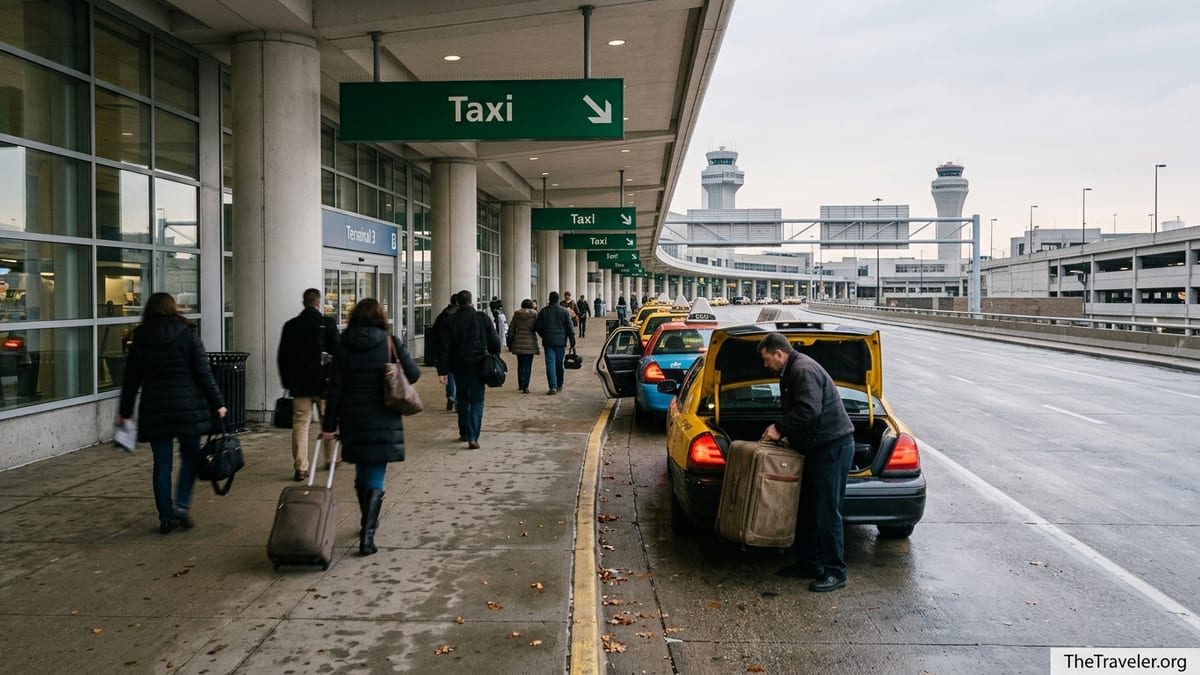
Chicago’s official city taxis remain one of the most straightforward ways to reach downtown from O’Hare International Airport. You do not need to book ahead, and you will find a steady stream of licensed cabs at each terminal throughout the day and night. Vehicles are typically yellow or other bright colors with a roof light, city medallion number, and “Taxi” markings on the doors. They are regulated by the City of Chicago, which sets the meter rate, flat airport fares, and mandatory surcharges.
In 2026, most journeys from O’Hare into central Chicago use a city-regulated flat fare, which replaces the old fully metered system for typical airport trips. The headline figure many visitors care about is the flat rate from O’Hare to the Loop, the traditional downtown core. Recent guidance and fare calculators put that flat fare in the low 50 dollar range for a standard taxi to central downtown, with additional small surcharges for airport departure, rush hours, or overnight travel. This removes much of the anxiety over being stuck in traffic on the Kennedy Expressway and watching the meter climb.
Every official taxi leaving O’Hare also carries an Illinois airport fee on top of the base price. On typical city taxis, this is a fixed state departure fee added per trip that the driver must include in the final fare. You may also see minor extras, such as a small credit card processing fee and any tolls if the driver uses a tollway route to avoid congestion. Drivers are required to display a placard in the back seat listing the current meter rate, flat airport ranges, and all surcharges so you can double check before setting off.
Payment is straightforward. By regulation, Chicago taxis that serve the airport must accept credit and debit cards as well as cash. Major cards are processed through an in-car terminal; contactless payments are increasingly common but not universal, so you should still be prepared to insert or swipe. Tipping around 15 to 20 percent for good service is standard practice. If the trip was unusually fast in heavy traffic, the driver loaded several large suitcases, or you arrived late at night, most locals lean closer to 20 percent.
Finding the Official Taxi Ranks at Each O’Hare Terminal
The key to a stress free taxi ride from O’Hare is going directly to the official taxi rank instead of following a driver who approaches you inside the terminal. At O’Hare, legitimate city cabs line up on the lower level (arrivals) outside baggage claim at each terminal. Overhead signs inside the airport direct you toward “Ground Transport” and “Taxi” as soon as you exit the secure area.
If you arrive at Terminals 1, 2, or 3, which handle most United, American, and domestic flights, you will collect your luggage on the lower level and then walk straight outside to the curb. The taxi ranks are located just beyond the sliding doors under green “Taxi” signs. Uniformed airport employees often manage the line, directing you to the next available cab. You simply join the short pedestrian queue and wait until they wave you forward. In busy evening peaks, the passenger line can be 10 to 20 parties deep but usually moves steadily because taxis arrive in a continuous stream.
International and many foreign carriers use Terminal 5, which sits slightly apart from the main terminal core. After clearing immigration and customs, exit into the public arrivals hall and follow the signs for “Ground Transport” and “Taxi.” The main taxi rank is outside Door 5E on the lower level, directly in front of arrivals. For travelers connecting from Terminals 1, 2, or 3 to meet friends at Terminal 5, the free Airport Transit System train runs every few minutes and drops you a short walk from the taxi stand.
You should ignore anyone who approaches you inside the terminal offering a taxi or “cheap ride.” Official signage at O’Hare repeatedly warns against accepting rides from solicitors, as they may be unlicensed, uninsured, or priced far above regulated fares. As a rule, only walk to the marked curbside taxi ranks or to a prearranged pickup point if you have booked a private car service in advance. This simple habit eliminates most common scams that still catch tired international visitors off guard.
What You Should Expect to Pay: Fares, Surcharges, and Real Examples
For many visitors, the most practical question is what a taxi from O’Hare to downtown will actually cost in 2026. Official guidance and recent airport transfer resources suggest that the city’s flat rate from O’Hare to the Loop is just above 50 dollars for a standard cab, before tip. With surcharges and a modest gratuity, most travelers can expect to pay somewhere in the 60 to 70 dollar range for a straightforward trip to a central hotel in good traffic.
To understand how this plays out, imagine a midafternoon arrival at Terminal 3, heading to a well known hotel like the Palmer House or a business tower on LaSalle Street in the Loop. The flat fare to the Loop covers the distance into central downtown. On top of that, the taxi meter system adds the Illinois airport departure fee automatically. If you are traveling during the published rush hour window in late afternoon, a rush hour supplement also applies. With no tolls and payment by credit card, your final total often comes out at roughly 63 to 70 dollars including a 15 to 20 percent tip.
If your destination is closer to the northern edge of downtown, such as a hotel in River North near the Merchandise Mart, expect a similar total. Some routes may be slightly shorter but experience heavier traffic turning off the expressway, in which case the value of the flat fare becomes more obvious on a bad traffic day. For example, drivers sometimes detour via Ohio Street or Lower Wacker Drive; your price does not balloon with every extra minute in traffic because the base flat rate still anchors the cost.
Trips that stretch south of the Loop or into popular lakefront areas may cost a little more but remain in roughly the same band. Heading from O’Hare to a hotel in the South Loop near McCormick Place, or to a trendy stay in the West Loop near Randolph Street, often pushes the metered portion slightly, particularly if congestion is heavy on local streets. In these cases, visitors frequently report final fares in the upper 60s to low 70s after tip, still competitive with surge priced rideshare services on busy convention or game days.
Downtown & Hotel Zones: How Your Destination Affects the Fare
Chicago’s downtown is larger than one central square, so it helps to think in rough hotel zones when estimating your O’Hare taxi cost. The classic “Loop” sits inside the elevated train tracks that form a ring around the central business district. Many business hotels, such as those near the Willis Tower, the Board of Trade, and Millennium Park, fall inside this compact area. Journeys to Loop addresses tend to track closest to the published flat fare examples.
Immediately north of the river, River North and the Magnificent Mile make up Chicago’s premium shopping and dining strip. Hotels like those near Michigan Avenue, the historic Water Tower, or on State Street remain well within a similar fare band to the Loop. In typical conditions, the difference between a taxi to the Palmer House in the Loop and one to a hotel near the John Hancock Center is modest, often just a few extra dollars compared with the Loop figure, plus the same airport and time of day surcharges.
West of the Loop, neighborhoods like the West Loop and Fulton Market have become major hotel and dining destinations. Reaching a boutique property on Randolph Street or a converted warehouse hotel near the old meatpacking area involves a slightly more complex surface route once the cab leaves the expressway, especially during dinner hours. The distance from O’Hare is just a bit longer than a classic Loop address, so fares land at the upper end of the downtown range. Many travelers find that a taxi still beats rideshare on reliability when evening events generate severe surge pricing.
If you are staying farther afield, such as in Hyde Park near the University of Chicago or in a north side neighborhood like Lincoln Park or Andersonville, you will move beyond the typical downtown flat rate comparisons and into longer trips that take noticeably more time. At that point, a visitor might compare the cost of a direct taxi against a combination of Blue Line plus a short rideshare or local cab. For example, a guest flying into O’Hare and staying in Lincoln Park might ride the Blue Line to the Clark/Lake station, then take a rideshare north for the final leg, often saving 20 to 30 dollars versus a door-to-door cab from the airport while adding a transfer and some luggage handling.
Luggage, Group Size, and Late-Night Arrivals
Luggage and group size are where taxis from O’Hare often start to shine relative to the Blue Line. A standard Chicago taxi can comfortably handle two large checked suitcases and two smaller carry-ons in the trunk while seating up to four passengers, though space in the rear seat gets tight with three adults and bulky bags. For families or small groups with a stroller, sports gear, or multiple large cases, a taxi saves a great deal of hauling up and down escalators and through station gates.
Consider a family of four arriving on an evening transatlantic flight at Terminal 5 with two big checked bags and a couple of backpacks. The idea of getting everyone to the Blue Line station at O’Hare, managing tickets at the Ventra machines, and then standing on a crowded train for 40 minutes may feel daunting. In this scenario, a taxi straight from the Terminal 5 rank to a hotel near Millennium Park costs more than the train but usually delivers them door to door in about the same overall time, with far less strain and uncertainty after a long flight.
Late night arrivals are another moment when taxis hold an advantage over rail. The Blue Line operates 24 hours, but overnight frequencies drop and station platforms can feel quiet. Visitors who are unfamiliar with Chicago, traveling alone, or carrying expensive equipment often report feeling more comfortable taking a licensed taxi directly to their hotel after midnight. Drivers are used to late arrivals and will typically help with luggage at both ends, particularly if you tip at the upper end of the standard range.
For those landing during brutal winter weather, a taxi also keeps your time outdoors minimal. On subzero nights with lake effect snow, simply stepping from the baggage hall to a waiting cab at the lower level can be a major comfort upgrade compared with waiting on an exposed train platform or changing at a downtown station with icy sidewalks. In January and February, when Chicago’s climate is at its harshest, this convenience is often worth the extra cost to many visitors who just want a warm, direct ride.
Taxi vs Blue Line: When a Cab Is the Better Choice
The CTA Blue Line is a workhorse connection between O’Hare and downtown, running roughly every few minutes during the day and every 10 to 15 minutes overnight. The ride into the Loop typically takes about 40 to 45 minutes. The standard fare from O’Hare is higher than a regular city ride because it incorporates a specific airport surcharge, but it still undercuts most taxi journeys by a wide margin, especially for solo travelers without much luggage.
However, there are many situations where a taxi is the better choice despite the higher fare. If your hotel is not near a Blue Line station or requires one or two additional transfers, a taxi often becomes competitive in total travel time. For example, a traveler staying in the South Loop near McCormick Place would need to take the Blue Line to the Loop and then either transfer to the Green Line or catch a bus or rideshare. In heavy traffic, a taxi from O’Hare to McCormick Place might take 35 to 50 minutes door to door and cost around the upper 60s including tip, but avoids juggling tickets, platforms, and transfers with luggage.
Time of day matters, too. During the morning and evening peaks, the Kennedy Expressway between O’Hare and downtown regularly slows to a crawl. In those windows, the Blue Line often runs as quickly or faster than taxis because it bypasses traffic entirely. Yet at very early or very late hours when road traffic thins out, a taxi can cover the same distance significantly faster than the train, sometimes delivering you from Terminal 1 to a Loop hotel in around 25 to 30 minutes. Visitors arriving on a tight schedule for a business meeting or performance may judge the extra cost worth paying.
Comfort and environment also differentiate the two options. Taxis offer private space, air conditioning or heating tailored to your preference, and a direct route without intermediate stops. The Blue Line, while generally safe and widely used, is a public transit line with standing passengers, periodic delays, and the usual mix of city life. Travelers carrying sensitive work equipment or those who simply prefer a quieter, more controlled environment after a long flight often choose a taxi from the airport even if they happily ride the train during the rest of their stay.
Practical Tips to Avoid Problems and Save Money
A few simple habits can make your taxi ride from O’Hare smoother and more predictable. Before leaving home, store your hotel’s full address on your phone or write it down on paper, including the street number and neighborhood if it is not a well known downtown property. Chicago’s river, diagonal streets, and multiple “downtowns” can confuse even experienced drivers if you only know the hotel’s name. Showing the exact address on your phone screen as you get in helps the driver choose the right expressway exit and local streets from the outset.
When you reach the taxi rank, glance at the posted fare information near the queue or in the back seat once you sit down. If the driver mentions a price that seems far above the city’s quoted range for downtown, you can politely ask to confirm that the flat fare and airport fee are being used according to city rules. Most drivers work by the book and may even explain the likely route and estimated total up front if you ask. If a quote feels unreasonable, you can step out of the cab before it leaves the stand and take the next one in line.
Travelers looking to save money can also consider hybrid strategies. A solo visitor arriving at midday might take the Blue Line to a central station like Clark/Lake, then transfer to a short taxi or rideshare for the final mile to a riverfront or lakefront hotel. This combination still allows you to avoid the higher airport departure fees that attach to cars leaving O’Hare, while limiting your time dragging luggage through the system. For parties of three or four adults, though, the math often flips and a taxi from the airport can become comparable per person to four individual Blue Line tickets.
Finally, be sure to keep your receipt. Official Chicago taxis can print a small paper slip that lists the cab number, date, and fare. This is useful both for expense claims and in the rare case you leave a phone or passport on the back seat. The city and many large fleets have lost property procedures that depend on knowing the cab number and approximate trip time. Ask the driver for a receipt before you step out, and double check the rear seat and floor for small items before closing the door.
The Takeaway
Getting from Chicago O’Hare to downtown by taxi in 2026 is simpler than many visitors expect. Official taxi ranks at each terminal provide a constant supply of licensed vehicles, all operating city regulated flat fares and meters that give you a predictable price to most central hotels. While the Blue Line remains the budget champion and a favorite of light packing solo travelers, taxis offer comfort, privacy, and door to door service that shine when you have heavy luggage, are traveling in a group, or arrive late at night or in rough winter weather.
If your hotel sits in the Loop, River North, or along the Magnificent Mile, expect your taxi fare from O’Hare to land in a predictable band that most recent travelers report as the low 60s to low 70s including tip, depending on surcharges and traffic. For South Loop, West Loop, and other near downtown neighborhoods, fares rise modestly but remain competitive with peak rideshare pricing and more convenient than complex train transfers. By heading straight to the official taxi stands, checking the posted fare card, and keeping your hotel address handy, you can step off the plane and into the city center with minimal hassle.
FAQ
Q1. How much does a taxi from O’Hare to downtown Chicago cost in 2026?
Most travelers pay somewhere in the 60 to 70 dollar range including tip for a standard taxi from O’Hare to a central downtown hotel, depending on surcharges and traffic.
Q2. Where exactly do I find the taxi rank at O’Hare?
At Terminals 1, 2, and 3, taxis line up on the lower level outside baggage claim under green “Taxi” signs. At Terminal 5, follow signs to Ground Transport and taxis wait outside Door 5E on the arrivals level.
Q3. Do Chicago airport taxis accept credit cards?
Yes. City regulated taxis serving O’Hare are required to accept major credit and debit cards. A small processing fee may appear on the meter, and tipping is still customary.
Q4. Is it safe to arrive late at night and take a taxi from O’Hare?
For most visitors, taking an official taxi from the airport rank is considered a safe option at any hour. Late night arrivals often prefer a cab over the train for comfort and direct door to door service.
Q5. How long does the taxi ride from O’Hare to downtown usually take?
In light traffic, taxis can reach downtown in about 25 to 35 minutes. During rush hours or heavy construction on the expressway, the journey can stretch to 45 minutes or more.
Q6. When is it better to take the Blue Line instead of a taxi?
The Blue Line is a smart choice if you are traveling alone or as a couple with light luggage, arrive during rush hour when traffic is severe, or have a hotel near a Blue Line station in the Loop.
Q7. Are there extra charges on top of the flat fare from O’Hare?
Yes. Expect an Illinois airport departure fee, possible rush hour or overnight surcharges, a small credit card fee, and any tolls if the driver uses a tollway, all visible on the fare card.
Q8. Can I prebook an official city taxi from O’Hare to downtown?
Most standard Chicago taxis work from the airport ranks without advance booking. If you want a guaranteed vehicle type or meet and greet service, you would usually book a private car or limousine rather than a regular cab.
Q9. What should I do if a driver offers an off meter or unmarked ride?
Politely decline and walk to the official taxi rank. Licensed taxis have clear markings, a visible meter, and a posted fare card. Avoid unmarked cars and anyone soliciting rides inside the terminal.
Q10. Is a taxi cheaper than rideshare from O’Hare?
On calm days, rideshare can be similar or slightly cheaper, but during peak times, bad weather, or major events, surge pricing can make a regulated taxi fare equal to or better than many rideshare quotes.