


Copenhagen Airport (CPH) is one of Scandinavia’s busiest hubs, and its parking system reflects that scale. For drivers, the mix of short-stay car parks, long-stay budget lots, drop-off zones and online-only offers can feel confusing, especially on an early-morning departure or late-night arrival. This guide walks you through how parking works at CPH in 2026, with clear explanations of each option, realistic example prices and concrete tips to save time and money.
Get the latest updates straight to your inbox!
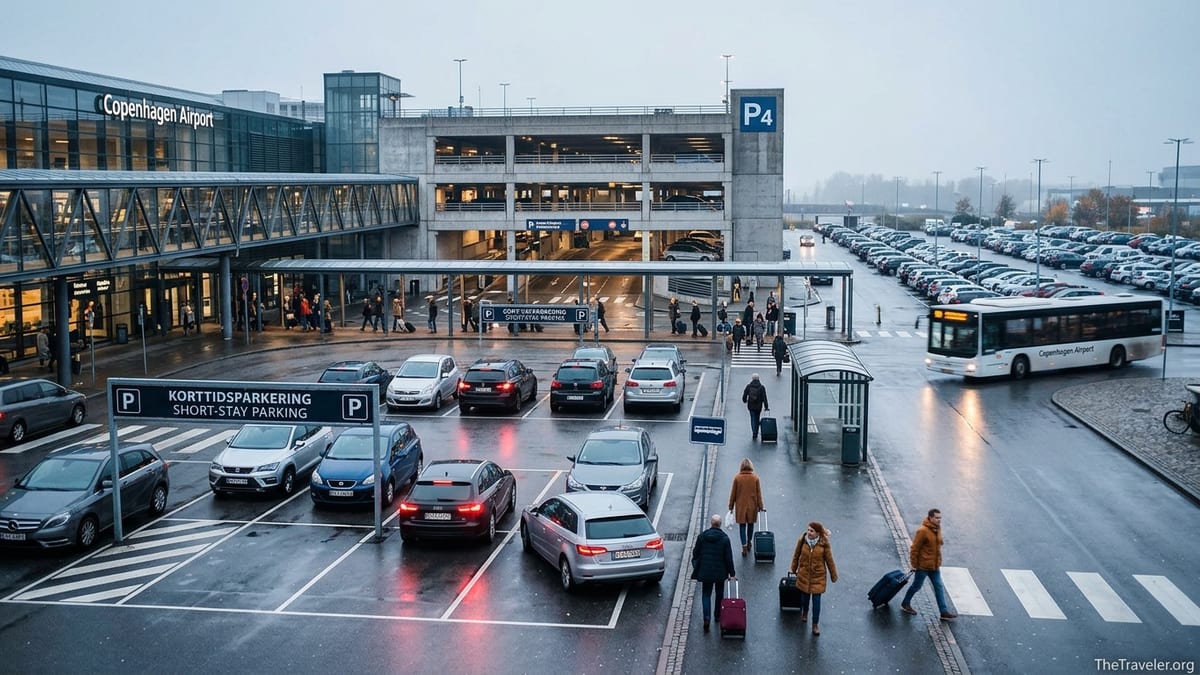
How Copenhagen Airport Parking Is Organized
Parking at Copenhagen Airport is divided into a few main categories: Direct parking closest to the terminals, Standard parking a short walk away, and Budget parking in the outer lots served by shuttle buses. Within those categories you will also find dedicated short-term areas for quick pickup and drop-off, as well as a few premium services for travelers who want valet-style convenience. The system is designed so that the more you pay, the shorter your walk to Terminals 2 and 3.
For most international passengers, Terminals 2 and 3 are the key reference points. The multi-storey car parks P4, P6, P7b and P8 sit very close to these terminals and fall under the Direct category, while Budget lots such as P15, P17 and P19 are further away with shuttle-bus connections. The airport publishes a live map of its parking areas and regularly updates pricing tables, and those prices for official car parks were revised for 2026. In practice that means you should always treat any prices you see on older blogs or forums as rough guidance only.
To illustrate the layout, imagine you are dropping a family off for a summer flight to Barcelona. If you choose Direct parking in P4, you can drive straight into a covered structure attached to Terminal 3 and have your passengers inside the check-in hall in a couple of minutes. If you prefer to save money, you might instead book Budget parking in P15, leave the car there and ride the free shuttle bus for around 5 to 7 minutes to reach the same terminal entrance.
Inside the airport, clear blue-and-white signage points you to each parking zone, and the main access roads are designed to feed you either toward the short-stay and Direct car parks beneath and beside the terminals, or onward to the Budget and long-stay areas. The key to a smooth experience is deciding in advance what trade-off you want between price and walking distance, then following the signposts for that particular zone rather than improvising at the last minute.
Short-Stay Parking for Pickups and Quick Visits
Short-stay parking at Copenhagen Airport is aimed at drivers who need to be in the terminal for less than a couple of hours, whether to greet arriving passengers, help with luggage or join colleagues for a meeting. The airport offers clearly signed short-term sections in the car parks closest to the arrivals halls, typically in or adjacent to the Direct parking structures near Terminals 2 and 3. These areas charge relatively high hourly rates but keep walking times to a minimum.
As of 2026, short-stay pricing at the official car parks is structured so that the first hour or two are comparatively expensive, then the cost per hour gradually drops as you approach a full day. A typical pattern is paying a double-digit amount in Danish kroner for the first 30 minutes in a Direct garage under the terminals, with additional time billed in short increments. Travelers who only need a 45-minute window to meet someone at the arrivals exit often find that paying for one or two hours of Direct short-stay parking is worthwhile because it avoids waiting in the car or circling the terminal access roads repeatedly.
Consider a real-world scenario: you are picking up relatives arriving from North America in the evening. Their flight time is long and delays are possible, but once they arrive it may take them 30 to 45 minutes to clear passport control and collect checked bags. In this situation, you could park in a short-stay area of P4 or P6, walk directly into Terminal 3, check the overhead arrival boards, and then wait just outside customs. The extra few kroner spent in short-stay parking buys peace of mind and avoids the stress of trying to time your arrival to the minute.
Short-stay parking is also a practical option for those using the airport as a transport hub without flying. For example, some residents of southern Sweden drive to CPH, park for a couple of hours and then take the train into central Copenhagen for meetings. In these cases, using a Direct or Standard short-stay car park near Terminal 3 provides easy access to the railway station beneath the terminal, with the car close at hand for the return trip across the bridge.
Long-Stay and Budget Parking for Trips of Several Days
For trips lasting several days or longer, Copenhagen Airport’s Budget and long-stay car parks offer far better value than the premium Direct garages under the terminals. The main economy option is the Budget category, which in 2026 includes outdoor lots such as P15, P17 and P19. These car parks are located a short distance from the terminals and connected around the clock by free shuttle buses. Journey time between a Budget lot and the terminal buildings is typically in the region of 5 to 7 minutes, not including waiting time.
The airport’s own information for 2026 indicates that Budget parking is the cheapest official option for travelers who are away for several days, with prices calculated per day and often significantly lower than Direct or Standard alternatives for stays of a week or more. Some of the Budget car parks can only be used with an online reservation, and the airport specifies a minimum stay duration for certain lots, for example requiring at least four days of parking in P17 or P19 when booked online. This is an important detail to check if you are planning a long weekend rather than a two-week holiday.
In practice, Budget parking works like this: a family flying to Thailand for two weeks books a space in P15 through the airport’s website before departure. On the day of travel they drive straight to the P15 entrance, scan the QR code or registration that the booking confirmation provided, park in an open-air space, and then go to the nearest shuttle stop. A branded shuttle bus arrives every few minutes and drops them off outside Terminal 2 or 3, from where they proceed to check-in. On their return, they simply take the shuttle back to P15, load the car and drive out through the automated barrier.
For slightly shorter trips, some travelers choose the Standard or Direct car parks if they value covered parking and a shorter walk more than the absolute lowest price. For example, a business traveler leaving on Monday and returning Wednesday might book a Direct space in P8, paying more per day than Budget but avoiding shuttle buses altogether. The decision often comes down to the total number of days, the time of day you arrive and depart, and your tolerance for adding an extra 10 to 20 minutes to your overall journey for shuttle transfers.
Drop-Off, Pickup and Kiss & Fly Zones
Like many major European hubs, Copenhagen Airport uses designated areas for quick drop-off and pickup to keep traffic moving and reduce congestion at the terminal curbs. These areas are often described as Kiss & Fly or short-stay drop-off zones. They are typically located on the access roads directly outside the departures and arrivals levels of Terminals 2 and 3, with bright signage indicating where stopping is permitted and for how long.
Rules for these Kiss & Fly areas generally allow very short stops so passengers can exit or enter the vehicle, unload luggage and say goodbye, but they do not permit drivers to leave the car unattended. In practice, that means you can pull up at the marked area, open the boot, help with bags at the side of the car and give a quick farewell or welcome hug, but you cannot park and walk into the terminal for coffee. Enforcement is usually handled by a combination of cameras and on-site staff who monitor vehicles that linger too long or are left without a driver.
Different airports adjust their Kiss & Fly policies over time, often introducing charges for longer stops or for entering certain lanes. Copenhagen Airport has followed this broader European trend by managing the terminal-front traffic more actively and encouraging anyone who expects to wait or spend more than a few minutes at the terminal to use the nearby short-stay car parks instead. In practical terms, if you know your arriving passenger has to clear passport control and collect checked baggage, it is usually wiser to park properly in a short-stay area and walk into the terminal rather than circling the Kiss & Fly lane multiple times.
As an example, imagine you are collecting a friend whose flight is due at 08:30, but you know from experience that morning arrivals can face queues at border control. Rather than pulling into the Kiss & Fly lane at 08:30 and risking being moved on repeatedly, you could aim to park in short-stay at about 08:40 or 08:45, then follow the signs to the arrivals hall. If their flight is delayed by 20 minutes, you will still be comfortably within a one- or two-hour parking window and can meet them as they exit customs, rather than idling in your car and worrying about time limits.
Online Booking, Apps and Payment Options
Copenhagen Airport strongly encourages drivers to book parking online in advance, particularly for the Budget and long-stay car parks. This is partly because demand is high during peak travel periods such as school holidays, and partly because advance booking allows the airport to offer more attractive prices compared with simply driving up to the barrier on the day. In 2026, some Budget lots like P17 and P19 are explicitly available only with online reservations and have minimum-stay requirements.
The booking process typically involves choosing your arrival and departure dates and times on the airport’s website, selecting a parking product such as Budget, Standard or Direct, and then entering your vehicle registration details and payment information. Many travelers find that booking even a few days ahead can result in noticeable savings, especially for stays of four days or more. For example, an early-booked Budget stay from Friday to the following Sunday is usually priced lower than paying at the gate for Direct parking for the same period, even before accounting for the higher daily rate of the closer garages.
On arrival, most official car parks at CPH use automatic number plate recognition or QR codes to open the barrier, meaning there is no need to collect a physical ticket. Payment is often handled entirely online, either at the time of booking or via a customer account that charges your registered payment card when you exit. For drivers who prefer more traditional methods, it is still usually possible to pay with a credit or debit card at payment machines in or near the car parks before returning to your vehicle.
The airport also promotes the use of mobile tools such as its own app to manage parking. Through such apps, travelers can often check which car parks currently have available spaces, view guidance on walking distances to the terminals and sometimes extend their parking session if their return flight is delayed. This can be useful if, for instance, a winter storm causes your evening arrival to be pushed back by several hours and you need to know that your long-stay parking reservation will comfortably cover the additional time.
Terminal Access, Walking Times and Shuttle Buses
One of the main advantages of paying for Direct or Standard parking at Copenhagen Airport is the short and predictable walk to the terminals. The multi-storey car parks nearest Terminals 2 and 3 are connected to the passenger buildings either directly or via covered walkways, and walking times are typically in the range of 2 to 5 minutes from car to check-in for most spaces. For travelers with heavy luggage, small children or mobility issues, those few minutes can make a significant difference.
In contrast, Budget and long-stay lots such as P15, P17 and P19 rely on shuttle buses to bridge the distance to the terminals. These shuttle services run around the clock, with buses looping between the car parks and the terminal forecourts, stopping at clearly marked points. The ride itself generally takes about 5 to 7 minutes, though you should allow extra time in your schedule for waiting, especially at off-peak hours or during severe weather. As a rule of thumb, drivers using Budget parking are wise to add at least 20 minutes to their usual airport arrival time compared with Direct parking.
For example, if you typically aim to arrive at the terminal 2 hours before a European departure when being dropped off, you might want to arrive at your Budget car park 2 hours and 20 or even 2 hours and 30 minutes ahead when you are driving yourself. That buffer allows for finding a space, walking to the nearest shuttle stop, waiting for the next bus and then riding to the terminal. Travelers catching early-morning flights around 07:00 should be particularly careful to factor in this extra time, as queues at security can be longer during the first bank of departures.
Passengers using the airport’s rail and metro connections should note that Terminal 3 is the main hub for public transport. The mainline railway station sits immediately beneath the terminal, while the metro station is just outside, connected by escalators and lifts. Drivers who plan to park and then continue by train or metro to the city center often prefer Direct parking close to Terminal 3, since this keeps the walk with luggage short and straightforward. The same logic applies for passengers arriving by car from elsewhere in Denmark or Sweden who then meet tour buses or long-distance coaches around the airport.
Cost-Saving Strategies and Practical Tips
Parking at a major European hub is never cheap, but there are several practical ways to keep costs under control at Copenhagen Airport without sacrificing too much convenience. The first step is to decide honestly how close you really need to be to the terminal. For most leisure trips lasting a week or more, Budget parking in lots like P15 or P19 offers the best compromise between price and convenience, especially when booked online. While daily rates fluctuate, airport information consistently positions Budget products as the most economical choice for stays beyond a couple of days.
Another money-saving tactic is to book as early as possible, particularly for peak travel periods such as summer holidays, Christmas and autumn breaks. During these times the cheapest Budget categories can sell out, leaving only higher-priced Direct or Standard options available to drivers who wait until the last minute. By reserving a space several weeks ahead, you are more likely to lock in a lower daily rate and secure a spot in your preferred car park. Some travelers even set a reminder to book parking at the same time they purchase flights, treating it as part of the overall trip cost.
For very short trips of one or two days, it can be worth comparing the total cost of official airport parking with alternatives such as off-airport private car parks in the wider Copenhagen region, combined with a train or metro ride to the terminal. For example, a driver from central Copenhagen might leave their car in a city car park near a metro station and ride line M2 or another service to the airport, avoiding airport parking completely. This approach requires more planning and may not suit travelers with bulky luggage, but it illustrates that the most convenient option at the terminal is not always the cheapest overall.
Finally, a few small habits can prevent unpleasant surprises. Always check the exact time your parking session ends and allow a cushion in case your return flight is delayed. If you realize during your trip that you will be coming back later than planned, use the airport’s online tools or app, where available, to extend your booking rather than risking overtime charges. Keep your booking confirmation accessible on your phone and, if possible, take a quick photo of your parking bay or level so you can find the car easily after a long journey.
The Takeaway
Navigating parking at Copenhagen Airport is easier when you understand how the different products fit together. Direct and Standard car parks bring you within a short walk of the terminals and are ideal for short-stay visits, business trips and travelers with mobility needs, while Budget and long-stay lots such as P15, P17 and P19 provide the lowest daily rates for longer journeys, with shuttle buses bridging the final stretch to the terminal doors.
Drop-off and pickup rules center on keeping traffic flowing at the terminal curbs, with Kiss & Fly areas reserved for very brief stops and dedicated short-stay parking better suited to anyone who needs to wait inside the terminal. Online booking is essential for securing the best prices and, in some cases, for accessing specific Budget car parks at all. By planning your parking in advance, arriving with a realistic buffer before departure and using the airport’s digital tools to manage your stay, you can turn a potential stress point into a smooth and predictable part of your journey.
FAQ
Q1. What is the cheapest way to park at Copenhagen Airport for a week?
The cheapest official option for a week is usually Budget parking in lots such as P15, P17 or P19, booked online in advance. These car parks are farther from the terminals and connected by free shuttle buses but typically offer the lowest daily rates for longer stays.
Q2. How early should I arrive at the car park before my flight?
If you are using Direct parking close to the terminals, arriving 2 hours before a European flight or 3 hours before a long-haul departure is usually sufficient. If you are parking in a Budget or long-stay lot with a shuttle bus, add at least 20 extra minutes to allow for finding a space, waiting for the shuttle and riding to the terminal.
Q3. Can I use the Kiss & Fly zone to wait for someone coming through arrivals?
No, Kiss & Fly zones are intended only for very short stops to drop off or pick up passengers, and you must remain with your car. If you expect to wait more than a few minutes or want to meet someone inside the terminal, you should use a short-stay car park instead.
Q4. Is it necessary to book Copenhagen Airport parking online?
It is not always strictly required, but it is strongly recommended. Some Budget car parks, such as P17 and P19, can only be used with an online reservation that meets a minimum-stay requirement. Booking in advance also typically provides better prices and guarantees a space during busy travel periods.
Q5. Are there covered parking options at Copenhagen Airport?
Yes, several of the Direct and Standard car parks closest to Terminals 2 and 3 are multi-storey structures that provide covered parking. These garages are popular with travelers who want to protect their car from rain or snow and prefer a quick, weather-protected walk to the check-in area.
Q6. How do I pay for parking if I do not want to use an app?
You can usually pay with a credit or debit card at payment machines located in or near the car parks, or at exit barriers where card readers are installed. Many car parks also use automatic number plate recognition so you can drive in and out without a ticket, with payment handled at a machine or barrier when you leave.
Q7. What happens if my return flight is delayed and I overstay my booking?
If you overstay your booking by a short period, the system may automatically charge you for the additional time at the relevant daily or hourly rate. If you know in advance that you will be delayed, it is better to extend your parking session via the airport’s website or app where possible, so you remain within your booked period and avoid higher overtime charges.
Q8. Is long-stay parking safe at Copenhagen Airport?
Official long-stay car parks at CPH are monitored and patrolled, and they are designed specifically for vehicles left for several days or weeks. While no car park can guarantee complete security, using the airport’s own Budget or long-stay facilities is generally considered safer than leaving a car in unmonitored public streets for an extended period.
Q9. Can I park at the airport and then take the train into Copenhagen?
Yes. Many travelers park in Direct or Standard car parks near Terminal 3 and then use the mainline railway station or metro to reach central Copenhagen. This can be convenient if you are continuing your journey by train or meeting people in the city before returning to your car and flying later.
Q10. Are there special parking options for passengers with reduced mobility?
Yes. Copenhagen Airport provides designated disabled parking spaces in its car parks, particularly in the Direct structures closest to the terminals. These spaces are designed to shorten walking distances and improve accessibility, and drivers should always display the appropriate disabled parking permit when using them.