


Copenhagen’s driverless metro is one of the easiest airport connections in Europe, and the green M2 line from Copenhagen Airport to the city center is usually the smartest option for visitors. Yet every day, stressed travelers step off their flight, tap the wrong ticket, get off at the wrong stop, or accidentally ride without a valid fare. This practical guide walks you through the M2 line from Terminal 3 to the key central stations, how tickets and zones really work, and the most common mistakes that lead to fines and frustration.
Get the latest updates straight to your inbox!
Overview: How the M2 Metro Line Works from the Airport
The M2 line of the Copenhagen Metro runs between Vanløse in the western suburbs and Lufthavnen station at Copenhagen Airport, with 16 stations along the way. For most visitors, the important part is the stretch between the airport and the central city stops such as Christianshavn, Kongens Nytorv and Nørreport. Travel from the airport to Nørreport is about 15 minutes, and to the city center around Kongens Nytorv roughly 13 to 15 minutes, depending on time of day and intermediate stops.
Trains run 24 hours a day. During daytime and early evening, you can expect a train every 3 to 6 minutes, and even late at night they typically run every 7 to 10 minutes. On weekend nights the system maintains at least a 15-minute headway. The metro is fully automated and driverless, which means services are regular and predictable, and there is no need to check specific departure times for most journeys.
The M2 operates through fare zones 1 to 4, with the airport located in zone 4 and the historic center in zones 1 and 2. Because of a ring-zone rule, you normally pay for three zones when traveling between the airport and central Copenhagen, even though the line technically crosses four numbered zones. This “three-zone” logic is key for choosing the right ticket from the airport machines and avoiding fines later.
All M2 trains are level-entry and step-free, with space for luggage and prams. Electronic information screens in each carriage show the next stops, and station announcements are made in Danish and English. At the airport end, connections to long-distance and regional trains run from the mainline station below Terminal 3, while the metro platform is on an upper level directly linked to the terminal concourse.
Terminal 3 and Lufthavnen Station: Finding the Metro
The airport metro stop is called “Lufthavnen” and is attached to Terminal 3 at the northern end of the arrivals hall. After collecting your luggage and exiting customs into Terminal 3, you simply follow the white-on-blue “Metro M” signs. The walk from the baggage reclaim area to the metro platform typically takes less than five minutes, and you never leave the covered terminal building.
Just before the escalators up to the platform, you will see ticket machines and, in many cases, a staffed DSB ticket office or information counter. Machines are available both in the arrivals hall and on the metro level. They accept international bank cards and Danish coins, but cash use in Denmark is generally low, so most visitors pay by debit or credit card. If you want a City Pass or Copenhagen Card that covers public transport, you can also arrange this here or have it on your phone via the official apps before you arrive.
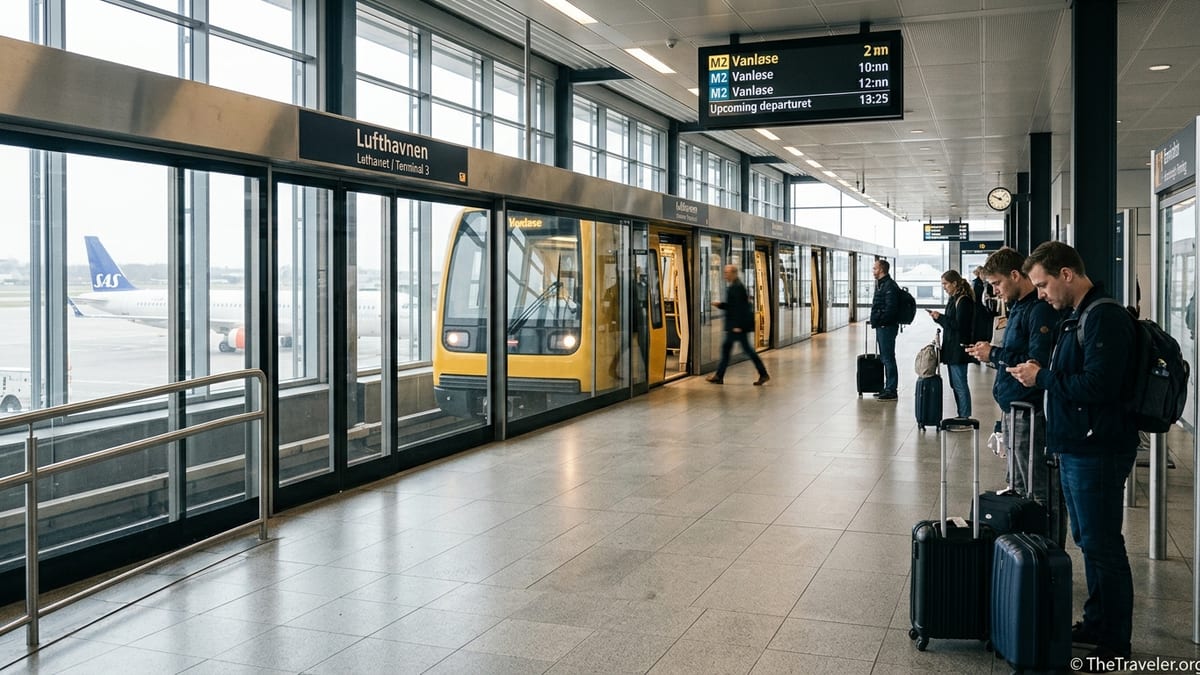
The metro station itself is bright and modern, with glass screens separating the platform from the tracks. Digital signs above the platform show the destination “Vanløse” for trains heading toward the city. Since the airport is one end of the line, there is only one direction to choose on the M2, which eliminates the risk of boarding the wrong train in terms of direction.
Many travelers land late in the evening, when they are tired and in a hurry to reach their hotel. This is exactly when mistakes happen: people walk straight through to the escalator without stopping at the machines, assuming they can pay on board, or they buy the first cheap-looking ticket on the screen without noticing the number of zones. Taking two extra minutes in Terminal 3 to choose the correct product for a three-zone journey from Lufthavnen to the city center will save you money and stress later.
Key Central Stops: Christianshavn, Kongens Nytorv and Nørreport
The first inner-city station you encounter heading from the airport is typically Christianshavn. This stop is just across the harbor from the old town and is convenient if you are staying near Christianshavn’s canals, the alternative neighborhood of Christiania, or in hotels around Islands Brygge or Amagerbro with a short bus or metro connection. From the airport, the metro ride to Christianshavn is around nine minutes in normal traffic, making it one of the fastest ways to reach the harbor area.
Next, the M2 runs through Kongens Nytorv, which is one of the most important transfer and sightseeing hubs in Copenhagen. From this station, you are a short walk to Nyhavn harbor, the high-end shopping of Strøget, the Royal Danish Theatre and several major hotels around the square. You can change here to the M3 Cityringen and M4 lines, which loop through Frederiksberg, Nørrebro, Østerbro and the Nordhavn harbor district. Many first-time visitors book accommodation within a few minutes’ walk of Kongens Nytorv precisely because of this connectivity.
Nørreport is another key M2 stop, further north in the city center. It is Copenhagen’s main hub for S-trains, regional trains and intercity connections, and sits next to the Botanical Garden, Torvehallerne food market and the edge of the Latin Quarter. If your hotel is near City Hall, Tivoli Gardens or the Central Station, you might prefer to transfer at Nørreport to an S-train for one stop to København H, or walk roughly 10 to 15 minutes depending on your exact address. Nørreport is especially useful if you are catching a morning train onwards to Sweden or another part of Denmark the following day.
Even though these three stations are all central, they feel quite different on arrival. Christianshavn has a more local, residential vibe with smaller streets and canals. Kongens Nytorv opens straight into grand boulevards, flagship stores and tourist sights. Nørreport is busy and functional, with heavy commuter foot traffic and quick onward train connections. When choosing where to stay, it helps to picture what you want to see on your first day: Nyhavn and the inner harbor suggest Kongens Nytorv, canal-life and Christiania suggest Christianshavn, while food markets and rail connections suggest Nørreport.
Tickets, Zones and City Passes on the M2
The most confusing part of using the M2 from the airport is not the trains themselves but the ticketing system. Greater Copenhagen is divided into fare zones, and your ticket must cover all the zones you travel through. Copenhagen Airport is in zone 4, while most central sights and hotels are in zones 1 and 2. A standard single journey between the airport and the city center therefore requires a ticket valid for three zones.
As of 2026, a three-zone single ticket between Lufthavnen and central Copenhagen typically costs in the mid-30s in Danish kroner, purchased from official ticket machines or apps. The exact amount can vary with adjustments, but you should expect to pay roughly the equivalent of a few euros or a small coffee in the city. Importantly, the same ticket is valid for interchanging between metro, S-trains and city buses within the time limit, so you do not need a separate fare if you, for example, change from the M2 at Nørreport to an S-train for the last leg to Copenhagen Central Station.
For many visitors, a City Pass or tourist transport card is better value if they plan to use public transport several times per day. City Pass Small usually covers zones 1 to 4, which includes both the airport and the central city, for 24 to 120 hours depending on which option you buy. This means you can ride the M2 from the airport to your hotel, use buses and other metro lines around town, and return to the airport at the end of your trip without worrying about individual tickets. There is also a City Pass Large for wider suburbs and regional trips, but most city-break travelers do not need it.
You can buy single tickets or City Passes from ticket machines in Terminal 3, from machines on the metro platforms, or via the official transport apps. Machines and apps allow you to switch the language to English and show a zone map to help you select the correct product. When in doubt, choose the option that clearly states travel between the airport and the city center or a three-zone ticket rather than guessing at the cheapest price. The cost difference between two and three zones is small, but the difference between a valid and invalid ticket can be a 750 kroner inspection fee.
Frequency, Night Service and Travel Times
One of the M2 line’s biggest advantages is its reliability and frequency. During normal daytime hours, trains run so often that most travelers simply show up and wait for the next one. At peak periods, such as weekday mornings, the headway on the shared central section can be as low as 2 to 4 minutes. At other times of day you might wait around 4 to 6 minutes. This makes the metro particularly attractive if your flight lands at an awkward time or is slightly delayed, since you never risk missing one specific departure.
In the late evening and overnight, Copenhagen’s metro continues to run, but with longer intervals. On many nights you will see trains roughly every 7 to 10 minutes, and on some sections 15 to 20 minutes is normal during the very quietest night hours. From the airport, this still means you are rarely waiting longer than a quarter of an hour, which is considerably better than airport train or bus services in many cities of similar size.
In terms of travel time, you can broadly assume about a quarter of an hour from Lufthavnen to the heart of the city. Trips from the airport to Kongens Nytorv are typically around 13 to 15 minutes, while Lufthavnen to Nørreport is around 15 minutes. If you stay out towards Vanløse at the western end of the M2 line, your total journey will be a little over 20 minutes. The metro runs fully separated from street traffic, so you are not affected by congestion in the way airport buses or taxis often are, especially in rainy weather or during big events.
For late-night arrivals and very early departures, the metro can be significantly faster than a taxi when you factor in the time spent waiting in the taxi queue or navigating traffic lights and roadworks. For example, a traveler landing at 23:30 and staying near Nørreport can usually be on the platform within 10 to 15 minutes of landing, catch a train within another 10 minutes, and check into their hotel just after midnight. In contrast, a taxi might be stuck behind other airport pickups and then crawl through city-center traffic if road closures or events are taking place.
Common Tourist Mistakes and How to Avoid Them
The most expensive mistake tourists make on the M2 line is boarding the metro without a valid ticket or with the wrong ticket. Copenhagen’s metro operates on a self-service system, which means there are no gates or turnstiles. Ticket inspectors conduct random checks both on the trains and on platforms, and if you cannot show a valid ticket or pass that covers the correct zones and time period, you can be issued with an inspection fee of around 750 Danish kroner. This applies even if your mistake was genuine, you bought a cheaper ticket thinking it was correct, or you intended to pay but had not completed the purchase before boarding.
A very common scenario involves travelers who buy a two-zone ticket out of habit, because two zones covers many short journeys within the city itself. They then ride that ticket all the way to or from the airport, not realizing that the airport trip requires three zones. Ticket inspectors know this is a typical error, particularly on the last few stops before the airport, and checks can be frequent on that section. To avoid this, always double-check that the ticket or pass you buy explicitly covers travel between the airport (zone 4) and central zones 1 and 2, or that the product is clearly described as valid for the airport journey.
Another frequent mistake is misunderstanding time validity. App-based and printed tickets are usually valid from a specific start time for a set period. Some tourists purchase an evening ticket for the next morning without realizing it becomes invalid a short time after purchase, then use it again hours later on the way back to the airport. Others select a City Pass that starts immediately when they buy it in the afternoon, even though they do not actually need it until the following morning, losing half a day of value. To avoid wasting money or riding on an expired ticket, check the start and end time printed on your ticket and align the activation time with your first planned trip.
Finally, many visitors simply assume they can resolve an honest mistake on the spot by explaining it to an inspector. While inspectors are often polite, the rules are strict and they are required to issue a fine if no valid ticket can be presented. Appeals are possible later, but most disputes end with the original fee upheld. It is therefore far better to pause for a moment in Terminal 3, check the number of zones you need and the validity period of your chosen product, and ensure your app ticket has actually been paid and activated before you go up the escalator to the platform.
Practical Tips for a Smooth Airport-to-City Metro Ride
To make your first metro journey from Copenhagen Airport stress-free, think through the sequence before you land. As you walk into Terminal 3, decide whether you will buy a simple three-zone single ticket, a City Pass covering your whole stay, or rely on a tourist card that already includes public transport. If you are using an app-based ticket, download the app and create an account on your home Wi-Fi before your trip, then add a card and test a small purchase so that you are not trying to troubleshoot payment errors on a crowded platform.
On arrival, keep your luggage trolley with you and stop at the nearest ticket machine or information desk in the arrivals hall, rather than rushing directly to the platform. Machines allow you to choose English and display example journeys, such as “Airport to City Centre,” which automatically select the correct number of zones. Take a clear photo of your ticket or pass with your phone in case you misplace it, and if you are traveling in a group, make sure each person has either their own valid ticket or is clearly included on a shared product according to the rules.
When you reach the platform at Lufthavnen, check the overhead screens for the next departure to Vanløse and note which side of the train is opening at your destination. Stations like Kongens Nytorv and Nørreport have multiple exits that lead to very different streets. For example, exiting the wrong side at Kongens Nytorv can add ten minutes of walking to reach a hotel near Nyhavn compared with choosing the right exit. Station maps near the escalators show the street names around each exit, so it is worth taking a moment to match the map with the address on your hotel booking.
Finally, remember that Copenhagen is a very luggage-tolerant city. Travelers with suitcases and backpacks are a normal sight on the metro, especially between the airport and central stations. There are spaces by the doors and in the middle of each carriage where you can stand with bags without blocking the aisles. Locals are generally patient if you are visibly trying not to obstruct doors or reserved seating, and you are likely to see airport staff, airline crew and commuters all using the same M2 service alongside you.
The Takeaway
Copenhagen’s M2 metro line is one of the most convenient airport links in Europe, with frequent trains, short travel times and a direct connection from Terminal 3 to the heart of the city. From Lufthavnen station you can reach Christianshavn, Kongens Nytorv and Nørreport in well under 20 minutes, often faster than a taxi and at a fraction of the price. The driverless system runs around the clock, which means even late-night flights and early departures are relatively painless.
The main challenges for visitors are understanding the zone-based ticketing system and avoiding common mistakes around invalid or expired tickets. If you remember that the airport-to-city journey requires three zones, that your ticket must be valid before you board, and that inspection fees are high, you will already be ahead of most first-time travelers. Combine that awareness with a bit of pre-trip planning, a City Pass or correctly chosen single ticket, and a quick glance at the station maps for the right exit, and your first ride on Copenhagen’s M2 line should be smooth, efficient and a reassuringly simple start to your stay.
FAQ
Q1: How long does the metro take from Copenhagen Airport to the city center?
The journey from Lufthavnen station at Terminal 3 to central stops like Kongens Nytorv or Nørreport usually takes around 13 to 15 minutes, depending on the time of day and intermediate stops.
Q2: How often do M2 metro trains run from the airport?
During the day and early evening, M2 trains typically run every 3 to 6 minutes. Late at night and in the very early morning, intervals are longer, often around 7 to 15 minutes, but the service operates 24 hours a day.
Q3: Which ticket do I need for the trip between Copenhagen Airport and the city?
You need a ticket that covers three zones, since the airport is in zone 4 and the central city is in zones 1 and 2. Many visitors either buy a three-zone single ticket or a City Pass Small that includes zones 1 to 4.
Q4: Where exactly is the metro station at Copenhagen Airport?
The metro station, called Lufthavnen, is directly connected to Terminal 3. After leaving baggage reclaim and customs, you follow the metro signs through the arrivals hall and up the escalators to the platform level.
Q5: Can I buy metro tickets on the train?
No, you cannot buy tickets on board. Copenhagen’s metro is self-service, so you must buy and activate your ticket or pass before boarding, either from machines in Terminal 3, on the platform, or via official transport apps.
Q6: What happens if I accidentally buy the wrong ticket or too few zones?
If inspectors find that your ticket does not cover the correct zones or has expired, you can be issued with an inspection fee, which is a substantial fixed amount. It is therefore important to double-check zones and validity times before you step onto the train.
Q7: Is it better to use a City Pass or single tickets on the M2?
If you only travel between the airport and the city once each way, single three-zone tickets may be enough. If you plan to ride the metro, buses and trains several times per day during your stay, a City Pass that includes zones 1 to 4 often offers better overall value and convenience.
Q8: Which M2 station should I use for Nyhavn and the old town?
For Nyhavn, Kongens Nytorv is usually the best choice, since one of its exits brings you close to the harbor and the start of the canal. For the pedestrian shopping street Strøget and the heart of the old town, both Kongens Nytorv and Nørreport are convenient, depending on your exact destination.
Q9: Are there lifts and escalators for luggage on the M2 line?
Yes, Copenhagen’s metro stations, including the airport, Christianshavn, Kongens Nytorv and Nørreport, are all designed with lifts and escalators. Platforms are step-free, making it easy to move with suitcases, strollers or mobility aids.
Q10: Is the metro safe late at night from the airport?
The M2 is generally considered safe, and many airport staff, airline crew and local passengers use it at all hours. As in any major city, you should keep an eye on your belongings, but the trains and stations are well lit, monitored and regularly patrolled.