


Crete is Greece’s largest island and almost a small country in its own right, with rugged mountains, fertile plains, four distinct coasts and a deep sense of local identity. It combines headline sights such as the Minoan palace of Knossos, Venetian and Ottoman old towns like Chania and Rethymno, dramatic gorges including Samaria, superb beaches, characterful mountain villages and one of the strongest food cultures in Greece. With more than six million visitors a year and growing pressure on certain resorts and beauty spots, choosing when to come, where to base yourself and how to move around the island has never mattered more.
Get the latest updates straight to your inbox!
Why Consider Crete, and How It Differs From Other Greek Islands
Crete stretches roughly 260 kilometres east to west and covers more than 8,300 square kilometres, making it by far Greece’s largest island and the second largest in the eastern Mediterranean. It is often divided informally into western, central and eastern regions along the more developed north coast, plus a wilder, more remote-feeling south coast backed by mountain ranges. For travelers comparing Greek islands, that scale and variety are the key difference: you do not “do” Crete in a weekend and many visitors return to explore a different corner on a second or third trip.
The island is one of Greece’s main tourism engines. Recent regional data suggests several million international visitors arrive each year and stay around five nights on average, with August still the single busiest month. That means that popular strips and famous beaches can feel very crowded in high summer, while inland villages and stretches of the south coast remain comparatively quiet. Planning is less about ticking off a fixed list of sights and more about matching your bases to the kind of atmosphere, scenery and pace you want.
Crete’s cultural layer is unusually rich even by Greek standards. It was the heartland of the Bronze Age Minoan civilisation and sites such as Knossos, Phaistos, Malia and Zakros form one of Europe’s most important archaeological landscapes. Later, Venetian and Ottoman rule left distinctive harbours, fortifications and old quarters in cities like Chania, Rethymno and Heraklion. Add deeply rooted musical, culinary and village traditions and you have an island that rewards slow, locally focused travel just as much as it does beach-hopping.
For independent travelers, Crete works well because it supports both car-free and self-drive trips, has substantial year-round populations in its main cities and offers everything from simple rooms over tavernas to large resorts. The trade-off is that distances are longer than on compact islands, and “seeing everything” requires time and multiple bases. This guide focuses on helping you choose the region, season and style of trip that best fits your priorities.
Getting to Crete: Airports, Ferries and Gateways
Most visitors arrive by air through one of Crete’s three civilian passenger airports. Heraklion International Airport, near the island’s largest city, handles the bulk of traffic and ranks second in Greece by passenger numbers after Athens. It is the main gateway for charter and low-cost flights from across Europe, especially between April and October, and serves the central north coast resorts and eastern hubs such as Agios Nikolaos and Elounda. A new airport inland at Kastelli is under construction and expected to replace Heraklion’s current field in the coming years, so travelers visiting later in the decade should double-check which facility will be in use.
Chania International Airport in the northwest is Crete’s second major gateway and particularly convenient if you plan to focus on western Crete, including Chania, Rethymno and the famous beaches like Balos and Elafonissi. Passenger numbers here have also grown in recent years, and a wide range of seasonal international routes now operate alongside year-round domestic flights. Sitia Public Airport in the far east is much smaller and primarily handles domestic services and a handful of seasonal charters. It is useful for those heading directly to more remote eastern bases but is not a primary entry point for most international visitors.
Ferries remain an important way to reach and leave the island, especially for those combining Crete with other parts of Greece. Regular overnight and daytime ferries link Piraeus, near Athens, with Heraklion and Chania, and there are seasonal routes to smaller Cycladic or Dodecanese islands. Main passenger ports include Heraklion and Chania, with additional services at Rethymno, Agios Nikolaos and Sitia. Many travelers fly into one gateway and sail out of another, for example arriving by air in Chania, road-tripping east along the north coast and taking a ferry back to the mainland from Heraklion.
Your choice of airport or port should be driven by where you plan to stay. If your time is short and your focus is western Crete, flying into and out of Chania avoids an extra two to three hours’ surface travel each way. If you intend to visit Knossos, central Crete or the east, Heraklion is usually the most practical. Those who want to end with a quieter few days in the far east sometimes arrive in Heraklion and depart via Sitia’s airport or port, but this requires careful timetable checks as services are less frequent.
When to Visit Crete: Seasons, Weather and Overtourism
Crete has a Mediterranean climate with hot, dry summers and mild, wetter winters. In recent years, local tourism observatories and climate summaries have highlighted hotter heatwaves and increased pressure in peak months. As of late 2026, summer high temperatures in lowland areas commonly reach the low to mid 30s Celsius, and late July and August can feel uncomfortably hot for strenuous outdoor activities, especially away from the breezy coasts. Sea temperatures are warm, nightlife is in full swing and nearly all resort-oriented businesses are open, but crowds and prices are at their highest.
The shoulder seasons of late April to June and September to October generally offer the best balance for most independent travelers. Days are usually warm enough for swimming, especially from mid May onwards, but better suited for hiking gorges and exploring archaeological sites than the peak of summer. Wildflowers are a major draw in spring, while the sea retains summer warmth well into October. Based on 2026 timetables and tourism board advice checked in November 2026, many coastal resorts now extend their season slightly at both ends, but some beach bars, water parks and package hotels still operate only from roughly May to October, with July and August their core months.
Winter, from November through March, is increasingly promoted for “slow travel” and local culture, but it is a very different experience. Heraklion, Chania and Rethymno remain lively working cities with open museums, cafes and restaurants, and there are increasing numbers of domestic visitors and long-stay digital nomads. However, weather is changeable, some mountain roads can be affected by snow or heavy rain, ferries are more prone to disruption and many resort strips on the north coast and in isolated south-coast villages are largely shut. If you plan a winter trip, check current opening times for specific attractions and accommodation, and be prepared for a more urban and village-focused itinerary rather than a beach holiday.
Overtourism concerns are most evident in a few hot-spots such as Balos Lagoon, Elafonissi beach and the narrow alleys of old Chania and Rethymno at the height of summer. To ease pressure, it helps to travel outside the peak weeks if you can, visit major sights early or late in the day, and consider staying in less saturated bases such as inland villages or secondary towns. As visitor numbers continue to grow, particularly via low-cost flights and short-stay rentals, those choices play a real role in shaping both your own experience and the island’s long-term sustainability.
Understanding Crete’s Regions: Where to Base Yourself
Because of its size, Crete is best imagined as several overlapping travel regions rather than a single, uniform island. The north coast hosts the main cities, airports and ferry ports, threaded together by the island’s primary highway. The west centres on Chania and its surrounding prefecture, the central north coast runs from Rethymno through Heraklion, and the east revolves around Agios Nikolaos, Elounda and Sitia. The south coast, facing the Libyan Sea, is more fragmented, with small, relatively isolated pockets like Paleochora, Loutro, Plakias and the villages near Hora Sfakion.
Each of these areas offers a distinct mix of scenery, infrastructure and atmosphere. The west is famous for photogenic beaches and gorges, the centre for historic cities and major Minoan sites, the east for a calmer resort feel and easier-going seaside towns, and the south for quieter villages with a frontier-like charm. Distances between them are manageable but not trivial, so basing in the right place for your interests can save many hours on buses or in the car. For a first trip of a week or more, many independent travelers either choose one main base with a few day trips, or split their time between two contrasting regions such as Chania and Heraklion, or Chania and the south coast.
When choosing your base, weigh up not only sights and beaches but also practicalities such as driving comfort, reliance on public transport, noise tolerance and whether you prefer a lived-in town or a dedicated holiday strip. Old towns and small south-coast villages often have limited parking, narrow lanes and high demand in peak season, while newer resort areas along the north coast may be more road-friendly but less atmospheric. Families with younger children might prefer flatter, more sheltered beaches and short transfer times, while hikers and repeat visitors often accept longer journeys in exchange for quieter surroundings.
The following sections break down the main regions in more detail, outlining their strengths, drawbacks and which kinds of travelers they tend to suit best.
Western Crete and Chania: Beaches, Gorges and Old-Town Charm
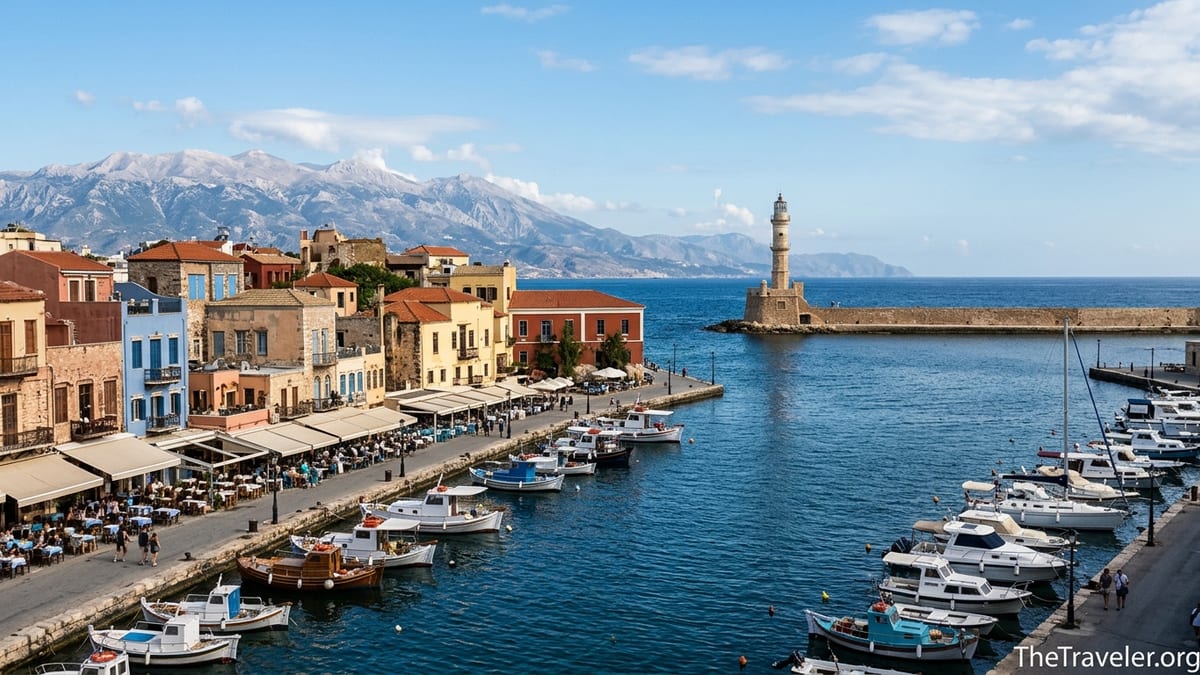
Western Crete, centred on Chania and the surrounding prefecture, is many visitors’ favourite corner of the island. Chania’s old town wraps around a Venetian harbour with lighthouse and arsenals, framed by narrow lanes, Ottoman-era houses and a busy market area. It combines picture-postcard looks with the amenities of a small city, including year-round residents, good food and a mix of accommodation from simple rooms to boutique hotels. This makes it an excellent base for those who want charm and convenience without giving up urban comforts.
Beyond the city, western Crete delivers some of the island’s most photographed coastlines. Balos Lagoon, on the Gramvousa peninsula, is famous for its turquoise shallows and sandbar, reached by rough-road drive and hike or by boat from Kissamos. Elafonissi, near the southwest tip, offers pale sand with pink hues in places and shallow water that is especially popular with families, though in peak season it can feel extremely busy and parking is limited. Falasarna, on the northwest coast, has a long, sandy bay that handles crowds slightly better and often has surf and wind. The region is also your springboard to the Samaria Gorge, a long one-way hike through a national park that typically operates from May to October, depending on weather and safety assessments.
The main advantages of basing in western Crete are access to these headline natural sights, strong bus connections along the north coast, and the ability to combine beach days with time in Chania’s old town. Drawbacks include crowding at the most famous beaches, windy conditions on exposed coasts, and long day-trip logistics. For example, a full day to Balos or Elafonissi from Chania usually involves several hours on buses or in the car each way. Mountain and south-coast villages like Paleochora, Sougia and Loutro offer quieter bases with better access to hiking, but they require more commitment in travel time and may have limited services outside the main season.
Western Crete suits first-time visitors who are drawn to Chania’s atmosphere, couples and groups of friends who enjoy evening life, and active travelers keen on hiking Samaria or coastal trails. Families can also be very happy here, particularly if staying near flatter beaches close to town, but may want to avoid the most crowded days at Balos and Elafonissi in high summer by arriving early or visiting in shoulder season.
Central North Coast: Rethymno, Heraklion and the Heart of Minoan Crete
The central north coast links Rethymno and Heraklion, two cities with very different personalities that together form the island’s most practical corridor for transport and sightseeing. Rethymno is smaller and more intimate, with a well-preserved old town of Venetian mansions, Ottoman mosques and a hilltop fortress. Its long town beach and promenade give easy access to the sea, and the surrounding area offers a mix of resorts and traditional villages in the hinterland. It is a strong choice for those who want an atmospheric base that is less busy than Chania yet still well connected by bus.
Heraklion, by contrast, is a working port city and administrative capital with a more modern face but excellent museums and direct access to key archaeological sites. The Heraklion Archaeological Museum holds many of the finest finds from Minoan Crete, while the palace site of Knossos lies a short bus or taxi ride inland. This makes Heraklion the natural base for visitors prioritising ancient history, as well as a practical entry and exit point thanks to its major airport and ferry connections. The city’s centre has improved markedly in recent years, with pedestrianised streets, more cafes and a growing food scene that highlights local produce and Cretan wines.
Staying along this central strip offers other advantages. Regular KTEL buses run between Chania, Rethymno and Heraklion for much of the day in both summer and winter, so car-free travelers can move between bases relatively easily. Coastal resorts east and west of both cities provide beach-focused options, while inland villages such as Archanes or Anogia offer access to vineyards and mountain scenery. The main downsides are that long sandy beaches near the cities can feel busy in high summer, and the highway corridor lacks some of the wildness found in the far west, deep south or far east.
This region works well for first-time visitors who want a balanced introduction to Crete’s history, food and beaches without excessive driving, as well as for families who appreciate the convenience of being near hospitals, larger supermarkets and year-round services. It is also a logical hub for those arriving late or departing early from Heraklion, who can add at least one night to explore the museum and Knossos rather than treating the city purely as a transit point.
Eastern Crete: Agios Nikolaos, Elounda, Sitia and a Calmer Coast
Eastern Crete, stretching from Malia and Agios Nikolaos to Elounda, Ierapetra and Sitia, sees fewer visitors than the central and western north coasts but has strong appeal for those seeking a gentler pace. Agios Nikolaos is an attractive town built around a small inner lake and harbour, with a compact centre, walkable waterfront and plenty of tavernas. Elounda, just to the north, has grown into a smart resort area with a mix of mid-range and higher-end hotels, some with direct waterfront access and views across to the island of Spinalonga.
Spinalonga itself, a small fortified island that later became a leper colony, is one of eastern Crete’s signature excursions. Boats run from Elounda and the nearby village of Plaka, usually from late spring to autumn, and the site combines Venetian fortifications with poignant more recent history. Eastern Crete also offers numerous smaller, lower-key beaches and coves, as well as the palm-fringed beach of Vai in the far northeast, reached more easily from Sitia than from the central part of the island. The interior of Lassithi prefecture hides traditional villages and the plateau of the same name, known for its white windmills and fertile fields.
Practical upsides of basing in the east include a somewhat quieter feel than the busiest strips around Chania or Heraklion, particularly outside the core months of July and August, and a good selection of family-friendly beaches with relatively calm waters. However, distances from here to western highlights such as Balos or Samaria Gorge are long, so eastern Crete is best appreciated on its own terms rather than as a base for the entire island. Public transport is adequate along the main coast road, but more limited in the interior and far east, so hiring a car becomes increasingly useful if you want to explore beyond the main towns.
Eastern Crete is well suited to repeat visitors who have already seen the west, couples or families wanting a relaxing seaside holiday with occasional excursions, and travelers who prefer slightly more understated nightlife and quieter evenings. Those arriving at Heraklion Airport can reach Agios Nikolaos in around an hour and a half by car under normal conditions, making it a manageable transfer after a flight.
South-Coast Pockets: Quieter Villages and Hiking Bases
The south coast of Crete feels quite different from the busier north. Mountains drop more steeply to the sea, settlements are smaller and more scattered, and development has been constrained by terrain and access. Well-known pockets include Paleochora and Sougia on the southwest coast, the ferry-accessible village of Loutro near Hora Sfakion, and the area around Plakias and the palm beach of Preveli further east. These are not continuous resort strips but individual communities separated by dramatic headlands, gorges and high passes.
For many independent travelers, the south coast’s appeal lies in its combination of quieter beaches, excellent hiking and a sense of being closer to traditional village life. Sections of the E4 long-distance trail run along this coast, linking gorges and coves, and short boat hops connect villages such as Loutro, Agia Roumeli and Hora Sfakion in season. Tavernas often lean heavily on local produce, particularly fresh fish, greens and olive oil. Nights are generally low-key, skewing more to long dinners on the waterfront than to clubs and bars.
The trade-offs are significant and worth acknowledging. Road journeys from north-coast airports and cities can be long and winding, and in some cases buses are infrequent or require changes, especially outside the main summer timetable. Some villages are connected only by boat or footpaths, making arrival and departure dependent on sea conditions. In winter and the shoulders, many south-coast accommodations and some tavernas close, leaving only a small core of year-round services. Those who prize convenience, broad restaurant choice and nightlife may find the south coast frustrating.
South-coast bases are ideal for hikers, repeat visitors, and anyone who values tranquility and scenery over easy logistics. They also work well as a second or third base on a longer trip, after you have spent a few days in one of the north-coast cities. If your time is short or you are travelling with very young children or mobility issues, you may prefer to sample the south coast on a day trip or single overnight rather than committing your entire stay.
Transport Within Crete: Driving, Buses and Journey Times
Crete’s main transport spine is the north-coast highway, which links Chania, Rethymno, Heraklion and Agios Nikolaos. Parts of this road are being upgraded and reconfigured, so drivers should be alert to speed changes, ongoing work and local driving styles. Under typical traffic, realistic driving times between the main cities are roughly: Chania to Rethymno in just over an hour, Rethymno to Heraklion in about one to one and a half hours, and Heraklion to Agios Nikolaos in around one to one and a half hours. Conditions vary with season and construction, so allow extra time for transfers, especially in peak summer and on weekends.
Two intercity bus companies, both known as KTEL, share responsibility for the network. KTEL Chania–Rethymno covers the western part of the island, while KTEL Heraklion–Lassithi operates central, eastern and many south-coast routes. As of November 2026, both companies run frequent services along the main north-coast corridor, with approximately hourly buses between Chania, Rethymno and Heraklion for much of the day, and regular buses from Heraklion to Agios Nikolaos. Summer schedules usually add extra departures and “express” runs, while winter schedules reduce frequency but maintain core connections between the main cities.
For planning purposes, it is helpful to think in ranges rather than exact minutes. The following table gives a rough sense of typical journey times under normal conditions by car or direct bus along the north coast:
Chania to Rethymno: about 1 to 1.5 hours. Rethymno to Heraklion: about 1 to 1.5 hours. Heraklion to Agios Nikolaos: about 1 to 1.5 hours. Chania to Heraklion: about 2.5 to 3 hours, usually with a stop in Rethymno. Heraklion to Sitia: about 2.5 to 3 hours. These are approximate and do not account for intermediate stops, roadworks or busy holiday traffic.
Hiring a car is strongly advisable if you want to explore villages, south-coast pockets, multiple beaches in a day or inland plateaus without being tied to bus timetables. It is especially useful for families, groups of friends and photographers who prefer flexibility and early starts. Car rental availability is generally good near airports and in major towns, though specific vehicle types may sell out in July and August, so booking ahead is wise. For city-to-city travel along the main north coast, or if you are uncomfortable with mountain driving, relying on KTEL buses works well and can be combined with occasional taxis and organised excursions.
Before you travel, check the latest bus timetables directly with the two KTEL companies, as their official websites and station notices are updated seasonally. If you plan to drive, confirm whether any major road projects are under way in the sections you will use and factor that into your timings. This is particularly important around Heraklion and in stretches of the north-coast highway being upgraded to newer standards.
Accommodation and Practical Planning
Most visitors to Crete cluster in a relatively small number of areas: the old towns and adjacent beaches of Chania and Rethymno, the coastal strip around Heraklion, the Agios Nikolaos and Elounda area in the east, and a handful of established south-coast villages such as Paleochora and Plakias. Choices range from large all-inclusive resorts and branded hotels to boutique properties in restored townhouses, simple studios by the beach and self-catering apartments. In the last decade, short-stay rentals have expanded rapidly, especially in old-town districts and along the north coast.
Seasonality plays a big role in what is available. Many resort hotels and some apartment complexes in dedicated tourist strips open roughly from late April or May to October, with their peak rates and occupancy in July and August. In the off-season, those areas can feel partly shuttered. In contrast, cities like Heraklion, Chania and Rethymno, and genuinely lived-in villages, retain a core of year-round accommodation, cafes and shops, making them better bases outside high summer. If you are considering a winter or shoulder-season trip, choosing a town with a substantial permanent population will make your experience far smoother.
Greek regulations require legal tourist accommodation to display a registration number issued by the authorities, and this requirement applies to hotels, guesthouses and short-stay rentals. When booking through any platform, it is sensible to verify that the property lists this number and that the details match what you are expecting. This helps ensure you are dealing with a legitimate operation that meets basic standards and tax rules.
Demand for certain locations far outstrips supply in high season. Atmospheric old-town quarters with limited historic buildings, and tiny south-coast villages hemmed in by mountains and sea, fill early for July and August. If your heart is set on staying inside Chania or Rethymno’s old town, or in a small bay accessed only by boat, consider booking several months in advance and being flexible on exact dates and room types. Conversely, last-minute deals are more realistic in larger resort strips and in shoulder months when capacity exceeds demand.
How Long to Stay, What to Do and Sample Trip Frameworks
There is no single ideal length of stay for Crete, but it is useful to think in terms of how many bases you can realistically enjoy. A short visit of three to four days works best as a city break focused on one urban centre, such as Chania or Heraklion. In Chania, that might mean two relaxed days exploring the old town and harbour, plus one or two day trips to nearby beaches or villages. In Heraklion, you could divide your time between the Archaeological Museum, Knossos, the historic centre and perhaps a nearby winery or village.
With a week, many travelers are happiest either settling into one region or splitting their time between two nearby bases. For example, you might spend four nights in Chania to enjoy the old town, Balos or Falasarna and perhaps Samaria Gorge, then move to Rethymno or Heraklion for three nights to explore central Crete’s history and food scene. Alternatively, a week based around Agios Nikolaos could combine Spinalonga, local beaches, a visit to Lassithi Plateau and a day trip to Heraklion for Knossos and the museum.
Trips of 10 days or longer lend themselves to a multi-base itinerary. One common pattern is to start in the west, spending several nights in Chania and perhaps a night or two in a south-coast village like Paleochora or Loutro, then travel along the north coast to Heraklion or the east for a contrasting finale. Another is to focus on central and eastern Crete, combining Heraklion, a village in the interior for food and wine, and a seaside base in Agios Nikolaos or Sitia. Each move costs you part of a day in travel and packing, so it is wise to limit yourself to two or three bases rather than changing beds every night.
Across any of these frameworks, the main themes of a Crete trip are relatively consistent. Ancient history centres on Knossos near Heraklion and other Minoan sites such as Phaistos in the south and Malia in the east. Coastal highlights include the north-coast town beaches, remote coves on the south coast and boat trips to Balos, Gramvousa and Spinalonga. Hiking ranges from marquee routes like Samaria Gorge to shorter gorges and village-to-village trails in the White Mountains and Psiloritis ranges. Food and drink are ever-present, with local cheeses, olive oil, wild greens, honey and wine forming the backbone of Cretan cuisine, often best enjoyed in small, family-run tavernas or at wineries that welcome visitors. Traditional villages, whether on inland plateaus or in the foothills above the coasts, provide opportunities to see a more everyday side of island life.
Ultimately, the question is not only how to visit Crete, but whether it is the right island for your current trip. Travelers who enjoy variety, are willing to accept some driving or longer transfers and like mixing cities, villages, beaches and hikes tend to find Crete exceptionally rewarding. Those seeking a very compact, car-free island where everything is walkable from a single harbour might be better served by smaller Cycladic islands or the Saronic Gulf. If you are drawn to deep history, big landscapes and a strong sense of local culture, and you have at least several days to spare, Crete is likely to be an excellent fit. If your time is very short or you dislike any kind of overland travel, you may want to save it for a trip when you can give Greece’s largest island the attention it deserves.