


More news on this day
Emergency crews in Eureka, Missouri, converged on a stretch of Union Pacific rail line near Lewis Street after more than two dozen coal cars derailed close to a golf course, crumpling freight cars and spilling loads but sparing nearby homes and businesses from direct impact.
Get the latest news straight to your inbox!
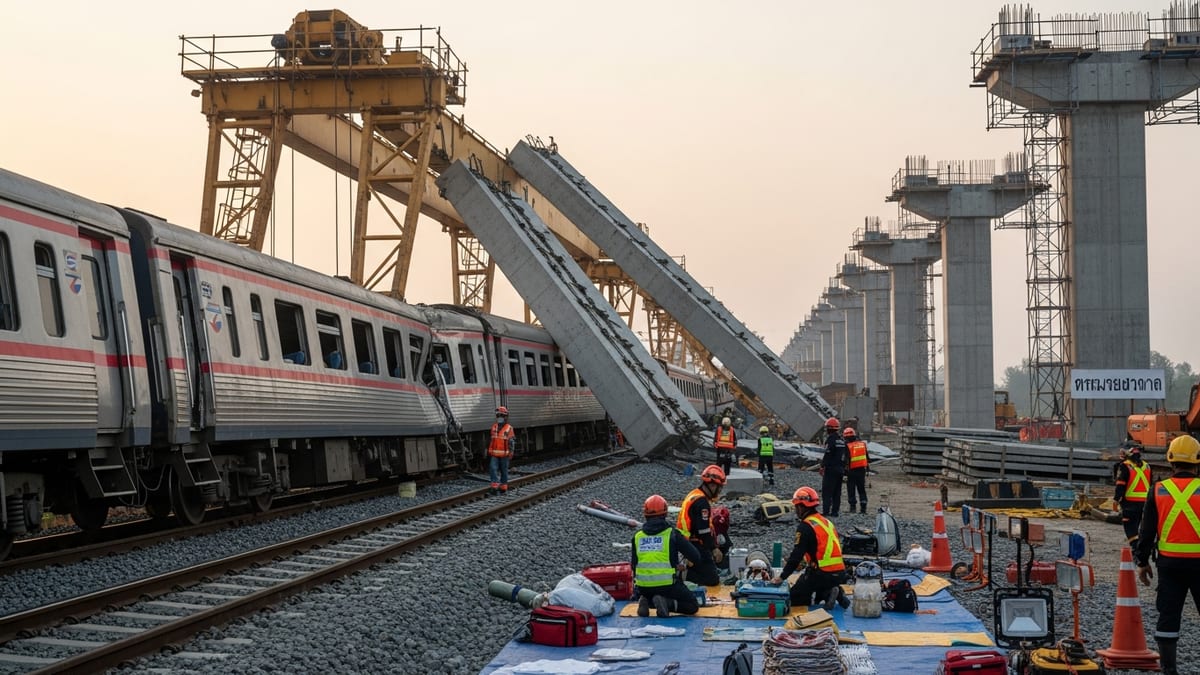
Dozens of coal cars off the tracks near Lewis Street
Published coverage indicates that 26 cars from a 135-car Union Pacific coal train left the tracks near Lewis Street in Eureka, a suburb southwest of St. Louis. The derailment occurred in the vicinity of Crescent Farms Golf Club, a green corridor that parallels the busy freight route through the Meramec River valley.
Drone images shared by local broadcasters show crumpled and jackknifed coal hoppers scattered along the right-of-way, with several cars tipped on their sides and others stacked at sharp angles. The locomotives and remaining cars in the consist appeared to remain upright, limiting the footprint of the wreck.
Initial reports describe the incident as a freight-only derailment, with no passenger services directly involved. The affected segment of track carries a mix of through freights and unit trains moving bulk commodities across the central United States, making it a critical artery in the regional rail network.
Local media accounts note that the derailment halted rail movements through the area while responders assessed damage and began clearing the wreckage. The disruption is expected to affect coal deliveries along this corridor until full service can be restored.
Emergency response focuses on safety and containment
According to publicly available information from the scene, fire crews, rail responders and other emergency personnel established a perimeter around the derailment shortly after the incident was reported. Their immediate focus centered on confirming that no one was injured and that no hazardous materials were involved.
Reports from the Eureka Fire Protection District and regional outlets indicate that all derailed cars were loaded with coal and that no tank cars or placarded hazardous materials were part of the affected portion of the train. That assessment helped keep the response at the level of a transportation and cleanup incident rather than a broader chemical or public health emergency.
Responders also monitored air quality and potential ignition sources around the site, as coal dust can present fire risks when heavily concentrated. No fires or secondary incidents were reported in the immediate aftermath, and nearby neighborhoods and businesses did not receive shelter-in-place or evacuation instructions.
Traffic impacts on local roads were limited mainly to emergency vehicle access and temporary closures around Lewis Street and adjacent crossings, based on accounts from the area. Passenger and commuter routes on nearby highways continued to function, though drivers reported increased activity and occasional slowdowns near the scene.
Rail operations and cleanup expected to stretch into coming days
Rail-focused coverage suggests that the derailment left damage to both the track structure and the ballast supporting the rails. Replacing twisted rail sections, realigning the track bed and removing damaged cars typically requires specialized heavy equipment and coordinated work windows, particularly on a busy main line.
Union Pacific and contracted crews are expected to cut and section damaged coal cars, remove spilled coal from the right-of-way and rebuild the affected portion of the line before regular traffic can resume. In similar derailments, partial service sometimes returns within a day or two on an adjacent track, while full restoration of double-track capacity can take longer.
Coal from ruptured hoppers will need to be gathered and removed from embankments and drainage areas to prevent it from entering nearby waterways or storm systems. Cleanup plans often involve loading spilled material into replacement cars or trucks for disposal or reloading, followed by grading and replanting disturbed ground.
Freight customers depending on coal shipments through the corridor may experience delays or rerouted trains while repairs progress. Rail enthusiasts and local observers have noted detours and adjusted schedules on other lines in the St. Louis region in response to the disruption near Eureka.
Environmental considerations near green spaces and waterways
The derailment’s proximity to Crescent Farms Golf Club and the broader Meramec River basin raises environmental questions common to coal train incidents. Coal itself is generally categorized as a non-hazardous bulk commodity in transit, but large spills can still affect soil, vegetation and drainage patterns if not thoroughly removed.
Published coverage so far has not indicated any direct contamination of the Meramec River or nearby streams. However, standard practice after a coal spill typically includes inspections of ditches, culverts and low-lying ground to ensure that runoff carrying fine coal particles does not migrate into waterways during heavy rain.
Golf course fairways, rough areas and surrounding natural habitat may require targeted cleanup where coal or ballast has encroached beyond the rail right-of-way. In similar cases elsewhere in the United States, restoration work has involved vacuum equipment, controlled excavation and reseeding to bring recreational landscapes back to pre-incident conditions.
Local and state environmental agencies commonly review post-incident reports, and railroads are often required to document cleanup efforts and any long-term monitoring. Those assessments will help determine whether additional mitigation around Eureka is needed beyond the initial removal of debris and damaged cars.
Derailment renews focus on coal trains through communities
The Eureka derailment arrives at a time when coal train traffic and its risks are receiving renewed scrutiny in multiple regions. Energy-sector reporting notes that coal remains a significant commodity on North American railroads, even as utilities and exporters reassess long-term demand and port capacity.
Communities along busy coal routes frequently raise concerns about derailments, dust and blocked crossings, particularly where tracks run close to residential areas, schools or recreational facilities. The incident near Eureka, adjacent to a popular golf course and close to homes, underscores how freight corridors intersect with everyday community spaces.
Rail safety advocates point to ongoing federal discussions about track maintenance standards, wayside defect detectors and train handling practices on heavy unit trains. While the specific cause of the Eureka derailment has not yet been publicly detailed, many observers use such incidents to call for closer oversight and infrastructure investment.
For travelers and visitors using highways and trails in the Eureka area, the derailment is a visible reminder that major freight lines often run parallel to scenic and recreational corridors. As cleanup progresses and trains begin moving again, the site is likely to remain a point of interest for residents and rail watchers following the broader conversation about freight safety in and around St. Louis.