


The Cyclades are made for island hopping, and ferries are how most travelers move between Athens and the Aegean. The system is extensive but can feel confusing, with multiple ports, dozens of routes and strong seasonal swings. This guide explains how it all fits together and how to plan realistic ferry-based trips without last minute stress.
Get the latest updates straight to your inbox!
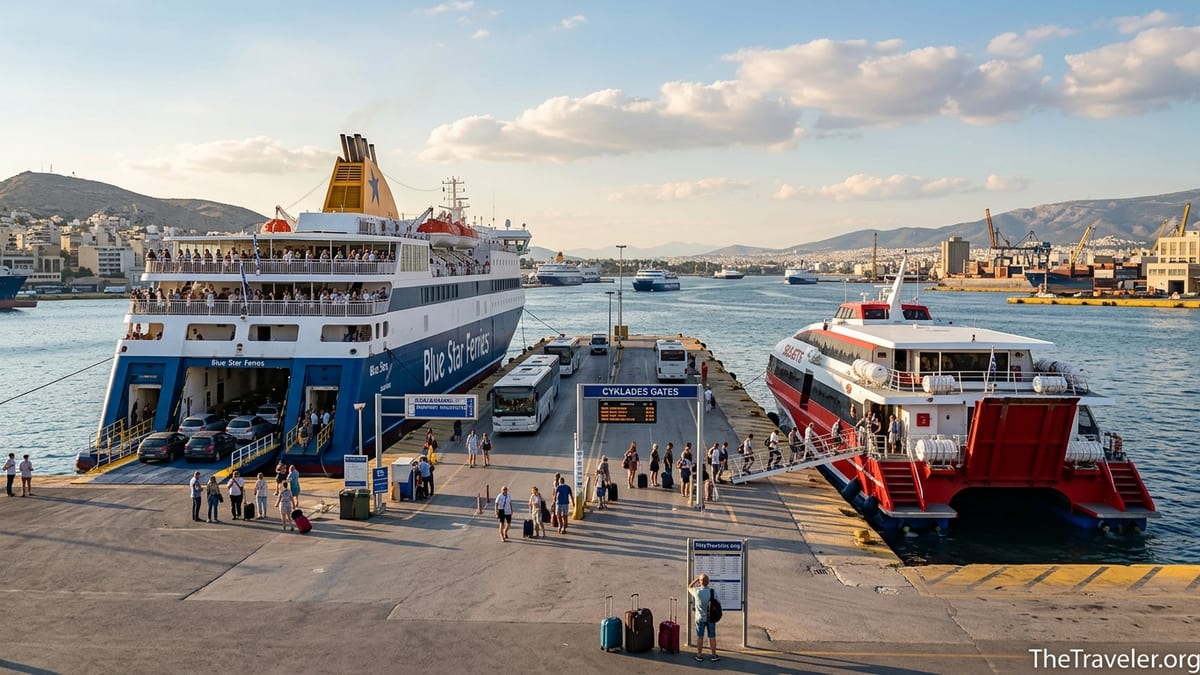
How the Cyclades ferry system works
Ferries are the backbone of transport in the Cyclades, linking Athens with more than 20 inhabited islands and providing most of the inter-island connections. Services are run by several private operators, notably Blue Star Ferries, Seajets, Golden Star Ferries, Fast Ferries and a handful of smaller companies. Routes, vessel assignments and even the companies involved can change from year to year, so any route or timing in this article is an example only, based on timetables and operator information available in November 2026. Travelers should always confirm current-season schedules directly with ferry companies and at least one reputable aggregator before booking.
Two broad types of vessels operate in the Cyclades. Large conventional ferries are slower, generally more spacious ships that carry vehicles and passengers. They usually have big indoor lounges, open decks, multiple ticket classes and, on some longer routes, cabins. High speed ferries and catamarans are faster, smaller vessels that focus on passengers, with limited or no vehicle capacity and mostly airline-style seating. On the same route, a high speed can often cut journey time nearly in half compared with a conventional ship, but usually at a higher fare.
The system is highly seasonal. From roughly late June to early September there are many more sailings and more direct links between islands. Shoulder seasons such as May, early June, late September and early October often see reduced frequency, and outside that period some routes disappear entirely. Even within the same week, departure times can vary by day. For planning purposes, always work with the specific calendar for your travel dates and remember that an example crossing time or frequency describes what was available around November 2026, not a guarantee for a future year.
In practice, most visitors will combine at least one long leg between Athens and the Cyclades with shorter hops between islands. The long legs are usually on larger ships that handle open sea conditions better, while the shorter segments may involve a mix of conventional ferries and high speeds depending on what operates between your chosen islands.
Athens ports: Piraeus, Rafina and Lavrio
Greater Athens has three different ferry ports serving the Cyclades: Piraeus, Rafina and Lavrio. Each has its own character and typical usage patterns, and each connects differently to the city and the international airport. Before publishing, the writer should confirm current bus, metro and taxi options, and typical daytime transfer times for each port, since traffic patterns and public transport timetables in Athens can change.
Piraeus is the main port of Athens and by far the largest hub for Cyclades routes. As of November 2026 it offers daily departures to major islands such as Syros, Paros, Naxos, Mykonos, Santorini, Milos and others, with additional islands served several times per week. A representative example is the Piraeus to Naxos route, where conventional ferries take roughly 5 to 6 hours and high speeds around 3.5 hours, depending on the vessel and intermediate stops. Typical access from central Athens is by metro or suburban rail plus short walks inside the port, or by taxi. From the airport, most travelers either take a direct bus to Piraeus or a taxi; the journey time depends heavily on traffic.
Rafina lies northeast of central Athens and is closer to the airport than Piraeus for most road routes. It is smaller but important for northern Cyclades links. As checked in mid November 2026, Rafina has frequent sailings to Andros, Tinos and Mykonos, with journey times around 2 hours to Andros and 4 to 5 hours to Mykonos on representative sailings. Timetables vary through the year and not all Cyclades islands are served. Some summers see high speed services from Rafina to islands like Naxos or Paros, but an example week of departures in November 2026 showed three daily sailings to Andros and three to Tinos and Mykonos, and no direct Rafina connections that week to Paros, Naxos, Ios or Santorini. Travelers should expect more options in high season but must confirm for their dates.
Lavrio, southeast of Athens, is the smallest of the three ports. It is often used for western Cyclades islands and for islands like Kea and Kythnos. Sailings from Lavrio are generally slower and less frequent than from Piraeus on similar routes, making this port more relevant if you are already staying in the southeast Attica area or targeting a specific island served primarily from Lavrio. For example, in 2026 there are sailings from Lavrio to Kea and Kythnos and some slower services to islands such as Paros or Naxos, with journey times that can be several hours longer than the equivalent routes from Piraeus. Access from central Athens and the airport is almost always by road, using either public buses where available or taxis and private transfers, so current road travel times and bus timetables should be verified before publication.
Main ferry corridors into the Cyclades
To make sense of the route network it helps to think in terms of corridors rather than isolated lines. From Piraeus, a core conventional route runs through Syros, Paros and Naxos, often continuing to smaller islands or to the Dodecanese. As of schedules sampled in late 2026, a typical morning departure from Piraeus might call at Paros and then Naxos on the way to other islands, with total time to Naxos in the region of 5 to 6 hours. On busy summer days there can also be evening departures. High speed operators may run a similar corridor that skips some stops and reaches Paros or Naxos in around 3 to 4 hours; one recent example listed Naxos around 3.5 hours from Piraeus on a high speed catamaran.
Another Piraeus corridor serves Syros and the northern Cyclades, including Mykonos and Tinos, and in summer may extend further to Ikaria or the Dodecanese. A separate stream serves the western and southern Cyclades such as Serifos, Sifnos, Milos, Folegandros and Santorini. Travel times on these routes vary markedly with the vessel. Conventional ferries from Piraeus to Santorini often take 7 to 8 hours or more, while the fastest high speeds on seasonal schedules may quote times close to 4.5 to 5 hours. For Milos, conventional ferries can take 5 to 7 hours, while high speed services, when running, may do it in roughly 3.5 to 4 hours.
Rafina’s main corridor focuses on Andros, Tinos and Mykonos, sometimes continuing to Naxos or Paros in high summer when there is greater demand. Sample data checked for mid November 2026 showed multiple daily sailings from Rafina to Andros, Tinos and Mykonos operated by Fast Ferries, Golden Star Ferries and Seajets, with Andros reached in just under 2 hours on some sailings and Mykonos in around 4.5 hours on a representative conventional ship. In summer, timetables may list additional high speed departures and extended routes, but prospective travelers must consult both operator sites and an aggregator shortly before travel to see what is actually operating.
Lavrio’s corridors tend to be slower but strategically useful. Regular routes link Lavrio to Kea and Kythnos, and in many seasons longer routes connect Lavrio with some western or central Cyclades islands, although these sailings can take significantly longer than alternatives from Piraeus or Rafina. One observed pattern in recent years has been an overnight or long daytime service looping through several islands, but because smaller vessels and complex multi-stop routes are more vulnerable to seasonal adjustment, readers should treat any mention of specific island sequences from Lavrio as illustrative only and verify them in the current year’s schedules.
Planning an efficient island hopping route
When planning an island hopping trip, the key is to choose a logical sequence that follows the main corridors and minimizes backtracking. On a map the Cyclades form an arc; instead of jumping randomly, pick a direction and move along it. For example, one efficient line might be Athens to Naxos, then Paros, then back to Athens, using the well served Piraeus–Paros–Naxos corridor. Another could be Athens to Milos, then Sifnos and Serifos, then back to Athens, broadly following the western Cyclades corridor. Checking a current Cyclades ferry map and cross referencing it with a reputable timetable aggregator will make these patterns clearer.
For a one week trip that includes time in Athens, it is usually realistic to include two islands at most, or even just one if you prefer slower travel. Each ferry day consumes at least half a day once you include packing, hotel check out, waiting at the port, boarding, the crossing itself and settling into a new place. In a two week trip, three islands plus Athens is often comfortable, and four is possible if you are disciplined about limiting moves to short hops of 2 to 4 hours and avoiding long zigzags across the Aegean. With three weeks you can think about four or five islands if routes line up, but it is still better to focus on coherent clusters, such as Naxos with the Small Cyclades, or Milos with nearby western islands.
Always work from actual timetables for your travel dates rather than assumptions. As of November 2026, for instance, sample data show daily Piraeus to Naxos sailings by a conventional operator and additional high speed options in high summer, but the exact departure times and intermediate stops differ by date. Similarly, intra-Cyclades links such as Paros to Sifnos or Naxos to the Small Cyclades may run multiple times per week rather than daily. Build your plan by first fixing the key long legs between Athens and your furthest island, then fitting island to island hops in between, and only then locking in accommodation.
Crucially, leave buffer time at the end of your route. Meltemi winds and other weather factors can delay or cancel ferries at short notice, even in peak season. It is wise to spend your final night on the mainland or at least on an island with multiple daily connections to Athens, preferably arriving one day before any long haul flight. Many experienced visitors treat Athens as a bookend, spending their last night near Piraeus, Rafina or the city center to avoid the stress of a same day ferry and flight connection.
Choosing between conventional ferries and high speeds
Conventional ferries and high speed vessels offer different trade offs in time, comfort, price and reliability. Conventional ships are generally larger, more stable platforms with spacious decks, multiple lounges and sometimes private cabins. They are usually cheaper than high speeds on the same route. For example, on the Piraeus to Naxos route in 2026, sample fares show conventional economy tickets starting in the low to mid tens of euros while high speed services are typically priced noticeably higher, often by a margin that matters on a multi leg trip. The exact difference changes by operator, date and demand, so the writer should spot check a few typical August and shoulder season dates before publication to give an indicative low to high range without promising fixed prices.
High speed catamarans prioritize shorter journey times. On busy routes like Piraeus or Rafina to the more visited Cyclades, they can cut several hours off a crossing and make certain same day island combinations viable. As of schedules reviewed for 2026, high speed vessels can reach islands such as Naxos or Paros from Piraeus in roughly 3.5 to 4 hours compared with 5 to 6 hours on large conventional ships. However, these vessels tend to have mostly indoor seating with limited outdoor space, and motion can be more noticeable in rough seas. They are also more prone to cancellations or significant slowdowns when the meltemi wind is blowing strongly.
Comfort preferences are important. Travelers who value fresh air, outdoor views and the ability to walk around may prefer conventional ferries even if they take longer. Those who get seasick may appreciate the stability and size of big ships, especially on windy days, though sitting low and midships on a high speed can also help. For overnight or very long daytime routes, reserved airline seats or cabins on conventional ferries can make the experience much more restful, which is not an option on many high speed vessels.
Reliability should be part of the decision. All ferries in the Aegean can be affected by strong winds, but anecdotal reports from recent seasons and operator notices show that smaller high speed catamarans are often the first to be canceled or delayed when conditions deteriorate. If your schedule is tight, choosing a larger conventional ship on a heavily trafficked route can reduce, though not eliminate, disruption risk. Whichever option you choose, keep your schedule flexible enough to cope with changes.
Booking tickets and boarding procedures
Booking Cyclades ferries has become much easier in recent years. Most major operators allow online bookings, and several aggregators display multiple companies on the same search, allowing you to compare departure times, vessels and indicative fares. Common practice is to book popular summer sailings and key long legs in advance, especially on weekends in July and August, while leaving less critical short hops for closer to the date. Shoulder season travelers often find that booking a few days to a week ahead is sufficient, though this can vary around public holidays.
Digital ticket policies differ by company and route. Many operators now issue e tickets that you can board with directly, showing a QR or barcode on your phone. Others still require passengers to exchange an e booking confirmation for a physical boarding pass at a port kiosk or travel agency. Policies can change, so before publication the writer should check current instructions on the main operators’ booking pages and clarify which routes fully support mobile boarding and which still involve ticket collection. Travelers themselves should recheck these details a few days before departure.
On the day of travel you typically need to be at the port well before departure, particularly at Piraeus where walking from the metro or bus stop to the correct gate can take time. Conventional advice is to aim for arrival 60 to 90 minutes before departure for car ferries and at least 45 to 60 minutes ahead for foot passengers on high traffic summer sailings, especially from Piraeus. In smaller ports or in low season, shorter lead times may be acceptable, but there is little benefit to cutting it fine when ships will not wait for late passengers.
Boarding procedures are straightforward but can feel hectic. Vehicles line up in designated lanes while foot passengers queue at ramps or terminal doors. Staff will check your ticket or boarding pass, sometimes along with ID, and direct you to the correct entrance. On conventional ferries, you can usually leave luggage in designated racks near the entrances to passenger decks and then choose or find your reserved seat. High speeds often have less open space and more structured seating, so finding your allocated place early is wise. During disembarkation, announcements will guide passengers back to the vehicle deck or exits, but keep an eye on your stop if the ferry serves several islands in sequence.
Safety, disruptions and special rules
Safety standards on Greek ferries are regulated, and vessels must carry life saving equipment and conduct regular drills. Once on board, pay attention to the safety announcements, locate life jackets and exits, and note the emergency instructions posted in public areas. On larger ships, crew members are available to answer questions if you are unsure about procedures. While serious incidents are rare relative to the huge number of crossings each season, a basic awareness of exits and muster points is sensible.
Weather related disruptions are more common, particularly due to the meltemi, the strong seasonal wind that can blow across the Aegean from roughly June to September. High winds can force harbor authorities to restrict sailings or slow vessels for safety reasons, sometimes at very short notice. In practice this can mean same day cancellations, rerouting, or ferries skipping smaller ports. Travelers should monitor announcements from operators, local news, or SMS and email alerts where offered, especially in the 24 hours before a scheduled crossing. Having a flexible plan, such as being willing to stay an extra night or shift to an alternative route, makes disruptions easier to manage.
Rules on vehicles, pets and luggage vary by company and vessel. Conventional ferries usually accept cars and motorbikes, but space is limited and must be reserved when booking. Many companies allow pets on board, sometimes only in pet friendly cabins, designated lounges or kennels on deck, and usually require pets to be leashed or crated. Luggage allowances for foot passengers are typically generous and seldom enforced strictly, but weight or size rules may exist in the terms and conditions. Because these policies can change and may be enforced differently across routes, travelers should check the specific operator’s current rules for their sailing dates rather than assuming a standard practice.
If your ferry is canceled, options depend on the cause and the operator’s policy. In many weather related cases you may be offered rebooking on a later sailing or a refund, but accommodation or other incidental costs are usually at your own expense. When disruptions affect multiple islands simultaneously, local travel agencies at the port can be valuable allies in finding alternative routes, so keeping a calm, flexible attitude and carrying a basic backup plan matters as much as the specific rights you have on paper.
Sample island hopping itineraries
The following outlines are representative examples based on route patterns and journey times visible in late 2026. They are not fixed packages and rely on direct routes that may or may not operate in a given year or month. Readers must reconfirm that the specific direct sailings mentioned here run on their travel dates and at workable times before committing to flights or hotels.
A sample one week plan could be Athens to Naxos to Paros and back to Athens. Fly into Athens and spend a night in the city or near Piraeus, then take a morning conventional ferry from Piraeus to Naxos, with an approximate sailing time of 5 to 6 hours in many 2026 timetables. Spend three nights on Naxos, then a short hop to Paros that in recent seasons often takes around 1 hour on a conventional vessel or less on a high speed, depending on the route. After two or three nights on Paros, return to Piraeus by direct ferry, budgeting 4 to 6 hours depending on vessel type and intermediate stops, then spend your final night in Athens before flying home.
For two weeks, a western Cyclades route might be Athens to Milos to Sifnos to Serifos and back to Athens. Representative schedules in recent years have shown Piraeus to Milos on conventional vessels in roughly 5 to 7 hours, with faster high speed options in peak season. After three or four nights in Milos, a ferry of around 1.5 to 3 hours, depending on vessel and stops, can connect you to Sifnos. Continuing to Serifos is usually another short hop, often quoted in the 2 hour range on representative ferries. Finally, return from Serifos to Piraeus, with typical crossing times between 2.5 and 4.5 hours depending on ship and whether you choose a slower or faster service. Throughout, the logic of the sequence is to move steadily along a corridor without doubling back.
In both examples you would plan at least one buffer night on the mainland, ideally the night before any international flight. If disruptions arise, you may need to adjust by, for instance, returning to Athens a day earlier, skipping one island or changing from a high speed to a conventional ferry on a different route. When building your personal itinerary, start with the furthest island and work backwards to Athens, checking that the key long legs run on your intended days before filling in the shorter hops and accommodation.
Pre booking checklist and final thoughts
Before you commit to a final plan and purchase tickets, run through a simple mental checklist. Confirm exactly which Athens port you are using for each departure or arrival and how you will get there from your accommodation or the airport, including realistic travel times with traffic. Check that all your chosen crossings run on your specific dates, in your chosen month and year, at workable times of day. Make sure that connection gaps between ferries, or between ferries and flights, allow for delays and do not rely on perfection.
Verify whether your chosen sailings accept e tickets for direct boarding or require ticket collection at a port agency, and understand when those offices open. If you are traveling with a vehicle or pets, read the operator’s current policies for those cases. Take note of likely weather conditions for your season, particularly the possibility of strong winds, and be prepared with basic contingencies such as flexible hotel bookings for the last nights of your trip.
With thoughtful planning, the Cyclades ferry network is not something to fear but a rich part of the travel experience. Approached with realistic expectations, adequate buffers and a clear grasp of the main corridors and port options, it allows you to string together island stays in a way that suits your pace. Use current year timetables from major operators and at least one reliable aggregator as your primary planning tools, stay flexible, and your island hopping journey is far more likely to unfold as a memorable Aegean adventure rather than a race against the clock.