


More news on this day
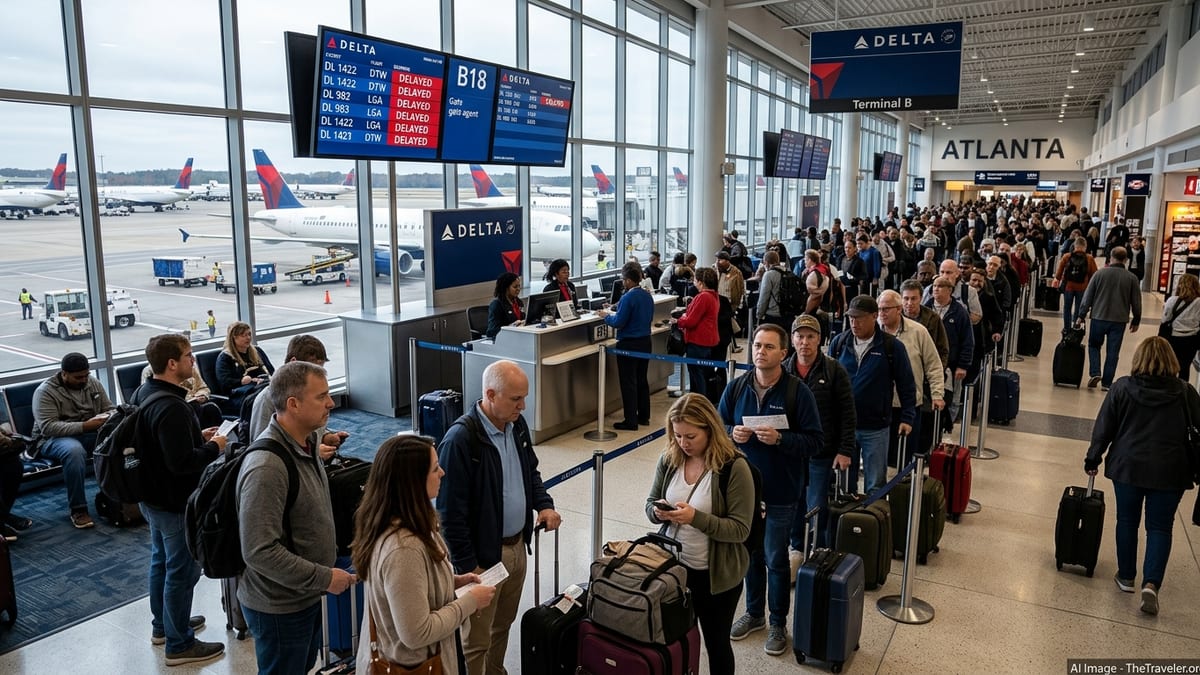
Delta Air Lines has restored a malfunctioning weight‑and‑balance automation system that forced a brief ground stop and extensive delays at Hartsfield‑Jackson Atlanta International Airport on Sunday, November 22, 2026, with operations now stabilizing as the busy Thanksgiving travel period begins.
Get the latest news straight to your inbox!
What went wrong with Delta’s system in Atlanta
According to Delta and multiple airport and federal aviation updates, the disruption began on the morning of Sunday, November 22, when the airline’s automated system for calculating aircraft weight and balance stopped functioning reliably at its Atlanta hub. The software is used to combine passenger, baggage, cargo and fuel data to determine safe takeoff weights and proper loading for each aircraft. When the system fault occurred, dispatchers and flight crews could no longer depend on automated calculations for departing flights.
To maintain safety, Delta temporarily shifted to manual procedures for loading and dispatching aircraft while technicians worked to restore the platform. For a period on Sunday morning, the Federal Aviation Administration implemented a ground stop for Delta flights bound for Hartsfield‑Jackson at the airline’s request, later easing this to a ground delay program once some departures could again be processed. Arrivals and departures continued at reduced capacity as crews carried out weight and balance checks by hand, which significantly slowed the flow of aircraft through the world’s busiest passenger airport.
The outage did not affect core air traffic control systems or in‑flight safety equipment, but it did halt normal dispatch operations long enough to trigger a queue of delayed flights that spread from Atlanta to Delta’s wider domestic network. The issue came less than two weeks after a separate nationwide FAA communications failure that grounded flights across all U.S. airlines, increasing scrutiny of the resilience of aviation technology just as holiday demand peaks.
Scale of delays and how travelers were affected
The system problem in Atlanta translated quickly into concrete disruptions for passengers. By Sunday afternoon, flight‑tracking data compiled by FlightAware showed more than 1,300 Delta flights facing delays across the United States, with some reports citing over 2,000 delayed operations and several hundred cancellations once knock‑on effects were included. Not all of those disruptions originated in Atlanta, but Delta has said a substantial majority of its delays and cancellations on Sunday were linked directly to the automation failure rather than to weather or air traffic constraints.
At Hartsfield‑Jackson itself, local reports indicated that around 1,250 flights in and out of the airport were delayed by early Sunday evening as ground handling and dispatch operations slowed. Because Delta is the dominant carrier at the airport, its outage also affected some flights on other airlines that were scheduled to connect with Delta passengers or share gates and taxiway space. Travelers described multi‑hour waits on taxiways and at gates as aircraft queued for revised paperwork, manual baggage processing and new pushback times once the ground stop and ground delay measures were in place.
The disruption rippled beyond Atlanta throughout Sunday and into Monday. Some passengers misconnected at the hub as delayed inbound flights arrived after their onward departures had left or been retimed. Others experienced rolling delays as aircraft and crews found themselves out of position. While Sunday saw the most acute operational impact, Delta’s schedule on Monday morning still showed several hundred delayed flights and around 90 cancellations as the airline worked through residual imbalances in aircraft and staffing.
How the outage was resolved and current operating status
Delta said on Sunday afternoon that automation for weight and balance calculations had been restored and that normal system functionality was returning across its network. The FAA subsequently lifted its ground delay program for Atlanta‑bound Delta flights late Sunday morning, and by Sunday evening the airline was again dispatching flights using its standard automated processes rather than manual workarounds. Local Atlanta media reported on Monday, November 23, that operations at Hartsfield‑Jackson were stabilizing, with the airline describing performance as largely back to normal.
Although the root technical cause of the automation failure has not yet been detailed publicly, Delta has consistently characterized it as an internal equipment or software issue rather than the result of a cyberattack or an FAA air traffic control problem. The carrier emphasized that at no point were aircraft operated without verified weight and balance calculations; instead, the outage forced a more time‑consuming manual process that could not keep up with the volume of scheduled departures during the morning and midday peaks.
By Monday evening, major flight‑tracking services were reporting a sharp decline in Delta‑specific delays compared with Sunday’s peak, even though some flights continued to run late as the airline repositioned aircraft and crews. Travel industry analyses published Monday and Tuesday anticipated that residual disruptions would continue to taper through November 24, with Delta’s operation expected to be largely normalized heading into the core Thanksgiving departure window. For now, the airline has not announced any special extended waiver or long‑term schedule change linked to the outage beyond standard rebooking options tied to delayed or canceled flights.
Context: a sensitive moment for U.S. aviation technology
The timing of Delta’s system failure intensified attention on the reliability of aviation technology. It occurred during the buildup to what transportation officials expect to be one of the busiest Thanksgiving travel periods in more than a decade, only days after a separate U.S. router issue on November 13 forced the FAA to order a rare nationwide ground stop for all carriers. That earlier incident, unrelated to Delta’s automation problem, led to more than 18,000 flight cancellations and delays and prompted renewed calls in Washington to accelerate modernization of the national air traffic infrastructure.
In contrast to the FAA‑wide outage, Sunday’s disruption was confined to Delta’s internal systems, but because the airline is the primary carrier in Atlanta and a major player nationwide, the operational impact was still substantial.vised The Atlanta event also followed several high‑profile IT and automation problems at other U.S. airlines in recent years, including a United Airlines system outage just days before Delta’s latest glitch. Industry regulators and lawmakers are using the recent spate of problems to question whether airlines and aviation authorities have built sufficient redundancy into critical technology that supports schedule planning, dispatch and baggage handling during peak travel periods.
For passengers, the distinction between an airline‑specific issue and a government‑wide failure matters mainly in terms of who provides support and compensation. When a disruption is traced to an airline’s own systems rather than external constraints such as weather or air traffic control, federal guidance makes clear that customers whose flights are canceled are generally entitled to refunds if they choose not to travel. Delta has not announced any special blanket compensation program linked to Sunday’s outage, but standard U.S. Department of Transportation rules on cancellations and significant schedule changes continue to apply.
What affected travelers can do now and what to expect next
With Delta’s automation system restored and Atlanta operations returning to normal, most travelers over the next several days are expected to see schedules that closely resemble pre‑outage planning, although minor knock‑on delays remain possible as aircraft and crews fully return to their regular rotations. Industry forecasts ahead of the holiday suggest U.S. passenger volumes will reach multi‑year highs this Thanksgiving week, so even with Delta’s systems now working, congestion and weather could still drive additional day‑of‑travel schedule changes.
Passengers whose flights were canceled on Sunday or Monday because of the automation problem can request refunds instead of rebooking if they no longer wish to travel, consistent with federal consumer protection rules. Those who were delayed but ultimately flew on their original itinerary can review Delta’s customer service commitments to see whether meal vouchers, hotel accommodation or miles are being offered in specific circumstances. Any such support is typically arranged through the airline’s usual customer service channels, including online rebooking tools, mobile apps and airport agents.
For travelers with upcoming trips involving Atlanta, the most practical step is to closely monitor flight status in the 24 hours before departure and again on the day of travel. Delta advises arriving at least two hours before domestic departures and three hours before international flights during peak periods, guidance that Atlanta’s airport has echoed for the week of November 24. While there is currently no indication of an ongoing systems problem at Delta, the recent event underscores how quickly technical issues can cascade through modern hub‑and‑spoke operations, making real‑time updates from airlines, airports and official aviation authorities a critical resource for anyone flying during the holiday rush.