


More news on this day
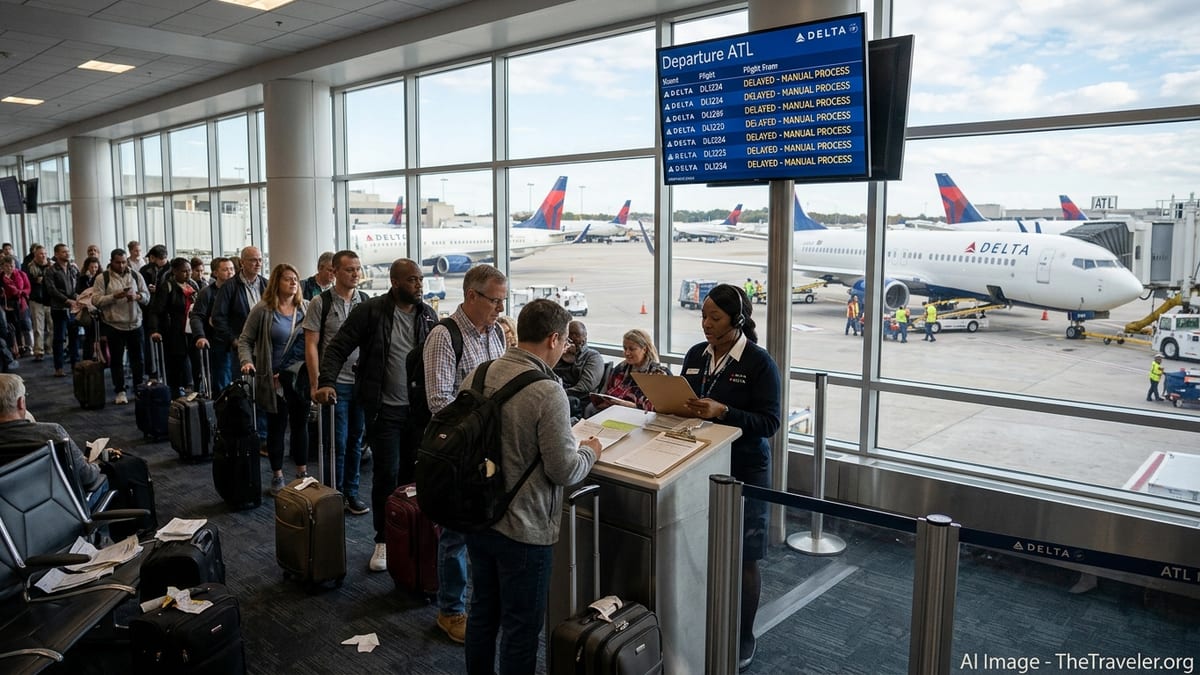
Delta Air Lines says operations are stabilizing after an outage in its automated weight-and-balance system on Sunday, November 22, disrupted flights nationwide and triggered a ground delay program into Atlanta during one of the busiest U.S. travel weeks of the year, with lingering knock-on delays still affecting some customers into Tuesday.
Get the latest news straight to your inbox!
What happened to Delta’s system on Sunday?
The disruption began on the morning of Sunday, November 22, when Delta reported problems with the automated system it uses to calculate weight and balance figures for departing flights. The carrier relies on this software to generate load instructions, including how baggage and cargo are distributed and the final takeoff weight for each aircraft, a mandatory safety step before every departure. Delta confirmed that the system issue was internal to the airline and not caused by Federal Aviation Administration air traffic control equipment.
As the automation failed, dispatchers and airport teams switched to manual workarounds to complete the required calculations. That process is slower than normal automated workflows, so some aircraft that were otherwise ready to depart remained at gates while staff verified figures by hand or with backup tools. The delays on departures meant gates at busy airports, especially Hartsfield-Jackson Atlanta International Airport, opened later than scheduled for arriving flights, which in turn reinforced congestion on the ground.
According to statements from Delta, the airline’s automated system was restored later on Sunday. The carrier has not released technical details about the underlying cause beyond describing the episode as an automation outage affecting its weight-and-balance tools. There have been no reports from regulators indicating that flight safety was compromised, and the FAA has treated the event as an operational disruption rather than an accident or incident.
Ground stop, ground delay and scope of disruption
In response to the growing backlog of aircraft, the FAA on Sunday morning temporarily halted some Delta flights bound for Atlanta under a ground stop and then converted the measure into a ground delay program. Under such programs, flights are held at their origin airports and released into the airspace on a managed schedule designed to prevent gridlock at the destination, rather than allowing all affected flights to depart and then queue in the air or on taxiways on arrival.
Advisories published on Sunday indicated that the ground delay into Atlanta was expected to last into the early afternoon, with typical holds of around an hour before departure for some affected services. Flight-tracking data showed hundreds of delayed departures and arrivals at Hartsfield-Jackson, and by midafternoon multiple outlets were reporting close to or above 1,000 delayed flights involving all airlines operating at the airport, not only Delta. Separate weather and air traffic control constraints in the Northeast also contributed to delays for some routes that intersected congested airspace.
Delta said around 70% of the delays and cancellations attributed to the airline on Sunday were linked to the automation failure, with the remainder connected to weather and air traffic control programs. The carrier and regional partner Delta Connection had roughly 5,000 flights scheduled for the day across their combined networks, making even a modest slowdown in departure processing translate into a large number of passengers affected, particularly with Thanksgiving travel already building.
Impact on travelers across the network
Although the technical issue was centered on Delta’s weight-and-balance tools and the most visible congestion occurred at Atlanta, customers reported disruption across the United States. Delays were noted at major Delta stations including New York’s LaGuardia and Newark, Washington’s Reagan National and Dulles, Boston, Baltimore, Miami, Minneapolis, Nashville, San Antonio and Birmingham, among others. In some cases, aircraft departed late from outstations yet still faced waits for a gate upon arrival in Atlanta, because earlier delays had pushed connections and turnarounds out of their planned order.
The timing of the outage amplified its effect. The problems emerged during the last weekend before the Thanksgiving holiday in the United States, when airlines are already operating near peak capacity and spare seats for same-day rebooking are limited. Some passengers saw itineraries delayed by several hours, while others experienced missed connections and overnight disruptions as aircraft and crews wound up out of position. Social media posts and passenger reports described extended tarmac waits, longer-than-expected lines at customer service desks and difficulty finding alternative flights on other carriers due to heavy seasonal demand.
Delta has said it is rebooking affected travelers on the next available itineraries and offering meal vouchers and hotel accommodation where overnight stays become necessary. The airline has also reiterated that customers whose flights were canceled and who choose not to travel are eligible for refunds. These measures align with the carrier’s standard disruption policies and the expectations outlined by U.S. authorities for handling significant delays and cancellations, although the practical value for passengers varies depending on how much seat inventory remains on alternative departures.
How quickly did operations recover?
By Sunday afternoon, Delta reported that its automated system for calculating weight and balance had been restored and that aircraft were again being processed using normal electronic procedures. Flight operations gradually improved through the remainder of the day as the backlog of delayed departures and arrivals was worked down, and by Monday, November 23, Atlanta airport officials and local media described the carrier’s schedule as stabilizing, even though some residual delays and scattered cancellations continued as aircraft and crews were repositioned.
Data from flight-tracking services on Monday showed a lower volume of same-day disruptions compared with the peak of Sunday’s outage, but still above typical levels for Delta at this time of year. Travelers in several cities reported that crews were still referencing manual verification of weight-and-balance data on some flights on Monday and into Tuesday, suggesting that while the main automation tools were functioning, dispatchers and pilots were proceeding cautiously and confirming figures before departure.
There is, at this stage, no indication from the airline or regulators that a repeat outage is expected, and the event has been treated as a concluded systems failure with ongoing operational cleanup. The FAA has not announced a formal investigation specific to Delta’s internal software, and any review of the carrier’s technology performance would ordinarily fall under regular safety oversight rather than a separate public inquiry unless further issues were reported.
Link to the earlier nationwide ground stop
The Delta outage occurred less than two weeks after a separate, unrelated technology failure triggered a rare nationwide ground stop across the United States. On Friday, November 13, a router problem in the FAA’s communications network led the agency to halt departures for more than four hours, the longest such stoppage in roughly a quarter century. That earlier event forced thousands of flights to delay or cancel and had lingering effects on airline schedules for several days.
Officials and independent analysts have emphasized that the November 13 FAA ground stop and Delta’s November 22 internal outage were distinct incidents with different technical causes: the former involved federal communications infrastructure, while the latter involved airline-specific weight-and-balance tools. However, their close timing has highlighted the sensitivity of the U.S. air travel system to both government and airline technology problems, especially during periods of heavy seasonal demand when there is little slack in aircraft and crew schedules.
For travelers headed through Atlanta and other major hubs, the combination of the earlier nationwide halt and Delta’s subsequent system issue has meant facing elevated risk of disruption during a time when Thanksgiving air travel volumes are already at their highest levels in years. As a result, both the FAA and airlines have been under additional public pressure to demonstrate that contingency plans, redundancy measures and manual fallbacks are robust enough to keep people moving even when automated tools fail.
What travelers should know for the days ahead
As of Tuesday, November 24, there is no evidence of an ongoing system failure at Delta, and schedules into and out of Atlanta and other hubs are broadly following their planned timetables, according to publicly available flight status data. However, some knock-on effects from Sunday’s disruption remain possible, including isolated delays linked to aircraft or crew still returning to their normal rotations, particularly on routes that experienced cancellations earlier in the week.
Travelers booked on Delta services over the Thanksgiving period are advised to monitor their flight status closely in the 24 hours before departure through the airline’s website or app, and to allow extra time at the airport in case security lines or rebooking queues lengthen if weather or other factors introduce new complications. Customers whose flights were directly affected by the November 22 outage should review any email or app notifications from Delta regarding rebooking, vouchers or refund eligibility, and contact the airline promptly if their plans have changed or if they require written confirmation of delays for insurance or employer documentation.
Looking slightly further ahead, there have been no formal announcements from Delta detailing new investments or specific upgrades tied to this incident, but large U.S. carriers typically review internal outages to assess whether additional redundancy, alternative processing paths or staff training are needed. Until any such measures are publicly described, passengers can assume that standard operational safeguards remain in place and that manual weight-and-balance procedures continue to be available as a backup if automation issues reappear. In practice, flexibility in travel plans, up-to-date contact information in airline profiles and a clear understanding of refund and rebooking options remain the most effective tools for minimizing the impact of any future disruption.