


The Dodecanese islands stretch across the southeastern Aegean, close to the coast of Turkey, and form one of Greece’s most varied island groups. Defined today as 15 main islands plus many smaller islets, the Dodecanese include Rhodes, Kos, Karpathos, Patmos, Kalymnos, Symi, Astypalaia, Leros, Tilos, Nisyros, Lipsi, Kastellorizo, Kasos, Chalki and Agathonisi. They are known for a mix of medieval castles and walled towns, volcanic landscapes, quiet under-the-radar islands and a blend of sandy and pebbly beaches.
Get the latest updates straight to your inbox!
What and where are the Dodecanese?
In modern usage, the term Dodecanese refers to a Greek island group in the southeastern Aegean Sea that today comprises 15 principal islands and numerous islets. Authoritative references, including Greece’s official tourism materials and modern encyclopedias, consistently list the main islands as Agathonisi, Astypalaia, Chalki, Kalymnos, Karpathos, Kasos, Kastellorizo, Kos, Lipsi, Leros, Nisyros, Patmos, Rhodes, Symi and Tilos, with many smaller inhabited and uninhabited satellites. Historically the name means “twelve islands,” but administrative and geographical definitions have expanded over time.
Geographically, the Dodecanese run in a broken arc from Patmos and Leros in the north down to Karpathos, Kasos and tiny Kastellorizo in the south and east. They sit considerably closer to Turkey than to mainland Greece, which has influenced their history, cuisine and architecture. For many travelers, this archipelago feels slightly more remote than the Cyclades or Saronic islands, yet still accessible through well-established ferry and flight links.
The region’s reputation rests on a distinctive blend of experiences. On Rhodes you find a UNESCO-listed medieval city and grand fortifications that recall periods of Knights Hospitaller, Ottoman and Italian rule. Volcanic Nisyros offers crater hikes and stark caldera scenery, while rugged Kalymnos attracts climbers from around the world. Quieter islands such as Tilos, Lipsi and Kasos offer low-rise villages, uncrowded beaches and a notably relaxed pace of life.
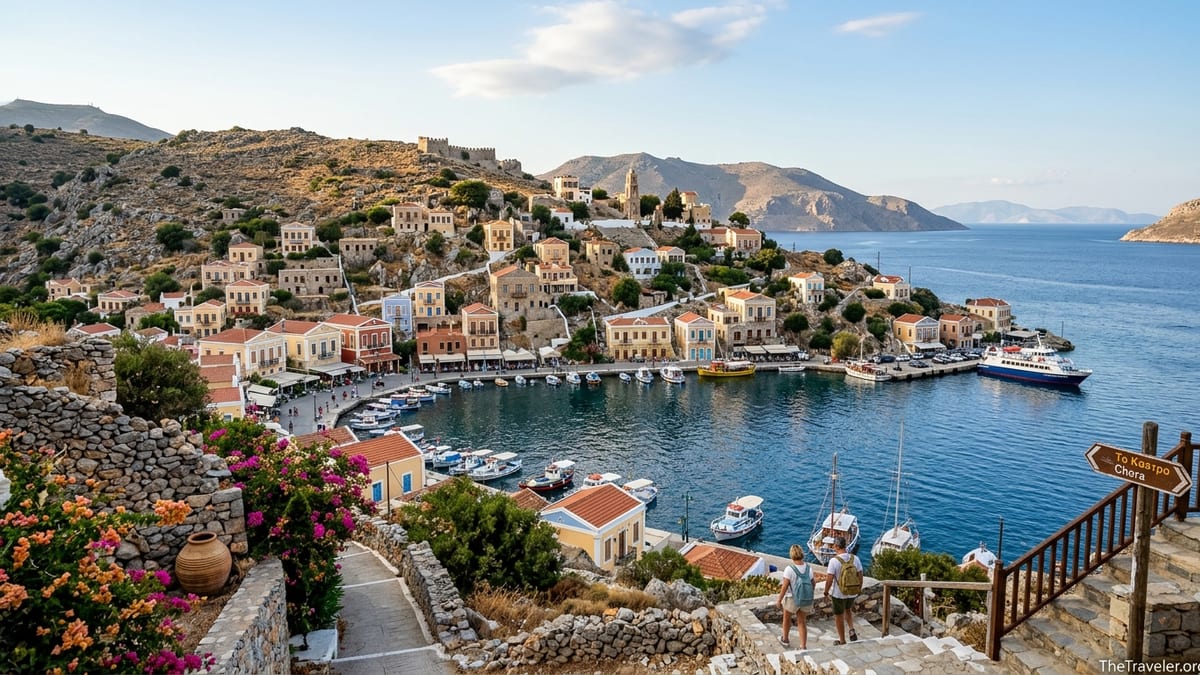
Architecturally, visitors notice differences from the whitewashed Cycladic stereotype. Italian occupation in the 20th century left Art Deco and neoclassical public buildings and waterfronts in Rhodes, Kos and elsewhere, while colorful neoclassical mansions ring Symi’s harbor. Traditional villages like Olympos in Karpathos and old quarters in Leros or Patmos preserve stone-built houses and narrow lanes that feel distinct within the Aegean.
Who the Dodecanese are best for
The Dodecanese appeal strongly to travelers with an interest in layered history. Rhodes Old Town, enclosed within well-preserved medieval walls, is a major draw with its Palace of the Grand Master and cobbled streets. Patmos is renowned for early Christian heritage, especially the Monastery of Saint John the Theologian and the Cave of the Apocalypse, making it a significant site for religious and cultural tourism. Karpathos and Leros also feature Second World War remnants and small museums that add further historical depth.
Families often choose Rhodes or Kos for their broad choice of beach resorts, shallow bays and organized activities. These larger islands offer waterparks, boat excursions, plentiful tavernas and a spectrum of accommodation from simple apartments to all-inclusive hotels. With international airports and regular domestic flights, they work well for one-island holidays where logistics stay simple, especially with young children.
Hikers, nature-lovers and climbers find the Dodecanese particularly rewarding. Nisyros and its volcanic caldera, the protected landscapes of Tilos, and the rugged interior of Karpathos offer marked trails, traditional villages and scenic coastlines. Kalymnos has become a global climbing destination, with bolted routes on limestone cliffs and an enduring sponge-diving tradition that forms part of its identity. On quieter islands, spring and autumn bring wildflowers and migratory birds alongside comfortable hiking temperatures.
Couples and travelers seeking romantic harbor towns are often drawn to Symi, with its amphitheatrical neoclassical waterfront, as well as small-scale Halki and remote Kastellorizo with their colorful house-fronts. Many of the smaller Dodecanese islands suit visitors who prefer low-key nightlife and evenings spent in waterfront tavernas. While you can certainly find lively bars on Rhodes and Kos, the overall feel of the region leans more toward convivial evenings than late-night clubbing.
Dodecanese versus Cyclades and Ionian islands
When comparing the Dodecanese to better-known groups such as the Cyclades and the Ionian islands, it helps to think in terms of broad tendencies rather than rigid rules. Climatically, the southeastern Aegean is generally among the warmest and driest parts of Greece, with long summers and relatively mild winters. This can mean more settled beach weather in late spring and early autumn compared to some northern and central Aegean islands, although local microclimates still matter.
Architecturally and historically, the Dodecanese show stronger traces of Ottoman and Italian rule than many Cycladic islands. Visitors notice medieval fortifications, mosques, Italian-era town plans and neoclassical seafronts alongside Greek Orthodox churches and traditional stone houses. In contrast, the Cyclades are best known for cubic whitewashed houses and blue-domed churches, while the Ionian islands on Greece’s west coast exhibit Venetian and occasionally British influences and greener, more wooded landscapes.
In terms of access, many Cycladic and Ionian islands are closer to Athens or mainland ports, so travel times from the capital can be shorter. The Dodecanese lie further southeast, which often means longer ferry journeys or a preference for domestic flights via Athens or Thessaloniki. On the other hand, Rhodes and Kos have extensive seasonal direct flights from across Europe, which can make them easier entry points if you are coming from abroad.
Experientially, the Dodecanese often feel a little less homogenized than some heavily touristed Cycladic islands. You will still find busy resorts on Rhodes and Kos, yet several smaller Dodecanese islands remain relatively low-profile internationally. That said, every Greek island group contains both developed and quiet corners, and the decision should ultimately be made by researching individual islands against your priorities and the season of your trip.
Getting to and around the Dodecanese
Two main airports function as gateways to the Dodecanese: Rhodes International Airport and Kos International Airport. Both have year-round flights from Athens, typically operated by Aegean Airlines and Sky Express, with several daily services in high season. These flights usually take under an hour. In summer, a wide range of additional airlines from across Europe operate seasonal direct flights to Rhodes and Kos from cities such as London, Manchester, Berlin, Amsterdam, Rome and many others, though the exact roster of routes changes each year and should be confirmed close to your travel dates.
Smaller islands such as Leros, Kalymnos, Karpathos, Kastellorizo and Astypalaia also have airports with scheduled domestic services, mostly routed via Athens or regional hubs like Rhodes. Carriers such as Sky Express and Aegean periodically adjust which islands they serve non-stop from Athens or via island hops, so it is important to check current schedules for your specific dates rather than rely on past patterns. In shoulder seasons, frequencies usually decrease compared to July and August.
By sea, the “spine” of the network is the long ferry line connecting Piraeus, Athens’ main port, with Dodecanese islands including Patmos, Leros, Kalymnos, Kos, Nisyros, Tilos, Symi, Rhodes, Karpathos, Kasos and Kastellorizo. These routes are typically operated by Blue Star Ferries or related brands, with timetables published into 2026 showing overnight and all-day sailings with multiple intermediate stops. A full run from Piraeus to Rhodes commonly takes around 15 to 17 hours depending on the exact itinerary and number of ports of call.
Regional operators such as Dodekanisos Seaways connect main hubs with smaller islands using high-speed catamarans and conventional vessels. Routes in recent seasons have linked Rhodes and Kos with Symi, Tilos, Nisyros, Leros, Lipsi, Patmos and Kastellorizo, among others, often with morning departures and afternoon returns. Crossing times vary from under an hour on short hops, such as Rhodes to Symi, to several hours for more distant islands. Reliability is generally good, but sailings remain subject to weather conditions, especially strong winds, and services are significantly reduced in winter.
How island hopping works in the Dodecanese
Most island-hopping in the Dodecanese follows a hub-and-spoke pattern. Travelers often fly into Rhodes or Kos, spend several nights there, then branch out by ferry to one or two smaller islands. For example, it is common to combine Rhodes with Symi or Tilos, or Kos with Nisyros, Kalymnos or Leros, depending on current ferry links. Some routes also connect northern Dodecanese islands like Patmos and Lipsi with the Dodecanese hubs and with the North Aegean or Cyclades, which allows more complex itineraries for those with time.
There are a number of cross-links, particularly among the northern islands, but they do not form a perfect loop and may operate only on certain days. Ferries may run, for instance, between Leros and Patmos, Kalymnos and Leros, or between Karpathos, Kasos and Rhodes, but not necessarily every day of the week. Many travelers plan their route by identifying a few must-visit islands and then building an itinerary around the specific sailings available on the days they can travel.
Constraints to keep in mind include seasonal route changes, occasional cancellations in high winds and very limited winter services on minor routes. In the off-season, you may need to route via Rhodes, Kos or even back to Piraeus to move between islands that are a short distance apart on the map. Because 2026 timetables are already available for many lines but can be updated, it is wise to re-check schedules a few weeks before departure and again just before each leg of your journey.
Booking tickets can usually be done online through ferry operators, agents or aggregators, or in person at local travel agencies and port kiosks. In peak months and on popular weekend sailings, cabins and vehicle spaces on longer routes can sell out. For shorter inter-island hops, same-day purchase is often feasible outside the busiest weeks of July and August. Always allow buffer time when planning same-day ferries and flights, as delays are not uncommon.
When to visit the Dodecanese
The months of May and June and then September into early October are widely recommended as the most comfortable periods to visit the Dodecanese. During these shoulder seasons, sea temperatures are inviting, most tourist services are open, and daytime weather is typically warm and dry without the most intense heat. These months usually bring fewer crowds than high summer, which makes walking, sightseeing and inter-island travel more relaxed.
July and August deliver the hottest and busiest conditions. On larger islands like Rhodes and Kos, resort areas, beaches and historic centers can feel crowded, and accommodation prices often reach their peak. The upside is a full slate of ferry connections, excursions and cultural events, along with very reliable beach weather. Travelers who do not tolerate high temperatures well may prefer to focus activities in the early morning and evening or aim for the cooler shoulders of the season.
Spring and autumn are also prime times for hiking and outdoor activities such as climbing on Kalymnos or walking on Nisyros and Tilos. Trails are more pleasant in moderate temperatures, and landscapes in April and early May can be particularly green with wildflowers. Sea temperatures in late April and early May can still be fresh, while October often offers warm water but a small increase in the chance of unsettled weather.
Winter in the Dodecanese is quieter and, on smaller islands, quite subdued in tourism terms. Larger islands like Rhodes and Kos have year-round populations and maintain everyday services, but many seasonal hotels, restaurants and tour operations close from late autumn until Easter. Ferry and flight schedules are reduced, and some inter-island connections pause entirely. A winter visit suits travelers interested in experiencing local life, hiking on cooler days and not relying on beach-focused activities, but it requires more flexible planning and up-to-date checks of transport options and climate data for the specific month.
Choosing your islands: characters and highlights
Rhodes is the largest and most visited island of the Dodecanese, often functioning as a base for regional trips. Its UNESCO-listed Medieval City features stone walls, gates, and the Palace of the Grand Master, while the town of Lindos frames an ancient acropolis above a sheltered bay. Beyond the built heritage, Rhodes offers a wide sweep of beaches, forested interior hills, and resort zones that range from busy to relatively quiet. It suits first-time visitors who want a single island with a bit of everything.
Kos, another major island with an international airport, combines sandy beaches with significant ancient sites and a lively main town. Remains such as the Asklepieion sanctuary and a castle at the harbor testify to its long history. Many visitors come for beach holidays in developed resort areas, but inland villages and cycling routes add variety. Kos often works well combined with nearby Nisyros, Kalymnos or Leros, subject to current ferry links.
Symi is celebrated for its striking harbor, lined with neoclassical mansions painted in soft pastels and ochres rising amphitheatrically from the water. The island is relatively small and rocky, with clear-water bays reached by boat or on foot, and a famous monastery at Panormitis. Symi is popular for short breaks from Rhodes or as part of a multi-island itinerary, especially for travelers who value atmosphere and architecture over long sandy beaches.
Kalymnos has a dual identity as a historic sponge-diving center and a leading European climbing destination. Limestone cliffs above the sea host hundreds of bolted routes that draw climbers, especially in spring and autumn. Away from the crags, you find small beaches, a busy main town, and boat links to Telendos and neighboring islands. Kalymnos pairs logically with Kos, Leros and sometimes Patmos for those building a northern Dodecanese circuit.
Patmos is known worldwide for its religious significance, particularly in Christian traditions. The fortified Monastery of Saint John crowns the main hill above the island’s Chora, while the nearby Cave of the Apocalypse is associated with the writing of the Book of Revelation. Beyond pilgrimage, Patmos offers coves, walking paths and a characterful hilltop town that mixes mansions and narrow lanes. It often attracts visitors looking for a contemplative, village-scale atmosphere and cultural depth.
Karpathos lies toward the southern end of the Dodecanese arc and retains a somewhat remote, traditional feel for its size. The village of Olympos in the north, perched on a ridge, is especially known for its preserved customs and architecture, including windmills and colorful houses. Around the island you find beaches that range from organized bays to more secluded coves, plus hiking opportunities in the mountains. Karpathos is often reached by flight from Athens or by long-haul ferry and can be linked with Kasos or, on some schedules, Rhodes.
Astypalaia, often described as butterfly-shaped, straddles the geographic and cultural boundary between the Cyclades and the Dodecanese. Its whitewashed Chora climbs up a hill beneath a Venetian castle, overlooking a string of windmills and a curved harborfront. The island offers small beaches, low-key nightlife and a relaxed pace that appeals to travelers seeking a blend of Cycladic-style architecture and Dodecanese location. Ferries from Piraeus and connections with neighboring islands usually define how easily it fits into an island-hopping route.
Tilos has a reputation as a quiet, nature-oriented island with an emphasis on sustainable tourism. Its small main port at Livadia, abandoned village of Mikro Horio and walking trails combine with pebbly beaches and birdlife to attract hikers and those looking for a slower rhythm. Nisyros, by contrast, is best known for its active volcano and caldera interior. Visitors often walk on the crater floor or follow paths along the rim, then explore whitewashed villages like Nikia and Mandraki. Nisyros is reachable from Kos and sometimes from other islands, and many travelers visit either as a day trip or for a few nights.
Leros and Lipsi offer yet another flavor of the Dodecanese. Leros has a broken coastline with inlets and bays, a mix of Italian-era buildings around Lakki and traditional quarters crowned by a hilltop castle above Platanos. Its World War Two history and diving sites add interest for some visitors. Lipsi, smaller and quieter, features a compact port town, small chapels, and beaches that are often uncrowded even in high season. For those seeking off-the-beaten-path stays, these islands reward longer visits.
Kastellorizo, officially Megisti, sits far to the east near the Turkish mainland and is known for its colorful harborfront houses and outlying sea caves. Its location gives it a feeling of remoteness relative to the rest of Greece, although ferry and flight connections link it to Rhodes and sometimes beyond. Chalki, close to Rhodes, offers a small, photogenic harbor town and a relaxed atmosphere, often serving as a peaceful counterpart to a busier stay on its larger neighbor. Although this overview touches only on key islands, there are many more islets and communities within the Dodecanese that may be worth considering once you clarify your interests.
How long to stay and sample trip structures
For a first trip focused on relaxation rather than logistics, a 5 to 7 day stay on a single larger island such as Rhodes, Kos or perhaps Karpathos is a practical choice. This allows time for a mix of beaches, a few day trips and exploration of main historic sites without the stress of tight ferry connections. You might, for instance, base in Rhodes Town or along the east coast, with possible day excursions by boat to nearby Symi depending on available timetables at the time of travel.
With 10 to 14 days, many travelers choose a combination of one main hub and one or two smaller islands. For example, you could divide time between Kos and Nisyros, or between Rhodes and Tilos or Symi, adjusting your choices based on which islands have convenient ferries in the relevant season. Another pattern is a linear itinerary through the northern Dodecanese, such as starting in Samos or the Cyclades, then continuing via Patmos, Lipsi, Leros and Kalymnos before exiting through Kos or back to Piraeus.
A three-week trip opens up the possibility of a broader loop through the archipelago. Conceptually, you might fly into Rhodes, spend several days exploring the island and its medieval city, then work gradually north or south via intermediate islands chosen according to current routes and your interests. Alternatively, you could concentrate on the quieter central and northern islands, allowing multiple nights on places like Leros, Lipsi and Tilos to settle into their slower rhythms.
Whatever the duration, it is important not to overpack your itinerary. Even when islands look close on the map, ferry schedules in 2026 may mean that direct connections only operate on specific days or at inconvenient times. Rather than planning precise sequences in advance without schedule data, identify a few priority islands, check up-to-date timetables and flight options for your travel window, and leave some margin for occasional weather-related disruptions.
Practicalities: budget, stays and on-the-ground logistics
Overall costs in the Dodecanese sit in a similar range to other popular Greek islands, though they vary significantly by destination, season and accommodation type. Budget travelers can usually find simple rooms or studios, especially on smaller islands, at rates that are relatively moderate outside peak August. Midrange guests may opt for family-run hotels or stylish boutique properties on islands like Symi, Patmos or Astypalaia, while luxury-seeking travelers will find full-service resorts and high-end suites primarily on Rhodes and Kos. Prices in 2026 continue to reflect broader inflation trends, so it is wise to compare current rates across several booking channels before committing.
Accommodation styles differ by island. Rhodes and Kos feature large beachfront resorts, all-inclusive complexes and sizable apartment hotels, particularly in dedicated tourist zones. In contrast, Symi, Patmos, Leros and similar islands emphasize smaller boutique hotels, guesthouses and renovated mansions in historic settings. On low-key islands such as Tilos, Lipsi and Kasos, you may find mainly family-run rooms and basic studios close to the water, often representing good value but with limited high-end options.
Local transport also depends heavily on island size. Larger islands maintain bus networks linking main towns, beach areas and some villages, especially in the summer season, as well as plentiful taxis. Smaller islands often have few or no buses outside peak months, and visitors rely on walking, occasional taxis, boat services to remote beaches, or rental scooters and cars. Renting a vehicle can be very useful for exploring interiors and reaching trailheads, but you should confirm license requirements, insurance coverage and any local restrictions, and remember that helmets for scooters and quad bikes are compulsory under Greek law.
Cultural and safety considerations mirror those in much of coastal Greece, with a few specifics. Summer heat can be intense, particularly in July and August, so sun protection, hydration and early or late activity patterns are advisable. Hikers on volcanic or mountainous terrain, such as Nisyros, Karpathos or sections of Tilos and Kalymnos, should bring sturdy footwear, check route descriptions and avoid exposed trails during the hottest hours. Some Dodecanese islands lie very close to Turkish shores, including Kastellorizo and parts of Kos and Rhodes; while they remain established tourist destinations, it is prudent to consult up-to-date travel advisories from your home government regarding regional political or security developments before departure.
Deciding if the Dodecanese are right for you
Choosing between the Dodecanese and other Greek island groups, or narrowing this archipelago down to one to three islands, comes down to your priorities. If you value medieval architecture, traces of multiple empires, and a subtle blend of Greek, Levantine and Italian heritage, the Dodecanese provide rich material, particularly on Rhodes, Kos and Symi. If your ideal trip centers on hiking, climbing or quieter nature-oriented stays, islands like Kalymnos, Tilos, Nisyros, Karpathos and Lipsi compare very favorably with options elsewhere in Greece.
Travelers who prefer quick access from Athens and classic postcard Cycladic architecture might lean toward the Cyclades, while those dreaming of lush green hills and Venetian-era towns could favor the Ionian islands. By contrast, the Dodecanese’s strengths lie in their southeastern climate, historic depth, and a range of islands that stretch from full-service resorts to very low-key, traditional communities. The region works especially well for travelers prepared to invest some time in understanding ferry networks and seasonal variations.
To refine your plans, start by clarifying what balance of beach time, cultural exploration, activity and quiet you want, then shortlist a few islands whose characters match. From there, consult current ferry and flight schedules for your intended month, paying close attention to which islands connect efficiently with each other and with your international arrival and departure points. Once you have confirmed logistics, you can dive into more detailed guides on topics such as island-hopping combinations, where to stay on each island and how to structure your days.
Viewed as a region rather than a single destination, the Dodecanese offer a coherent yet diverse slice of the Aegean. With thoughtful planning around routes, seasons and island selection, they can deliver trips that feel both unmistakably Greek and subtly different from experiences in other island groups, rewarding travelers who enjoy variety and discovery.