


More news on this day
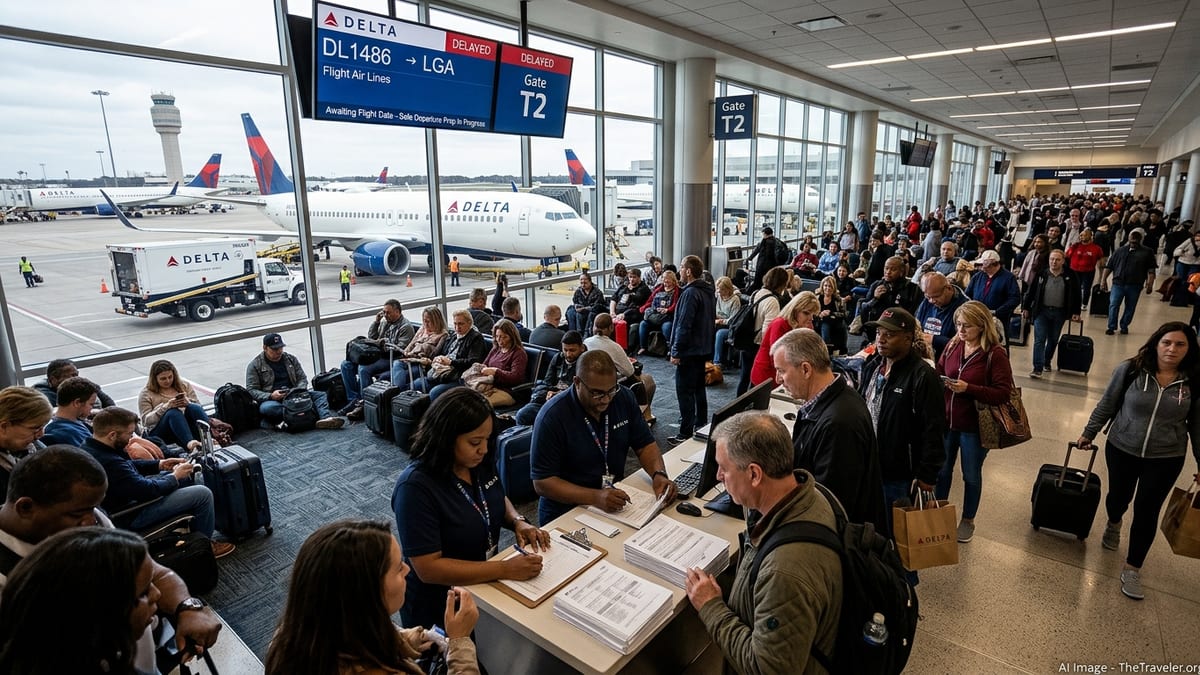
Delta Air Lines has restored the automated system it uses to calculate aircraft weight and balance after a technical failure on Sunday 22 November 2026 triggered extensive delays across its network at the start of the U.S. Thanksgiving travel period, forcing pilots and dispatchers to revert to slower manual procedures while regulators briefly restricted Atlanta-bound flights.
Get the latest news straight to your inbox!
What went wrong with Delta’s weight-and-balance system
According to statements from Delta and the Federal Aviation Administration (FAA), the disruption began early on Sunday 22 November when the airline’s weight-and-balance automation failed, affecting flights to and from Hartsfield-Jackson Atlanta International Airport and other U.S. stations. The system, known internally as the Automated Load Instruction System (ALIS), generates load sheets and performance data that show how passengers, baggage, cargo and fuel are distributed on each aircraft and whether total weight remains within certified limits.
When ALIS became unavailable, Delta’s operations and customer center in Atlanta directed dispatchers, load controllers and pilots to use established backup procedures. Those include manual or semi-manual calculations based on standard passenger and bag weights, aircraft loading charts and performance tables. The airline and the FAA each said that flights would only depart once valid weight-and-balance data had been produced, meaning the outage translated primarily into delays rather than safety compromises.
To manage congestion around Delta’s largest hub, the FAA ordered a brief ground stop on Sunday morning for Delta flights bound for Atlanta, followed by a ground delay program that spaced arrivals over several hours. The FAA described the problem as limited to Delta’s systems rather than to air traffic control infrastructure, a distinction that was important given a separate nationwide telecommunications failure in the FAA network on 13 November that had temporarily halted departures across multiple airlines.
Scale of delays in Atlanta and across the Delta network
Operational data compiled by flight-tracking services and media outlets show that the system failure produced one of Delta’s most disruptive single days in recent years, particularly given its timing at the start of the holiday peak. By Sunday evening, more than 1,500 Delta and Delta Connection departures and arrivals had been delayed across the United States, with some counts exceeding 1,600 affected flights. That represented roughly 40 to 50 percent of the airline’s scheduled operation for the day, depending on the source and cutoff time used.
At Hartsfield-Jackson Atlanta International Airport, where Delta operates the majority of passenger flights, the impact was especially visible. The airport saw an hours-long period in which a high proportion of Delta departures and arrivals operated at least 15 minutes behind schedule, while some sat at gates or in departure queues for considerably longer as crews waited for revised load paperwork. Because Atlanta functions as the center of Delta’s hub-and-spoke network, delays there quickly cascaded into missed connections and late operations at smaller airports that had no local weather or infrastructure problems of their own.
Outside Atlanta, airports including New York LaGuardia, Los Angeles International, Seattle-Tacoma, Detroit Metropolitan and Minneapolis–St. Paul all reported clusters of late-running Delta flights on Sunday, even when other airlines at the same airports were moving normally. Delta’s own figures, cited in local news reports, indicated that about 70 percent of the schedule changes it made that day could be traced directly to the automation issue rather than to local conditions or routine congestion. A smaller share of flights, around 3 percent of the daily schedule, were canceled entirely as extended delays caused crews to reach duty-time limits or aircraft to fall irrecoverably behind their planned rotations.
How passengers experienced the disruption
For travelers, the outage translated into extended waits at gates and on board aircraft at the very start of a nine-day period that is typically one of the busiest for U.S. air travel. Passengers posting on social media and speaking to local broadcasters in Atlanta, Washington, Dallas, Seattle and other cities described boarding on time before captains announced that they were awaiting manual weight-and-balance numbers from Delta’s operations center. In many cases aircraft then remained parked at the gate, or joined long taxi queues, for between one and three hours before receiving clearance to depart.
Some travelers reported sitting on aircraft for more than four hours before their flights were eventually canceled when crews timed out or when downstream sectors could no longer be operated. Others whose flights departed later in the day encountered lengthy waits for gates at their destinations because earlier arrivals were still occupying stands after late pushbacks. The result was a patchwork of experiences in which some passengers completed trips with only modest delays of under an hour, while others arrived many hours late or were rebooked for flights on Monday or Tuesday.
Delta said it was rebooking affected customers on the next available flights and, in cases where travelers were stranded overnight, offering hotel accommodation and meal vouchers in line with its policies for controllable disruptions. The airline also reiterated that passengers whose flights were canceled were eligible to request refunds if they chose not to travel. Some customers interviewed on Monday reported that they were able to complete trips with relatively minor residual delays as aircraft and crews gradually returned to their normal positions in the schedule.
Safety procedures, FAA oversight and recent tech failures
The FAA and Delta each stressed that at no point were flights allowed to depart without valid weight-and-balance calculations, whether produced automatically or through manual backup methods. Weight, balance and aircraft performance are fundamental safety parameters that determine not only whether an aircraft can lift off within the available runway length, but also how it will respond in the event of an engine failure, wind shear or other abnormal conditions. Operating outside certified weight limits or with the center of gravity significantly out of position can compromise controllability or structural margins.
Airlines therefore operate with multiple layers of redundancy for performance planning. In Delta’s case, ALIS normally automates the creation of load instructions for baggage crews and the final load sheets used by pilots, drawing on booking, check-in and cargo data. When that system failed on Sunday, staff reverted to backup procedures that the FAA expects carriers to maintain precisely for rare occasions when primary tools are unavailable. Those processes are slower and more labor-intensive, which contributed to the lengthy queues and holds seen at gates and on taxiways, but they are designed to meet the same regulatory standards as automated tools.
The Delta outage came only days after two other high-profile technology incidents affected U.S. aviation. On 13 November, a failure in an FAA telecommunications component led to a nationwide ground stop that temporarily halted departures for multiple airlines before operations gradually resumed. On 16 November, United Airlines reported its own outage that interfered with internal communications and delayed departures while pilots awaited final load and weight data. Regulators and industry groups have not yet released comprehensive analyses tying the three events together, but the sequence has highlighted the dependence of modern air travel on complex software and networked systems.
Thanksgiving timing and what travelers should do next
The timing of Sunday’s failure increased its effect on travelers. The outage struck on the first Sunday of the Thanksgiving travel window, a nine-day span from Monday 23 November to Tuesday 1 December during which airlines and regulators had forecast some of the heaviest U.S. air traffic since before the pandemic. Forecasts indicated that more than 400,000 flights were scheduled nationwide over the period, with peak passenger volumes expected on the Tuesday and Wednesday before Thanksgiving and on the Sunday after the holiday.
For Atlanta in particular, airport officials had projected more than 4 million passengers during the same window, reflecting its role as both Delta’s primary hub and one of the world’s busiest airports by passenger volume. In that context, an interruption of just a few hours in Delta’s normal departure flow was enough to create rolling knock-on effects in cities that rely on Atlanta connections for domestic and international services. Aviation analysts noted that while overall cancellation percentages remained relatively low, the concentration of delays among connecting passengers amplified the disruption to individual travel plans.
By Monday 23 November, Delta and local airport authorities reported that operations in Atlanta were stabilizing, with the airline’s automated weight-and-balance system restored and most flights departing within typical tolerance of their scheduled times. Data gathered by local media and flight-tracking services still showed residual delays at some hubs into Monday and isolated cases on Tuesday, largely as aircraft and crew pairings were realigned after Sunday’s irregular operations. For passengers booked to travel in the middle and later parts of Thanksgiving week, weather and routine congestion again became the dominant risks rather than lingering effects of the automation issue.
Travelers with upcoming Delta flights during the remainder of the Thanksgiving period are being advised to monitor their flight status closely through the airline’s app or airport departure boards, particularly when connecting through Atlanta or through weather-sensitive hubs in the Northeast and Midwest. Given the tight schedules and high load factors typical during holiday peaks, even relatively minor disruptions can limit rebooking options. Passengers who were directly affected by Sunday’s outage and have not yet rebooked or requested refunds are encouraged to contact Delta or their booking provider promptly to confirm available alternatives, voucher eligibility and any changes to onward accommodation plans.