


More news on this day
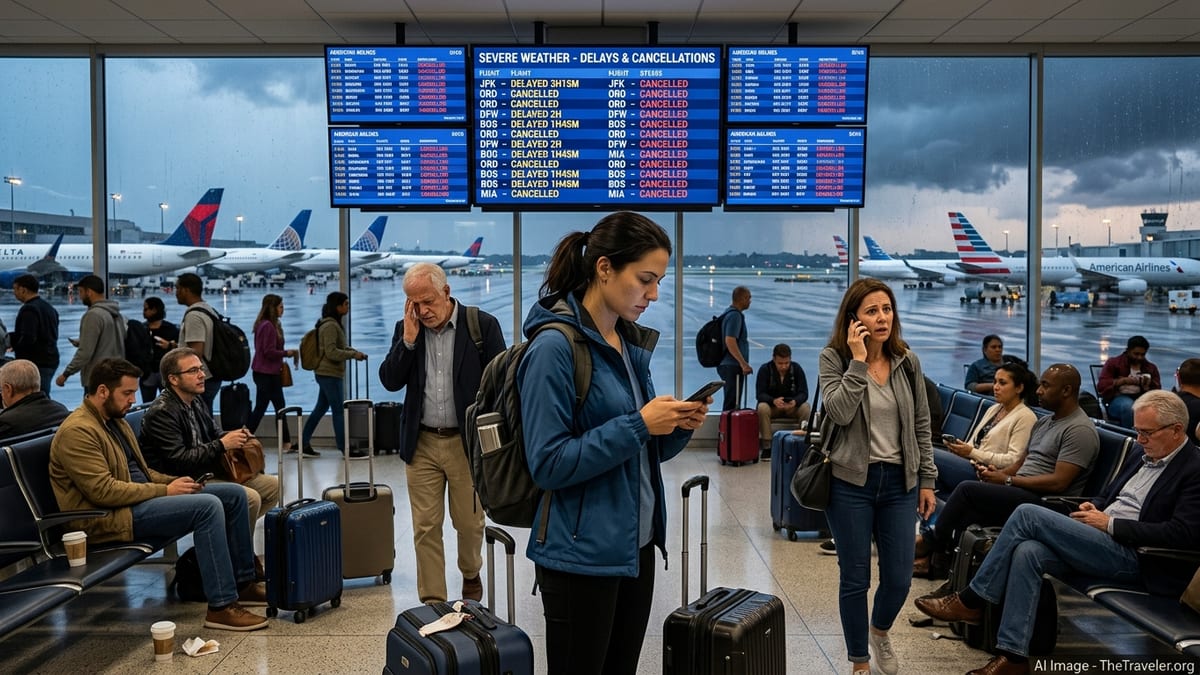
Newly updated federal data and early findings from the November 13, 2026 nationwide ground stop investigation indicate that, despite the scale of this month’s telecommunications failure, routine and severe weather still account for most serious U.S. flight delays tied to the aviation system itself.
Get the latest news straight to your inbox!
What federal delay statistics currently show
The clearest quantitative picture of weather’s role in U.S. flight disruption still comes from the Federal Aviation Administration’s Operations Network, or OPSNET, which aggregates air traffic delay reports from facilities across the National Airspace System. In a public summary used for its NextGen weather program, the FAA reports that weather was responsible for 74.26 percent of “system-impacting” delays of more than 15 minutes between June 2017 and May 2023, meaning delays attributed to airspace and airport capacity constraints rather than to airline-specific issues such as crew, maintenance or security.
OPSNET defines a delay as system-caused when air traffic managers must constrain traffic flows because of conditions at airports or in controlled airspace. That can include closing or rerouting standard arrival and departure procedures, changing runway configurations, increasing the separation required between aircraft or limiting how many flights may enter a sector during a given period. Within that framework, the FAA highlights convective thunderstorms, low cloud ceilings and visibility, strong or shifting winds and winter precipitation as the primary weather phenomena that reduce usable capacity on busy routes and at major hubs, even when the printed schedule does not change.
A complementary view comes from the U.S. Department of Transportation’s Bureau of Transportation Statistics on-time performance database, which tracks arrival delays for individual flights. Large U.S. passenger airlines report late arrivals of 15 minutes or more using five main categories: Air Carrier, National Aviation System, Weather, Late-arriving Aircraft and Security. BTS documentation and recent pocket guides indicate that, in a typical year through 2023, roughly one in five domestic scheduled flights arrived at least 15 minutes late, with NAS, Extreme Weather and Late-arriving Aircraft together accounting for most recorded delay minutes once security-related disruptions are excluded.
The reporting rules mean that the stand-alone Weather or Extreme Weather categories understate the true role of weather. Airlines are instructed to list the factor that ultimately made the individual flight infeasible. When an initial weather-driven ground delay triggers a chain of missed connections, curfew violations or crew duty-time conflicts, the final leg in that chain may be logged as an Air Carrier or Late-arriving Aircraft delay, even though storms or low ceilings set the disruption in motion. Federal statistical notes acknowledge that many weather effects are embedded inside NAS and Late-arriving Aircraft data, which is why OPSNET’s system-level perspective and BTS’s flight-level figures need to be interpreted together.
How the 13 November nationwide ground stop unfolded
The strongest recent counterexample to routine, forecastable weather disruptions came on Friday 13 November 2026, when the FAA ordered a rare nationwide ground stop after instability in its internal telecommunications network triggered alarms across several facilities. According to a question-and-answer document the agency published on 15 November, operators canceled about 12,462 flights that day, including 9,082 cancellations by major airlines, as a consequence of the stop and its knock-on effects, with some disruption spilling into 14 November as aircraft and crews remained out of position.
That FAA account and a separate brief from the Congressional Research Service state that the nationwide order remained in effect for approximately 4 hours and 45 minutes before being lifted in the evening of 13 November. The timeline is broadly consistent with contemporaneous reports from airlines, flight-tracking services and state emergency management summaries, which describe a sharp halt to most departures followed by a gradual resumption once engineers stabilized communications and controllers could again rely on consistent radar and radio links.
Early technical findings focus on ongoing modernization work in the agency’s communications backbone. The FAA and members of the Senate Commerce Committee have confirmed that the outage occurred in the middle of a multi-year program to transition portions of the network from aging copper lines to fiber optics and to replace thousands of routers. Federal documents released since mid-November describe how a new router at a remote radio site in El Dorado, Arkansas, installed by telecommunications contractor L3Harris as part of this upgrade effort, flooded the network with excessive data and destabilized older equipment across multiple en route centers. Officials have also pointed to a second site near Amarillo, Texas, as part of the event sequence, although detailed root-cause timelines are still being compiled.
In public statements, Transportation Department leaders have said they are examining why existing redundancy did not prevent a localized malfunction from cascading into a national-scale disruption, and why recovery required a broad halt rather than a rapid reconfiguration. The FAA has temporarily paused further installation of the same model of Juniper Networks routers while the investigation proceeds and has told Congress it will provide a joint technical briefing with its contractors. As of late November 2026, those briefings and a more granular engineering report are pending, so the precise technical chain remains subject to further confirmation even though the broad outline of a router-induced telecommunications failure is now widely accepted.
For passengers, the 13 November disruption looked very different from a typical winter storm or summer thunderstorm pattern. Because the trigger was a sudden network instability rather than a forecast weather system, there was little advance warning visible to the public. Travelers across the country received abrupt messages about a “national ground stop” or “FAA systems issue,” and in some locations aircraft that had already pushed back returned to gates as departure queues froze. Once the FAA lifted the order and allowed departures to resume, missed connections, duty-time limits and local curfews meant cancellations and long delays remained common into the following day, particularly on the last wave of evening flights.
Why weather still dominates delay statistics
Despite the attention created by the November telecommunications outage and by earlier technological failures such as the January 2023 Notice to Air Missions system problem, aggregated federal statistics still show that, over a typical year, most U.S. delay minutes originate with weather rather than equipment or software issues. The operational chain begins with specialized aviation weather forecasting within the National Weather Service. The Aviation Weather Center produces national charts and bulletins focused on hazards such as thunderstorms, icing, turbulence and low visibility, identifying where and when conditions are likely to constrain flight levels, routes and approach or departure procedures.
Those national products are refined by meteorologists in Center Weather Service Units co-located with each of the FAA’s Air Route Traffic Control Centers. These forecasters translate broad outlooks into route- and airport-specific guidance, indicating, for example, when a line of storms is expected to cross standard arrivals into a major hub, when crosswinds could force a switch to a less efficient runway configuration, or when cloud ceilings might fall below the thresholds needed for simultaneous approaches on closely spaced parallel runways. Their briefings feed into the FAA’s Air Traffic Control System Command Center in northern Virginia, which coordinates national traffic management decisions and balances predicted demand against expected capacity.
Command Center specialists incorporate these aviation forecasts with demand projections drawn from filed flight plans and historical traffic patterns over planning horizons that typically range from several hours up to about a day. In recent years, planning calls that bring together FAA facilities, airline operations centers, cargo carriers, business aviation and, when necessary, neighboring air navigation service providers such as NAV CANADA have increasingly used probabilistic forecasts that express the likelihood of particular weather hazards. That allows traffic managers to calibrate responses to different confidence levels rather than relying on a single deterministic storm track or timing.
When deteriorating conditions move from forecast to reality and begin to reduce actual capacity, the FAA applies formal Traffic Management Initiatives to keep demand within what the system can safely handle. The agency’s orders describe a toolbox that includes Ground Delay Programs, Ground Stops, Airspace Flow Programs, route revisions and spacing measures such as miles-in-trail restrictions. Guidance instructs traffic managers to apply the least restrictive measure capable of restoring a safe balance between demand and capacity, which is why passengers may see relatively modest schedule adjustments on some days and much sharper cutbacks on others as evolving storms intersect with the heaviest arrival and departure banks.
How specific traffic management tools work in practice
Ground Delay Programs are among the most visible tools for travelers. The FAA implements a GDP when expected arrivals at a particular airport are projected to exceed the safe arrival rate for a sustained period because of weather or other limitations. Specialized software then allocates each inbound flight a controlled departure time from its origin, based on target arrival rates and any en route bottlenecks, and airlines receive these as Expected Departure Clearance Times. For passengers at an origin airport with clear skies, this often appears as a series of rolling schedule changes in airline apps, even though the constraint lies at the destination or along a weather-affected corridor of airspace.
Ground Stops are more abrupt and typically shorter-term responses. Under FAA directives, a ground stop temporarily halts or tightly restricts departures bound for specified airports or regions of airspace, regardless of whether aircraft, crews and passengers are otherwise ready. Stops are generally reserved for fast-changing or severe situations where near-term arrival capacity cannot be forecast with sufficient confidence, such as thunderstorm lines that close all usable approach paths, sudden visibility drops below landing minima, heavy snow or ice that quickly contaminates runways, or ramp conditions that become unsafe because of lightning or very strong winds. A stop can buy time for planners to design and implement a more structured GDP or Airspace Flow Program once they better understand how conditions are evolving.
For broader complexes of storms, especially the convective patterns common in summer across the eastern United States, the FAA can apply Airspace Flow Programs in addition to or instead of airport-specific measures. These initiatives limit how many aircraft may enter defined blocks of en route airspace during set intervals when weather or large regional rerouting could overload key sectors. Airlines may be issued route advisories that shift flights onto longer paths around storm systems or through less congested corridors, trading extra flight time and fuel burn for improved safety margins and less airborne holding near major hubs. Across these tools, federal policy favors placing as much delay as possible on the ground, because aircraft on the ground burn less fuel and do not occupy scarce arrival and runway capacity.
Within this system framework, airlines determine how to adapt their schedules once they know what the network can accommodate. Air traffic controllers and traffic managers focus on managing flows and do not routinely cancel individual flights; instead, carriers cancel or consolidate services when they face extended restrictions, crew duty limits, aircraft performance constraints or local curfews. For large, slow-moving systems such as winter storms that are forecast several days ahead, major U.S. airlines now regularly issue public travel advisories and rebooking waivers one to three days before expected peak impacts. These waivers allow customers to move trips within a defined window or re-route through alternate hubs without standard change fees, while giving carriers room to trim schedules at constrained airports to an operation that is more likely to hold once the weather arrives.
Emerging modernization efforts and what travelers should watch
Federal transportation data through 2023 and preliminary figures for 2024 indicate that, at a system level, U.S. carriers have generally kept annual cancellation rates in the low single digits as a share of scheduled flights, even in years with major winter storms and notable technology failures. That pattern reflects a network that operates near its maximum throughput at some hubs during clear-weather peaks, but that remains sensitive to prolonged capacity reductions or multiple constraints at once. In summer, convective weather along dense corridors into the Northeast, Mid-Atlantic and upper Midwest often drives afternoon and evening delays, while in winter, coastal low-pressure systems and widespread snow or ice can restrict operations at several large hubs over longer periods.
Events such as the NOTAM outage in January 2023 and the nationwide telecommunications-related ground stop on 13 November 2026 demonstrate that non-weather failures can, at times, rival severe weather in their short-term effects. Public tallies compiled since 2022 suggest that large-scale non-weather disruptions affecting a whole airline, multiple airports or more than about 1,000 flights in a day occur several times per year, whereas weather-related constraints affect some part of the system on most days. Current federal datasets, however, still indicate that over multi-year periods, storms, low cloud and wind remain the principal drivers of system-attributed delay minutes.
On the technology side, the November ground stop has already become a focal point in debates over the pace and structure of FAA modernization programs. Congressional correspondence following the outage cites multi-year efforts to replace legacy communications infrastructure with fiber, increase redundancy and expand the use of decision-support tools that can incorporate probabilistic weather guidance more directly. Lawmakers on the Senate Commerce Committee have requested detailed timelines, explanations of existing backup arrangements and joint briefings with the FAA and key contractors, as well as information on past localized telecommunications failures in places such as Philadelphia and Minneapolis and how lessons from those incidents are being applied.
For travelers planning itineraries through weather-prone hubs or during peak seasons, the implications of the latest data and recent outages are practical rather than abstract. In the near term, the statistics point to weather-driven reductions in airspace and airport capacity as the primary cause of system-level delays, with rare but high-impact technology failures adding an extra layer of risk. Passengers can reduce some exposure by checking both general and aviation-focused forecasts in the days before departure, monitoring airline apps and carrier websites for early travel waivers when significant storms are forecast for major hubs, allowing wider connection windows at busy airports, avoiding the last flight of the day on essential legs where alternatives are limited and rechecking flight status on the day of travel.
Looking ahead, the most immediate developments for travelers to watch are the forthcoming technical briefings and final incident reports on the November 13 ground stop, along with any related funding or regulatory changes that emerge in the FAA’s next budget cycle. Those documents will clarify which elements of the telecommunications network are being redesigned, how much additional redundancy will be added and how quickly upgrades can proceed without triggering further instability. Until that work is complete, the best available federal evidence suggests that while isolated technology failures can generate highly visible disruptions, routine and extreme weather will remain the dominant factor shaping U.S. flight delays that originate in the air traffic system.