


More news on this day
A powerful Thanksgiving nor’easter that soaked and battered the U.S. East Coast on Thursday, November 26, 2026, has now shifted offshore and conditions are improving along most of the Interstate 95 corridor, but the nation’s transport network is still working through the aftermath, with hundreds of Friday flight delays, lingering coastal flooding and residual disruptions likely to intersect with one of the year’s busiest return‑travel weekends.
Get the latest news straight to your inbox!
Storm center moves offshore as conditions slowly normalize
Forecasts from the National Weather Service through Thanksgiving week highlighted a coastal low expected to intensify as it tracked from the Southeast toward the Mid‑Atlantic and New England, producing periods of heavy rain, strong winds and coastal flooding along much of the Eastern Seaboard on Thursday, November 26. By Friday morning, November 27, Weather Prediction Center discussions described the primary low‑pressure center as shifting eastward over the Atlantic, with the worst of the wind and rain no longer over land, although pockets of heavy showers and breezy conditions lingered from coastal Virginia into New England.
Into Saturday, November 28, local forecast offices along the East Coast reported a general trend toward calmer weather, with rain tapering to scattered showers and winds easing across most major population centers. Nonetheless, coastal flood warnings and advisories remained in effect in parts of the Mid‑Atlantic and New England for successive high‑tide cycles, reflecting the storm’s broad wind field and the time it takes elevated water levels to recede. Travelers heading to and from beach communities and low‑lying shoreline districts in New Jersey, Delaware, Maryland and coastal New England continued to face detours or slow‑moving traffic where roads sat under water or required debris clearance.
National power‑outage trackers and regional utilities reported that more than a million customers across the United States lost electricity at some point during Thanksgiving Day as a combination of the East Coast nor’easter and a separate central U.S. winter storm affected grids. Many of those outages were concentrated from Virginia through New York, where saturated soils and gale‑force gusts brought down trees and distribution lines. Restoration efforts proceeded through Friday and into Saturday, with priority given to critical facilities and major transport corridors, but travelers using suburban rail lines or electric‑powered road infrastructure in some areas still encountered sporadic disruptions.
Flight disruption eases, but network recovery is uneven
The nor’easter’s timing, tracking squarely along a densely trafficked holiday corridor, produced noticeable but not extreme disruption for U.S. aviation. Data compiled by FlightAware for Thursday, November 26, show just over 460 flights within, into or out of the United States canceled and more than 2,800 delayed, figures well above a quiet day but below the worst Thanksgiving‑week disruptions seen in some recent years. By Friday, November 27, reported cancellations for U.S. flights had fallen to a little over 100, with several hundred delays, and the Federal Aviation Administration’s national airspace status page showed no active nationwide ground stops or ground delay programs related to the storm during the afternoon and evening.
Even with improved statistics, the experience for individual travelers remained variable. On Friday morning, some passengers at major East Coast hubs still faced rolling delays as airlines rebalanced their schedules, completed maintenance checks that had slipped during the height of the disruption and waited for inbound aircraft and crews arriving late from other parts of the network. Disruption dashboards and airport‑status logs indicated that the most significant residual delays were concentrated on high‑frequency short‑haul routes in the Northeast and mid‑Atlantic, where tight turn times left little slack after Thursday’s metering and periodic ground stops.
Carriers emphasized that much of Friday’s disruption no longer stemmed from direct weather restrictions, but from aircraft and crew being out of their planned positions after Thursday’s irregular operations. U.S. Department of Transportation on‑time performance data from previous years underline how late‑arriving aircraft and crew availability often dominate delay statistics in the days immediately following a large weather event, even when the skies appear clear at departure airports. That pattern was already visible heading into the weekend, with relatively modest numbers of fresh cancellations sitting alongside higher‑than‑normal delay counts at several hubs.
Major East Coast hubs and other modes feel the impact
The storm’s footprint covered many of the nation’s most capacity‑constrained airports on one of the busiest travel days of the year. In the New York metropolitan area, strong crosswinds and periods of low ceilings on Thursday forced air traffic managers to reduce arrival and departure rates at LaGuardia, John F. Kennedy International and Newark Liberty International. Publicly available observations captured gusts above 50 miles per hour in the city and even higher at exposed coastal and airport locations, conditions that are especially challenging for LaGuardia’s short runways and for densely layered terminal airspace across the region.
Farther south, airports serving the nation’s capital and the mid‑Atlantic corridor, including Washington Reagan National, Baltimore/Washington International Thurgood Marshall and Philadelphia International, experienced a mix of rain bands, low clouds and gusty winds at times on Thanksgiving Day. Federal Aviation Administration traffic‑management logs and airline advisories indicated intermittent use of tools such as ground delay programs and, during the storm’s most intense periods, short ground stops to keep traffic within safe limits. Those measures lengthened travel times even during lulls in precipitation, particularly for passengers on shuttle‑style routes linking New York, Washington and Boston.
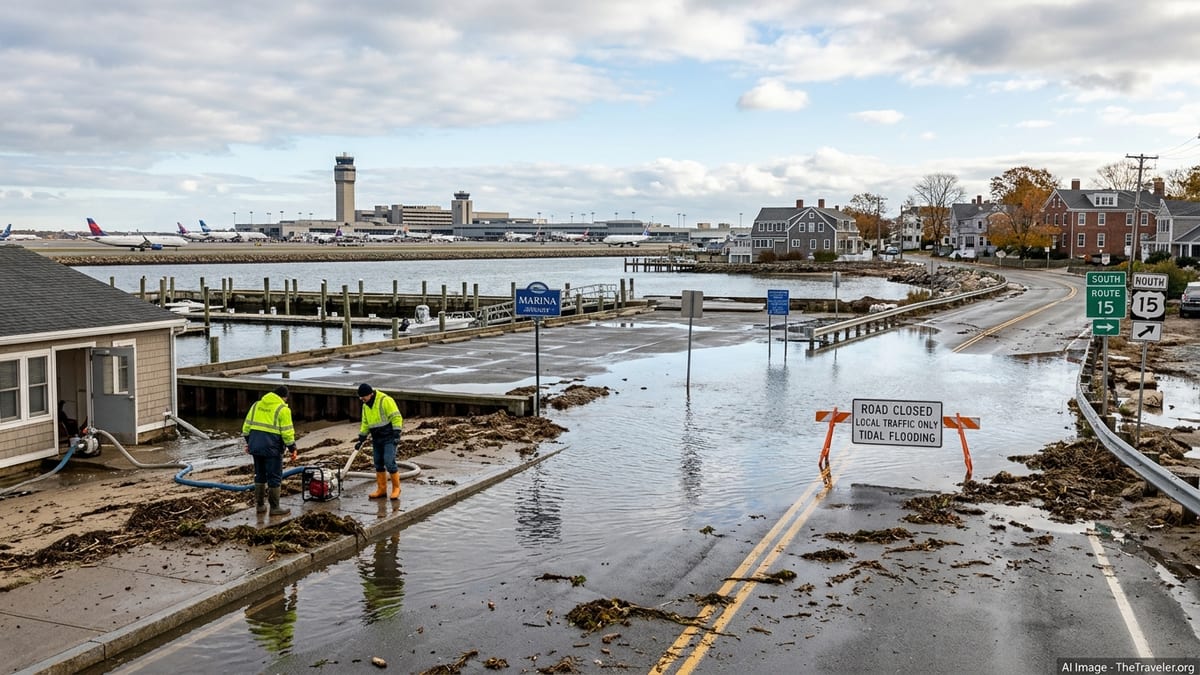
On the ground, the combination of heavy rain, onshore winds and elevated tides led to tidal flooding along parts of the Jersey Shore, the Delaware and Chesapeake Bays, and sections of the New England coast. State and local emergency‑management briefings cited temporary closures on low‑lying parkways and local roads that provide key access to coastal communities and, in some cases, to airport perimeter routes and commuter rail stations. Amtrak and regional rail operators along the Northeast Corridor reported weather‑related speed restrictions and localized delays where water encroached on tracks or windblown debris required removal, although core long‑distance services between Washington, Philadelphia, New York and Boston continued to operate.
Tech glitches and earlier disruptions reduced the system’s margin
The U.S. airline system entered the Thanksgiving holiday period with less operational headroom than usual following a series of technology problems earlier in November. On Sunday, November 22, Delta Air Lines experienced a significant outage affecting its automated weight‑and‑balance calculation system, a safety‑critical tool used to determine performance limits for each departure. According to statements from Delta and subsequent media reporting, the glitch prompted delays across the carrier’s network, as some flights awaited manual or alternate calculations before pushback and taxi. The Federal Aviation Administration briefly held certain Delta departures bound for Atlanta at the airline’s request while the issue was resolved.
Publicly available flight‑tracking data suggest that the November 22 weight‑and‑balance problem delayed well over 1,000 flights operated by Delta and its regional affiliates, with effects spilling into the early part of Thanksgiving week as aircraft and crews were repositioned. The incident followed other technology‑related interruptions in U.S. aviation during November, including a separate system issue at United Airlines and an unrelated Federal Aviation Administration system problem that triggered a short‑lived nationwide ground stop earlier in the month. While those earlier disruptions had largely cleared before the nor’easter reached the East Coast, they left airlines operating dense holiday schedules with limited spare aircraft and crews.
In addition to technology concerns, the week’s aviation news included at least one runway‑related incident away from the immediate storm zone. Local and aviation outlets reported that a FedEx MD‑11 freighter experienced a runway overrun at Miami International Airport on Wednesday, November 25. No injuries were reported, and investigators later cleared the aircraft for recovery, but the event temporarily restricted runway availability at one of the country’s busiest international gateways. For a brief period, that added complexity to traffic flows in southern Florida just as weather elsewhere in the country was forcing diversions and reroutes. By late Wednesday night, however, Miami’s operations had broadly returned to normal patterns.
What travelers should expect into the main return‑travel rush
Looking ahead to the peak return‑travel window on Sunday, November 29, official forecasts indicate no second major coastal storm on the scale of the Thanksgiving nor’easter affecting the Eastern Seaboard. National Weather Service outlooks point to a gradually stabilizing pattern for the eastern United States through the remainder of the weekend, with only scattered showers and breezy conditions in parts of the Northeast and Great Lakes, and residual coastal flooding confined to a few vulnerable low‑lying communities during remaining high tides. As always, travelers should still monitor short‑range forecasts, particularly if their plans involve early‑morning or late‑evening departures when fog, low clouds or temperature inversions can produce localized disruption.
Even in relatively benign weather, Sunday after Thanksgiving is historically one of the United States’ most crowded travel days. The Federal Aviation Administration and airline planners signaled ahead of the holiday that the November 23 to December 1, 2026 period would be the busiest Thanksgiving flying window in more than a decade, with scheduled services across U.S. carriers projected to exceed 417,000 flights over nine days and daily activity peaking above 50,000 flights. Combined with robust demand and high load factors, that means limited spare seats on many trunk routes, especially those linking congested East Coast hubs such as New York, Boston, Washington and key Midwest connections.
For travelers yet to complete their journeys, the most practical strategies involve allowing additional time and staying closely informed rather than assuming that calmer weather automatically translates into normal operations. Transport agencies and airlines continue to advise passengers to arrive early at airports, taking account of any road closures, transit detours or residual congestion near terminals caused by earlier flooding or storm cleanup. Checking flight status through airline apps and official airport channels remains important, as aircraft swaps, altered departure times and gate changes are more likely while carriers rebuild regular rotations.
Passengers connecting through constrained hubs such as LaGuardia, Newark Liberty, Boston Logan or Washington Reagan National may want to schedule longer connection windows where possible or choose earlier departures that provide a buffer against possible knock‑on delays later in the day. In cases where rebooking becomes necessary after a cancellation or missed connection, seat availability on popular East Coast and long‑haul routes is likely to be tight through the end of the weekend, given strong holiday demand and limited spare capacity. More broadly, the 2026 Thanksgiving period underscores how a single strong coastal storm, interacting with pre‑existing operational strains, can affect travel reliability for several days after the weather itself has improved, a dynamic that travelers may wish to factor into planning for future peak‑season trips through major hubs.