


More news on this day
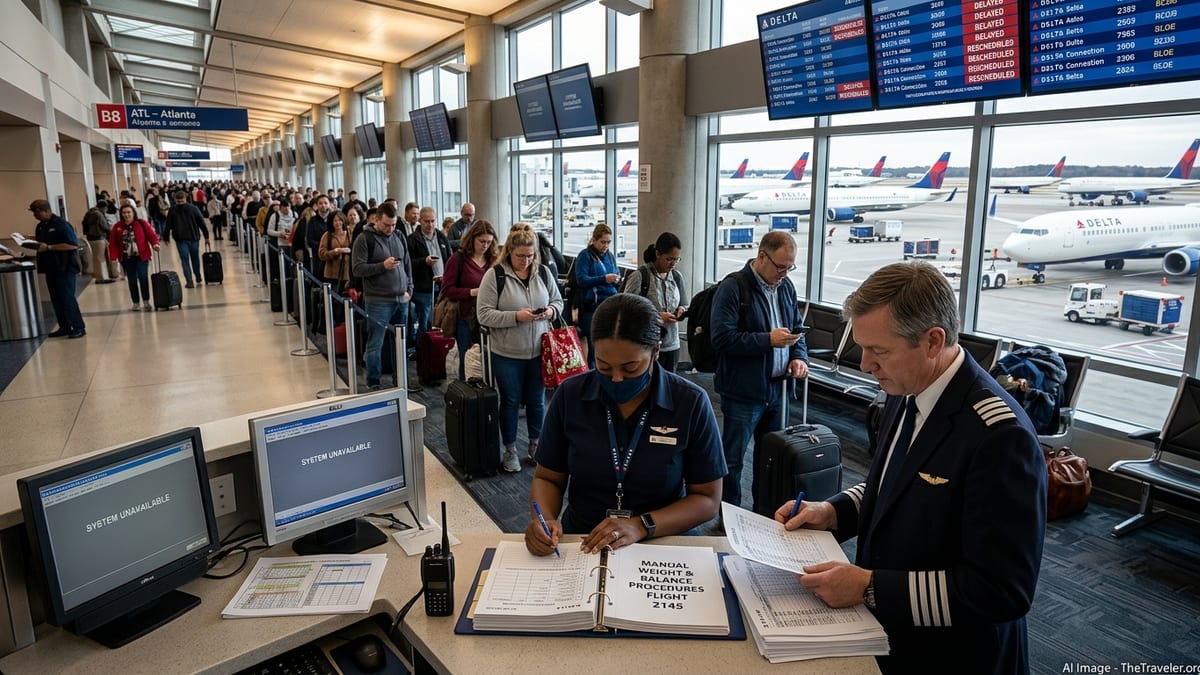
Delta Air Lines is recovering from a technical failure in its automated weight-and-balance system that triggered more than 2,000 flight delays across the United States on Sunday 22 November 2026, disrupting tens of thousands of passengers just as Thanksgiving travel began to surge.
Get the latest news straight to your inbox!
What happened to Delta’s automation system
Delta confirmed on Sunday that an automated system used to calculate the weight and balance of its aircraft before departure malfunctioned, forcing crews across its network to switch to manual procedures. The tool is central to preflight performance planning, ensuring that passenger, baggage, cargo and fuel loads stay within the structural and operational limits of each aircraft and are properly distributed.
According to multiple statements from the airline and the Federal Aviation Administration (FAA), the issue emerged early on 22 November and primarily affected flights departing for, or arriving at, Delta’s main hub at Hartsfield-Jackson Atlanta International Airport. At Delta’s request, the FAA imposed a brief ground stop for Atlanta-bound Delta flights on Sunday morning, which was later converted into a ground delay program as the carrier began moving aircraft again using manual workarounds.
By Sunday afternoon, Delta said the automation system for weight and balance calculations had been restored. However, because many flights had already been held at gates or on the ground while dispatchers and pilots calculated performance numbers by hand, the operational disruption continued for the rest of the day and into Monday as delayed aircraft and crew rotations worked back into place.
Scale of delays across Delta’s network
Flight-tracking data from FlightAware and figures released by Delta show that the outage produced one of the airline’s most severe single-day disruptions in recent years. By Sunday evening, more than 1,600 and in some tallies more than 2,000 Delta and Delta Connection flights had arrived or departed at least 15 minutes late, representing roughly half to nearly two-thirds of the carrier’s schedule that day.
At Atlanta, one of the world’s busiest airports and the core of Delta’s hub-and-spoke network, about half of all departures and roughly the same share of arrivals were delayed during the peak of the incident. Because Delta operates the majority of flights at the airport, problems with its operation quickly translated into longer taxi queues, gate shortages and missed connections for travelers attempting to connect through Atlanta to destinations across the United States and overseas.
Nationwide, the impact extended to other Delta stations such as New York LaGuardia, Los Angeles International, Dallas–Fort Worth, Seattle, Detroit and Minneapolis–St. Paul. Some airports reported dozens of late departures on Delta alone, even when local weather conditions were favorable, because flights were waiting either for revised performance paperwork or for delayed inbound aircraft and crews.
How the outage affected passengers
For travelers, the immediate effect of the system failure was extended waits on board aircraft and in terminal gate areas on one of the first major travel days of the Thanksgiving period. Social media posts and passenger interviews with local media in Atlanta and other cities described boarding completed on time, only for flight crews to announce that they were waiting for manual weight-and-balance figures from dispatchers or airport staff.
In some cases, aircraft sat at gates or on taxiways for one to three hours before departure while ground and flight crews recalculated loads or awaited updated clearances. A smaller share of flights were ultimately canceled when delays grew too long for crews to remain within legal duty-time limits or when aircraft could no longer complete their scheduled rotations for the day. FlightAware data indicated that around 3 percent of Delta flights on Sunday were canceled outright, a relatively low percentage in comparison with the volume of delays but still significant for affected passengers trying to reach family or holiday destinations.
Delta said that it was rebooking customers whose travel plans were disrupted and that it offered hotel accommodation and meal vouchers to passengers stranded overnight where required. The airline also stated that refunds were available for travelers whose flights were canceled and who chose not to be rebooked. Some passengers, particularly those with early-week departures after the outage, reported that they were able to travel with only modest delays as Delta’s operation gradually stabilized on Monday and Tuesday.
Safety considerations and FAA’s role
The weight and balance of an aircraft are critical safety parameters that determine whether it can safely take off, land and maneuver. FAA guidance stresses that operating above certified weight limits, or with weight distributed improperly along the aircraft’s length, can compromise structural integrity and degrade performance margins, especially on shorter runways or in adverse weather. For that reason, airlines use specialized software to calculate takeoff weight, center-of-gravity position and performance data for each departure.
During Sunday’s outage, there was no indication from regulators or the airline that aircraft were at any time dispatched without valid weight and balance calculations. Instead, the consequence of the automation failure was slower departure processing as pilots, dispatchers and ground crews reverted to manual or backup methods that are designed for use when primary systems are unavailable. While those methods are more time-consuming, they are intended to provide the same safety assurances as automated tools, which helps explain why the primary effect was widespread delay rather than any reported loss of safety margins.
The FAA emphasized publicly that the delays were not linked to any malfunction in its own air traffic control or communications systems. That distinction carried particular weight because, less than two weeks earlier, an unrelated failure in an FAA telecommunications component had triggered the longest nationwide ground stop in the United States in roughly a quarter-century, temporarily halting departures across multiple airlines. Within days of that earlier incident, United Airlines also reported a separate technology outage affecting its own operations. The Delta disruption thus became the third major technology-related flight issue to affect U.S. travelers in November.
Timing with Thanksgiving travel surge
The timing of Delta’s system failure added to its impact. The outage struck on the first Sunday of the nine-day Thanksgiving travel period, during which U.S. air traffic is forecast to reach its highest level in more than a decade. FAA projections indicate that more than 400,000 flights are scheduled nationwide between 23 November and 1 December, with the heaviest passenger volumes expected on the Tuesday and Wednesday before Thanksgiving and on the Sunday after the holiday.
Atlanta is a central node in that network, with airport and airline officials expecting more than 4 million passengers to pass through the hub over the extended holiday period. As a result, even a few hours of serious disruption there can ripple widely through domestic and international routes, compounding the effect on passengers in cities that are not directly affected by local weather or infrastructure problems.
By Monday, Delta and the FAA reported that operations at Atlanta and across the Delta network were stabilizing. Delay levels fell significantly from Sunday’s peak, although data compiled by aviation analysts and travel media suggested that some knock-on delays continued into Monday and, in isolated cases, Tuesday as aircraft and crew assignments were realigned. For most travelers flying in the middle and later parts of Thanksgiving week, schedules therefore appeared closer to normal, with weather conditions becoming a larger variable than residual effects of the automation issue.
What travelers should do next
For passengers with upcoming Delta flights during the remainder of the Thanksgiving period, the main advice from airline, airport and regulator updates is to plan for heavy crowds and the possibility of weather-related delays, but not a continuation of Sunday’s system-wide technology problem. Delta has said its weight-and-balance automation is again functioning and that its operation has returned to a routine schedule, even as it reviews the root causes of the failure.
Travelers are nevertheless encouraged to monitor their flight status closely through Delta’s app or departure boards, particularly if connecting through Atlanta or through weather-prone hubs in the Northeast and Midwest. Given the tight aircraft utilization typical during peak holiday periods, even modest disruptions can cascade into larger delays, and rebooking options may be more limited than at quieter times of the year.
Passengers with flexible plans who were directly affected by Sunday’s outage and have not yet rearranged their travel may wish to contact Delta or their booking provider promptly to confirm rebooking, refund eligibility or travel-credit options. For those flying later in the week, arriving at the airport earlier than usual, allowing extra connection time where possible and keeping accommodation plans flexible remain prudent steps as the holiday travel peak continues.