


More news on this day
U.S. travelers heading into the late‑2026 holiday season are flying under a tougher federal refund regime that now forces airlines to issue automatic cash refunds when flights are canceled or significantly changed and certain paid extras are not delivered, even as most long delays, weather disruptions and crowded terminals still do not trigger cash compensation on their own.
Get the latest news straight to your inbox!
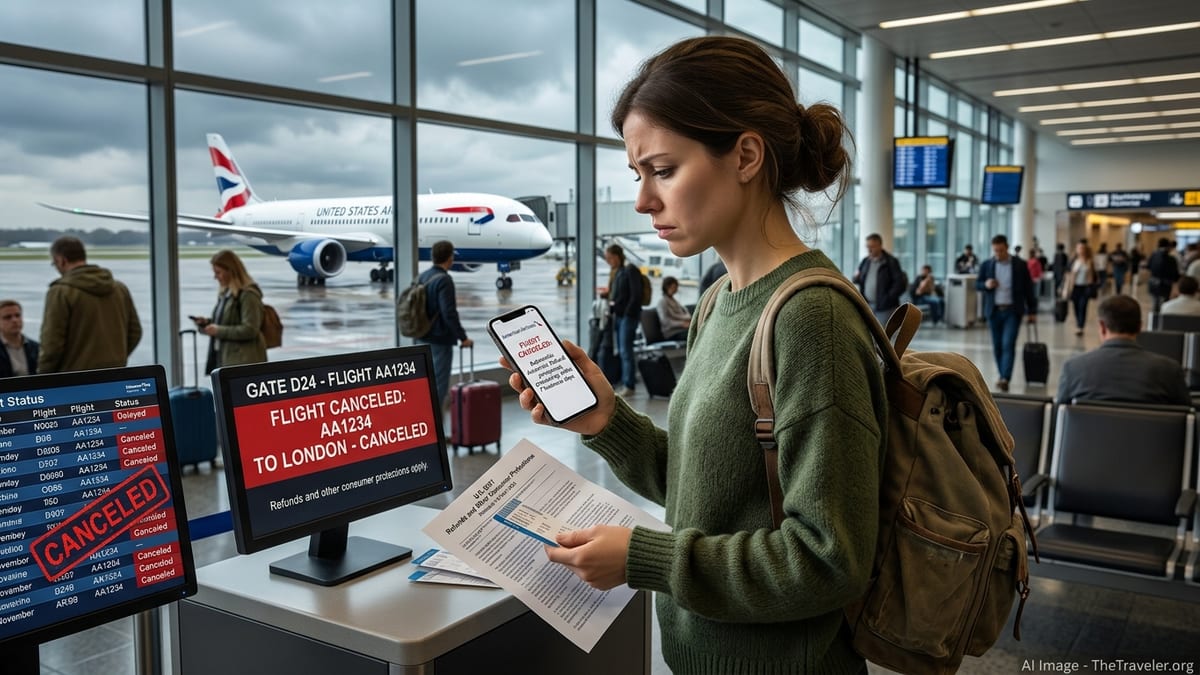
Automatic cash refunds: what now triggers them
The core change affecting 2026 holiday passengers grew out of the U.S. Department of Transportation’s “Refunds and Other Consumer Protections” rule, finalized on 26 April 2024 and implemented in stages from May and October 2024. The rule, built on authorities in the 2024 FAA Reauthorization Act and existing aviation statutes, now requires airlines and covered ticket agents to provide prompt, automatic cash refunds when a covered flight is canceled or significantly changed and the passenger chooses not to travel on the alternative itinerary.
For flights to, from or within the United States, this obligation applies to both U.S. and foreign carriers when they or their ticket agents are the merchant of record for the ticket. A key point for holiday travelers is that the refund right does not depend on whether the fare was sold as nonrefundable. Once a passenger becomes entitled to a refund and declines any alternative transportation or noncash credit that is offered, the carrier or ticket agent must return the money to the original form of payment.
The timelines are now defined in regulation. For tickets bought by credit card, airlines and ticket agents must process refunds within seven business days of the passenger becoming entitled to one. For tickets bought with cash, check or other non‑card methods, the refund window is 20 calendar days. The Department has emphasized that these are outside time limits for processing, not goals, and has warned that failure to meet them can trigger enforcement action.
What counts as a “significant change” to your holiday flight
Before the 2024 rule, airlines had substantial discretion to decide when a revised schedule counted as a major change. For late‑2026 travel, that discretion is sharply narrowed. For domestic U.S. itineraries, a change is automatically treated as significant if the new departure or arrival time moves by at least three hours from what was originally scheduled. For international itineraries, the automatic threshold is six hours. If a Christmas or New Year trip is shifted beyond those limits and the passenger decides the change no longer works, they can refuse rebooking and request a refund for the unused portion of the ticket and associated carrier‑imposed surcharges and government taxes.
Time is not the only trigger. The regulations spell out several other circumstances that count as significant changes when they are not accepted by the passenger. Moving a flight to a different departure or arrival airport in the same city area, adding one or more extra connections compared with the original itinerary, downgrading the passenger to a lower cabin class than purchased, or substituting aircraft in a way that removes a previously available accessibility feature that the passenger relied on all qualify. In each of these cases, the airline must clearly notify affected travelers that they may choose a refund instead of accepting the changed itinerary.
These protections only apply to segments that the traveler has not used. If an outbound leg operates largely as booked but the return is significantly changed, the refund will generally be limited to the unused part of the ticket tied to the disrupted segment. The Department’s rules also make clear that carriers may still offer vouchers, credits or frequent‑flyer miles in place of cash, but passengers must actively choose that alternative; airlines can no longer default customers into noncash options when a refund is owed.
Checked bags and paid extras: new rights on ancillary fees
The 2024 regulations extended the refund framework beyond base fares to certain ancillary fees that have become routine on U.S. flights. For checked baggage, airlines that charge separate bag fees must now automatically refund those fees when a bag is lost or significantly delayed and the passenger has submitted a mishandled baggage report with the operating carrier, or for multi‑carrier trips, with the carrier operating the final leg.
For most domestic itineraries, a bag is considered significantly delayed for fee‑refund purposes if it is not delivered to the passenger within 12 hours of the aircraft’s arrival at the gate at the final destination. For international journeys, the rule allows longer thresholds that increase with scheduled flight length, stretching to roughly a day or more on some long‑haul routes. If the bag arrives after those thresholds and the passenger has filed the required report, the airline must refund the checked‑bag fee promptly and automatically, without requiring a separate claim for the amount paid.
Paid extras on the ticket also receive clearer protection. If a traveler buys a specific ancillary service in advance, such as a particular seat assignment, onboard Wi‑Fi, transport of sports equipment or musical instruments, or other separately charged add‑ons, and that service is not provided through no fault of the passenger on the affected flight, the carrier that was responsible for the service must refund the charge. This applies even if the underlying ticket is nonrefundable and even when the disruption is weather‑related. Airlines are still free to offer vouchers or miles of equal or greater value instead, but the consumer has to opt in to a noncash solution.
What still is not guaranteed when holiday flights are delayed
Despite the expanded automatic refund rights, the United States continues not to require airlines to pay standardized cash compensation simply because passengers arrive late, whether during Thanksgiving, Christmas or other peak travel weeks. If a traveler ultimately completes the trip after a long delay, federal law does not currently obligate the carrier to pay additional money for lost time, missed gatherings or disrupted plans.
DOT guidance continues to distinguish between disruptions considered within an airline’s control, such as many maintenance problems, crew‑scheduling issues and certain airline‑IT outages, and those viewed as outside the carrier’s control, such as snowstorms, hurricanes, air‑traffic‑control ground stops and airport closures. This distinction matters mainly for what airlines choose to promise in their customer service plans rather than for any federal requirement to pay delay compensation. A nonrefundable ticket that still gets the traveler to the destination, even many hours late, generally does not become refundable solely because of the delay if the passenger accepts transportation on the revised schedule.
Efforts by the Biden administration in 2023 and 2024 to create European‑style compensation for controllable cancellations and long delays led to formal rulemaking proposals and public debate, but as of late November 2026 there is no binding nationwide scheme that pays fixed cash sums just for arriving late. DOT has said that its current authority clearly covers refunds when passengers choose not to travel after a cancellation or significant change, and refunds of certain fees, but that broader compensation for delays remains constrained by statute and would require additional legislative support.
Using the DOT dashboard and airline policies when plans unravel
To help travelers compare what airlines voluntarily promise beyond the legal minimum, the Department continues to maintain an Airline Cancellation and Delay Dashboard for the largest U.S. carriers. The online dashboard, last updated in 2025, summarizes in plain terms what each airline commits to do when a flight is canceled or significantly delayed for reasons within the carrier’s control. It lists whether the airline pledges to offer free rebooking in the same cabin, rebooking on another carrier, complimentary meal vouchers after a specified waiting period, overnight hotel accommodation and hotel‑airport ground transport during controllable disruptions.
These customer service pledges become particularly relevant during busy holiday periods when bad weather and heavy traffic interact. Although the dashboard only covers controllable causes, airlines sometimes choose to extend help during mixed‑cause disruption events, such as when storms coincide with technology problems or staffing shortages. Public statements after recent nationwide ground stops and winter storms show some carriers offering hotel rooms or additional meal vouchers even when not strictly required by their controllable‑event policies, but such assistance remains voluntary and case‑specific.
Because the customer service plans summarized on the dashboard are treated as enforceable consumer commitments, passengers can rely on them when asking for help during a disruption. If an airline’s published policy states that it will provide meal vouchers after a three‑hour controllable delay or hotel rooms for overnight disruptions that it controls, travelers can cite that language at the airport and in any follow‑up complaint. DOT has said that failing to honour these public commitments may be treated as an unfair or deceptive practice, and advises passengers to keep screenshots of the relevant policy, boarding passes, receipts and any written communication from the airline during the disruption.
Denied boarding, tarmac delays and how older rules interact with refunds
Alongside the 2024 refund rules, several long‑standing federal protections still apply to oversales and long tarmac delays, and they can overlap with the newer regime during peak holiday travel. Oversales, where more tickets are sold than there are seats on a flight, continue to be governed by denied‑boarding rules in 14 CFR Part 250. Airlines must first seek volunteers who are willing to give up their seat in exchange for compensation. If there are not enough volunteers and passengers are involuntarily bumped, carriers must provide a written statement of rights and pay cash compensation based on the one‑way fare and the length of the delay in reaching the final destination compared with the original schedule, subject to minimum amounts that were raised for inflation from January 2025.
Separate protections contained in 14 CFR Part 259 limit how long passengers can be kept on a plane during tarmac delays at U.S. airports. For domestic flights, airlines generally must allow passengers to deplane before a tarmac delay reaches three hours. For international flights, the limit is four hours. Carriers must also provide food and drinking water no later than two hours into a tarmac delay, maintain operable lavatories and ensure adequate medical attention if needed, subject to narrow safety, security and air‑traffic‑control exceptions. DOT continues to bring enforcement actions and civil penalties when airlines exceed these limits without falling within one of the specified exceptions.
These older rules can combine with the new refund requirements in particular scenarios. A holiday traveler who is involuntarily bumped from an oversold flight may be entitled both to denied‑boarding compensation under Part 250 and to a refund of any fees paid for ancillary services that are not provided on the substitute transportation. Similarly, if a flight spends hours on the tarmac and is eventually canceled, passengers who decide not to travel on any alternative arrangements can decline rebooking and request a full refund under the refund rule, while still using airline customer service policies, travel insurance or credit card protections to seek reimbursement for hotels, meals and other knock‑on expenses.
How to decide between rebooking and a refund during the 2026 holidays
For end‑of‑year travelers caught in storms or cascading delays, the strengthened refund regime makes the choice between rebooking and walking away more consequential. If a cancellation or federal‑level significant change makes the trip unworkable, clearly declining rebooking and choosing not to travel is usually what activates the strongest money‑back protections. At that point the airline must refund the fare and qualifying fees within the legally defined time limits, regardless of whether the original ticket was marketed as nonrefundable.
For travelers who still need to reach their destination, airline customer service plans and the DOT dashboard become the main tools for estimating what help is likely. Before booking busy dates, passengers can review how individual airlines handle controllable cancellations and long delays, including whether they promise hotel rooms when an overnight stay is required and when meal vouchers begin. During a disruption, it is important to ask airline staff how the cause is being categorized, since most voluntary benefits are tied to whether the disruption is within the carrier’s control.
Because federal law remains focused on refunds rather than compensation for time lost, many frequent travelers continue to rely on standalone travel insurance policies or premium credit cards for coverage of extra accommodation, missed connections or nonrefundable arrangements such as tours and event tickets. Coverage terms and delay thresholds vary widely, and policies often treat severe weather or air‑traffic‑control restrictions differently from airline‑caused issues. Ahead of a holiday trip, passengers are generally advised to check what protections already come with their card or insurance, confirm how delays and cancellations are defined, and keep detailed receipts and records if plans go awry.
Looking into early 2027, regulators are expected to keep monitoring how airlines carry out the automatic refund requirements and whether further steps on delay compensation are legally feasible. For the 2026 holiday season itself, the main federally backed remedies for disrupted U.S. trips remain concentrated on getting cash refunds when a canceled or significantly changed flight is no longer worth taking, along with automatic refunds of some baggage and ancillary fees when the services paid for are not delivered.