


More news on this day
Newly updated federal statistics and early findings from the 13 November 2026 nationwide ground stop investigation indicate that, despite this month’s rare telecommunications failure, routine and severe weather still account for most serious U.S. flight delays linked to the air traffic system itself over multi‑year periods.
Get the latest news straight to your inbox!
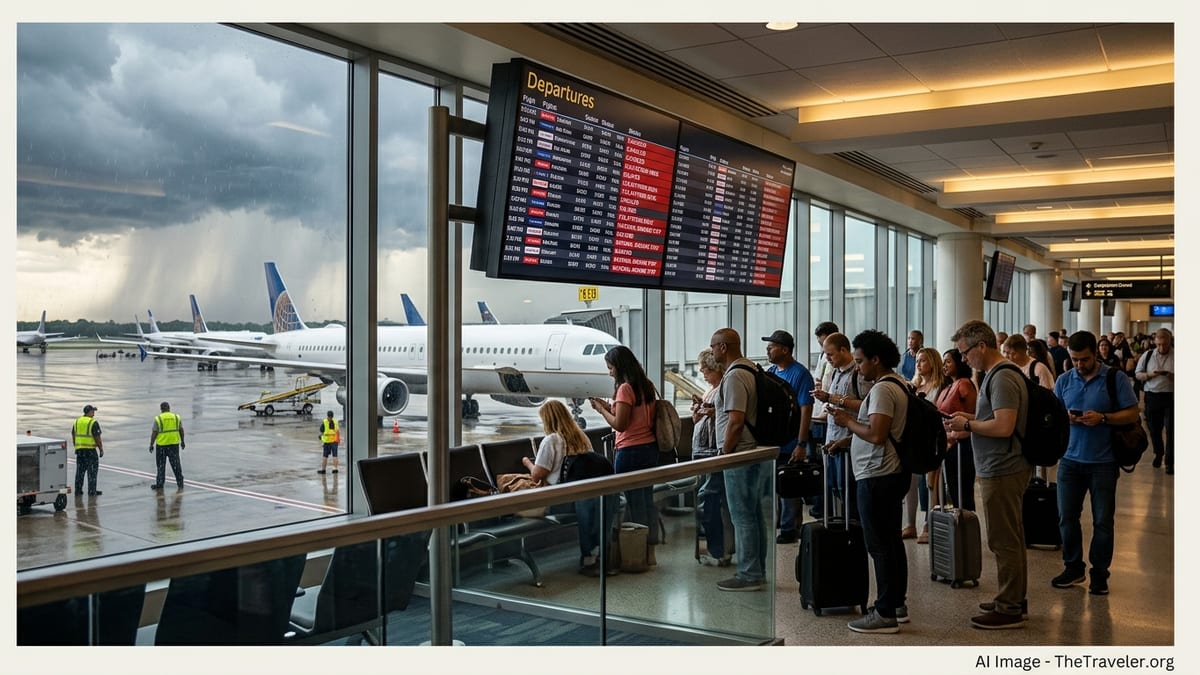
What the latest federal delay statistics show
The clearest quantitative picture of weather’s role in U.S. air traffic disruption continues to come from the Federal Aviation Administration’s Operations Network, or OPSNET, which aggregates delay reports from air traffic facilities across the National Airspace System. In a public summary used for its NextGen weather program, the FAA reports that weather caused 74.26 percent of “system‑impacting” delays of more than 15 minutes between June 2017 and May 2023. In OPSNET terms, these are delays attributed to airspace and airport capacity constraints rather than to airline‑specific issues such as crew, maintenance or security.
OPSNET classifies a delay as system‑caused when air traffic managers must constrain flows because of conditions at airports or in controlled airspace. That can include temporarily closing or rerouting standard arrival and departure procedures, changing runway configurations, increasing separation requirements between aircraft or limiting how many flights may enter a sector during a given period. Within that framework, the FAA highlights convective thunderstorms, low cloud ceilings and visibility, strong or shifting winds and winter precipitation as the recurring weather phenomena that reduce usable capacity on busy routes and at major hubs, even on days when the printed schedule does not change.
A complementary view comes from the U.S. Department of Transportation’s Bureau of Transportation Statistics (BTS) on‑time performance database, which tracks arrival delays for individual flights. Large U.S. passenger airlines must report arrival delays of 15 minutes or more using five main categories: Air Carrier, National Aviation System (NAS), Extreme Weather, Late‑arriving Aircraft and Security. BTS summaries through 2023 show that roughly one in five domestic scheduled flights typically arrives at least 15 minutes late in a given year, with Late‑arriving Aircraft, Air Carrier and NAS together accounting for the large majority of recorded delay minutes once security‑related disruptions are excluded.
Recent BTS analyses indicate that Late‑arriving Aircraft has often been the single largest named cause of delay minutes, representing about 40 percent of delay minutes in the early 2020s, while NAS delays contribute around one quarter and Extreme Weather typically falls in the mid‑single‑digit percentage range. Those figures, however, need careful interpretation. The NAS category explicitly includes non‑extreme weather effects, airport operations, heavy traffic volume and some air traffic control constraints, while Late‑arriving Aircraft reflects knock‑on disruption from earlier sectors rather than the initial trigger. As a result, a substantial share of weather‑related disruption is embedded inside NAS and Late‑arriving Aircraft figures even when it does not appear directly under Extreme Weather.
BTS guidance explains that reporting carriers are instructed to assign each delayed flight to the factor that ultimately made the individual operation infeasible at the time of departure. If a line of storms near a hub airport prompts an initial ground delay, leading to missed connections or crew duty‑time conflicts that cascade through the schedule, the final leg in that chain may be logged as Late‑arriving Aircraft or Air Carrier delay, even though weather set the disruption in motion. Federal documentation notes that allocations can be made to estimate the share of Late‑arriving Aircraft that is indirectly driven by weather, but publicly available data sets do not fully decompose those secondary weather effects at flight level.
How the 13 November nationwide ground stop unfolded
The most striking recent exception to routine, forecastable weather disruptions came on Friday 13 November 2026, when the FAA ordered a rare nationwide ground stop after instability in its internal telecommunications network triggered alarms across multiple facilities. According to FAA public statements in the days that followed, the order halted most departures nationwide for several hours while engineers worked to stabilize communications used by air traffic controllers.
Preliminary accounts from the FAA and the U.S. Department of Transportation describe a ground stop that remained in effect for roughly four to five hours before being lifted on the evening of 13 November. During that period, flight‑tracking services and airline operations centers reported sharp drops in departures, followed by a gradual resumption as communications and surveillance links were confirmed stable. While detailed, audited tallies are still being finalized, federal officials have cited nationwide totals in the tens of thousands of flights disrupted through cancellations and long delays on 13 November, with some knock‑on disruption persisting into 14 November as crews and aircraft remained out of position.
Early technical findings focus on ongoing modernization work in the FAA’s communications backbone. Officials have confirmed that the outage occurred during a multi‑year program to transition parts of the network from aging copper lines to fiber optics and to replace thousands of routers provided by contractor L3Harris and equipment suppliers including Juniper Networks. In statements issued between 15 and 17 November, the FAA identified a radio communications site near El Dorado, Arkansas, and a radar site near Amarillo, Texas, as two locations whose equipment sent excessive data into the network shortly before the ground stop.
Transportation Secretary Sean Duffy and FAA spokespeople have said that a new Juniper router installed at the El Dorado site as part of the copper‑to‑fiber transition began “flooding” older network elements with connection attempts, which in turn prompted instability across multiple air traffic facilities. According to subsequent explanations, a related router at the Amarillo site, replaced several weeks earlier, appears to have contributed to the volume of data seen during the event. The FAA has secured both devices for analysis and has temporarily paused further installation of the same router model while a joint technical investigation with its contractors proceeds.
Members of the Senate Commerce Committee have requested detailed timelines and technical briefings on the incident, citing concerns about why existing redundancy did not contain a malfunction at one or two remote sites and why nationwide recovery required a broad ground stop rather than a rapid reconfiguration. Committee correspondence dated 16 November notes that the copper‑to‑fiber transition involves converting several thousand routers across the network, and asks the FAA and DOT to explain what safeguards were in place and what additional protections will be added before upgrades resume at scale.
For travelers at airports around the country, the 13 November disruption looked very different from a typical winter storm or summer thunderstorm pattern. Because the initiating event was a sudden network instability rather than a forecast weather system, there was little visible advance warning. Airline apps and airport information screens began displaying references to an “FAA systems issue” or “national ground stop,” and in some locations aircraft that had already pushed back returned to gates as departure queues froze. Once the FAA lifted the order and allowed departures to resume, missed connections, crew duty‑time limits, local curfews and aircraft‑positioning challenges meant cancellations and long delays continued into the following day, particularly on late‑evening and early‑morning banks where replacement options were limited.
Why weather still dominates multi‑year delay statistics
Despite the attention generated by the November telecommunications outage and earlier technology failures such as the January 2023 Notice to Air Missions system problem, aggregated federal statistics continue to show that, over multi‑year periods, most U.S. delay minutes attributed to the air traffic system originate with weather rather than equipment or software malfunctions. The operational chain begins with specialized aviation weather forecasting within the National Weather Service, where the Aviation Weather Center produces national charts and bulletins focused on hazards such as thunderstorms, icing, turbulence and low visibility that are critical to air traffic planning.
Those national products are refined by meteorologists in Center Weather Service Units co‑located with each of the FAA’s Air Route Traffic Control Centers. These forecasters translate broad outlooks into route‑ and airport‑specific guidance, indicating, for example, when a line of storms is expected to cross standard arrival routes into a major hub, when crosswinds could force a switch to a less efficient runway configuration, or when cloud ceilings might fall below the thresholds needed for simultaneous approaches on closely spaced parallel runways. Their briefings feed into the FAA’s Air Traffic Control System Command Center in northern Virginia, which coordinates national traffic management decisions and balances predicted demand against expected capacity.
Command Center specialists integrate aviation forecasts with demand projections drawn from filed flight plans and historical traffic patterns over planning horizons that typically range from several hours to about a day. In recent years, planning calls that bring together FAA facilities, airline operations centers, cargo carriers, business aviation and, when required, neighboring air navigation service providers such as NAV CANADA have increasingly used probabilistic forecasts that express the likelihood of particular weather hazards. This allows traffic managers to calibrate responses to different confidence levels rather than relying on a single deterministic storm track or timing.
When deteriorating conditions move from forecast to reality and begin to reduce actual capacity, the FAA applies formal Traffic Management Initiatives to keep demand within what the system can safely handle. Agency orders describe a toolbox that includes Ground Delay Programs (GDPs), Ground Stops, Airspace Flow Programs, route revisions and spacing measures such as miles‑in‑trail restrictions. Guidance instructs traffic managers to apply the least restrictive measure capable of restoring a safe balance between demand and capacity, which is why passengers may see only modest schedule adjustments on some days and much sharper cutbacks on others as evolving storms intersect with heavy arrival and departure banks.
GDPs are among the most visible tools for travelers. The FAA implements a GDP when expected arrivals at a particular airport are projected to exceed the safe arrival rate for a sustained period because of weather or other limitations. Specialized software then allocates each affected inbound flight a controlled departure time from its origin, based on target arrival rates and any known en route bottlenecks, and airlines receive these as Expected Departure Clearance Times. For passengers waiting at an origin airport with clear skies, this often appears as a series of rolling schedule changes in airline apps, even though the binding constraint lies at the destination or along a weather‑affected stretch of airspace.
Ground Stops are more abrupt and typically shorter‑term responses. Under FAA directives, a ground stop temporarily halts or strictly limits departures bound for specified airports or regions of airspace, regardless of whether aircraft, crews and passengers are otherwise ready. Stops are generally reserved for fast‑changing or severe situations where near‑term arrival capacity cannot be forecast with sufficient confidence, such as thunderstorm lines that close all usable approach paths, sudden visibility drops below landing minima, heavy snow or ice that quickly contaminates runways, or ramp conditions that become unsafe because of lightning or very strong winds. A stop can buy time for planners to design and implement a more structured GDP or Airspace Flow Program once they better understand how conditions are evolving.
For broader clusters of storms, especially the convective patterns common in summer across the eastern United States, the FAA can apply Airspace Flow Programs in addition to or instead of airport‑specific measures. These initiatives limit how many aircraft may enter defined blocks of en route airspace during set intervals when weather or large regional rerouting could overload key sectors. Airlines may be issued route advisories that send flights along longer paths around storm systems or through less congested corridors, trading added flight time and fuel burn for improved safety margins and less airborne holding near major hubs. Across these tools, federal policy favors placing as much delay as possible on the ground, because aircraft on the ground burn less fuel and do not occupy scarce arrival and runway capacity.
Modernization, resilience and what travelers should watch
Federal transportation data through 2023, supplemented by preliminary analyses of 2024 and 2025, indicate that U.S. carriers have generally kept annual cancellation rates in the low single digits as a share of scheduled flights, even in years featuring major winter storms and notable technology failures. The pattern reflects a network that runs close to maximum throughput at some hubs during clear‑weather peaks but remains sensitive to prolonged capacity reductions or multiple constraints at once. In summer, convective weather along dense corridors into the Northeast, Mid‑Atlantic and upper Midwest often drives afternoon and evening delays, while in winter, coastal low‑pressure systems and widespread snow or ice can restrict operations at several large hubs over longer periods.
Events such as the January 2023 NOTAM outage and the 13 November 2026 telecommunications‑related ground stop show that non‑weather failures can, at times, rival or exceed severe weather in their short‑term impact on a particular day. Public compilations since 2022 suggest that large‑scale non‑weather disruptions affecting a whole airline, multiple airports or more than roughly 1,000 flights in a day occur several times per year. By contrast, some form of weather‑related constraint affects at least a portion of the system on most days, whether or not it makes national headlines. Current OPSNET and BTS datasets still indicate that, over multi‑year windows, storms, low cloud and wind remain the principal drivers of delay minutes that regulators classify as originating in the air traffic system.
On the technology side, the November ground stop has become a focal point in discussions about the pace and structure of FAA modernization programs. Congressional letters and public statements following the outage highlight multi‑year efforts to replace legacy communications infrastructure with fiber, increase redundancy and expand the use of decision‑support tools that can ingest probabilistic weather guidance more directly into traffic management decisions. Lawmakers on the Senate Commerce Committee have requested joint briefings from the FAA, L3Harris and equipment suppliers, along with information on previous localized telecommunications incidents and how lessons from those events are being applied to prevent nationwide recurrences.
Separate from the communications backbone, the FAA and industry partners continue to invest in NextGen weather capabilities, including improved convective weather forecasting, more detailed turbulence products and better integration of weather information into cockpit displays and airline operations centers. The stated goal is not to eliminate weather‑related delays altogether, which is not feasible, but to reduce avoidable disruption by tailoring restrictions more precisely to the location and timing of hazards. Over time, that could allow the system to handle more flights safely in marginal conditions that were previously treated with broader, more conservative measures.
For travelers, the implications of the latest data and recent outages are largely practical. In the near term, the statistics point to weather‑driven reductions in airspace and airport capacity as the primary cause of system‑level delays, with rare but high‑impact technology failures adding an extra layer of risk that is difficult to predict from the passenger perspective. When significant storms are forecast for major hubs, airlines now routinely issue travel advisories and temporary change‑fee waivers one to three days ahead, allowing customers to move trips within a defined window or re‑route through alternate hubs. Taking advantage of those options can reduce exposure to days when Ground Delay Programs or Airspace Flow Programs are likely.
Looking ahead from late November 2026, the most immediate developments for travelers to watch are the forthcoming technical briefings and final incident reports on the 13 November ground stop, along with any related funding decisions or regulatory changes in the FAA’s next budget cycle. Those documents are expected to clarify which elements of the telecommunications network will be redesigned, how much additional redundancy will be added and how quickly upgrades can proceed without introducing new instability risks. Until that work is complete and its outcomes reflected in updated procedures, current federal evidence suggests that routine and extreme weather will remain the dominant influence on U.S. flight delays that originate in the air traffic system, while large‑scale non‑weather outages will continue to be uncommon but highly disruptive events that travelers cannot fully anticipate.