


More news on this day
Passengers traveling through Des Moines International Airport on Saturday experienced significant delays and scattered cancellations after a regional Federal Aviation Administration equipment outage disrupted air traffic flows across the Upper Midwest.
Get the latest news straight to your inbox!
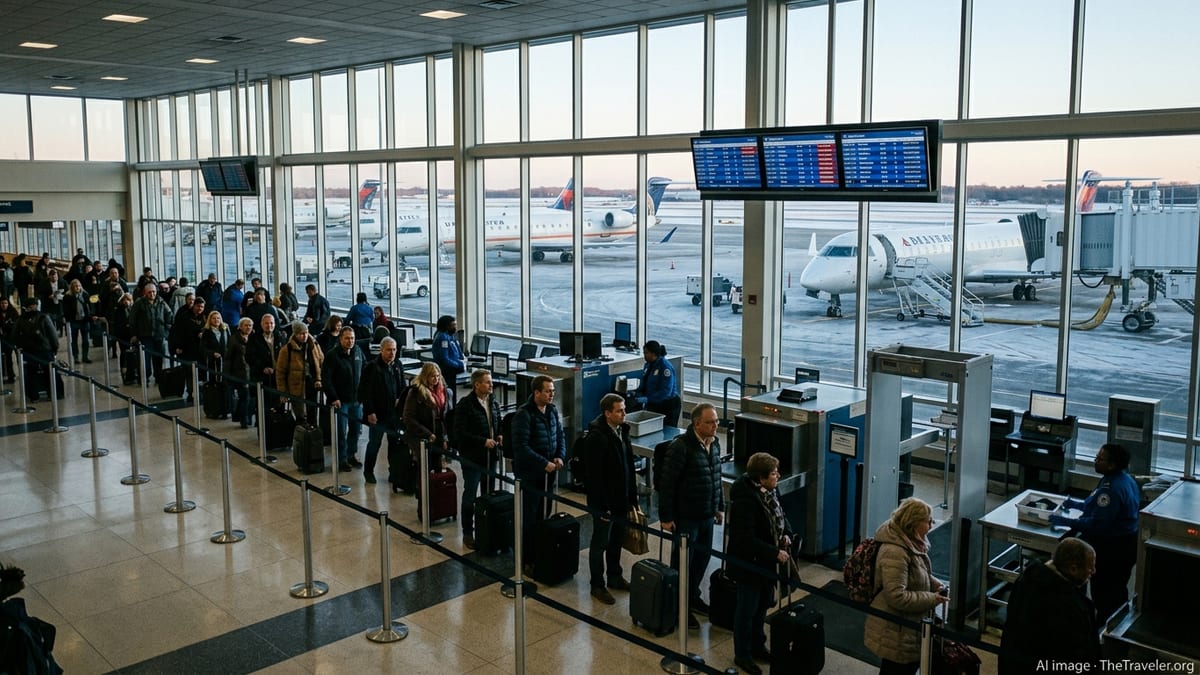
Regional radar and communications issues ripple into Iowa
Publicly available flight status boards for Des Moines International Airport showed a cluster of delayed departures and late-arriving inbound flights on Saturday afternoon, with many services pushed back by one to three hours. The pattern of disruptions coincided with reports of a major radar and communications problem at the Minneapolis Air Route Traffic Control Center, which manages high-altitude traffic over a large swath of the north central United States.
According to coverage from regional news outlets and aviation tracking platforms, the Minneapolis facility experienced a temporary loss of key surveillance and communications capabilities earlier in the day. The issue prompted a ground stop at Minneapolis–Saint Paul International Airport and forced controllers to sharply reduce the number of aircraft moving through the surrounding airspace while contingency procedures were activated.
Because Des Moines sits inside that broader airspace, flights to and from Iowa were required to pass through the constrained region or accept longer, less direct routings. Data from airline trackers indicated that aircraft bound for DSM from hubs such as Minneapolis, Chicago and Denver accumulated holding delays or were metered into the area at wider intervals than normal, reducing the overall throughput of arrivals and departures.
The slowdown occurred at the height of the weekend travel period, when passenger volumes at medium hub airports like Des Moines typically increase. Even modest capacity cuts in the regional air traffic control system can trigger a backlog during these peak times, with late-arriving aircraft and crews then cascading into further schedule disruptions.
Ground stops and flow programs extend delays beyond the outage window
Reports from passengers across the Midwest described flights that were boarded and held at the gate or on taxiways while the FAA limited traffic into the affected airspace. At Minneapolis, some departures were reportedly kept at the gate for several hours during the height of the outage. Once the immediate technical problem was addressed, the system had to be gradually restarted, with air traffic managers prioritizing safety and spacing between flights.
For Des Moines, that meant delays continued even after the underlying equipment issue had been stabilized. Airline operations data indicated that flights originally scheduled for early and midafternoon were among the hardest hit, with knock-on delays appearing in the early evening as aircraft arriving late into DSM turned around for subsequent departures.
Industry analysts note that this pattern is typical following a regional air traffic control disruption. Even brief outages can require ground delay programs and reroutes that push effects far beyond the local facility, impacting smaller and midsize airports that rely on connections through larger hubs. In practical terms, passengers at DSM saw the impact through rolling departure time changes, extended waits at gates and, in some cases, missed onward connections.
By early evening, publicly visible flight boards suggested that operations at Des Moines were stabilizing, although some flights remained significantly behind schedule. Carriers appeared to be focusing on operating as much of the planned schedule as possible, accepting delays rather than widespread cancellations as aircraft and crews were repositioned.
How a single FAA center can affect multiple states
The Minneapolis Air Route Traffic Control Center is one of several regional facilities that manage en route traffic between airports, handling aircraft across portions of Minnesota, Wisconsin, Iowa, the Dakotas and surrounding states. When these centers experience a serious equipment failure, traffic flows must be reduced to maintain safe separation between aircraft while backup procedures and alternate routes are put in place.
Publicly available FAA documentation explains that such events can trigger what is known in the industry as an “ATC zero” or partial service condition at a facility. In those situations, neighboring centers and local approach control facilities take on additional responsibilities, but the overall capacity of the system is temporarily constrained. Flights may be held on the ground at their origin airports, diverted around the affected airspace, or rerouted on longer paths.
Even though Des Moines has its own control tower and terminal radar services, much of its traffic still depends on the higher altitude structure managed by the regional center. Flights departing DSM toward major hubs first transition into the en route airspace overseen by Minneapolis Center or adjacent facilities, while inbound flights descend through that same region before being handed off to local controllers.
Aviation data from previous national and regional outages shows that these kinds of constraints tend to have an outsized effect on hub-and-spoke networks. When a key center like Minneapolis is restricted, flights to smaller cities in its orbit, including Des Moines, Sioux Falls and others, are often delayed or rescheduled as airlines work to keep long-haul and high-demand routes moving.
Impact on travelers and advice for upcoming flights
For travelers passing through Des Moines on Saturday, the most immediate effects were extended time in the terminal and the risk of missed connections at downstream hubs. Social media posts from passengers described rebooked itineraries, long customer service lines and gate changes as airlines adjusted their operations through the afternoon and evening.
Consumer advocates typically recommend that passengers caught in similar air traffic control disruptions stay closely aligned with their airline’s mobile app or text alerts, which often provide the earliest notice of new departure times and gate assignments. For those with tight connections, asking at the gate about rebooking options before departure can reduce the risk of getting stranded at a connecting airport later in the journey.
Travel planning experts also point out that regional FAA equipment outages are fundamentally different from airline-specific technology problems or localized weather events. Because multiple carriers and airports are affected at once, options to switch to another airline or reroute through a nearby city can be limited, particularly on same-day travel. In the Des Moines case, many alternative routings still required aircraft to pass through the constrained Upper Midwest airspace, limiting the effectiveness of workarounds.
Passengers scheduled to fly into or out of DSM later in the weekend are being advised, in publicly shared guidance, to monitor their flight status frequently and allow extra time for connections. While the immediate technical fault at the Minneapolis center appears to have been resolved, residual delays can persist as airlines reposition aircraft and crews and work through the backlog created during the outage.
Ongoing focus on infrastructure resilience
The disruption has renewed attention on the resilience of the United States air traffic control infrastructure and the potential vulnerabilities posed by aging equipment and complex networked systems. Past incidents involving national systems have already prompted calls in policy circles for accelerated modernization, additional redundancy and improved contingency planning.
Des Moines International Airport has been in the midst of a broader modernization effort, including terminal expansion and airfield infrastructure projects intended to support growing passenger volumes. While Saturday’s problems originated outside the airport’s own facilities, the event highlighted how even well-managed local operations are exposed to issues elsewhere in the national system.
Aviation analysts suggest that as traffic levels continue to build, particularly in peak summer periods, the National Airspace System will remain sensitive to disruptions at key nodes such as regional centers and large hubs. Medium-size airports like DSM, which depend heavily on connections through those hubs, are likely to experience periodic knock-on delays when technical problems arise.
For now, the focus for airlines and airport operators is on restoring normal operations and clearing residual delays. Travelers through Des Moines in the coming days are expected to see more typical schedules, but the weekend’s events will remain a reminder of how interconnected the system is and how quickly a single equipment outage can affect flight plans hundreds of miles away.