


More news on this day
Dubai International Airport has sharply lowered its passenger outlook for 2026 after reporting that traffic through September fell more than a quarter compared with last year, a setback that matters for travelers because it means fewer airlines, some longer routings and potentially higher fares on key routes through the Gulf hub.
Get the latest news straight to your inbox!
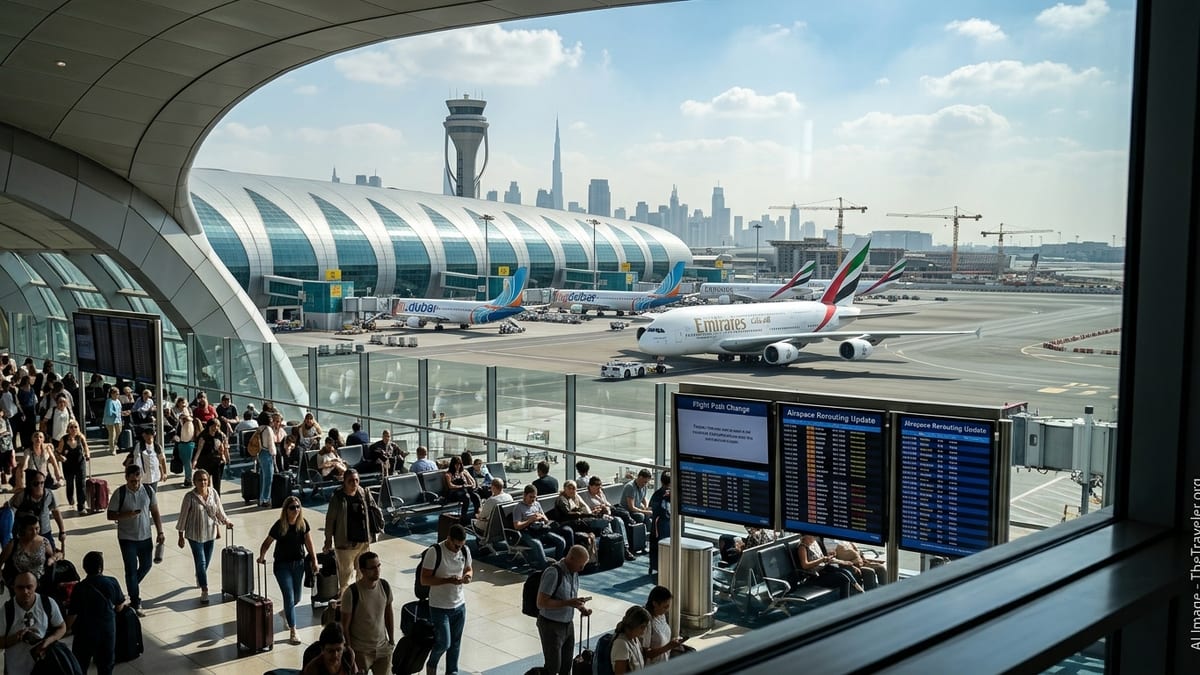
Traffic Slides After War-Linked Airspace Disruption
Dubai Airports reported that Dubai International (DXB) handled 31.5 million passengers in the first half of 2026, a 31.3 percent decline from 46 million in the same period of 2025. The operator described the first six months as one of the most challenging periods in the airport’s history, as the Iran war and resulting Gulf airspace restrictions pushed airlines and passengers onto alternative routes that bypassed the region.
Fresh figures released in mid-November show traffic improving but still well below last year’s levels. DXB welcomed 50.4 million passengers in the first nine months of 2026, down 28.1 percent year on year, with third-quarter volumes alone dropping 22.1 percent to 18.8 million passengers. Monthly throughput has climbed since April, with Dubai officials highlighting gains in June and July as capacity slowly returns, but the rebound has not yet erased the earlier losses.
By comparison, DXB handled a record 95.2 million passengers in 2025, its busiest year on record and the highest annual international passenger traffic ever reported by any airport. That benchmark, confirmed by Dubai Airports and UAE government data, underscores how abrupt the 2026 reversal has been for one of the world’s most important long-haul transit hubs.
Outlook Cut: 70 Million in 2026, 100 Million Delayed to 2027
The latest traffic data has prompted a formal reset of DXB’s near-term ambitions. Earlier internal projections had anticipated that the airport could handle close to 100 million passengers in 2026, building on the 2025 record. As the conflict-related disruption persisted into the second quarter, chief executive Paul Griffiths publicly abandoned that goal and now expects DXB to finish 2026 with “around” or “more than” 70 million passengers, a reduction of roughly 26 to 28 percent compared with 2025.
In recent briefings and interviews, Griffiths has tied the downgrade primarily to constrained capacity rather than underlying demand. Aircraft movements in the first nine months of 2026 fell by close to 27 to 28 percent compared with a year earlier, roughly in line with the drop in passenger totals, indicating that fewer flights are operating through the hub. Load factors, by contrast, are reported to be only modestly lower, suggesting that seats that are available are still being filled at relatively high rates.
Dubai Airports now guides that DXB is on track to cross the 100 million annual passenger mark by the end of 2027 instead of 2026. The revised timeline is echoed in public statements from the Dubai Government Media Office and local press coverage, which frame the war-related slump as a temporary but significant interruption to an otherwise upward growth trajectory supported by continued tourism and trade demand.
Fewer Airlines, Network Gaps and Longer Journeys
One of the more visible changes for travelers is the reduced number of airlines currently serving DXB. Industry reporting this month, citing Dubai Airports data, indicates that the tally has fallen to around 57 carriers, compared with roughly 108 a year earlier. Some major foreign airlines have temporarily suspended services or delayed planned resumptions out of caution over regional airspace, with several not expected to return before early 2027.
This contraction has a direct impact on choice and connectivity. While Emirates and flydubai have restored most of their networks and continue to anchor DXB’s role as a global transfer point, gaps created by absent European and Asian carriers can limit one-stop options, particularly for itineraries that previously relied on specific alliance partners or niche routes. Passengers on affected city pairs may find fewer nonstop choices via Dubai or need to connect through alternative hubs further north or south of the Gulf.
Airspace closures and reroutings have also lengthened some journeys that still pass through DXB. Airlines that continue to serve the airport but avoid certain conflict-affected corridors are operating with longer track miles and adjusted schedules, which can translate into extended flight times and tighter or less convenient connections. Industry analysts note that these operational constraints, combined with reduced seat supply on select routes, are likely to keep fares elevated in some markets relative to pre-war conditions.
What Travelers Can Expect Now and Next
For passengers, the headline is that DXB remains fully open and busy, but not operating at the record-breaking levels that became the norm before 2026. The airport still processed more than 50 million travelers between January and September and continues to rank among the world’s busiest international hubs. Most core services, including Emirates’ wide global network and connections to Dubai’s city infrastructure, are functioning normally, even as some secondary routes and airlines are missing from schedules.
Travelers transiting Dubai in the coming months should pay particular attention to which carrier and routing they book. With the number of operating airlines roughly halved compared with 2025 and some long-haul services rerouted, schedules and minimum connection times may differ from those experienced in previous years. Checking for schedule updates close to departure and allowing extra time for tight connections is advisable, especially on itineraries involving carriers that are gradually restoring Gulf operations.
Looking ahead, Dubai authorities and airport leaders emphasize that investment in both DXB and the planned expansion at Dubai World Central is continuing despite the 2026 setback. The pace of recovery will depend heavily on regional stability and the reopening of currently restricted airspace, but the official forecast remains that traffic will climb back toward 2019 to 2025 growth patterns, with DXB targeting the 100 million passenger milestone by the end of 2027. Travelers planning trips through Dubai in 2027 and beyond should watch for further airline resumption announcements and updated traffic guidance as the situation develops.