


More news on this day
US airspace has reopened after a rare nationwide ground stop halted most departures on Friday, but federal officials and airlines are warning passengers to expect severe delays and rolling disruptions across the country well into the weekend.
Get the latest news straight to your inbox!
Ground Stop Lifted After Communications Failure
The Federal Aviation Administration ordered a nationwide halt to most departing flights on Friday following what public statements described as a widespread communications issue affecting multiple regional air traffic control centers. The disruption, which began in the afternoon on November 13, led to thousands of flight delays and cancellations and marked only the second time since the aftermath of the September 11, 2001 attacks that US airspace has effectively been paused.
According to published coverage, the problem was linked to telecommunications used by the 22 Air Route Traffic Control Centers that manage traffic between airports, rather than to radar or basic radio contact. Transportation officials described instability in the system and equipment overwhelmed with data, prompting the decision to halt new departures while aircraft already in the sky continued to land.
By Friday evening, the FAA confirmed that airspace had reopened nationwide and that the ground stop had been lifted. A briefing cited in national broadcast reports placed the reopening at around 8:15 p.m. Eastern, allowing airlines to begin launching heavily delayed flights and reassembling disrupted schedules.
The Department of Homeland Security has publicly stated that there is no sign the outage was caused by a cyberattack or any form of deliberate interference, though agencies continue to review technical causes and the sequence of failures.
Thousands of Flights Disrupted Across Major Hubs
Flight tracking data cited by several outlets showed the scale of the disruption as the ground stop rippled through the system. By Friday night, more than 10,000 flights within, into, or out of the United States had been delayed, with over 4,000 canceled across all airlines. Those figures placed the event among the most severe single day of air travel disruption since the pandemic era.
Major hubs including Chicago O’Hare, Atlanta, Dallas-Fort Worth, Denver, and New York area airports reported departure boards filled with delays as aircraft were held at gates and on taxiways. At O’Hare, local aviation authorities reported hundreds of delays and dozens of cancellations in the midafternoon alone as operations slowed to a crawl and available gate space tightened.
West Coast operations were also hit. San Francisco International confirmed that, during the height of the stoppage, only limited trans-Pacific departures to Hawaii and Asia were allowed to depart under specific windows, while most domestic departures were held. Los Angeles International Airport posted public alerts urging travelers to anticipate major delays and to check directly with airlines before heading to the terminal.
With planes and crews stranded out of position around the country, airlines are now working through a complex recovery that is expected to stretch beyond the initial reopening of airspace. Industry statements and airport advisories indicate that the knock-on effects could result in missed connections, overnight stays, and last-minute schedule changes for passengers through at least the remainder of the weekend.
Passengers Brace for Lingering Chaos
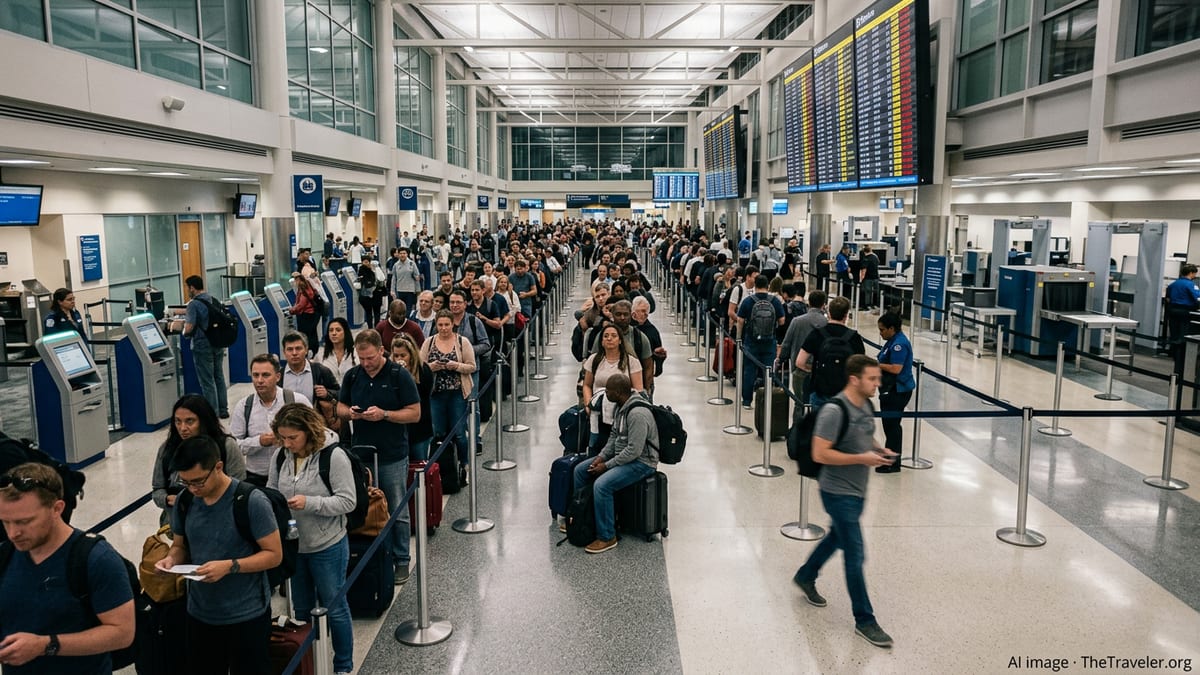
Inside terminals, scenes of crowded gate areas and improvised sleeping spots reflected the scale of the disruption. Reports from airports in Chicago, Washington, Los Angeles, and San Francisco described passengers learning of the nationwide ground stop from overhead announcements or departure screens suddenly turning red with delays.
In some cases, travelers remained on aircraft for extended periods as airlines waited for clarity on whether departures would be allowed. At several airports, carriers eventually returned planes to gates and permitted passengers to disembark, though rebooking options were often limited as available seats vanished.
Public accounts from stranded travelers published by national and local media described long lines at customer service desks, difficulty reaching airline call centers, and uncertainty about when or whether connections could be met. One theme emerging from these reports is emotional fatigue among passengers who had already endured a summer and fall of weather-related and staffing disruptions, only to be caught by an unprecedented systems failure.
Airlines are broadly advising passengers to monitor their carrier’s app or text alerts rather than relying on airport screens alone, and to be prepared for rolling time changes even after a flight is listed as scheduled. Some carriers have issued travel waivers allowing affected customers to change itineraries without additional fees on specified dates and routes.
Spotlight on Aging Air Traffic Infrastructure
The communications breakdown has renewed scrutiny on the age and resilience of the US air traffic control system. Transportation officials have publicly described the underlying infrastructure as decades old and heavily reliant on analog components, even as traffic volumes have climbed back toward or above pre-pandemic levels.
Friday’s outage followed a previous nationwide disruption in January 2023, when a malfunction in the system used to send safety notices to pilots triggered a separate ground stop. Aviation analysts note that having two large-scale stoppages in less than four years is highly unusual and raises questions about redundancy and modernization timelines.
Recent coverage has highlighted that the FAA has begun rolling out new digital and artificial intelligence based tools to better manage congestion and rerouting, but these upgrades coexist with legacy systems that can create complex points of failure. Investigators are now expected to examine whether a software update, capacity issue, vendor problem, or other technical factor set off the cascade that led to Friday’s freeze.
Transportation leaders are using the incident to renew calls for additional funding from Congress to accelerate replacement of older hardware, update telecommunications infrastructure, and bolster staffing at air traffic facilities. The political debate over how much to invest, and how quickly, is likely to intensify as more details of the outage are made public.
What Travelers Can Expect Next
With the ground stop rescinded and airspace open, the focus has shifted from immediate safety to operational recovery. Based on airline statements and airport advisories, travelers in the coming days can expect longer than usual lines at check in, security, and boarding as carriers work through backlogs and reposition aircraft and crews.
Published guidance from major US airlines urges passengers with flights over the next 24 to 48 hours to arrive at the airport earlier than normal and to complete as many steps as possible online, including check in and seat selection. Many carriers are encouraging customers to accept alternative routings or travel dates when offered in apps, as these automated options may be processed faster than in person assistance.
Consumer advocates point out that, because the disruption was caused by a federal systems failure rather than an airline specific issue, compensation policies may be more limited than during events such as crew shortages or carrier system outages. However, passengers may still be entitled to refunds for canceled flights they choose not to take, subject to individual airline policies and federal regulations.
For now, publicly available flight data show steady but uneven recovery as airlines restart operations from Friday’s standstill. For travelers heading to or within the United States, the most consistent piece of advice from airports, carriers, and aviation analysts alike is simple: expect delays, build in extra time, and be prepared for plans to change with little notice.