


More news on this day
Air travel across the United States began a slow recovery on Friday night after the Federal Aviation Administration lifted a rare nationwide ground stop that halted most departures for more than four hours and left tens of thousands of passengers stranded at airports from coast to coast.
Get the latest news straight to your inbox!
Hourslong halt follows telecommunications failure
According to publicly available flight tracking data and multiple news reports, the ground stop was issued at approximately 3:54 p.m. Eastern time on Friday, November 13, after a telecommunications outage hit multiple air route traffic control centers that manage high-altitude traffic across the country.
Coverage from national broadcasters and major newspapers indicates that the outage affected the private communications network that links air traffic control facilities, forcing controllers to limit or halt departures while aircraft already in the sky continued under established procedures. The Federal Aviation Administration later described the problem as a temporary telecommunications outage that disrupted communications between controllers and some aircraft.
Advisories shared publicly and compiled by aviation observers show that the national order applied to virtually all departing flights at U.S. airports, with limited exceptions for medical, law enforcement and other critical operations. The stop remained in place for just over four hours before the agency cleared airports to begin resuming departures on a case by case basis.
This was the first nationwide ground stop in the United States since January 2023, when an outage in a key safety system forced a brief nationwide pause, and only the second such interruption since the post-September 11 shutdown of the airspace.
More than 15,000 flights disrupted and schedules ripple into weekend
Data compiled by aviation analytics firms and cited in national media coverage indicate that more than 15,000 flights were delayed or canceled on Friday as a direct result of the outage and subsequent ground stop. That figure includes both domestic and international services touching U.S. airports, as aircraft and crews became stranded in the wrong cities.
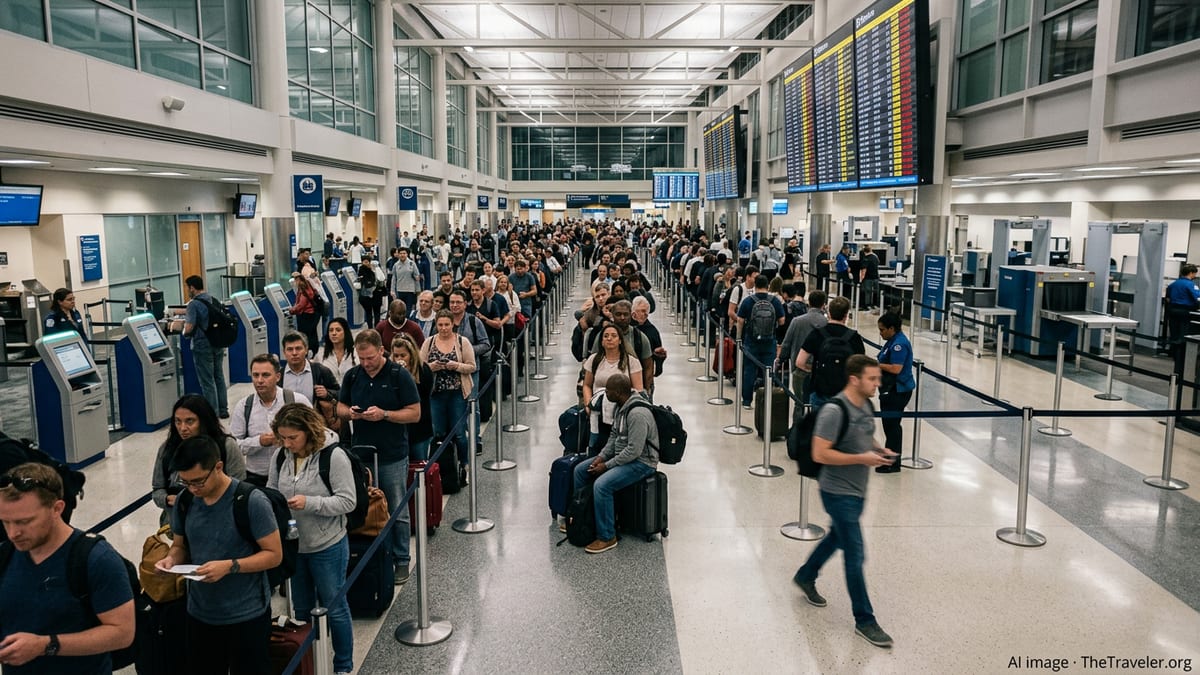
Major hubs such as Atlanta, Chicago O’Hare, Dallas Fort Worth, Denver, Los Angeles and New York area airports saw departure boards fill with long delays, while regional airports struggled with a lack of available gates and parking stands for aircraft already on the ground. Images from airports including San Francisco, Miami and Washington, D.C., showed concourses packed with travelers sitting on floors, queuing at customer service desks and watching departure screens refresh with rolling delays.
Reports from local outlets and travel data providers note that, even after the ground stop was lifted, airlines faced the challenge of repositioning aircraft and reassigning crews that had timed out under duty limits. Industry analysts quoted in coverage warned that the disruption is likely to echo through the weekend, with knock-on delays and cancellations persisting as carriers work through backlogs.
Rail operators such as Amtrak and intercity bus services also experienced surges in demand on Friday evening, as stranded passengers searched for alternative ways to complete trips that suddenly became uncertain.
Stranded travelers face long waits and shifting information
Accounts gathered by television networks, regional newspapers and social media posts depict a day of confusion for travelers who often learned of the ground stop from gate agents or pilots rather than from central announcements. Many passengers reportedly boarded aircraft, pushed back from gates and then sat on tarmacs for extended periods before being told that a nationwide halt was in place.
Coverage from airports including Los Angeles, San Diego, Jacksonville and New York describes passengers waiting hours on parked aircraft or in crowded terminals as airlines adjusted boarding times in 30-minute increments. In some cases, travelers arriving from international destinations were held on planes because terminals had no free gates, while others were instructed to deplane and re-clear security once new departure times were available.
Published reports also highlight the impact on connecting itineraries, with travelers missing evening transcontinental and transatlantic connections after the afternoon shutdown. Families starting vacations, business travelers heading to time-sensitive meetings and sports fans en route to weekend events all found their plans disrupted, with some choosing to rent cars and drive overnight when that was feasible.
Airlines advised customers through apps and public statements to monitor their flight status closely and, where possible, to rebook trips online rather than queuing at airport desks. Travel advisors quoted in news coverage recommended that affected passengers keep all receipts for hotels, meals and alternative transport to support later compensation or goodwill requests where airline policies allow.
Officials rule out cyberattack as aging systems scrutinized
Public briefings by transportation and homeland security leaders on Friday night emphasized that, based on information available so far, there is no indication that the outage was caused by a cyberattack or malicious activity. Instead, early technical assessments described in reports from national outlets suggest a failure in network routers or other telecommunications infrastructure that began in the Chicago area and then cascaded across the national air traffic control system.
Journalistic analysis has linked this latest disruption to broader concerns about the age and complexity of U.S. air traffic control technology. Recent coverage of modernization plans has noted that the FAA is in the process of replacing decades-old information systems across hundreds of facilities, with full upgrades scheduled over several years.
Transportation leaders have used the incident to renew public calls for substantial new funding to accelerate those upgrades, arguing in press conferences and written statements that the ground stop illustrates how a single point of failure in critical communications can freeze the entire aviation network. Aviation safety experts quoted in national and specialist outlets have echoed those concerns, pointing out that while built-in safety procedures protected aircraft already in the air, the economic and operational impact on travelers was severe.
Regulators are expected to work with telecommunications providers and system vendors in the coming days to pinpoint the precise sequence of events that led to Friday’s outage and to recommend safeguards designed to prevent a repeat at such a large scale.
What travelers should expect in the next 48 hours
As of Saturday morning, November 14, airlines have begun to restore more regular operations, but flight tracking sites still show elevated levels of delays and cancellations at major hubs. According to widely cited industry data, the late afternoon and evening peak periods on both Saturday and Sunday are likely to be the most challenging as carriers attempt to move displaced passengers while also operating scheduled services.
Travel experts interviewed across several outlets advise passengers with flights through affected hubs to arrive early, allow extra time for connections and check their airline’s mobile app or text alerts repeatedly before leaving for the airport. Same-day rebooking options may be limited on heavily affected routes until aircraft and crews return to their normal rotations.
For travelers who no longer wish to fly because of the disruption, many U.S. carriers have announced temporary travel waivers for specific dates and routes, allowing itinerary changes without standard change fees. Published airline advisories indicate that fare differences may still apply in some cases, and policies vary by carrier, so passengers are being urged to review the latest information directly from their airline.
While Friday’s ground stop is now officially over, aviation analysts note that its impact on travelers will continue until schedules and staffing return to balance. For those holding tickets in the coming days, patience, flexibility and close attention to real-time updates are likely to be as essential as passports and boarding passes.