


More news on this day
A rare nationwide ground stop in the United States has triggered thousands of canceled and delayed flights since Friday, leaving passengers stranded at airports across the country and forcing airlines to warn that disruptions could ripple through the weekend.
Get the latest news straight to your inbox!
System failure halts departures nationwide
Departing flights across the United States were halted for several hours on Friday, November 13, after a communications failure affected air traffic control centers, according to publicly available information from federal aviation authorities and media coverage. The outage led to a nationwide ground stop, one of the most disruptive actions in the U.S. aviation system and a step that has been taken only a handful of times in recent decades.
Reports from aviation analytics firms and major news outlets indicate that more than 4,700 flights were canceled and around 10,000 delayed on Friday alone, with widespread knock-on effects for aircraft and crew positioning. Airlines entered Saturday still working through large backlogs of passengers and out-of-position planes, with early data showing hundreds of additional cancellations and thousands more delays as the system slowly restarted.
Flight-tracking services cited in media reports estimated that roughly 11,000 flights carrying more than 1.5 million passengers were scheduled to depart from U.S. airports after 4 p.m. Eastern time on Friday, just as the ground stop took effect. With much of that traffic disrupted, passengers on both domestic and international routes faced missed connections, unplanned overnight stays, and significant uncertainty about when they would reach their destinations.
The Federal Aviation Administration has attributed the halt to a failure in a key communications network used by air traffic controllers. Statements summarized in published coverage suggest that early assessments point to a technical, rather than malicious, cause, although a detailed timeline of the outage and recovery process was still being assembled as of Saturday.
Stranded passengers crowd major hubs
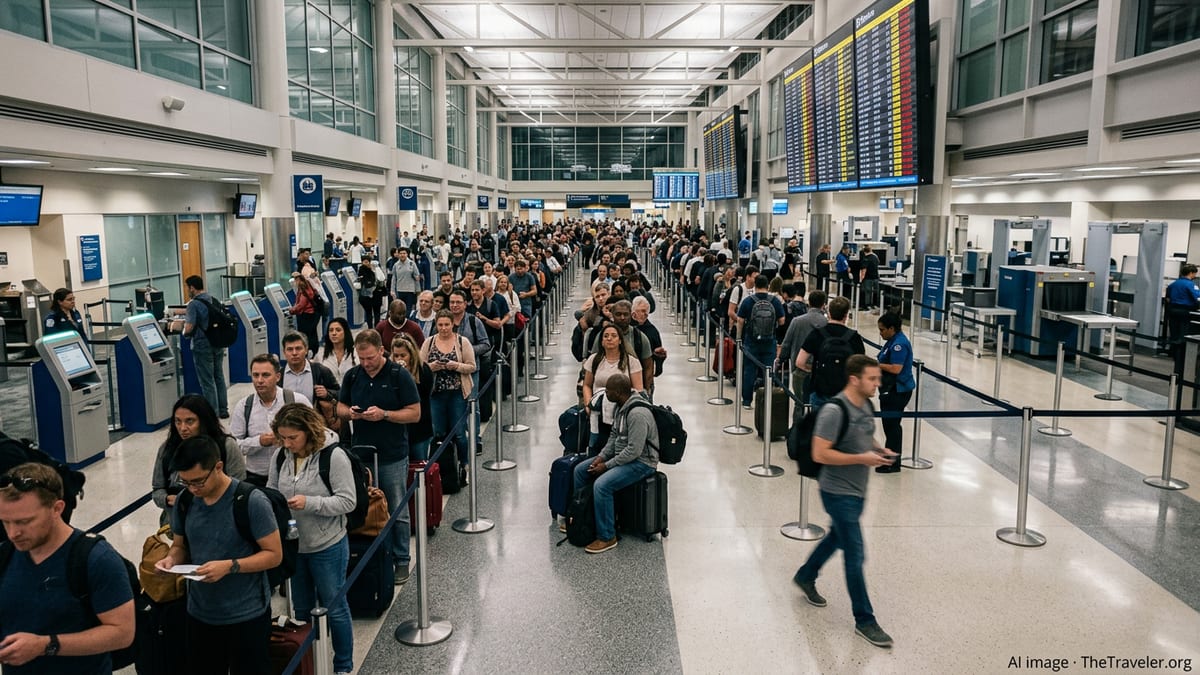
Scenes of stranded travelers played out at major hubs including Los Angeles International, New York’s John F. Kennedy, Chicago O’Hare, Dallas Fort Worth, and Atlanta, as departure boards filled with long sequences of delays and cancellations. Local and national outlets reported terminals packed with passengers stretched across concourses, many sitting on the floor near power outlets to keep phones charged while they refreshed airline apps for updates.
Coverage from West Coast airports described travelers at Los Angeles and San Francisco sleeping in terminals or crowding baggage claim areas as they waited to see if they would be rebooked on later flights. In Southern California, reports from regional airports such as John Wayne in Orange County noted passengers being told at the gate that flights listed as on time were unlikely to depart as scheduled, reflecting how quickly conditions shifted once the ground stop was imposed.
On the East Coast, published accounts from New York and Boston highlighted long security lines feeding into terminals where very few flights were actually leaving. At John F. Kennedy International Airport, photos and first-hand descriptions shared with news organizations depicted passengers queuing at airline counters late into the night as they sought new itineraries or hotel vouchers after missed connections.
In the Midwest, media outlets reported that travelers passing through Detroit and Chicago turned to nearby hotels as cancellations mounted. Local coverage around Detroit Metro Airport described nearby properties filling with stranded passengers late Friday and into early Saturday, with some travelers reporting that they secured rooms only after checking multiple hotels close to the terminals.
Ripple effects expected through the weekend
Even after the ground stop was lifted Friday evening, experts cited in national and regional coverage warned that the disruption would likely extend across the weekend. Airlines entered Saturday with hundreds of aircraft and thousands of crew members out of their planned positions, complicating efforts to restore normal schedules ahead of the Thanksgiving travel surge later this month.
Aviation data shared in recent media analyses suggested that more than 700 flights had already been canceled for Saturday morning, on top of the thousands grounded a day earlier. With demand for seats high in mid-November and many flights operating close to capacity, rebooking options were often limited, especially for long-haul routes and smaller regional airports that have fewer daily departures.
Industry observers pointed out that modern airline networks are tightly timed, with aircraft frequently scheduled to fly multiple segments per day. When one or two early flights are canceled or significantly delayed, subsequent legs for the same plane and crew can also be affected. With a nationwide ground stop, those cascading delays occur simultaneously across the system, making a rapid recovery difficult.
Weather has added further complexity in some regions. In the Northeast, recent storms brought heavy rain and wind to airports such as Boston Logan, contributing to additional delays and cancellations in the days leading up to the communications failure. That combination of earlier weather disruptions and the later nationwide halt has left some travelers facing multi-day journeys to reach their destinations.
Limited protections and guidance for affected travelers
The mass cancellations have renewed attention on what airlines are required to offer stranded passengers and where obligations remain limited. Publicly available guidance from the U.S. Department of Transportation explains that carriers must provide prompt refunds when a flight is canceled and the passenger chooses not to travel, or when there is a significant schedule change and the traveler declines rebooking. However, there is no broad federal requirement that airlines cover meals or hotel stays when disruptions are attributed to factors outside the carrier’s control, such as air traffic control system failures.
Following earlier periods of widespread disruption, several major U.S. airlines published customer service commitments outlining circumstances in which they will voluntarily provide hotel accommodations, meal vouchers, or ground transportation. These commitments tend to be more generous when an issue is within the airline’s control, such as mechanical problems or crew scheduling issues. In situations involving government-ordered ground stops or severe weather, coverage often varies by airline and may be more limited.
Recent rulemaking notices from federal transportation regulators show ongoing efforts to standardize how airlines report the causes of delays and cancellations, including clearer categories for disruptions sparked by national aviation system issues. Those regulatory changes are intended to give both policymakers and travelers better visibility into how often different types of events, such as technical failures in air traffic control networks, trigger widespread cancellations.
Consumer advocates quoted in recent articles have urged travelers affected by the current wave of cancellations to keep documentation of expenses, including hotel stays and ground transport, in case carriers offer reimbursements or travel credits at a later date. They also recommend that passengers monitor both airline communication channels and official aviation announcements, since recovery plans, rebooking options, and waiver policies can change as operations stabilize.
What travelers can expect in the coming days
With the ground stop lifted and flights gradually resuming, airlines are focusing on repositioning aircraft and crew to restore their scheduled networks before Thanksgiving week. Published statements and industry analyses suggest that carriers are prioritizing long-haul and high-demand routes, while some lower-frequency services may continue to see disruptions as resources are reallocated.
Travelers scheduled to fly over the next several days are being urged in public advisories from airports and airlines to check their flight status frequently, use mobile apps for rebooking where possible, and arrive early at major hubs that may still be dealing with heavier-than-usual crowds. Some carriers have temporarily relaxed change fees or fare difference rules for affected dates and routes, though the specific terms differ by airline and by ticket type.
Airport operators in cities such as Sacramento and Charlotte have issued their own travel alerts, encouraging passengers to verify departure times before heading to the terminal and to prepare for longer waits at check-in, security, and baggage claim. Ground transportation providers near major hubs, including taxis, rideshare services, and airport shuttles, have also reported elevated demand as stranded passengers seek hotels or alternative travel options.
Analysts note that the timing of the outage, less than two weeks before one of the busiest travel periods of the year, is likely to intensify scrutiny of the resilience of U.S. air traffic control systems. Public reporting indicates that significant funding has already been allocated for modernization projects, including upgrades to communications infrastructure. The latest disruption is expected to fuel additional debate over how quickly those improvements can be completed, and how best to protect travelers from future large-scale breakdowns that leave thousands of passengers stranded with little warning.