


More news on this day
U.S. airspace is open again after a rare nationwide shutdown of departures, yet publicly available tracking data shows thousands of flights still cancelled or heavily delayed as airlines warn of rolling disruption in the days ahead.
Get the latest news straight to your inbox!
A Rare Nationwide Halt to Departures
According to flight-tracking services and published coverage, the Federal Aviation Administration ordered a nationwide ground stop on domestic departures after critical aviation systems experienced a large-scale outage. Departures from U.S. airports were paused for several hours while backup systems were activated and engineers worked to restore normal operations.
Government records and historical chronologies indicate that nationwide halts of this scope are extremely unusual, with only a handful of comparable events in recent decades. The most recent precedent widely cited in public reporting is the January 11, 2023 disruption linked to the FAA’s Notice to Air Missions system, when domestic departures were paused and more than a thousand flights were cancelled in a single day.
In the latest incident, commercial airline schedules were heavily affected during the morning and early afternoon travel peaks, when large hubs such as Atlanta, Dallas Fort Worth, Denver, Chicago O’Hare, and New York area airports normally handle dense waves of departures. Aircraft already in the air were generally allowed to continue to their destinations, but the halt on new takeoffs quickly rippled through the network.
Public information released by the FAA and summarized by outlets including the Associated Press, Axios, and PBS NewsHour indicates that the outage was tied to air traffic communications and safety-information systems that provide real-time updates to pilots and controllers. Early assessments emphasize that there is no confirmed evidence of a security breach, with attention instead focusing on technical failures in aging infrastructure.
Thousands of Flights Cancelled and Delayed
Data from services such as FlightAware, Cirium, and other aviation analytics firms, cited across multiple news reports, shows that the shutdown and its aftermath led to thousands of cancellations and even more delays across the United States. Midday snapshots captured more than a thousand outright cancellations and many thousands of flights running late, with the figures continuing to climb as airlines reworked schedules.
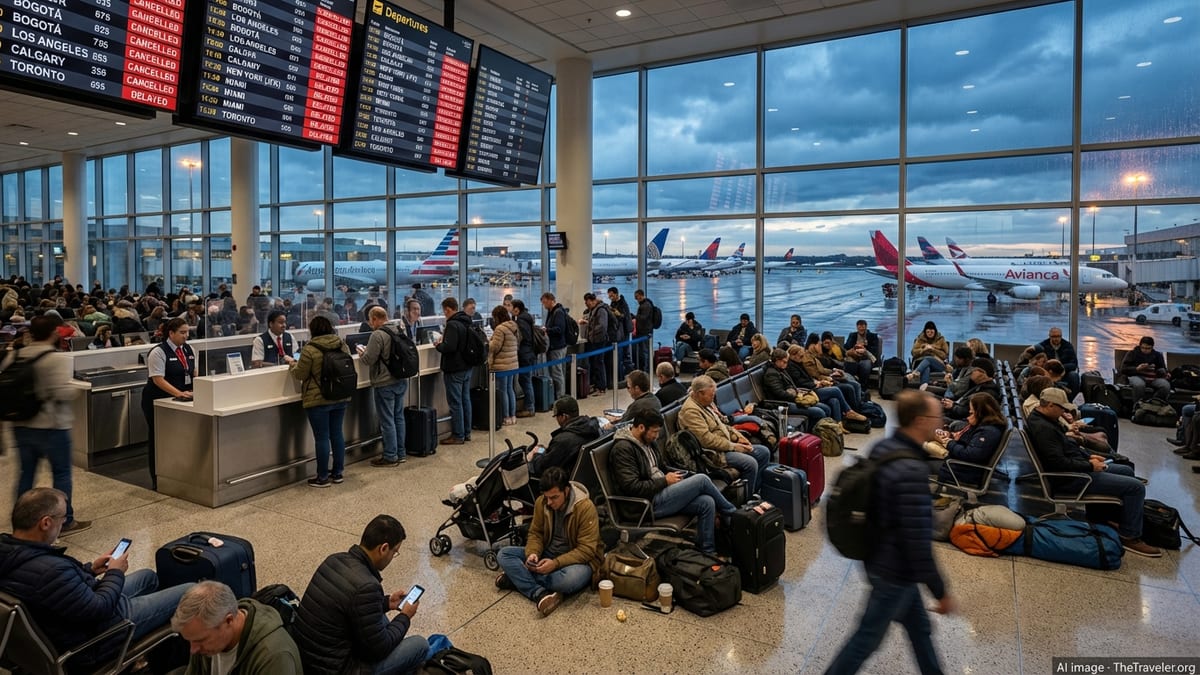
Major hubs were especially hard hit. Reports from airports including Hartsfield Jackson Atlanta International, Chicago O’Hare, Denver International, Orlando International, and New York’s LaGuardia and John F. Kennedy describe departure boards dominated by red and amber status alerts as the ground stop took effect and the backlog built. Travelers arriving for early flights in some cities discovered that their aircraft and crew were no longer in the right place to operate their trip.
International services also experienced knock-on effects. According to published coverage in outlets such as AP News and regional broadcasters, several transatlantic and transpacific flights bound for the United States were delayed, rerouted, or cancelled as carriers adjusted to capacity limits at U.S. airports and uncertainty over the duration of the outage. Some long-haul departures from European and Canadian gateways held on the ground to avoid extended holding patterns around congested American airspace.
Low cost and network carriers alike instituted broad waivers, allowing affected passengers to rebook without change fees or to request refunds when flights were cancelled. These policies varied by airline and route, and publicly available advisories urged travelers to use mobile apps and airline websites for the most up to date rebooking options rather than queuing at airport service desks.
Airlines Brace for Multi Day Recovery
Although the FAA lifted the ground stop and confirmed that primary systems were back online, airline planners now face the more complex task of untangling the operational aftermath. Aviation analysts quoted in outlets including The Washington Post, MPR News, and specialized trade publications note that even a shutdown lasting only a few hours can create a multi day imbalance in aircraft and crew positioning.
U.S. domestic flight networks are tightly choreographed, with many aircraft scheduled to operate several legs per day. When early morning departures are cancelled or delayed en masse, subsequent flights using the same aircraft and crews often fall out of place or into legal duty time conflicts. Public commentary from former pilots and scheduling experts highlights that bringing the system back into balance requires careful reassignments, ferry flights without passengers, and in some cases preventive cancellations for later days to build in recovery margin.
Travelers are being advised, in airline statements and airport alerts, to treat schedules as fluid for at least the next few days, particularly at the largest hubs and on routes that depend on tight connections. Same day rebooking options are expected to remain constrained on busy business and leisure corridors where load factors were already high before the outage.
Some carriers are prioritizing long haul international services and high demand transcontinental routes as they rebuild operations, while trimming frequencies on shorter regional links. Reports indicate that regional airports dependent on feeder flights to major hubs may experience irregular service patterns as mainline operators focus scarce aircraft and crews where demand and strategic importance are greatest.
Questions Over Aging Systems and Modernization Efforts
The shutdown has renewed scrutiny of the technology backbone of U.S. air traffic management. Previous disruptions, especially the January 2023 NOTAM outage, prompted investigations, congressional hearings, and a series of promised upgrades. FAA documentation and technical papers prepared for international aviation forums describe efforts to modernize databases, introduce redundancies, and redesign workflows to reduce the risk of single points of failure.
Despite those measures, the scale of the latest ground stop is reinforcing questions about whether investments have kept pace with growing traffic volumes and rising system complexity. Publicly available commentary from aviation safety specialists stresses that while U.S. airspace remains one of the safest in the world, resilience to technical failure is becoming a more prominent concern as airlines and airports adopt increasingly data intensive tools, from advanced routing algorithms to emerging artificial intelligence aids.
Industry groups have already begun pointing to the wider economic stakes. Trade association briefings and prior impact studies, frequently cited by national media, estimate that large scale flight disruptions can cost the U.S. economy tens of millions of dollars per day in lost productivity, missed business, and additional operating expenses for carriers and airports. The visibility of stranded travelers at terminals across the country is sharpening calls for sustained, long term funding of infrastructure upgrades.
At the same time, some experts quoted in outlets including The Atlantic caution against assuming that any one incident reveals a systemic safety gap. They argue that the decision to halt departures nationwide, while disruptive, reflects a conservative approach that prioritizes risk reduction when vital situational awareness tools fail or become unreliable.
What Travelers Can Expect in the Coming Days
For travelers with upcoming itineraries, public guidance from the FAA, airlines, and major airports converges on a few core messages. First, schedules for the next several days are likely to change at short notice as carriers continue trimming flights to restore overall reliability. Same day cancellations and rolling delays remain possible even though the airspace is open.
Second, passengers are being encouraged in widely shared advisories to monitor flight status closely through official airline channels and airport information pages, sign up for push notifications, and allow extra time at the airport in case security lines and rebooking counters become congested. Those traveling through large hubs with tight connections may wish to explore earlier departures or longer layovers, particularly where infrequent onward flights offer limited fallback options.
Third, consumer advocates interviewed by national broadcasters emphasize that the cause of the disruption matters for traveler rights. When delays stem from external factors such as government system failures, airlines are generally not required under U.S. regulations to provide compensation beyond refunds for cancelled flights or rebooking on later services, although some carriers may offer meal or hotel vouchers as a goodwill gesture.
Finally, as normal patterns gradually return, attention is likely to pivot from short term travel headaches to longer term policy debates over funding, oversight, and modernization of the systems that keep U.S. airspace running. For now, planes are taking off again, but the operational and political turbulence created by the shutdown is set to linger well beyond the last rescheduled departure.