


More news on this day
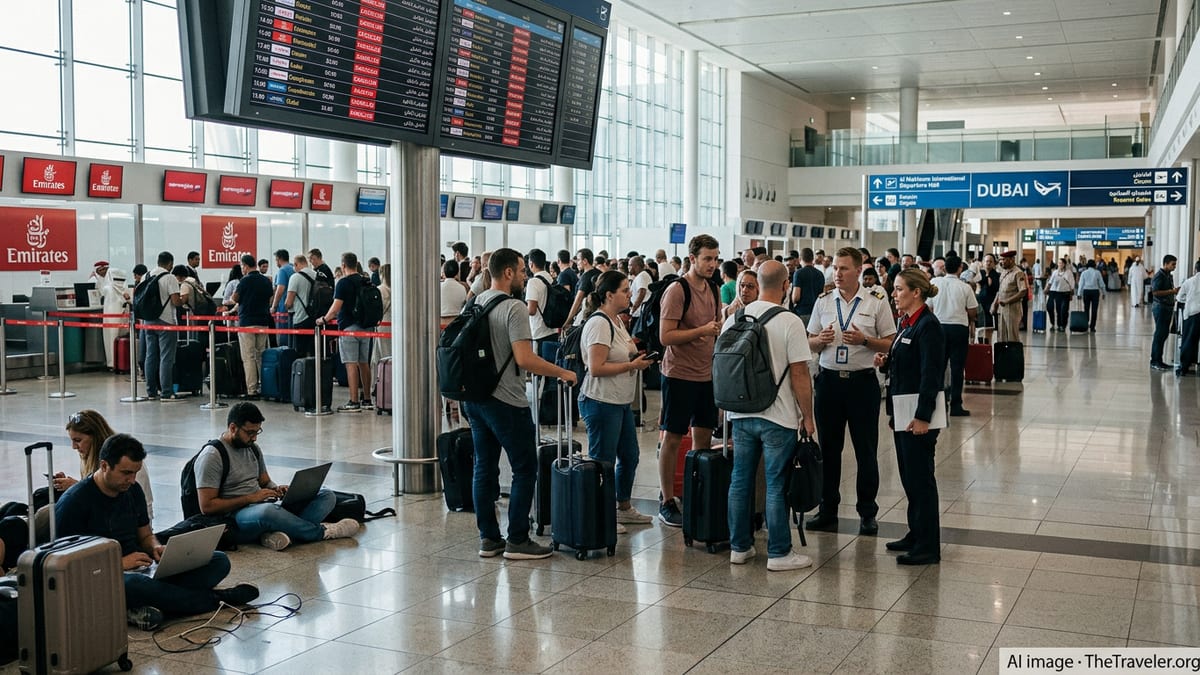
Flights across Dubai and the wider Gulf are coming under renewed pressure as the start of the Eid travel rush collides with ongoing airspace closures, diversions and security restrictions linked to the war between the United States and Iran, creating another wave of delays and cancellations for travelers using the region’s busiest hubs.
Get the latest news straight to your inbox!
Conflict reshapes air corridors over the Gulf
The US–Iran war, which erupted after joint US and Israeli strikes on Iran in late February, has left large parts of Middle East airspace subject to heightened risk assessments and temporary closures. Aviation data and industry analyses show that routes over Iran, Iraq, Israel and parts of the Gulf have been repeatedly thinned out or avoided altogether since the first days of the conflict, when flight-tracking maps briefly showed sections of regional skies almost empty of civilian jets.
Warnings from risk consultancies and aviation specialists describe a severe danger of misidentification across the Gulf region, including the airspace above the United Arab Emirates, Qatar, Bahrain, Kuwait and eastern Saudi Arabia. Airlines have responded by diverting aircraft on longer southern or northern tracks to bypass potential flashpoints, adding significant time and fuel burn to long-haul services between Europe, Asia and Australasia.
These structural changes to flight paths are now intersecting with the peak Eid travel period, when Gulf hubs normally run near capacity. The result is a more fragile operating environment, where any additional restriction, security scare or technical delay can ripple quickly through already stretched schedules in Dubai and neighboring airports.
Dubai hub strains under Eid demand and rolling delays
Dubai International Airport, one of the world’s busiest long-haul hubs, has been operating throughout the conflict, but public schedules and aviation analytics indicate that its role as a connector has been repeatedly tested. Previous months saw waves of cancellations and diversions affecting links to Iran and other parts of the region, and carriers based in the Gulf have been forced to re-time or reroute flights around shifting airspace constraints.
As the Eid holiday period gets under way, those underlying pressures are feeding into longer connection times, tighter aircraft rotations and higher odds of missed onward flights, according to travel industry reporting. Passengers transiting Dubai are encountering more frequent last-minute gate changes and rolling departure delays as airlines juggle late-arriving aircraft and congestion in surrounding airspace.
Operational updates published by airports and carriers across the Gulf also point to a pattern of short-notice adjustments, including tactical cancellations on routes most exposed to restricted airspace. While many long-haul services to Europe, North America and East Asia are continuing, they are often flying on circuitous paths that erode schedule resilience and leave little margin when demand spikes, as it typically does during Eid.
Region-wide cancellations and diversions reshape Eid travel
The latest disruption in Dubai comes against a wider backdrop of unprecedented flight reductions across the Middle East since the conflict began. Industry tallies compiled earlier in the war pointed to tens of thousands of flights either cancelled or substantially rerouted as airspace closures radiated outward from Iran to neighboring states. Some regional airports, including smaller Gulf gateways, have at times recorded near-total cancellation of departures on peak days.
According to published airline statements and travel-data analyses, major carriers in Europe, Asia and North America have suspended or sharply cut services to a range of Middle Eastern destinations, while Gulf-based airlines have trimmed frequencies on selected regional routes. Repatriation flights and limited resumptions have gradually restored some connectivity, but the overall network remains thinner and more volatile than before the war.
For Eid travelers, this means fewer non-stop options, busier remaining flights and an increased reliance on detours via alternative hubs such as Muscat and airports in Egypt and Türkiye. Longer routings over Saudi Arabia and the Arabian Sea are helping carriers maintain at least partial service, but at the cost of extended journey times and higher fares as fuel and operational expenses climb.
Safety advisories and airspace warnings shape airline decisions
Regulatory guidance has played a central role in how airlines plan Eid-season operations in and out of Dubai. Updated bulletins from European and other international aviation bodies continue to advise caution or avoidance for segments of Middle Eastern airspace affected by missile and drone activity, as well as by the risk of military miscalculation. Publicly available advisories summarize a patchwork of restrictions covering Iran and neighboring countries, reinforcing airlines’ preference for conservative routing.
Industry outlook reports published in recent weeks suggest that these warnings are likely to persist as long as negotiations over a ceasefire and the reopening of the Strait of Hormuz remain uncertain. Analysts note that large civilian hubs in the Gulf are viewed as high-impact targets for disruption, meaning that even in periods of reduced fighting, the perceived risk for overflying traffic remains elevated compared with prewar norms.
The cumulative effect is that scheduling around Eid has become a delicate balancing act. Airlines must weigh commercial demand for family visits and religious travel against operational constraints, crew duty limits and the need to keep aircraft clear of potential strike zones. Travelers are being urged through public communications to monitor their flight status closely and to allow extra time for connections, particularly when itineraries involve multiple carriers or tight layovers.
Uncertain outlook for the rest of the holiday period
Looking ahead to the remainder of the Eid rush, forecasts point to a continued tug-of-war between pent-up travel demand and the operational drag of the US–Iran war. Gulf-based carriers have signaled, through schedule filings and capacity guidance, that they intend to preserve as much of their long-haul network as possible, while keeping the flexibility to trim or consolidate frequencies on short notice if security conditions deteriorate.
For Dubai and other Middle Eastern hubs, the next few weeks will test the resilience measures adopted since the first wave of airspace closures in late February. Any renewed spike in missile or drone activity, or further restrictions around the Strait of Hormuz, could quickly translate into more diversions and cancellations, adding to queues at transfer desks and pressure on hotel capacity for stranded passengers.
Absent a durable ceasefire and a clear roadmap for reopening key air corridors, aviation observers expect the Eid period to mark only one phase in a longer cycle of disruption affecting travel through Dubai and the wider region. For now, the picture remains one of constrained capacity, elevated risk and a holiday travel season in which even routine journeys across the Middle East require a new level of flexibility and patience.