


Airport lounge access used to be reserved for frequent flyers and business-class passengers. Today, independent networks like Escape Lounge give many travelers a realistic way to trade busy gate areas for calm spaces with hot food, drinks, power outlets and Wi-Fi. Understanding exactly how Escape Lounge access works, though, can be confusing, especially because it is tied closely to American Express and certain airline credit cards. This guide breaks down the key rules, real costs and practical examples so you can decide whether it is worth planning your trip around these lounges.
Get the latest updates straight to your inbox!
What Is Escape Lounge and Where You’ll Find It
Escape Lounge is a small but growing airport lounge network operating mainly in the United States and the United Kingdom, with one location in Puerto Rico and a presence in Australia. In the US, the brand is officially known as “Escape Lounges – The Centurion Studio Partner,” reflecting a formal partnership with American Express. That partnership is what makes Escape Lounges part of the wider American Express Global Lounge Collection and explains why certain Amex cards unlock complimentary entry.
As of mid‑2026, Escape Lounges are concentrated in secondary and mid‑sized airports rather than the largest hubs. In the United States you will see them at airports like Minneapolis–Saint Paul (MSP), Sacramento (SMF), Oakland (OAK), Fort Lauderdale (FLL), Palm Beach (PBI), Reno–Tahoe (RNO), Providence (PVD), Hartford–Bradley (BDL), Cincinnati/Northern Kentucky (CVG), Columbus (CMH), Greenville–Spartanburg (GSP), Syracuse (SYR) and others, plus newer lounges in Kansas City (MCI), Tulsa (TUL) and San Juan’s Luis Muñoz Marín International Airport (SJU). In the UK, Escape Lounges operate at airports such as Manchester (all three terminals), London Stansted, Bristol and East Midlands.
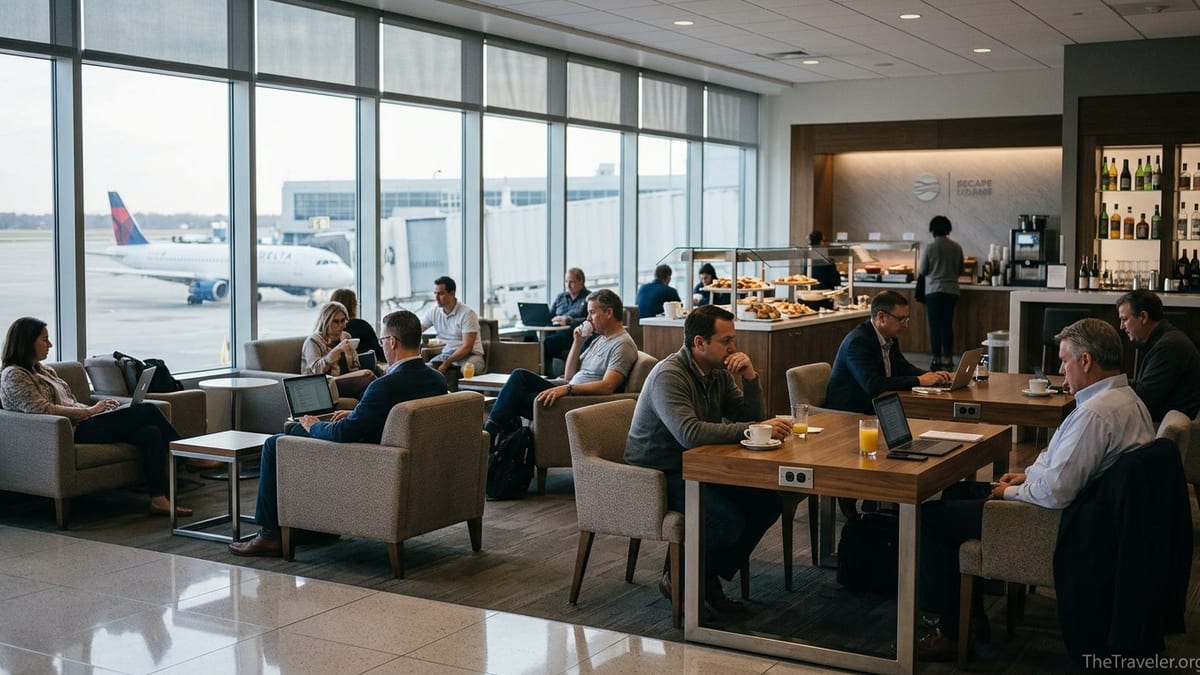
Each location is individually designed, but the general experience is similar: a check‑in desk where staff verify your eligibility, then a main seating area with a mix of tables, workstations and armchairs, a self‑service buffet with hot and cold food, a staffed or partially staffed bar offering complimentary house beer, wine and basic spirits, and quieter corners with power outlets and Wi‑Fi. For example, at Hartford–Bradley the lounge sits near Gate 1 in Terminal A with large runway‑facing windows, while at Oakland the lounge is in Terminal 1 between Gates 8 and 8A, tucked away from the busiest food court.
Because Escape Lounges are often the only full‑service lounge in their terminal, they can dramatically change your pre‑flight experience. If you usually fly low‑cost carriers out of airports like Stansted, East Midlands or Oakland, an Escape Lounge can provide the kind of calm and food options that would otherwise require a business‑class ticket.
Ways to Access Escape Lounges: Credit Cards vs Day Passes
There are three primary ways to access Escape Lounges: holding the right American Express card, holding certain Delta co‑branded American Express cards, or buying a day pass. A handful of Escape lounges in the UK can also be booked through third‑party lounge programs or packaged into airline tickets, but for most US readers the Amex and day‑pass options are the most relevant.
The flagship method is via the Platinum Card from American Express or the Centurion Card. These cards are part of the American Express Global Lounge Collection, which includes Centurion Lounges, Escape Lounges and several partner networks. When you hold an Amex Platinum, you can typically walk into an Escape Lounge on the same day you are flying, show your card, boarding pass and ID, and be admitted without paying a separate entry fee, subject to capacity controls and any time‑limit rules at that airport. In practice, this means that if you are flying from Minneapolis to Denver in economy on a low‑fare ticket, your Amex Platinum can still get you into the Escape Lounge at MSP at no additional cost.
Delta SkyMiles Reserve and Delta SkyMiles Reserve Business cardmembers also receive complimentary access to Escape Lounges and Escape Lounge – The Centurion Studio Partner locations, but only when traveling on a same‑day Delta‑marketed or Delta‑operated flight. For example, if you hold the Delta SkyMiles Reserve card and fly Delta from Cincinnati to Atlanta, you can use the Escape Lounge at CVG before departure without buying a day pass, as long as your ticket is not in a deeply restricted fare category that blocks lounge access. However, if you fly American or Frontier from that same airport on the same card, the complimentary Escape Lounge access linked to the Reserve card will not apply.
Travelers without eligible cards can buy access directly. In the US, Escape Lounge day passes typically run around 45 US dollars when purchased online in advance, with some locations advertising pricing in the low‑40s or sometimes in the mid‑30s if booked during promotions. At the door, prices can be slightly higher and admission will depend on space. In the UK, prices are often quoted in pounds sterling but work out to a similar range per person in US dollar terms. For a family of four departing from Bristol or Manchester on a budget airline, this can be a meaningful expense, so it is worth comparing the day‑pass total against simply buying better food in the public terminal.
How the Amex Global Lounge Collection Ties In
Escape Lounges are one of several networks within the American Express Global Lounge Collection, which is why travelers often confuse them with Centurion Lounges. Centurion Lounges are American Express’s own flagship spaces in major hubs like Dallas–Fort Worth, Miami, New York LaGuardia, London Heathrow and Hong Kong. Escape Lounges, by contrast, are partner lounges run by a separate company but co‑branded as “The Centurion Studio Partner” in the United States.
For a traveler with an Amex Platinum card, this distinction matters less in practice than the access rules. Your Platinum card generally opens the door to both Centurion Lounges and Escape Lounges, subject to each lounge’s guest policy and any capacity controls. That means a traveler flying from New York LaGuardia to Minneapolis could visit the Centurion Lounge at LaGuardia, then connect through Minneapolis and use the Escape Lounge there on the same day without paying extra at the door. The experience in each lounge will be slightly different, but both are part of the same overall benefit.
Where the distinction becomes more important is with Delta Reserve cardholders. Delta’s top co‑branded credit card grants access to Delta Sky Clubs and certain Centurion Lounges when flying on qualifying Delta tickets, plus access to Escape Lounges in the US. However, Reserve cardholders do not get worldwide access to every Centurion Lounge or every partner lounge; access is limited to specific locations and always tied to same‑day Delta travel. In other words, if you are connecting through Heathrow on a non‑Delta transatlantic itinerary, your Delta Reserve card will not suddenly unlock all of the airport’s lounges, but an Amex Platinum may still provide access where Escape or Centurion lounges are present and included.
Another subtlety of the Global Lounge Collection is that it is separate from other card‑linked lounge networks such as Priority Pass. Some travelers hold a premium Visa or Mastercard that offers Priority Pass membership, which opens doors to many independent lounges worldwide. Escape Lounge is not universally part of Priority Pass in the United States, and the rules can vary by location and by the specific card issuer’s partnership. For practical purposes, if your plan relies on Escape Lounges specifically, you should lean on Amex Platinum, Centurion or Delta Reserve access rather than assuming your generic Priority Pass card will work.
What to Expect Inside: Food, Drinks and House Rules
Escape Lounges aim to position themselves a step above the typical contract lounge while still accessible to leisure travelers. At most locations you can expect a self‑service buffet with hot and cold dishes, snacks and desserts, alongside a staffed bar with complimentary house beer, wine and well spirits, plus a cocktail menu where certain premium brands may incur an extra charge. Coffee machines, soft drinks and juices are generally free and self‑service.
In real‑world terms, that might mean a hot breakfast selection of scrambled eggs, roasted potatoes, bacon or sausage, pastries and yogurt at a place like Sacramento’s Terminal B lounge, or a lunch offering of salads, soups and locally inspired entrees at Hartford–Bradley, where the menu has been designed by a James Beard Award‑nominated chef. At UK locations such as Manchester or Bristol, the buffet often includes familiar British staples, from full‑English‑style breakfast items to afternoon cakes and biscuits, along with a pour‑your‑own coffee and tea station.
Seating is generally organized into zones: dining tables near the buffet, clusters of armchairs and small tables for relaxing or chatting, and a few more secluded spots with high‑top workstations and ample charging outlets for laptops and phones. At Minneapolis, for example, the lounge’s mezzanine‑style location above the main terminal offers a mix of bar‑height seating overlooking the concourse and quieter interior corners suited to catching up on email.
House rules are similar across the network. Most locations allow entry three hours before your scheduled departure time, with some flexibility if you are in transit between flights. Dress codes are casual but expect staff to intervene if clothing is overly revealing or offensive. Outside food is typically discouraged, but exceptions may be made for special dietary needs. Children are welcome but are expected to be supervised, and some lounges request advance notice if you are bringing multiple young children. As always, specific rules and opening hours vary by airport, so it is sensible to check your exact lounge’s details close to your travel date.
Pricing, Guest Policies and Real‑World Value
Understanding Escape Lounge pricing is key to deciding whether it offers good value for your trip. If you walk up without an eligible card, a day pass in the United States will usually be priced around 45 dollars per adult, sometimes slightly less when booked online in advance. In the UK, you will typically pay a similar per‑person amount once converted from pounds sterling, often with discounts for booking ahead or for off‑peak times. Children may receive reduced rates, but this depends on the location and booking channel.
If you hold an Amex Platinum card, your personal entry is complimentary. Guest policies, however, have become more restrictive over time, reflecting crowding issues across the lounge industry. Escape Lounges may allow a limited number of guests for free with certain Amex products, while others charge a fee per guest, often in the 30 to 50 dollar range. For example, a Platinum cardholder departing from Palm Beach might be able to bring a spouse and one child at a discounted guest rate, while a larger family would quickly see charges stack up. Some travelers respond by having multiple adults in the group each carry their own qualifying card, effectively spreading access across several accounts.
For Delta Reserve cardholders, guests at Escape Lounges generally incur a per‑visit charge aligned with the lounge’s guest fee, rather than being bundled into the card’s complimentary access. Imagine you are a Reserve cardholder flying from Kansas City to Seattle with a friend on the same Delta flight. You can enter the new Kansas City Escape Lounge for free, but your friend will likely pay a guest fee close to the standard day‑pass price, billed to your card at check‑in. On a long layover that might be a reasonable splurge; for a short hop you might both decide to grab a coffee in the main terminal instead.
Value depends heavily on how you use the lounge. A solo traveler on a three‑hour delay at Oakland or Providence may easily consume 20 to 30 dollars’ worth of food and drinks while gaining a quiet workspace and Wi‑Fi, making even a full‑price day pass feel acceptable. A family of four paying out of pocket at a UK lounge before a quick flight to Spain might be better served by choosing a sit‑down meal landside, unless they especially value the calm environment and bundled drinks. For frequent travelers who already carry an Amex Platinum or Delta Reserve card for other reasons, Escape Lounge access becomes a meaningful side benefit rather than a cost center.
How Escape Lounge Compares With Other Airport Lounges
From a traveler’s perspective, Escape Lounges sit in the middle of the airport lounge spectrum. They generally offer a more consistent and polished experience than many contract lounges that serve multiple airlines, but they are not quite as elaborate as the largest flagship spaces like certain Centurion Lounges or top‑tier international airline lounges.
Compared with Delta Sky Clubs, which are concentrated at larger Delta hubs such as Atlanta, Detroit and Salt Lake City, Escape Lounges tend to be smaller and more intimate. Food quality can be comparable or occasionally better at specific locations that emphasize local partnerships, but Sky Clubs often have more bar seating, more showers and longer opening hours. The biggest difference is access: Sky Clubs increasingly require higher‑tier tickets or specific credit cards and have moved away from selling walk‑up day passes, while Escape Lounges still sell day passes at most locations and rely heavily on Amex and Delta card tie‑ins.
Versus Priority Pass and other independent networks, Escape Lounges can feel more curated. Instead of assembling a patchwork of partner lounges with widely varying standards, Escape operates a relatively small, branded portfolio with consistent signage, food presentation and design language. A traveler who has used the Escape Lounge at Sacramento is likely to feel at home when walking into the one at Syracuse or Greenville–Spartanburg. However, Priority Pass membership often opens far more doors worldwide, including restaurants and mini‑suites in airports where Escape has no presence at all, so the two products solve different problems.
For travelers who primarily fly from airports served by both Escape and airline‑run lounges, the choice can be situational. If you are departing Fort Lauderdale on JetBlue with an Amex Platinum card, the Escape Lounge may be your only complimentary option and a reliable place to get breakfast. If you are flying Delta out of Minneapolis with both a Delta Reserve card and Sky Club access, you might choose between the Sky Club and the Escape Lounge based on which is closer to your gate, less crowded at that time of day or offers the food you prefer. Some frequent flyers even lounge‑hop, starting at an Escape Lounge for a quieter meal and moving to a larger airline club closer to departure.
Tips for Using Escape Lounges Effectively
A bit of planning can make Escape Lounges significantly more useful. First, confirm that your departure or connection airport actually has an Escape Lounge and note its exact location, such as “Terminal B, near Gate 32 in Columbus” or “between security and Concourse A at Syracuse.” Because many of these lounges are not directly on the main concourse, it is easy to underestimate walking times, especially at airports with split terminals like Phoenix, where Escape operates in both Terminal 3 and Terminal 4.
Second, check the opening hours for your travel date. While most Escape Lounges open early in the morning and close in the evening, specific hours vary and can shift seasonally. A 6 a.m. departure from Providence might mean the lounge is open just in time for a quick coffee and pastry, while a late‑night service from Kansas City could depart after the lounge has closed. When in doubt, consider calling the lounge a few days before traveling or checking the operator’s site for recent updates.
Third, time your arrival. Many Escape Lounges follow the common three‑hour rule, admitting passengers starting three hours before scheduled departure. If you arrive at the airport much earlier, you may need to spend some time in the public terminal before being allowed in. For instance, a traveler with an Amex Platinum flying from Hartford at noon might not be able to enter the lounge at 7:30 a.m., but arriving around 9 a.m. would generally fall within the accepted window and maximize lounge time without running afoul of policies.
Finally, know your backup plan. Escape Lounges can fill up at peak times, and staff may implement temporary waitlists or deny entry even to eligible cardholders when the lounge is at capacity. If you are relying on the lounge for a pre‑flight meal, build in a little flexibility to fall back on public‑area restaurants if needed. Many travelers treat Escape Lounges as a “nice‑to‑have” upgrade that significantly improves a journey when available, rather than as a guaranteed component of every trip.
The Takeaway
Escape Lounges provide a practical bridge between traditional airline clubs and the crowded public terminal, especially at mid‑size airports where other premium options are limited or nonexistent. By tying access to widely held products like the Amex Platinum and Delta Reserve cards, the network makes lounge life attainable for frequent economy travelers who are willing to invest in a premium credit card.
To decide whether Escape Lounges make sense for you, start with your home and most‑used airports, then map their locations and opening hours against your typical itineraries. If you regularly pass through Sacramento, Minneapolis, Oakland or Hartford with an eligible Amex card in your wallet, the lounges can become a dependable part of your routine. If you only occasionally visit airports with Escape locations and would need to pay out of pocket, treat them as an occasional splurge rather than a must‑use benefit.
Above all, remember that lounge access is meant to improve your travel experience, not complicate it. Understanding how Escape Lounge access works, from card rules to guest fees and time limits, lets you make calm, informed choices at the airport instead of scrambling at the check‑in desk. Used thoughtfully, these spaces can transform a noisy, stressful wait into a productive or genuinely relaxing start to your journey.
FAQ
Q1. Do I need to be flying a specific airline to use an Escape Lounge?
In most cases you can use an Escape Lounge regardless of airline if you are paying a day pass or using an Amex Platinum or Centurion card, as long as you have a same‑day boarding pass. However, Delta Reserve cardholders must be flying on a same‑day Delta‑marketed or Delta‑operated flight to receive complimentary access.
Q2. How early before my flight can I enter an Escape Lounge?
Most Escape Lounges follow a three‑hour rule, allowing entry starting around three hours before scheduled departure, with some flexibility for connecting passengers. Exact timing can vary by airport, so it is wise to check the specific lounge’s policy before you travel.
Q3. How much does an Escape Lounge day pass cost?
In the United States, day passes typically cost around 45 dollars per person, with some locations slightly cheaper when booked online in advance. In the United Kingdom, prices are broadly similar once converted from pounds, and may vary based on time of day, booking channel and occasional promotions.
Q4. Are food and drinks free inside Escape Lounges?
Yes, Escape Lounges generally include a buffet of hot and cold food, soft drinks, coffee and tea at no extra charge beyond your entry fee or card access. House beer, wine and basic spirits are typically complimentary as well, though certain premium alcoholic drinks may be subject to an additional charge.
Q5. Can I bring guests into an Escape Lounge with my Amex Platinum card?
Amex Platinum cardholders can usually bring a limited number of guests, but policies and fees have tightened over time. Some lounges charge a guest fee in the 30 to 50 dollar range per person, while others may include a small number of complimentary guests. You should confirm the current guest rules for your card and the specific lounge before traveling with companions.
Q6. Do children count as guests at Escape Lounges?
Children generally count toward your guest allowance, though some locations may offer reduced pricing or special rules for younger travelers. Because policies differ by airport, families should check in advance, especially if traveling with multiple children or infants, to avoid surprises at check‑in.
Q7. Is there a dress code for Escape Lounges?
Dress codes are relaxed and oriented around neat, casual attire. Sportswear, jeans and sneakers are normally fine, but clothing that is excessively revealing, dirty or carries offensive slogans may lead staff to refuse entry. The goal is to maintain a comfortable environment for all guests.
Q8. Can I use an Escape Lounge on arrival instead of departure?
Escape Lounges are primarily designed for departing passengers, and many locations only admit travelers with a departing same‑day boarding pass. Some exceptions exist for arriving or connecting passengers, but you should assume that arrival‑only use may not be allowed unless the lounge explicitly states otherwise.
Q9. Does Priority Pass membership get me into Escape Lounges?
Priority Pass access to Escape Lounges is limited and can vary by location and by the underlying bank issuing your card. In the United States, most Escape Lounges rely on Amex Platinum, Centurion and Delta Reserve benefits rather than broad Priority Pass partnerships, so you should not count on Priority Pass alone for entry.
Q10. Are Escape Lounges worth it for a short layover?
For layovers under an hour, it can be difficult to fully enjoy the food, drinks and calm without rushing. If you already have complimentary access through a card and the lounge is close to your gate, popping in for a quick snack and quiet seating can still be worthwhile. If you must buy a full‑price day pass, the value is typically better on longer waits of two hours or more.