


More news on this day
In the fields southeast of Addis Ababa, construction of Ethiopia’s Bishoftu International Airport is gathering pace, promising a mega hub that could redraw global air routes and cement the country’s status as Africa’s primary aviation gateway.
Get the latest news straight to your inbox!
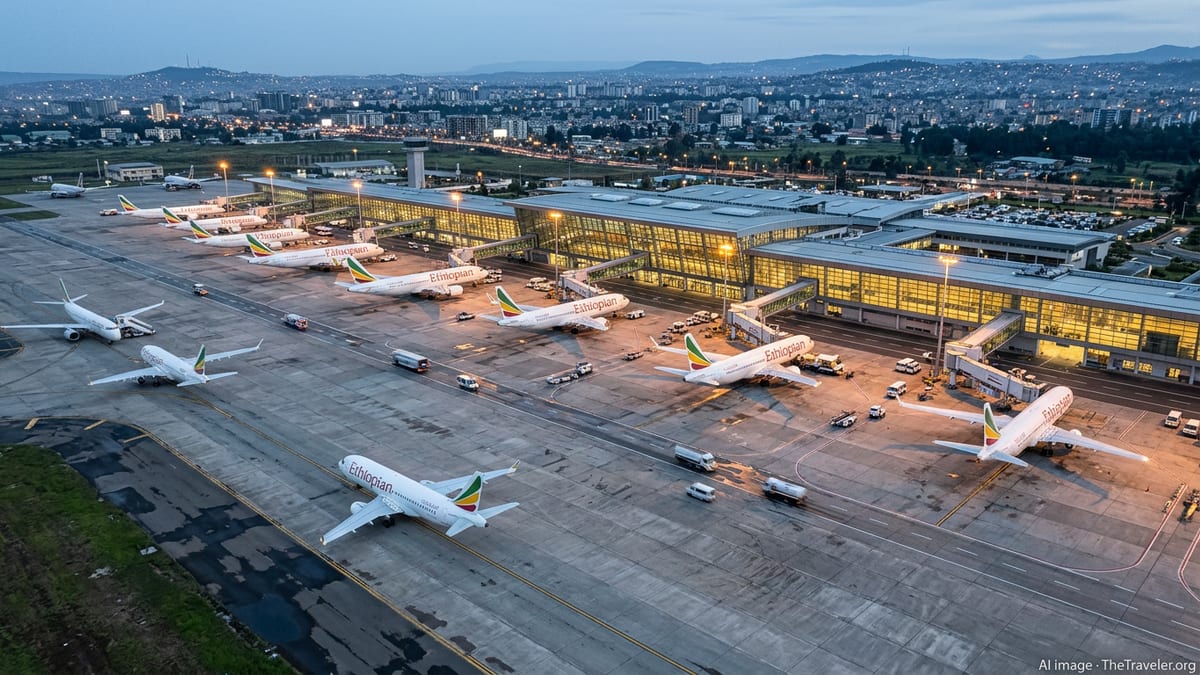
A Mega Hub on a Global Scale
Bishoftu International Airport, often described in public documents as a “mega airport city,” is being developed about 40 kilometers southeast of Addis Ababa to complement and eventually relieve Addis Ababa Bole International Airport, which is nearing its design capacity. The greenfield hub is planned as one of the largest aviation infrastructure projects in Africa’s history, with a total investment estimated at around 12.5 billion dollars.
According to project documentation and industry profiles, the new hub is designed with an ultimate capacity of roughly 100 to 110 million passengers a year, placing it in the same league as the world’s busiest airports. Its footprint includes multiple runways, extensive aircraft parking, and an airport city concept that integrates logistics, commercial development, and passenger services into a single master-planned node.
Phase one of Bishoftu is expected to be completed toward the end of the decade, with a terminal area of more than 1 million square meters and an initial capacity of about 60 million passengers a year. Published timelines indicate that key terminal and concourse works are sequenced between 2026 and 2029, aligning with a target to open the first phase before 2030.
Once operational, public information indicates that Bishoftu will handle the bulk of Ethiopia’s international traffic, while Bole is expected to focus more heavily on domestic and regional services. This multi-airport strategy is positioned as a response to rapid growth in Ethiopian Airlines’ network and Addis Ababa’s emergence as a leading transfer hub for Africa.
Designing an Airport City for the AfCFTA Era
Project material presents Bishoftu not only as an airport but as a full-scale “airport city,” integrating passenger infrastructure with logistics, commercial, and industrial zones. Plans highlight extensive cargo terminals, aviation support areas, and an aerotropolis-style development designed to attract investment from manufacturers, logistics providers, hotels, and service industries.
Reports on the project emphasize that the hub is being shaped with the African Continental Free Trade Area (AfCFTA) firmly in view. By pairing large-scale cargo capacity with modern cold-chain facilities and an agro-processing park, the development is framed as a logistics backbone for intra-African commerce as well as long-haul trade between Africa, Europe, the Middle East, Asia, and the Americas.
Technical assessments referenced by lenders and planners describe specialized facilities for perishables such as meat, flowers, fruits, and vegetables. These features are intended to build on Ethiopia’s existing export strengths, particularly in horticulture, and to reduce spoilage and transit times by co-locating processing and air freight capacity.
The airport city concept also anticipates an ecosystem of non-aviation real estate, including office parks, retail, and hospitality. This model, increasingly common among major global hubs, is expected to make Bishoftu a regional employment center in its own right and a catalyst for urban growth in the surrounding Oromia region.
New Corridors for Passengers and Cargo
Publicly available project information and feasibility studies suggest that Bishoftu’s capacity is calibrated to capture rising demand for Africa-Asia and Africa-Europe connections, as well as growing intra-African traffic. With its location close to the Ethiopian capital and near established air corridors over the Horn of Africa, the new hub is positioned as a strategic refueling and transfer point between continents.
The hub is also planned as a high-capacity cargo gateway, with project documents citing potential throughput of several million tons per year once all phases are complete. Combined with additional maintenance, repair, and overhaul (MRO) facilities and expanded aircraft parking, this is expected to give Ethiopian aviation a competitive advantage in time-sensitive logistics.
Analysts following the project note that the expansion of long-haul connectivity from Bishoftu could accelerate the trend of African travelers connecting via Addis Ababa rather than traditional hubs outside the continent. This shift would keep a greater share of aviation value chains within Africa, from ground handling to catering and maintenance.
For cargo, the new hub’s cold-chain and logistics capabilities may alter routing decisions for agricultural exports and high-value goods. Shorter dwell times, better integration with road and rail links, and a concentration of logistics providers could make Ethiopia a preferred consolidation point for East Africa and parts of the wider continent.
Financing and Phased Delivery
The financial architecture behind Bishoftu is as complex as the engineering itself. Public documents indicate a project finance structure, with Ethiopia’s national airline group as sponsor and the African Development Bank acting as mandated lead arranger and coordinator for a substantial portion of the roughly 10 billion dollars slated for core airport infrastructure. Additional financing is expected from commercial lenders and other development partners.
Expressions of interest and lender summaries describe a multi-phase construction schedule running through the latter part of this decade. Major packages include runway and airfield works, a large passenger terminal, concourses, cargo facilities, and support infrastructure such as fuel farms and control towers. Environmental and social impact assessment reports outline mitigation plans for land use, resettlement, and biodiversity in the project’s footprint.
On the technical side, a consortium of international engineering and design firms has been engaged to provide advisory services, master planning, and construction supervision. Publicly available information lists global architecture and engineering brands among the contributors to the project’s master plan and terminal design, signaling an ambition to match the design standards of leading global hubs.
While timelines remain subject to financing and construction progress, recent ground-breaking coverage and updated project documentation suggest that enabling works are advancing and that large-scale civil works are scheduled to intensify from 2026 onward.
Implications for Africa’s Aviation Map
The rise of Bishoftu as a mega hub has implications well beyond Ethiopia’s borders. Industry observers point out that, if delivered as planned, the airport’s scale would rival or exceed capacity at many long-established global hubs, potentially shifting competitive dynamics in Africa’s crowded transfer market.
Current analyses of African hub airports show Addis Ababa already competing with cities such as Nairobi and Johannesburg for connecting traffic. The addition of a purpose-built mega hub with significantly larger capacity and a surrounding logistics and commercial ecosystem could tilt more long-haul flows toward Ethiopia, particularly on routes linking West and Southern Africa with Asia and the Middle East.
For passengers, greater capacity and more extensive route networks may translate into increased frequencies, new non-stop destinations, and more competition on key city pairs. For regional carriers and logistics operators, Bishoftu could offer expanded interline and codeshare possibilities, as well as access to modern cargo handling and maintenance facilities.
The project is also drawing attention as a test case for how large-scale infrastructure can support the AfCFTA’s ambitions. By combining passenger connectivity with integrated cargo and industrial zones, Bishoftu is positioned as both an aviation asset and a trade platform, potentially reshaping how goods and people move across and beyond Africa in the decades ahead.
Ethiopian Airlines: Bishoftu International Airport project overview
African Development Bank: Mega airport financing partnership
NTU-SBF Centre for African Studies: Ethiopia breaks ground on Bishoftu airport