


More news on this day
Oman is increasingly appearing on cruise maps alongside Dubai and other leading Gulf hubs, as new alliances, homeports and itineraries signal a shift into a more integrated era for regional cruise tourism.
Get the latest news straight to your inbox!
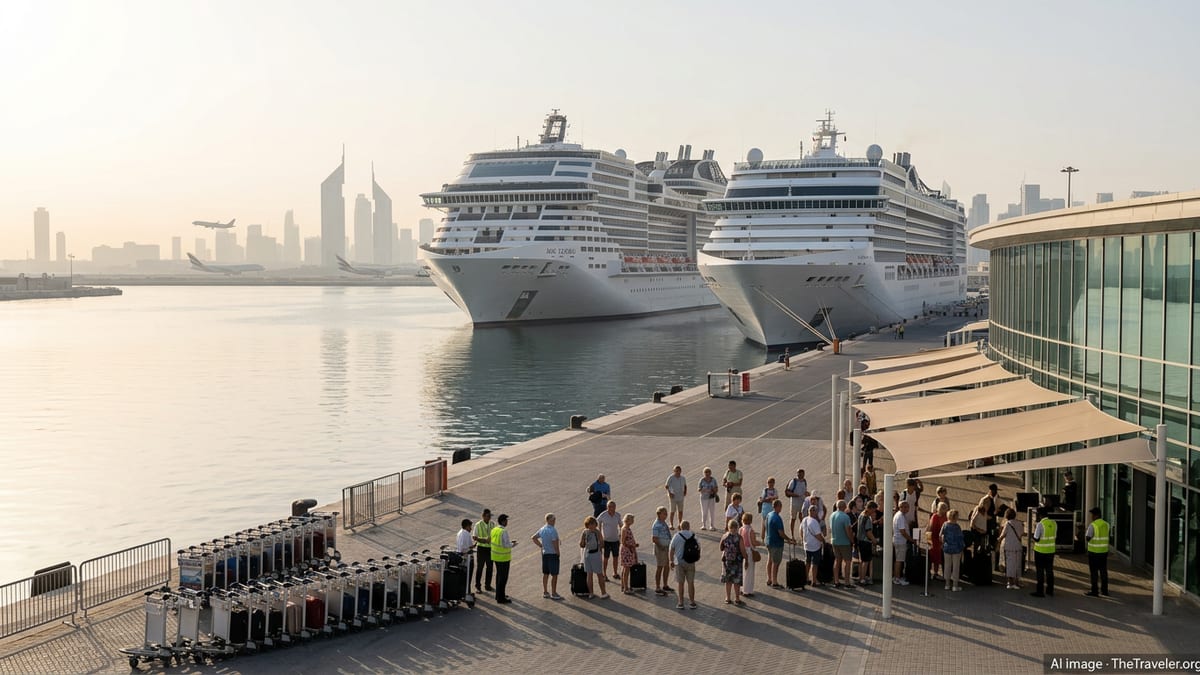
Gulf Cruise Alliance Puts Oman on Shared Itinerary Map
Publicly available information indicates that Gulf destinations are working more closely together to promote cruise tourism as a regional product rather than a series of standalone ports. A key development is the Cruise Arabia Alliance, launched in 2024 by tourism bodies from Dubai, Abu Dhabi, Bahrain and Oman to coordinate marketing and itinerary development across the Arabian Gulf. Subsequent announcements show that Saudi Arabia and Qatar have also aligned with the initiative, creating a broader platform for multi-country voyages that link major cities with emerging ports.
Within this framework, Oman is positioned as a natural complement to Dubai and Abu Dhabi thanks to its contrasting landscapes and heritage-focused shore experiences. Muscat’s traditional waterfront, forts and souqs, together with the fjord-like scenery around Khasab in the Musandam Peninsula and the beaches around Salalah, provide a different style of call compared with the urban skylines of the United Arab Emirates and Qatar. Reports from regional analysts suggest that this diversity is increasingly being promoted as a reason for cruise lines to design itineraries that combine several Gulf states in a single voyage.
Industry research focused on Gulf hospitality and cruise infrastructure notes that governments across the GCC are investing in cruise terminals and supporting facilities, including in Oman. Those studies point to expectations of continued growth in passenger numbers through at least the middle of the decade, driven by coordinated regional marketing and new winter deployment by international brands. In this context, Oman’s ports stand alongside Dubai and other Gulf markets as essential stops in longer, multi-country journeys.
Dubai Consolidates Role as Primary Gateway for Regional Cruises
Dubai continues to operate as the main embarkation point for Arabian Gulf cruises, underpinning the new era of itineraries that now routinely extend to Oman. Cruise-focused coverage reports that the 2024/25 Middle East season includes close to 90 itineraries departing from Dubai between November and April, supported by dedicated cruise terminals at both Port Rashid and Dubai Harbour. Several of these sailings are structured as seven-night loops that link Dubai with Abu Dhabi, Sir Bani Yas Island, Doha, Bahrain and Omani ports.
International cruise lines have assigned some of their newest or largest ships to this Dubai-centered network, particularly during the Northern Hemisphere winter. Schedules published by major operators show vessels homeporting in Dubai for back-to-back itineraries in the Arabian Gulf, with additional longer sailings reaching down the coast of Oman to Salalah. These programs position Dubai as the principal air and logistics hub, while featuring Omani destinations as headline ports of call that broaden the appeal of each voyage.
Airline partnerships support this structure by offering integrated cruise and flight arrangements. For example, airline information for passengers calling at Dubai’s cruise terminals highlights streamlined check-in services that allow travelers to connect directly from ship to flight at dedicated facilities. This infrastructure reinforces Dubai’s status as the regional gateway and makes it easier for cruise brands to market Gulf voyages that include Omani ports without adding complexity for international guests.
Oman’s Ports Gain Visibility in New and Expanded Itineraries
Operational schedules and trade brochures for the coming seasons show Omani ports appearing more frequently on cruise maps, both in shorter Gulf loops and in extended voyages that combine the Arabian Gulf with the Indian Ocean. Muscat remains the country’s main cruise gateway, regularly included on seven-night itineraries that originate in Dubai or Abu Dhabi and then call at Khasab, Sir Bani Yas and ports in Qatar or Bahrain. Several lines also use Muscat as a turnaround port on select departures, further raising its profile.
Khasab in particular is benefiting from a renewed focus on scenic cruising in the Musandam region. Itineraries marketed for the 2024/25 and 2025/26 winter seasons by European and international brands highlight dhow excursions among the rugged inlets as a signature experience. Cruise planners describe Khasab as a compact port that allows lines to offer both cultural and nature-focused excursions within a standard day call, complementing the more urban shore programs in Dubai and Doha.
Farther south, Salalah is featuring more often on longer itineraries that stretch from Dubai down Oman’s coast and into the Arabian Sea. Flight-inclusive packages published by agents for ships based in Dubai list Salalah as a full-day call on select winter departures, positioned as a beach and heritage stop within wider circuits. This pattern suggests that Oman’s role in Gulf cruise tourism is no longer limited to its northern ports but is expanding to create north-south routes that diversify the region’s offer.
New Homeports and Brands Expand Gulf Cruise Footprint
Alongside Oman’s growing presence, other Gulf markets are developing their own cruise homeports, reshaping how itineraries are built across the region. Market overviews for the 2024/25 season report that Doha, Abu Dhabi and Jeddah each host dozens of cruise departures, in addition to Dubai’s leading volume. This network of embarkation points allows cruise lines to design open-jaw trips and variations that can begin in one Gulf city and end in another while still including Omani ports as key calls.
New regional brands are also entering the market with plans that incorporate Oman. Aroya Cruises, for instance, has introduced itineraries from Jeddah in the Red Sea and has signaled expansion into Arabian Gulf sailings that include UAE ports, Bahrain, Qatar and Oman over the mid-2020s. According to operator communications and third-party travel agencies, these deployments are intended to run alongside international brands rather than replace them, adding locally focused products to the mix.
Other cruise companies are preparing dedicated Arabian Gulf programs beyond a single season. Planning documents and brochures from established Mediterranean operators outline three consecutive winter seasons of Gulf itineraries running into 2027, featuring patterns that connect Doha, Ras Al Khaimah, Khasab, Dubai and Abu Dhabi. In that structure, Oman appears not as an occasional outlier but as a stable component within multi-year deployment plans.
Security, Diversification and Long-Haul Trends Shape the Next Phase
The shift toward more Oman-inclusive Gulf itineraries is also influenced by wider security and routing considerations. Industry commentary notes that uncertainty in the Red Sea has prompted some brands to adjust or cancel repositioning voyages between Europe and the Gulf, in certain cases rerouting ships around Africa. As a result, several lines are emphasizing closed-loop or near-closed-loop Gulf itineraries that avoid narrower chokepoints yet still provide varied port experiences, a role for which Oman is well suited.
Analysts suggest that this environment has encouraged a diversification of shore offerings within the Arabian Gulf, with Oman’s natural landscapes and heritage sites balancing the shopping, entertainment and theme-park attractions of Dubai and neighboring cities. Market reviews of GCC hospitality and cruise projects forecast continued investment in terminals and visitor infrastructure across the region, including Oman, supported by expectations of rising passenger numbers through at least 2028.
At the same time, Gulf authorities and cruise lines are targeting long-haul travelers seeking winter sun alternatives to traditional Caribbean or Mediterranean sailings. Promotional materials for upcoming seasons position Dubai and its neighboring ports as a warm-weather circuit accessible via direct flights from Europe, Asia and the Americas, while emphasizing that Oman’s inclusion adds a distinct cultural and scenic dimension. Together, these trends indicate that Oman now stands firmly alongside Dubai and other Gulf markets as the region’s cruise sector enters a new, more interconnected itinerary era.
Overview of the 2024/25 Middle East cruise season
Dubai’s Cruise Arabia Alliance announcement