


More news on this day
Etihad Airways is set to double flights on its fast-growing Abu Dhabi–Kabul route, with the carrier moving to twice-daily services from July 15, 2026, in response to stronger-than-expected demand and increasing regional connectivity needs.
Get the latest news straight to your inbox!
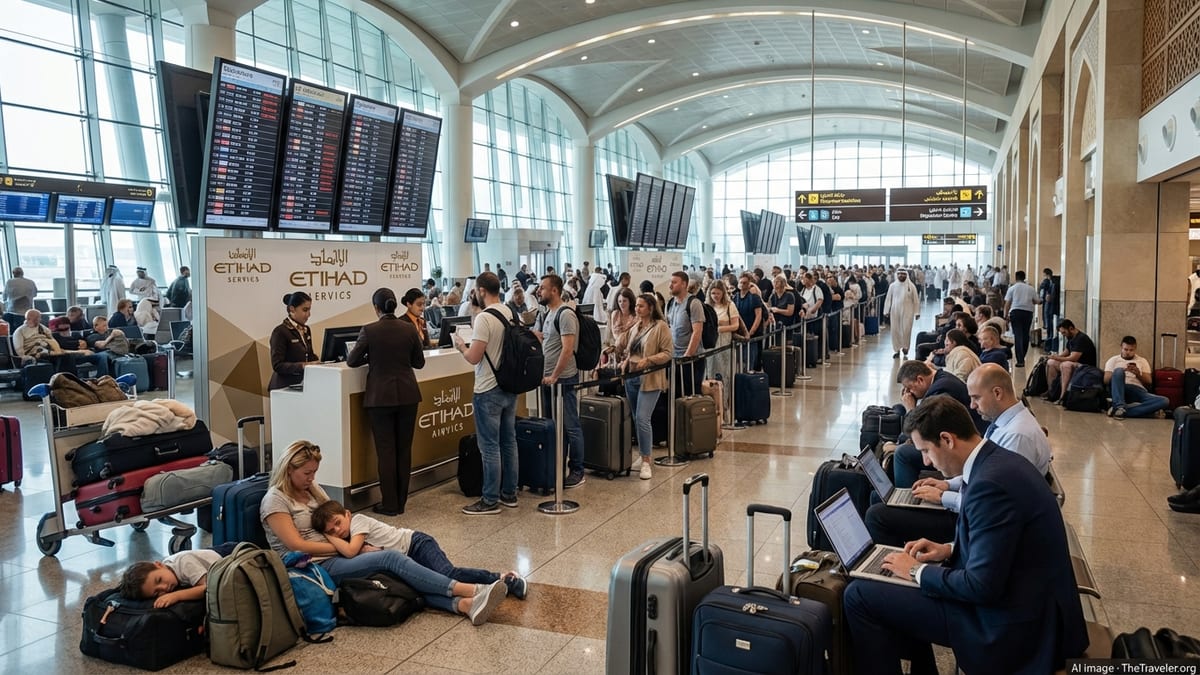
Twice-Daily Schedule Marks Rapid Scaling of New Route
Publicly available information shows that Etihad will introduce a second daily round trip between Abu Dhabi and Kabul from mid-July, only months after the route’s launch. The expansion follows an earlier increase in frequencies that took the service to daily operations, underscoring how quickly passenger numbers have grown.
Reports indicate that the route began with a limited schedule of three to four flights per week before moving to daily service as bookings strengthened. The decision to move again, this time to a twice-daily pattern, suggests sustained demand rather than a short-term spike, particularly from travelers who rely on Abu Dhabi for onward connections.
From July 15, Etihad’s published schedule shows two separate daily departures in each direction between Zayed International Airport in Abu Dhabi and Kabul International Airport. The additional rotation is expected to substantially increase available seat capacity on the corridor and provide more flexibility on departure and arrival times for travelers moving between Afghanistan, the Gulf and further afield.
The upgrade comes in the context of a broader rebuilding and recalibration of international air links to Afghanistan. As carriers adjust capacity to match evolving travel patterns, Etihad’s move to double-daily service positions Abu Dhabi as one of the most frequent, full-service gateways on the Kabul market.
Strong Point-to-Point and Connecting Demand
According to published coverage, the Abu Dhabi–Kabul route has outperformed initial expectations across several passenger segments. Point-to-point traffic between Afghanistan and the United Arab Emirates remains a core driver, particularly among Afghan residents of the UAE and families traveling for visits, education and medical care.
In addition, the route has developed as a key feeder into Etihad’s wider network via Zayed International Airport. Kabul-origin passengers increasingly use Abu Dhabi as a hub to reach destinations across the Gulf, the wider Middle East, Europe and North America, taking advantage of single-ticket itineraries and coordinated connections.
Regional travel analysts quoted in open reports note that limited long-haul options from Afghanistan have channelled a growing share of demand through Gulf hubs. Within this context, the Abu Dhabi–Kabul link serves not only as a bilateral route but as a vital bridge that reconnects Kabul with a large swathe of global destinations.
Higher-frequency service also tends to stimulate additional demand by making short-notice and time-sensitive trips more feasible. Business travelers, aid sector staff and organization workers, in particular, benefit from the ability to choose from multiple daily departure times when planning itineraries that often depend on changing field conditions.
Fleet, Schedule and Capacity Details
Etihad’s publicly released information states that the Abu Dhabi–Kabul flights are operated with Airbus A320 aircraft featuring eight seats in Business class and 150 in Economy. Maintaining this narrow-body configuration on both daily rotations allows the airline to nearly double capacity without introducing a new aircraft type to the market.
The twice-daily schedule from July 15 includes a morning departure from Abu Dhabi and an additional afternoon departure, each with corresponding return services from Kabul. This pattern is designed to maximize connectivity windows at Zayed International Airport, aligning Kabul arrivals and departures with Etihad’s established banks of flights to Europe, the Indian subcontinent and North America.
For Kabul-origin travelers, an earlier arrival into Abu Dhabi can open same-day onward connections to major European capitals and key Middle Eastern cities, while a later departure from Abu Dhabi gives inbound passengers more options when connecting from long-haul services. The increased number of seats should also bring some relief on days that have seen tight availability since the route’s launch.
Operationally, using a consistent A320 fleet and a clearly defined schedule can help simplify planning on a route that still requires careful coordination of slots, ground handling and security procedures. Aviation observers point out that replicating the same aircraft type across both daily flights may also support reliability as the route beds into Etihad’s wider network structure.
Regional Connectivity and Diaspora Links
Afghanistan has longstanding economic and community ties with the United Arab Emirates, and public reporting highlights that the UAE hosts one of the region’s larger Afghan diasporas. The expanded Etihad schedule is expected to further support these links, making it easier for residents, business owners and students to travel between Kabul and cities in the Emirates.
The additional capacity is also being viewed in the context of broader regional connectivity. Abu Dhabi functions as a strategic transfer point between South and Central Asia and markets across the Gulf, East Africa and Europe. By reinforcing the Kabul connection, Etihad effectively knits Afghanistan more tightly into these regional and long-haul networks.
Travel industry coverage notes that the enhanced service may generate competitive pressure on other carriers operating between Afghanistan and Gulf hubs. Additional frequencies and improved connectivity from one operator can prompt rivals to reassess their own schedules and capacity allocations, potentially leading to a more robust set of options for passengers over time.
For Abu Dhabi itself, stronger links with Kabul support the emirate’s wider ambition to grow as a global aviation gateway and a center for trade and investment. Increased passenger flows typically correlate with higher demand for cargo services, meetings and events, and business travel, deepening bilateral economic ties between Afghanistan and the UAE.
Positioning Within Etihad’s Wider Network Strategy
The expansion of the Kabul route fits into a pattern of targeted growth across Etihad’s regional network. Over the past year, the airline has added and restored routes around the Middle East and South Asia while adjusting frequencies to match shifting demand, based on publicly released network updates.
Industry coverage of Etihad’s strategy suggests a focus on markets that combine strong diaspora demand, trade flows and onward connectivity potential. Kabul, which joined Etihad’s network as part of a wave of new destinations, appears to meet each of these criteria by linking a sizable outbound market with a global hub that can distribute traffic in multiple directions.
The move to double-daily services also comes as Gulf carriers continue to refine how they deploy capacity in response to evolving geopolitical and economic conditions. Airlines across the region are selectively reinforcing high-performing routes while remaining cautious about overexpansion in more volatile markets.
By increasing frequencies between Abu Dhabi and Kabul in measured steps, Etihad is signaling confidence in the long-term resilience of demand on this corridor. The twice-daily schedule from July 15, 2026, will be watched closely by industry observers as an indicator of how regional connectivity to Afghanistan may develop in the coming years.