


The European Union’s Entry/Exit System (EES) is now part of the travel landscape for many cruise passengers, yet confusion remains over what it actually means in practice. Non‑EU and non‑Schengen visitors from countries such as the UK, United States, Canada and Australia often worry they will face biometric queues at every port call. In reality, EES checks for cruise passengers are closely tied to where you formally cross the external Schengen border, not to every stop on your itinerary. Understanding how different cruise patterns interact with the system is the key to calmer planning.
Get the latest updates straight to your inbox!
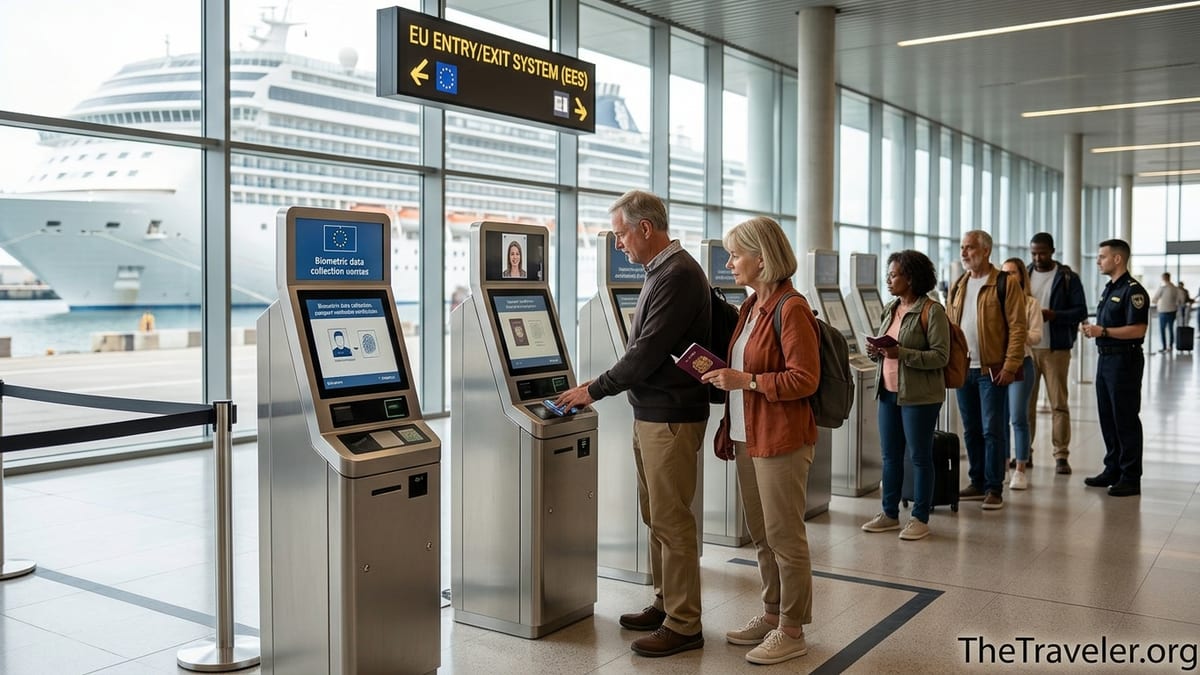
What the EU Entry/Exit System Is and Who It Covers
The Entry/Exit System is a Schengen‑wide digital register that replaces routine passport stamping for most non‑EU, non‑EEA and non‑Swiss short‑stay visitors when they cross an external Schengen border. Instead of relying only on physical ink stamps, border authorities record each traveler’s entry and exit electronically and link this to biometric data, typically a facial image and fingerprints for most adults. Official EU information describes EES as a tool to strengthen border security while also automating the calculation of how many days a traveler has spent in the Schengen area within the standard 90‑days‑in‑180 limit.
The system applies to third‑country nationals on short stays, regardless of whether they are visa‑exempt or hold a Schengen short‑stay visa. That includes most leisure visitors from the UK, United States, Canada, Australia, New Zealand and many Asian and Latin American countries. It does not change the underlying rules on who needs a visa, but it does change how your movements across the external border are recorded. The first time you cross an external Schengen border after EES went live, you can expect a one‑off biometric enrollment that is then re‑used on later trips for a limited period.
By contrast, EU, EEA and Swiss citizens, as well as non‑EU travelers who hold long‑stay permits or residence cards issued by a Schengen country, fall under different rules and are generally not processed in EES as short‑stay visitors. This article focuses on cruise passengers who are visiting the Schengen area on a short‑stay basis, typically for holidays of a few days or weeks. Mixed‑status families may find that only some members are subject to EES checks, which is normal under the regulations.
It is also important to distinguish EES from ETIAS, the planned European Travel Information and Authorisation System. ETIAS, expected to launch after EES, will be a pre‑travel authorisation for certain visa‑exempt visitors. EES is not an application you complete in advance, and it does not require a fee from travelers. It is a border‑control system operated by authorities at the crossing point, usually with help from automated kiosks.
If Your Cruise Starts and Ends Outside the Schengen Area
Many popular itineraries for UK, US, Canadian and Australian passengers sail round trip from ports such as Southampton or other non‑Schengen ports and include day calls at cities in Spain, France, Italy or Greece. Government guidance updated since the launch of EES in October 2025 explains that, for these closed‑loop cruises that start and finish outside the Schengen area, passengers who remain with the ship are typically considered to be in transit for the purposes of border formalities. UK Department for Transport cruise FAQs, for example, state that passengers on cruises which both embark and disembark in the UK “will not normally need to complete their EES entry or exit registration for EU day trips” that are part of the itinerary, with this position restated in materials circulated in 2025 and 2026.
In practice, this means that if your cruise begins and ends in the UK or another non‑Schengen country and you simply go ashore for the day in Schengen ports before returning to the ship each afternoon, you are unlikely to be sent through full biometric EES registration at each stop. The ship itself is treated as your means of transport in and out of the Schengen area, and the authorities do not regard every port call as a fresh external border crossing. You may still encounter basic identity checks controlled by port or police authorities, but these are distinct from a full EES entry or exit registration.
The key exception is where you break the pattern and leave the cruise in the Schengen area. If you disembark before the ship returns to its non‑Schengen home port and continue your journey independently, for example by staying on in Europe or flying home from a Schengen airport, you are then entering or exiting the Schengen area in your own right. In such cases, EES registration is normally carried out at the point where you permanently leave the ship or at the airport before your onward flight, depending on how the country has organised its border facilities.
Even for day‑call passengers who remain in transit, individual Schengen states may adjust procedures temporarily or run pilot schemes. Cruise lines and UK travel bodies have reported isolated instances of additional checks at certain Mediterranean ports during the early phases of EES roll‑out. However, these have generally been targeted trials or capacity tests rather than a permanent requirement for all day visitors to enroll in EES at every stop.
If Your Cruise Starts Outside and Ends Inside the Schengen Area
Transatlantic repositioning cruises or extended itineraries that begin in a non‑Schengen port such as Southampton, Miami or Dubai and finish in a Schengen port like Barcelona, Civitavecchia (Rome) or Piraeus create a different pattern of border crossings. In these cases, your definitive entry into the Schengen area usually occurs at the first Schengen external border where the authorities treat you as arriving for a short stay. That may be at the first Schengen port the ship visits where full border facilities are in place, or at the final disembarkation port if earlier stops are treated as strictly in‑transit visits.
Real‑world reports from the first season of EES operation indicate that some passengers on transatlantic cruises have completed their EES enrollment and exit checks at the main turnaround port rather than at each intermediate Schengen call. For example, cruise travelers disembarking in Barcelona in spring 2026 reported going through EES kiosks in the cruise terminal before leaving the secure area, even when they had already visited other Schengen ports earlier in the voyage. This reflects a local decision on where to place the external border control point for that particular itinerary.
For non‑EU passengers whose cruise ends in a Schengen port and who then fly home from an airport in the same country, border authorities may choose to treat the airport as the point of exit for EES purposes. In that scenario, you might complete your EES registration only on departure at the airport, with port‑side checks focused on identity and customs. Alternatively, some ports have installed full border‑control zones within the cruise terminal itself so that your EES exit is recorded as you leave the ship area and you can then connect domestically to your flight.
Because of this variation, it is important to pay close attention to information supplied by your cruise line about disembarkation procedures at the final Schengen port. Many operators now explicitly warn passengers to expect additional time for immigration and potential EES checks at ports like Barcelona and Civitavecchia, particularly when large ships arrive with significant numbers of non‑EU guests.
If Your Cruise Is Entirely Within the Schengen Area
For cruises that both start and end in Schengen ports, such as round trips from Barcelona, Piraeus, Copenhagen or Venice, the first and last border crossings for non‑EU short‑stay visitors generally occur at the airport or land border they use to reach and leave the Schengen area. In many cases, you will complete your initial EES registration when you first enter the Schengen area by air or rail on the way to your cruise, before taking what is then treated as an internal journey to the port.
Once you are inside the Schengen area, movements between Schengen ports on the same cruise are comparable to domestic travel within a single large border‑free zone. Routine EES checks are not normally repeated at each internal stop, since there is no external border being crossed. You may still show your cruise card and sometimes your passport when going ashore, but these are port‑security procedures rather than EES registrations. The main EES events for such a trip are the first entry to, and final exit from, the Schengen area, which may both occur at airports if you fly in and out.
There are some exceptions where a supposedly Schengen‑only cruise calls at a non‑Schengen country such as the United Kingdom, Türkiye or certain North African states. In those cases, the ship may cross the external Schengen border mid‑itinerary, and you can be recorded as exiting and later re‑entering the Schengen zone. Depending on how that particular route is structured, authorities might process those border crossings on board, in a dedicated area of the cruise terminal, or at the first Schengen port after visiting a non‑Schengen country. However, these are still limited to specific border points rather than every port visited.
Official EU communications consistently emphasize that EES does not alter the list of countries in the Schengen area or bring back routine border posts between Schengen states. What it changes is how external borders are managed and recorded. For cruise passengers on itineraries that remain within Schengen, this means the system is more likely to appear at the airport passport control than at the gangway.
If You Fly to or From Your Cruise
For many non‑EU cruise passengers, the most predictable place to encounter EES is at an airport rather than in a port terminal. Official guidance from EU institutions and foreign ministries, including information updated by the European External Action Service and national governments in 2025 and 2026, makes clear that air, land and sea borders all use the same core EES rules. Your first short‑stay entry to the Schengen area after the system went live is typically when the biometric enrollment happens, whether that is at an airport, rail terminal or seaport.
If your cruise starts in a Schengen port and you fly in from a non‑Schengen country, expect to complete EES checks on arrival at the airport. Border officers or automated kiosks will capture your facial image and, for most adults, a set of fingerprints as they record your entry, then your passport will be inspected as usual. At the end of your holiday, if you depart the Schengen area by air, your exit will usually be recorded and cross‑checked in EES at the airport before boarding. The port itself may handle only security and customs formalities, particularly where cruise terminals are not designated as full external border crossing points.
If your cruise starts outside Schengen and ends inside, the situation is more variable. Some passengers disembarking at a Schengen port and then flying home have reported that their EES exit was recorded at the port terminal, with airport checks focusing on security and boarding rather than immigration. Others have encountered EES primarily at the airport, especially where the national border‑police agency has concentrated its biometric facilities there. As a traveler, the safest approach is to allow extra time both at disembarkation and at the airport whenever your overall journey begins or ends at a Schengen external border.
Travel advisories issued by governments such as the UK and United States in 2025 and 2026 repeatedly highlight that EES may add processing time during busy periods, especially at major hub airports. Cruise passengers with morning flights after disembarkation should factor this into their planning and avoid tight same‑day connections whenever possible.
How EES Works Behind the Scenes for Cruise and Ferry Operators
Under EU regulations, cruise and ferry companies that carry passengers across the external Schengen border are treated as “carriers,” similar to airlines or international coach operators. Official carrier information produced by EU agencies since 2023 explains that these companies are expected to consult a dedicated interface to check whether certain passengers have the right documentation or authorisations before boarding for an external‑border crossing. Once ETIAS is in force, this will extend to verifying the status of required travel authorisations for visa‑exempt visitors.
For passengers, it is important to understand that this carrier interface is a back‑end system. You do not log into EES or ETIAS at the port, nor do you complete a separate EES application. Instead, your role is to provide the same documents you would normally show when boarding an international sailing, such as your passport and any required visa. The carrier’s systems and staff then use those details to run electronic checks against government databases, including EES records where relevant.
This behind‑the‑scenes checking can explain why check‑in staff sometimes ask additional questions, such as confirming your intended place of final disembarkation or onward travel. Carriers have compliance obligations and can be fined if they transport passengers who do not satisfy basic entry requirements. However, these checks are separate from the actual biometric enrollment, which is carried out by border‑control authorities at an official crossing point and not by the cruise line itself.
Because carrier obligations evolve in parallel with the technical roll‑out of systems like EES and ETIAS, both the European Commission and national authorities periodically update their guidance. Operators, in turn, update their pre‑departure emails and online FAQs. Cruise passengers should therefore read pre‑cruise information carefully for any notes about earlier check‑in times, changes in terminal assignment or new procedures that relate to border checks at the start or end of the voyage.
Local Variations: Examples From Major Cruise Ports
Although EES is based on EU‑wide regulations, implementation at seaports is organised at national and local level. Each Schengen country decides which port facilities qualify as official external border crossing points, where biometric kiosks are installed and whether certain movements, such as short in‑transit visits for cruise day calls, are temporarily exempt from full EES processing. As a result, experiences can differ between ports even for similar itineraries.
In Spain, official documents from the Port of Barcelona and national authorities describe a multi‑year programme to install automated border‑control equipment for EES and ETIAS at major passenger terminals. Barcelona’s port authority has confirmed that several cruise terminals are being equipped with EES‑compliant facilities, with tenders and planning documents referencing work schedules from 2024 through to the late 2020s. Cruise passenger reports from 2026 indicate that at peak times only a limited number of EES kiosks were available in certain terminals, leading to queues of one to several hours for non‑EU guests disembarking or embarking at Barcelona during the early months of operation.
In Italy, ports such as Civitavecchia, which serves Rome, have also begun using EES for cruise passengers at specific points in the journey, often focusing on embarkation or final disembarkation for non‑EU travelers whose cruise route crosses the external border. Some passengers disembarking in Civitavecchia in 2026 described going through biometric exit checks in a dedicated immigration area of the terminal, even when the cruise had visited other Schengen ports earlier. This illustrates how authorities may concentrate full EES processing at a single point on the itinerary that they define as the moment of exit from the Schengen zone.
Greece, with its busy cruise port at Piraeus and numerous island calls, has published general information about adopting EES across its external border points, but detailed port‑by‑port passenger guidance has tended to appear closer to each implementation phase. As in Spain and Italy, the pattern emerging from 2025 and 2026 has been that day‑call cruise passengers on closed‑loop itineraries are usually handled as in‑transit, while those embarking or disembarking in Piraeus fall under the full EES regime at the start or end of their stay.
Because these local arrangements can and do change, travelers should avoid assuming that one port’s procedure will be identical in another country. The most reliable sources are each country’s border‑police or interior‑ministry announcements, port authority notices and the pre‑cruise information issued by your specific cruise line for the departure year in question.
Practical Preparation and What Biometric Checks Involve
For individual cruise passengers, the most useful preparation is still very simple. You should travel with a passport that meets both EU validity rules and your cruise line’s requirements, hold any necessary visas, and carry proof of onward arrangements when appropriate, such as your cruise booking, return flight details or hotel reservations. Border officers using EES may ask basic questions about your itinerary, accommodation and means of support, just as they did before, and you should be ready to answer clearly.
The first time you are fully processed in EES, you can expect a short biometric enrollment. At many ports and airports, this starts at a self‑service kiosk where you scan your passport, have a live facial image captured and, for most adults, provide four fingerprints from each hand. Children may face reduced biometric requirements depending on national practice and age thresholds. After this step, you usually see a human border officer who verifies the data on screen, may ask a few questions and then either stamps your passport if local practice still includes stamps during the transition period, or simply confirms your entry or exit electronically.
Transport‑sector briefings and early EES operational updates have repeatedly warned of extra processing time during the first roll‑out phase, especially at busy holiday peaks. Travel industry associations in the UK and Europe have advised passengers to arrive earlier than they might have done previously for journeys that involve crossing the Schengen external border. Cruise passengers whose voyages start or finish at a Schengen port, or who connect to flights or international trains soon after disembarkation, should build additional margin into their plans. This is particularly important in ports such as Barcelona or Rome where multiple large ships may arrive on the same morning.
It is equally important to dispel a few myths. EES is not a mobile app that you must download, and there is no separate fee charged to travelers for EES registration. Any service that claims to sell “EES registrations” in advance of travel should be treated with caution. The system also does not mean that every traveler must queue for biometric checks at every cruise port. For most non‑EU cruise passengers, EES will be encountered only at the specific moments when they enter or exit the Schengen area, which may happen entirely at the airport, entirely at the cruise terminal or at a mix of both depending on the itinerary.
Stay Up to Date and Check Close to Departure
Because EES is a relatively new system, national authorities and ports are still refining their procedures. Guidance targeted at cruise passengers has been updated several times since 2025 by governments such as the UK, United States and individual EU member states. Port authorities, particularly in major hubs, have adjusted the number and placement of kiosks, the signage used to direct passengers and the specific categories of cruise movements that go through full EES versus simplified in‑transit processes.
For this reason, any description of how a particular port operated in early 2026 should be treated as a snapshot, not a permanent rule. Before you sail, review the latest official border information for the Schengen country or countries where you will embark and disembark, paying close attention to which terminals are designated as external border crossing points. Check your cruise line’s latest pre‑departure emails and online FAQs for updated arrival time recommendations and any notes about biometric processing in the terminal.
If your cruise involves complex combinations of non‑Schengen and Schengen ports, or if you plan to leave the ship early and continue overland, it is worth confirming with the cruise line and, where necessary, with the relevant national border authority how EES will apply in your case. Ask specifically where your first EES enrollment is likely to occur, whether cruise‑only day calls are currently treated as in‑transit for your itinerary, and how much extra time you should allow at the port and airport.
The bottom line for non‑EU cruise passengers is that EES is designed to streamline and automate short‑stay border controls at a limited number of key points in your journey. You are not expected to manage the system yourself, and you are unlikely to face biometric queues at every port stop. By understanding where your true Schengen entry and exit points lie and by checking the latest local guidance in the weeks before departure, you can plan realistically and enjoy your cruise with much less anxiety about digital borders.