


More news on this day
A freight aircraft approaching Leipzig/Halle Airport in eastern Germany collided with an unidentified flying object shortly after an explosive-laden drone was discovered on the ground nearby, prompting fresh security concerns over the vulnerability of European air traffic to small unmanned aircraft.
Get the latest news straight to your inbox!
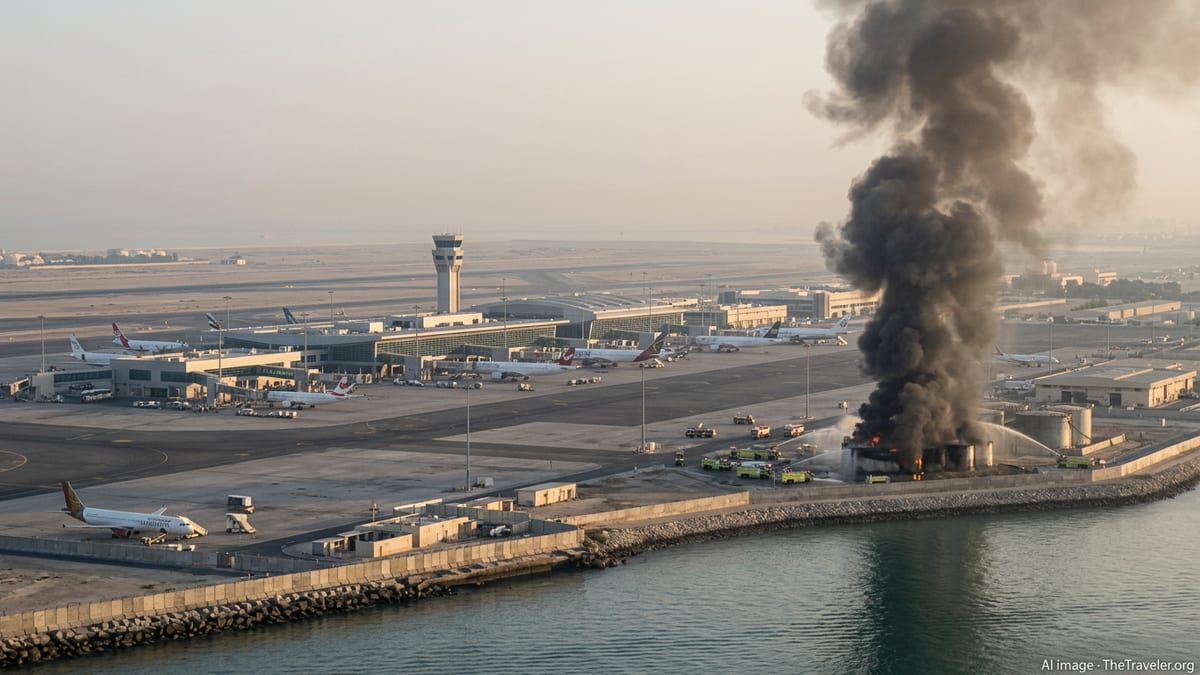
Explosive device found near Ukrainian cargo aircraft
According to published coverage, air traffic at Leipzig/Halle Airport was disrupted late on the night of 4 August after an airport employee spotted a drone near the south runway, close to a parked Ukrainian Antonov cargo plane. The device was described as a modified quadcopter carrying an improvised explosive charge and what investigators later treated as a detonator.
Bomb technicians were deployed to secure the drone, which was rendered safe on the tarmac. Reports indicate that the detonator was removed before detailed forensic examination began, and initial assessments classified the aircraft as a functioning explosive device rather than a harmless consumer drone.
Publicly available information shows that Leipzig/Halle is a key cargo hub that supports German military logistics, NATO supply chains and Ukrainian air freight operations. The presence of a weaponised drone within the airport perimeter has therefore been viewed by analysts as a serious escalation from earlier nuisance incursions by recreational drones around European airports.
The discovery triggered a precautionary closure of at least one runway and the diversion of several flights. Passenger and cargo traffic was temporarily redirected to other German airports while ground teams swept the area for additional devices.
Freight plane reports mid-air collision with unknown object
Shortly after the ground discovery, investigators began examining a second, related incident involving a DHL-operated cargo aircraft. The freighter, which had been approaching Leipzig/Halle, was instructed to abort its landing as a safety measure and continue to another destination.
During that go-around, the crew reported an impact with an unidentified flying object several kilometres from the airport at a few hundred metres altitude. The aircraft later landed safely in Hanover, where an inspection revealed minor damage consistent with a mid-air collision with a small object.
Reports so far have not confirmed whether the object that struck the aircraft was another drone or some other form of debris. Search teams have combed areas around the approach path near Leipzig/Halle for wreckage, but as of the latest updates no publicly reported find has definitively linked the impact to a second unmanned aircraft.
Despite the lack of firm identification, the sequence of events has intensified concern that a coordinated attempt may have been made to target aircraft operating in and out of the busy freight hub on the same night.
Investigators weigh possible motives and perpetrators
Counterterrorism specialists and aviation security experts are now trying to determine who was behind the apparent attack and what the intended target might have been. Some reporting has highlighted the proximity of the drone to Ukrainian-operated transport aircraft, which regularly move military and humanitarian cargo through Leipzig/Halle.
Public commentary from European security analysts has raised the possibility that the incident could be linked to efforts to disrupt Ukraine-related logistics, given the airport’s role in supporting supply routes to the country. Others caution that, without public claims of responsibility or clear forensic attribution, motives remain speculative.
According to open-source reporting, investigators are examining the drone’s components, explosive charge and guidance system to trace where it was assembled and how it was operated. Data from airport surveillance systems and radar tracking of low-flying objects around the airfield are also being reviewed to reconstruct the drone’s flight path and identify potential launch points beyond the perimeter fence.
German media coverage indicates that investigators are treating the case as a serious criminal incident with potential national security implications, rather than an isolated act of vandalism or mischief. The combination of an explosive payload and a near-simultaneous airborne collision has been described as a new level of threat to civil aviation in the region.
Growing drone threat to commercial aviation
The Leipzig/Halle events have reignited wider debate about how prepared airports are to counter hostile drones. European facilities have experienced repeated shutdowns in recent years after drone sightings near runways, but most of those episodes involved unarmed devices and were resolved without physical damage.
Security specialists note that modern quadcopters are inexpensive, widely available and increasingly capable of carrying small but dangerous payloads, including improvised explosives. Combined with off-the-shelf navigation and video systems, such drones can be launched from roadsides or open fields and flown into restricted areas with little warning.
Publicly available information on previous incidents shows that drone incursions have already forced temporary closures at major hubs, disrupted thousands of passengers and prompted investments in radar, radio-frequency detection and jamming systems. The discovery of a drone carrying an actual explosive charge at Leipzig/Halle adds urgency to efforts to move from basic detection to reliable interception and neutralisation.
Analysts argue that freight operations face particular vulnerabilities because cargo airports often handle night-time peaks when visibility is lower and staffing patterns differ from daytime passenger operations. The latest incident underscores the risk that even a relatively small explosive device, if detonated near a fuelled aircraft or crowded loading area, could have serious consequences.
Pressure builds for stronger defences and common standards
In the wake of the Leipzig/Halle scare, calls are growing for more robust and harmonised drone security standards across Europe’s aviation sector. Industry observers suggest that airports will face increasing pressure to deploy layered defences, combining advanced sensors, electronic countermeasures and rapid-response ground teams trained specifically to deal with unmanned aircraft threats.
Reports indicate that Germany already uses mobile counter-drone units and has installed protective systems at selected high-risk sites. However, the apparent ability of an explosive-laden drone to reach the vicinity of a major runway is prompting questions about gaps in coverage and rules governing when and how security forces can disable threatening devices.
Policy discussions are also likely to intensify around registration, geofencing and remote identification requirements for drone operators, as regulators seek to discourage reckless or malicious flights near critical infrastructure. Aviation groups have previously warned that enforcement must keep pace with rapid advances in consumer and military-grade drone technology.
For travellers and cargo customers, the Leipzig/Halle incident is a reminder that aviation security challenges are evolving from traditional hijacking and bomb threats inside terminals to new risks emerging in the airspace just beyond the airport fence. How quickly authorities and industry adapt to the drone era may shape the reliability of European air traffic in the years ahead.