


More news on this day
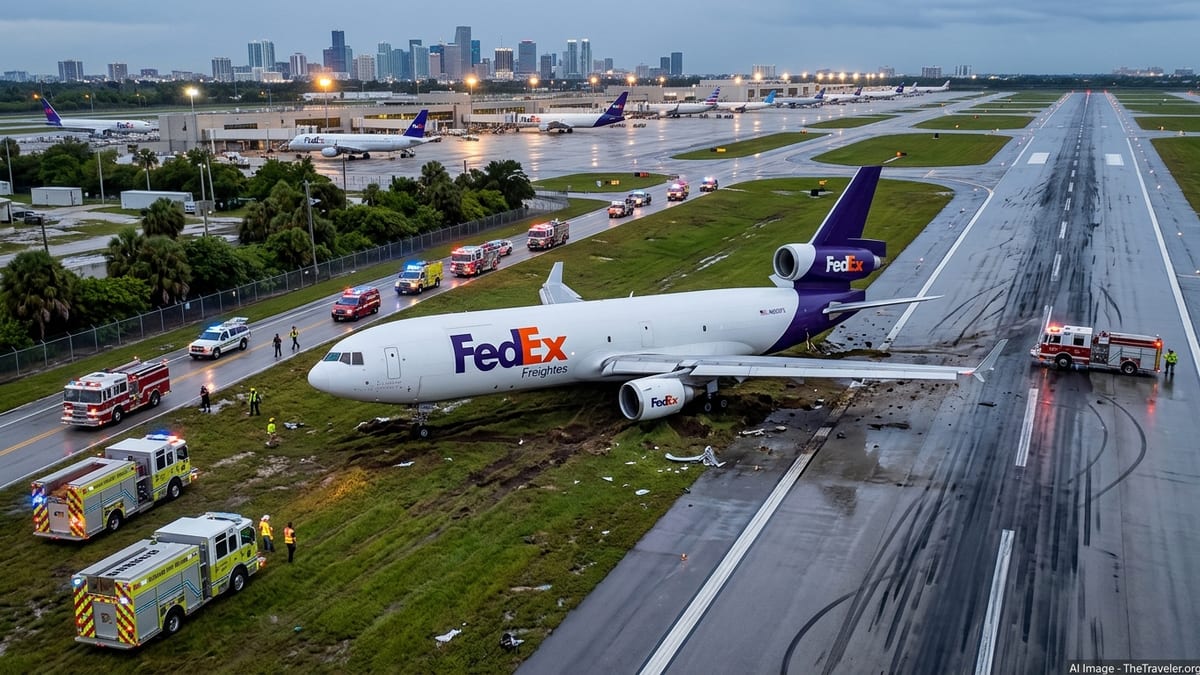
A FedEx Express McDonnell Douglas MD-11 freighter arriving from Memphis overran the end of a runway at Miami International Airport on the evening of November 25, 2026, forcing a temporary ground stop and leaving the airport operating with only one runway for several hours on the eve of the U.S. Thanksgiving holiday, according to airport officials and federal regulators.
Get the latest news straight to your inbox!
What happened during the FedEx landing at Miami
Authorities say the incident occurred at around 8:40 p.m. local time on Wednesday, November 25, when the FedEx aircraft was landing on Runway 26R at Miami International Airport after a scheduled cargo flight from Memphis. According to preliminary information from airport officials and the Federal Aviation Administration, the jet failed to stop within the paved surface and continued beyond the end of the runway before coming to rest near the airport’s western perimeter fence.
Specialist aviation incident databases that track flight movements and accident details identify the aircraft as an MD-11F registered N605FE operating as FedEx flight 910. They report that the freighter came to a halt several hundred meters past the runway end after veering slightly left, apparently avoiding localizer equipment situated on the extended centerline. Images and video recorded by local media and travelers at the airport show the aircraft stationary in a grassy area beyond the pavement, with dark smoke or dust visible around the landing gear area shortly after it stopped.
Miami-Dade Fire Rescue units responded to the scene and inspected the aircraft and surrounding area. FedEx and airport officials said there were no injuries among the flight crew, and there were no reports of injuries on the ground. The aircraft did not catch fire, and responders did not report any fuel spill affecting nearby roadways or airport facilities. The exact nature of the smoke or dust seen in early videos has not yet been formally described, and investigators have not released any assessment of structural damage to the aircraft.
Impact on Miami International during peak holiday travel
The overrun immediately affected operations at one of the nation’s busiest airports on one of the busiest travel nights of the year. Airport authorities said three of Miami International’s four runways were taken out of service after the FedEx jet came to rest beyond Runway 26R, leaving only a single runway open while emergency crews secured the scene and officials assessed the airfield. The Federal Aviation Administration issued a temporary ground stop for flights bound for Miami, meaning some departures from other airports were held on the ground until capacity at MIA improved.
Miami International and FAA status boards showed knock-on delays into early Thursday, with some flights experiencing multi-hour disruptions overnight as the airport worked to reopen additional runways. By the early hours of November 26, officials reported that three of the four runways had returned to service as crews completed inspections and confirmed that debris and equipment associated with the overrun did not pose a hazard to other aircraft. The runway where the FedEx jet came to rest remained closed while investigators documented the scene and plans were made to remove the aircraft.
The timing amplified the effect on travelers. The incident unfolded as Thanksgiving holiday traffic was peaking across the United States, with airlines expecting millions of passengers over the extended weekend. While Miami is a major cargo hub as well as a passenger gateway, the immediate operational constraint was mainly runway capacity rather than terminal infrastructure. Passengers scheduled to depart or arrive on Wednesday night and early Thursday were urged by the airport and airlines to monitor flight status closely and allow additional time, as some aircraft were held in departure queues or diverted to other Florida airports during the most constrained period.
Weather and recent safety concerns at Miami
The runway excursion coincided with a line of rain and thunderstorms passing through South Florida on Wednesday evening. Local weather reports and airport communications noted periods of heavy rain and reduced visibility around the time the FedEx flight landed. Investigators have not yet said whether weather conditions contributed to the incident, but they are expected to examine runway surface conditions, braking performance and wind and visibility data as part of their work.
The FedEx event follows a series of incidents at Miami International in 2026 that have already heightened scrutiny of airfield operations. In early September, a Boeing 767-300 cargo jet operating on behalf of Amazon overshot Runway 30 after landing, crossed a perimeter area and struck vehicles on a nearby public road. Five people traveling in a van used by an airport cleaning crew were killed, and several others on the ground were injured. That earlier overrun occurred on a different runway, but Miami’s runway layout means that several runways converge at the western end of the field, and both aircraft came to rest in the same general quadrant beyond the paved surface.
Federal investigators have said that the Amazon-related crash involved an unstable approach and serious issues with speed management and deceleration devices, based on preliminary flight data. In that accident, the aircraft traveled well beyond the runway end and caught fire, destroying the freighter. By contrast, initial images from the FedEx MD-11 event suggest comparatively limited visible damage and no post-incident fire. Nonetheless, the proximity in time and location between the two runway overruns will likely draw close examination from regulators, airport operators and airlines focused on runway safety at the busy South Florida hub.
Aircraft type, FedEx operations and ongoing investigation
The MD-11 is a three‑engine widebody aircraft that has long been used in dedicated cargo service. FedEx Express is among the largest operators of the type, primarily employing it on long-haul and high-volume domestic freight routes. Aviation industry reports note that the MD-11’s landing characteristics can be demanding, and several landing and rollout accidents involving MD-11 freighters have occurred worldwide over the past three decades. However, investigators consistently stress that each incident has unique contributing factors and that no conclusions about Wednesday’s event should be drawn before formal analysis of flight data and cockpit recordings.
In public statements after the Miami incident, FedEx confirmed that one of its aircraft “experienced an issue upon landing” at Miami International and said the company is cooperating fully with authorities. FedEx emphasized that its crew members were safe and that there were no reported injuries, but did not provide additional detail about the sequence of events or the condition of the aircraft, pending the outcome of official inquiries. The company did not announce any immediate change to its flight schedule or broader fleet deployment as a direct result of the overrun.
The Federal Aviation Administration has opened an incident investigation and is documenting the condition of the runway, associated lighting and navigational aids, and the aircraft itself. The National Transportation Safety Board has said it will lead a separate safety investigation, a standard procedure for significant runway excursions involving large transport-category aircraft. That process will typically involve recovering data from the flight data recorder and cockpit voice recorder, interviewing the flight crew, and reviewing maintenance and operational records. At this early stage, neither agency has indicated any suspected cause, and officials have cautioned that a final report could take many months.
What travelers using Miami should know now
For travelers, the most immediate practical consequence of the FedEx overrun was short-term disruption on the night of November 25 and into the early hours of Thanksgiving Day. With three of four runways closed for a period and an FAA ground stop in place for inbound flights, some passengers experienced extended taxi times, departure delays and diversions. As of the morning of November 26, Miami International and federal air traffic status feeds indicated that three runways were back in operation, with the remaining runway section near the disabled FedEx jet expected to stay closed until the aircraft is removed and safety checks are complete.
Passengers scheduled to travel through Miami over the Thanksgiving weekend are being advised by airlines and the airport to continue checking their flight status before leaving for the airport, particularly for late-night and early-morning operations while recovery work is ongoing. Most major carriers serving Miami have not announced large-scale schedule changes linked specifically to the FedEx incident, but residual delays are possible if runway capacity is temporarily reduced during aircraft removal or inspection activities. Connections involving tight layovers may be more vulnerable to disruption than point-to-point journeys.
Looking ahead, any longer-term operational changes at Miami International related to runway safety will depend on the findings of the NTSB and FAA investigations into both the November FedEx incident and the September Amazon-related crash. Those could include recommendations on approach procedures, runway overrun protection, pilot training or ground traffic management. Until such recommendations are issued and acted upon, travelers can expect periodic updates from the airport and federal regulators but no immediate structural changes to day-to-day passenger operations. For now, the key advice remains to verify flight information frequently, especially during peak holiday periods when even a single disabled aircraft can have a disproportionate effect on a busy hub.